


Most advice about micro influencer marketing starts with the same lazy conclusion: smaller creators are always the smartest buy. They're cheaper, more authentic, and more engaging, apparently solving every marketing problem short of fixing your checkout flow.
That's not a strategy. It's a tier preference.
Micro creators can be excellent for niche reach, performance creative, and iterative testing. They can also create a sprawling operational mess once your “small test” turns into twenty contracts, twenty content reviews, twenty tracking links, and a shared spreadsheet that nobody trusts. The hard part isn't finding creators. It's building a program your team can run without spending every afternoon in DMs or mortgaging the office ping-pong table.
Micro creators aren't automatically the best choice. If your objective is broad awareness in a short window, a creator with a large distribution advantage may be more appropriate. A portfolio of smaller accounts can extend reach, but it also introduces more coordination, more variable delivery, and more chances for the campaign message to drift.
Product launches can create a similar problem. When a new product needs instant credibility, a respected macro creator, industry personality, or specialist with established authority may carry more weight than a collection of smaller voices. The right question isn't “Which tier has the highest engagement?” It's “What must the campaign cause people to do?”
Polished categories deserve scrutiny, too. Luxury, automotive, premium electronics, and high-design interiors may require production standards that some micro creators can't consistently deliver. Authenticity is useful until the lighting makes the product look defective or the demonstration skips the feature buyers need to understand.
Practical rule: Choose the creator tier after defining the job. Don't choose the job to justify the tier.
Micro creators shine in a narrower, more useful set of conditions:
The economics also explain the enthusiasm. In 2025, 73% of brands preferred micro and mid-tier creators for their engagement-to-cost ratio, while micro creators reportedly commanded a median CPM of $119. Smaller creators also showed standout engagement rates in the 6.15% to 6.76% range, according to 2025 influencer marketing research from PR Newswire.
That makes micro influencer marketing attractive, not universally correct. Before scaling, use incrementality testing for creator campaigns to separate genuine lift from conversions that would have happened anyway. Otherwise, you may optimize for activity while paying for existing demand.
Follower count is a distribution metric, not a quality score. A creator can have a respectable audience and still generate weak commercial response if the audience doesn't match the offer, the comments show no buying intent, or the creator's sponsored posts feel bolted onto an unrelated feed.
Engagement benchmarks vary by platform and methodology, so don't treat one universal rate as gospel. A 2026 benchmark reports 3.86% average Instagram engagement for micro influencers versus 1.21% for mega influencers, while another benchmark places micro creators at 1.68% average engagement, with a 0.61% typical rate depending on platform and measurement method. The useful conclusion is directional: smaller, concentrated audiences can create denser interaction, but you still need post-level evidence.
A comparative academic study found micro influencers produced a 6.82% mean engagement rate and a 3.47% mean conversion rate, compared with 3.24% engagement and 2.02% conversion for macro influencers. The reported differences were statistically significant at p < 0.001, as documented in the comparative micro and macro influencer study.
Likes are easy to accumulate and easy to overvalue. Comments that mention a product use case, ask about shipping, compare alternatives, or tag a likely buyer tell you much more. Saves and shares can also indicate that the content has utility beyond the moment of publication.
Use the standard engagement formula consistently: (Likes + Comments + Shares + Saves) / Followers × 100. The formula is outlined in micro influencer engagement rate guidance, which also notes that broader analyses may include Stories and Reels interactions. Decide what counts before the campaign begins, or your reporting team will accidentally compare different definitions and call it analysis.
| Metric | TikTok | YouTube | Red Flag Threshold | |
|---|---|---|---|---|
| Engagement rate | Compare saves, shares, comments, and likes against the creator's own post history | Review interaction quality and audience relevance, not raw views alone | Assess comments and response around the integration | Sudden spikes with generic or repetitive interaction |
| Click activity | Track link clicks through creator-specific UTMs | Use unique links or platform-supported tracking where available | Use a dedicated landing page or tracked link | Clicks without corresponding sessions or qualified actions |
| Conversion activity | Attribute through links, codes, and defined windows | Separate organic post response from paid amplification | Review assisted actions as well as direct sales | Conversions concentrated outside the creator's active period |
| Content utility | Look for demonstrations, routines, and product context | Look for strong hooks and clear use cases | Look for explanation and sustained attention | High reach with no usable creative asset |
The table is a measurement framework, not a permission slip to invent thresholds. There is no verified universal red-flag percentage that identifies fake engagement across every platform. Check audience geography, follower growth patterns, comment specificity, and consistency across recent posts. Then connect the creator to conversion tracking infrastructure before judging performance.
Creator tiers are useful shorthand, but they're not a substitute for campaign design. A practical follower framework places nano creators around 1,000 to 10,000 followers, micro creators around 10,000 to 100,000, macro creators around 100,000 to 1 million, and mega creators above 1 million, based on the tier definitions summarized in micro influencer marketing research from IJRPR.
Micro is sometimes narrowed to 10,000 to 50,000 followers, a range also used in that 2025 benchmark. The label matters less than consistency. If one team calls a 70,000-follower account micro and another calls it mid-tier, your reporting taxonomy should still make the distinction clear.
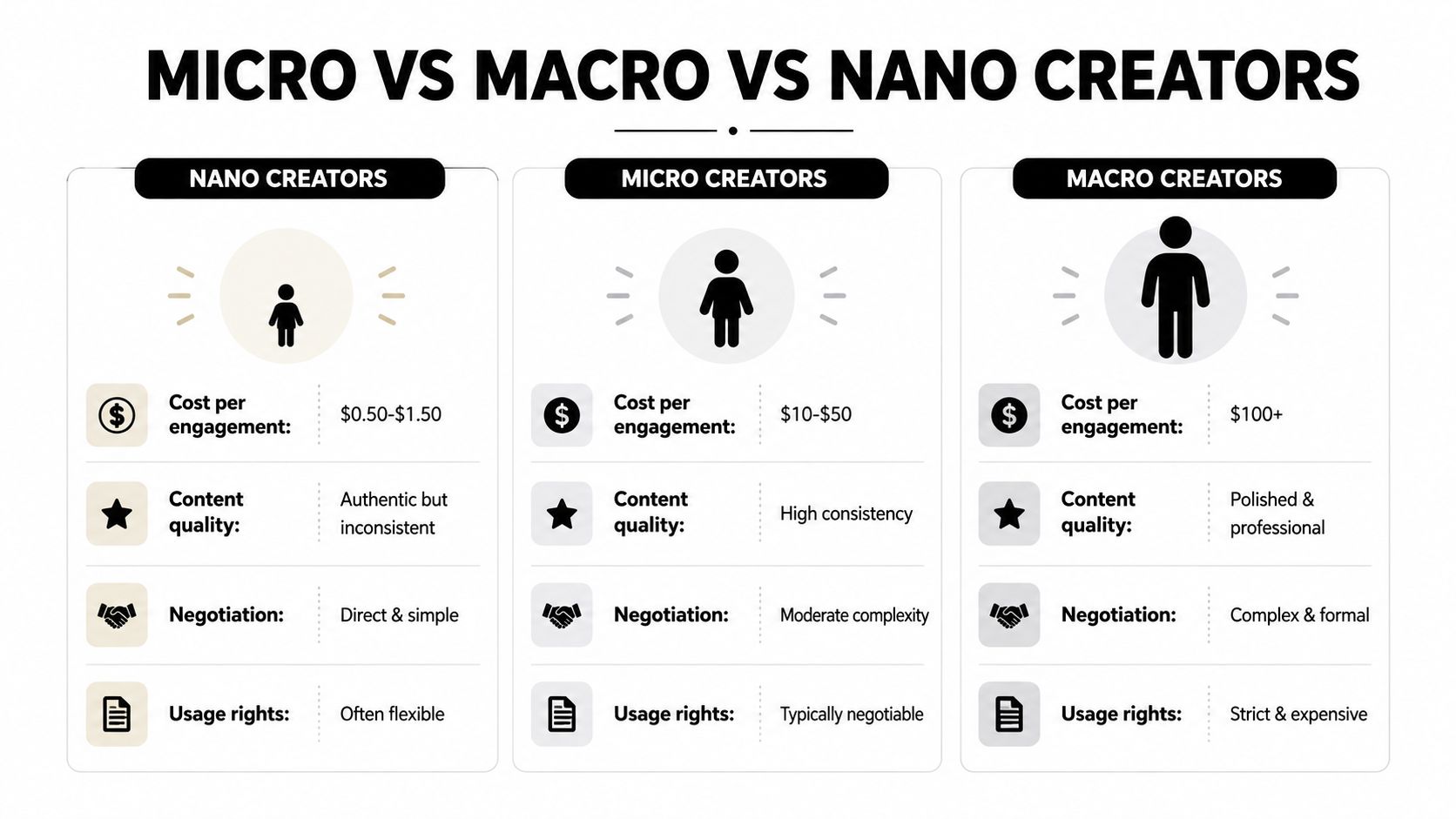
Nano creators are often the strongest fit for hyper-local campaigns, specialist communities, and products that benefit from personal recommendations. They may offer direct communication and flexible usage discussions, but content delivery can be less predictable. Their audience size also limits the amount of data each partnership produces.
Micro creators tend to occupy the practical middle ground. They have enough distribution to generate useful testing signals, while their content can still feel native to a specific community. The trade-off is management complexity. Once you activate a portfolio, you're not managing one media placement. You're managing a small production department.
Macro creators bring broader reach and often more polished production. That premium can make sense for brand lift, launch visibility, or campaigns where one recognizable voice matters. It usually comes with more formal negotiation, stricter usage terms, and less flexibility around revisions or paid amplification.
| Decision factor | Nano | Micro | Macro |
|---|---|---|---|
| Best fit | Local or highly specific communities | Performance testing and niche growth | Broad awareness and launch visibility |
| Content consistency | Authentic, variable | Generally more repeatable | Polished, professionally managed |
| Negotiation | Often direct | Moderate coordination | Formal and complex |
| Usage rights | May be flexible | Usually negotiable | Often tightly controlled |
| Main constraint | Limited distribution | Operational overhead | Higher cost and less flexibility |
The smartest mix is often hybrid. Use a macro creator when broad attention is central, micro creators to test messages and generate reusable creative, and nano creators where local credibility matters. The micro portion can then feed UGC-style ads without pretending that every creator must perform the same job.
A scalable campaign starts before discovery. Define the business outcome, the conversion event, the content formats, the rights you need, and the approval owner before contacting anyone. Otherwise, creators will receive different answers from different team members, which is a fast way to turn a clean campaign into interpretive dance.
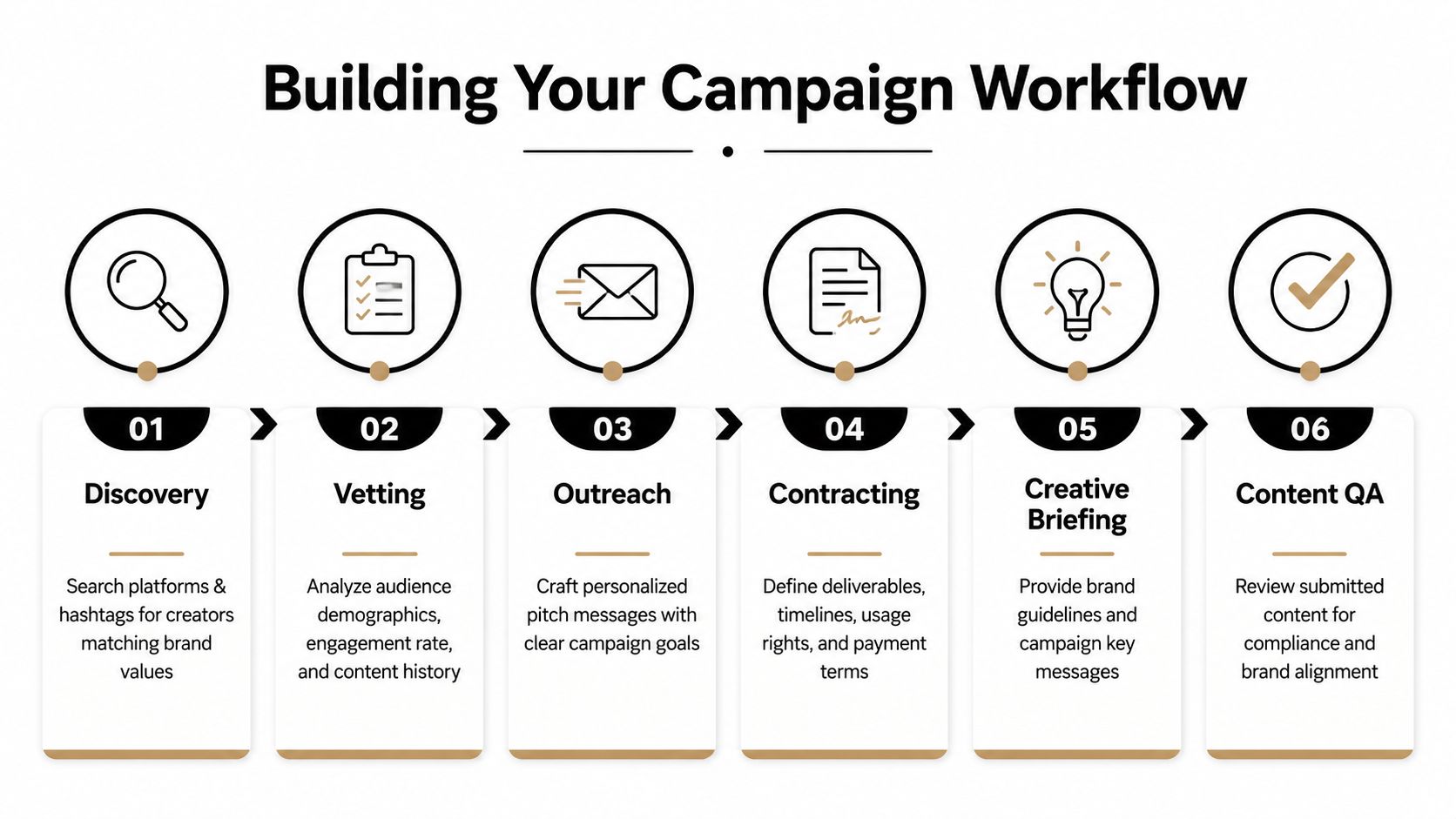
Use platform-native searches, relevant hashtags, customer mentions, competitor tags, and creator discovery tools. Manual research works for a small test. At portfolio scale, a searchable database becomes worthwhile because you need consistent fields, not just a bookmark folder full of promising profiles.
Vetting should cover more than follower count:
A useful brief states the audience, problem, required proof point, prohibited claims, deliverable, deadline, disclosure requirement, and call to action. It shouldn't dictate every word. You hired the creator for their communication style, not for their ability to read a script with the emotional range of a parking meter.
Give creators a clear single conversion event wherever possible. Ask for a demonstration, comparison, routine, or explanation that naturally leads to that action. Approve claims and brand safety elements, but don't force approval of every caption comma unless you enjoy becoming the bottleneck.
Your contract should define deliverables, deadlines, revision limits, payment terms, disclosure requirements, usage rights, exclusivity, and access to post-level reporting. Give every creator a distinct UTM structure, promo code, or affiliate link. Keep the naming convention boring and predictable, for example creator, platform, campaign, and asset identifier.
Batch the work. Vet creators in blocks, send outreach in batches, review content during fixed windows, and maintain a single status board for contracts, products, drafts, approvals, publication, and reporting. At scale, the time cost per creator becomes the primary media cost. If your team can't see which partnerships are blocked and why, adding more creators won't improve the program. It will just create more unread messages.
There isn't one “standard” micro creator rate. Platform, format, audience quality, production demands, usage rights, exclusivity, and revision requirements all affect the quote. Treat any benchmark as a planning reference, not a promise that a creator will accept the number.
The most useful compensation models are straightforward:
The article's verified data doesn't provide platform-by-follower rate bands, so the table below deliberately avoids fabricated dollar amounts. Build your own rate card from actual quotes, negotiated terms, format requirements, and performance history.
| Platform | Follower Band | Rate Per Post (USD) | Rate Per Reel/Short | Rate Per YouTube Integration |
|---|---|---|---|---|
| 10K–25K | Quote by deliverable and rights | Quote by production scope and rights | Not typically the primary format | |
| 25K–50K | Quote by audience fit and deliverable | Quote by production scope and rights | Not typically the primary format | |
| 50K–100K | Quote by distribution, exclusivity, and rights | Quote by production scope and rights | Not typically the primary format | |
| TikTok | 10K–25K | Quote by format and usage | Quote by concept, editing, and rights | Not typically the primary format |
| TikTok | 25K–50K | Quote by format and usage | Quote by concept, editing, and rights | Not typically the primary format |
| TikTok | 50K–100K | Quote by distribution and paid-use permissions | Quote by concept, editing, and rights | Not typically the primary format |
| YouTube | 10K–25K | Quote by placement | Quote by production scope | Quote by integration length and rights |
| YouTube | 25K–50K | Quote by placement | Quote by production scope | Quote by integration length and rights |
| YouTube | 50K–100K | Quote by placement | Quote by production scope | Quote by integration length and rights |
Specify whether the brand receives organic reposting rights, paid advertising rights, whitelisting or creator-authorized ad permissions, website usage, email usage, and editing rights. State the duration and territory. “We'd like to use the content” is not contract language. It's how teams accidentally buy a post and assume they bought a library.
Exclusivity should name the category, duration, and competitive scope. FTC disclosure obligations should be explicit, with creators instructed to use clear disclosures appropriate to the platform and placement. Performance bonuses can align incentives, but they should sit on top of a fair base fee when the creator is producing work the brand can reuse.
The first few partnerships feel like marketing. Beyond that, the work starts looking like operations. A 2025 benchmark found brands collaborated with an average of 30 micro influencers per campaign, a 36% year-over-year increase, while 81% said micro influencer content met or exceeded expectations, according to the 2025 micro influencer report from Statusphere. That kind of volume can work, but only when the system carries the load.
The bottlenecks are predictable:
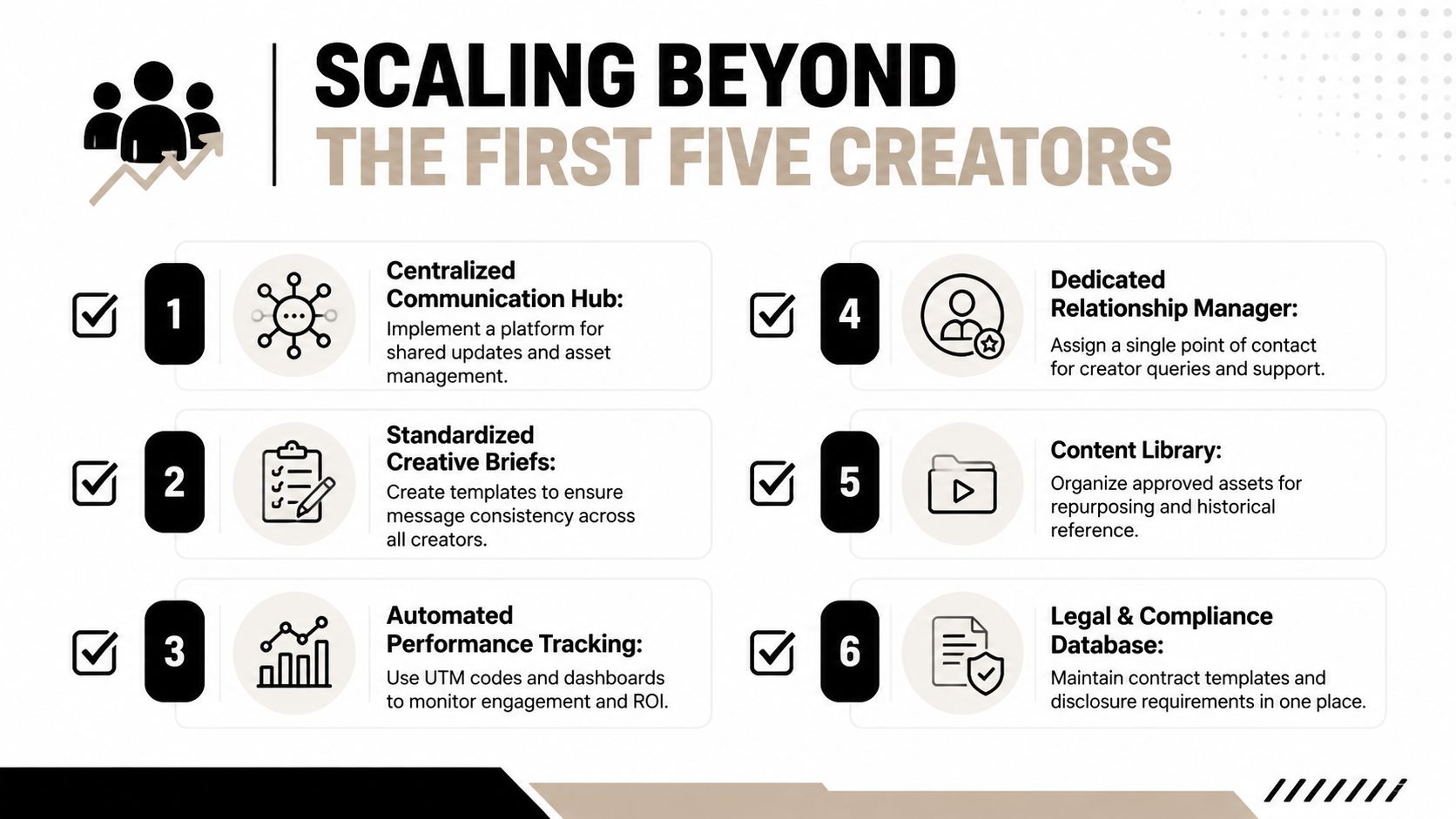
Use standardized briefs with modular sections for product, audience, proof points, mandatory disclosures, and prohibited claims. Keep one source of truth for creator status and assets. A shared workspace can be enough at modest volume, while a dedicated influencer platform becomes more attractive when discovery, contracting, payments, rights, and reporting need to connect.
Assign one relationship owner. Creators should know who can answer a question and who approves a draft. That doesn't mean one person must do every task. It means accountability has a name.
Measure the program as a portfolio, not as a leaderboard of isolated stars. Useful health indicators include:
Keep management in-house when the brand has a clear owner, repeatable briefs, fast approvals, and enough campaign volume to justify the role. Outsource when creator operations compete with paid media, product marketing, or customer work. The paradox is simple: scaling small creators requires surprisingly grown-up infrastructure.
Scaling test: If adding creators increases the number of unresolved tasks faster than it increases useful creative and attributable demand, fix the workflow before expanding the roster.
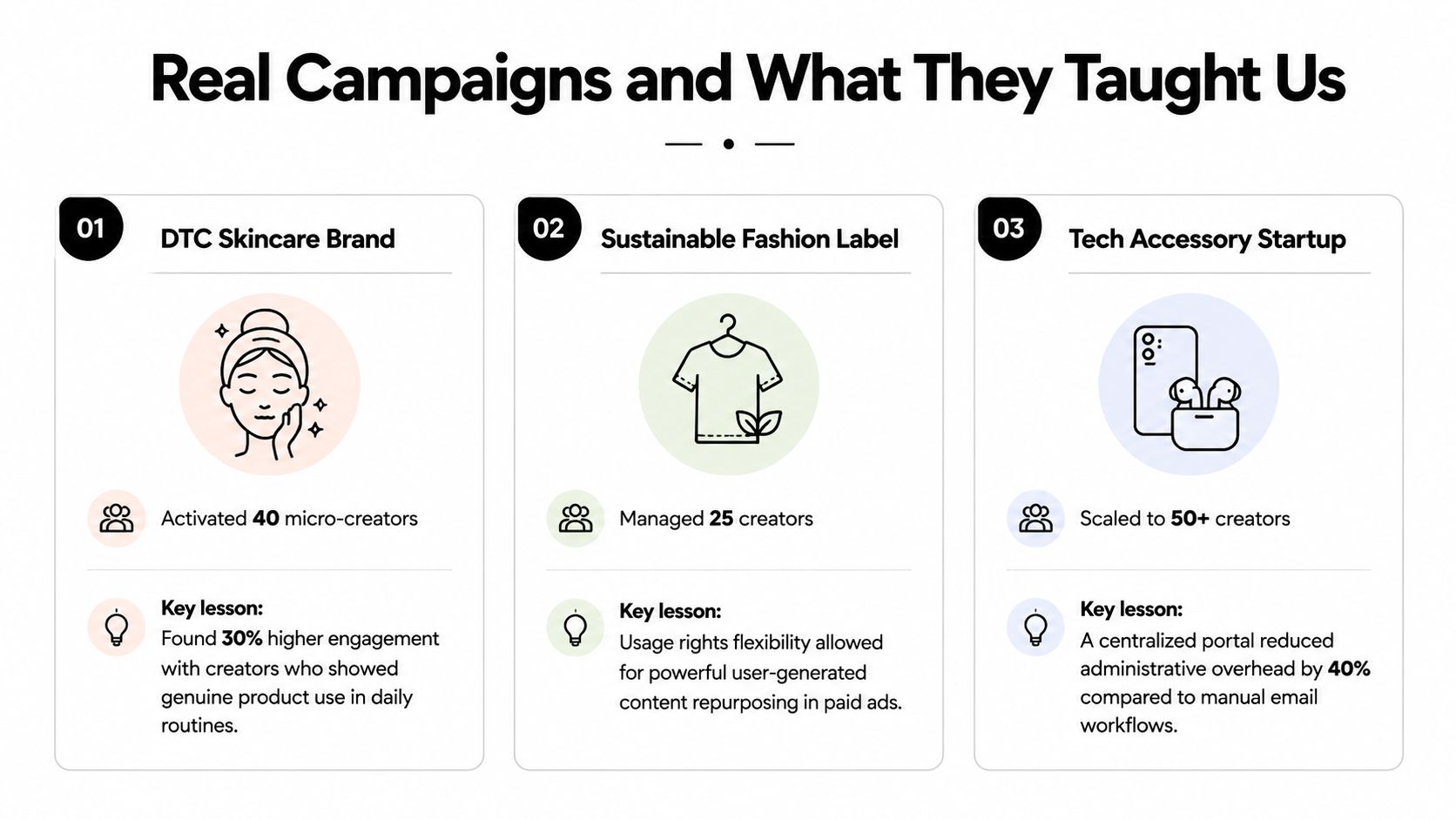
A necessary correction before the post-mortems: the three scenarios below are operating models and failure patterns, not verified case studies with documented performance results. The provided data doesn't substantiate the claimed campaign sizes, lifts, ROAS, or product-seeding outcomes, so those numbers shouldn't be presented as facts.
A DTC skincare team activates a large group of micro creators, then discovers that content review has become the publication schedule. Creators use inconsistent tracking links, some posts miss required claims guidance, and the team can't reliably connect activity to revenue.
The lesson is boring and expensive. Tracking infrastructure and approval ownership need to exist before outreach begins. A beautiful roster can't rescue broken attribution.
A B2B SaaS company runs a smaller pilot with fixed compensation and performance bonuses. The team gives creators one conversion event, one audience problem, and a limited set of proof points. The format stays flexible, but the desired action doesn't.
That structure improves learning because the team can compare creative against a consistent business outcome. The point isn't a magical ROAS number. It's the discipline of narrowing the test.
A fitness apparel brand sends products without guaranteeing compensation and expects content to appear. Some creators post, others don't, and the brand has no dependable publishing calendar or asset rights.
“Free” product isn't free if your team paid for fulfillment, follow-up, inventory, and uncertainty. Compensation alignment beats volume when creators are expected to deliver professional work.
Use this maturity matrix to choose your next move:
| Program stage | Best next decision |
|---|---|
| Testing | Prove audience fit and tracking with a manageable creator group |
| Repeatable | Standardize briefs, contracts, approvals, and reporting |
| Scaling | Add ownership, automation, and portfolio-level KPIs |
| Complex | Consider a specialist operator or agency when internal teams become the constraint |
Micro influencer marketing works best when the creative feels personal and the operations feel boring. That's the trick. Keep the creator experience human, make the measurement strict, and don't scale a process you haven't yet managed without chaos.
If your creator program is generating more spreadsheets than sales, HireMediaBuyers.com can help you find pre-vetted paid media specialists to connect creator content with disciplined acquisition and measurement. Visit the marketplace to explore flexible full-time or part-time talent, and build the performance infrastructure your growing creator portfolio needs.


