


You hired a media buyer who had a polished portfolio, confident answers, and a suspiciously perfect explanation for every campaign. Two weeks later, the account had burned through budget, tracking was unreliable, and the “seven-figure scaling experience” turned out to mean watching someone else do the work.
That's the hiring trap paid-media teams know too well. A bad media buyer doesn't just cost salary. They can waste ad spend every day, distort performance data, damage creative testing, and leave your team cleaning up an account that was healthier before the hire.
Vetting is the control system that prevents this. It's not paperwork, a quick Google search, or asking a former manager whether someone was “nice to work with.” A proper vetting process verifies whether a candidate can do the job, whether their history supports their claims, and whether they're suitable for the access and responsibility you're about to give them.
The interview went well. Too well, perhaps.
The candidate knew the language. They talked about blended ROAS, incrementality, creative fatigue, audience saturation, attribution windows, and campaign structure without stumbling. Their case studies looked tidy. Their answers sounded like someone who'd already solved every problem your account had.
So you hired them.
Then the work started. Meta campaigns were duplicated without a testing hypothesis. Budgets moved between ad sets without enough evidence to justify the changes. Google Ads search terms went unchecked. Creative performance got summarized with vague comments about “the algorithm learning.” Within two weeks, the account had spent $15,000 with little to show for it.
The salary was only one line item. The total bill included wasted media spend, delayed learning, missed revenue, emergency account repairs, and the founder's suddenly full-time career as an unwilling ad-platform detective.
Practical rule: A candidate's fluency with paid-media vocabulary proves they've heard the vocabulary. It doesn't prove they can manage your account.
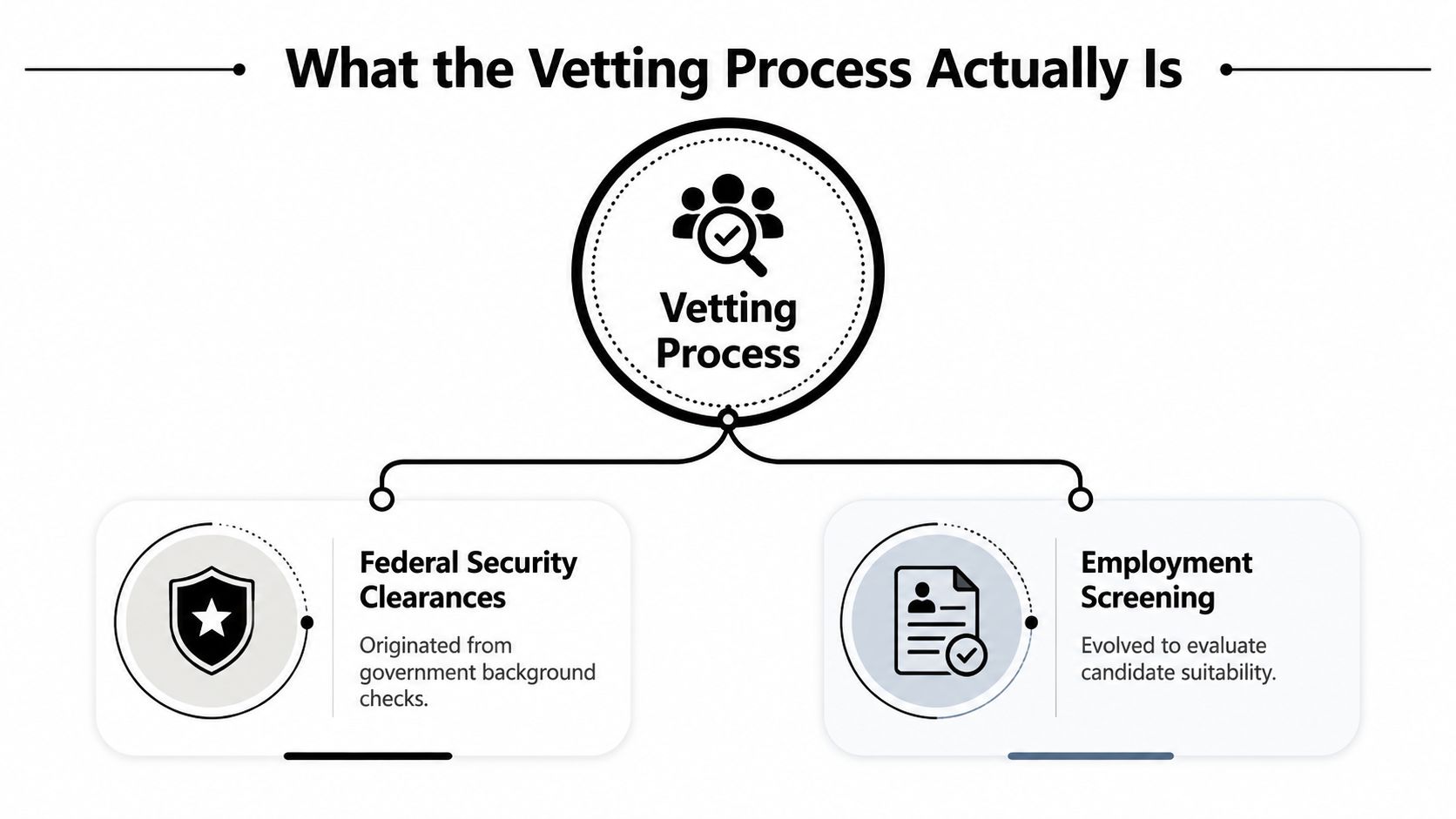
What is vetting process in a hiring context? It's a structured verification workflow that goes beyond resume screening to confirm identity, qualifications, employment history, capability, and role suitability before a final decision. Indeed's overview of the vetting process describes the sequence as application screening, interviews and assessments, followed by reference and background verification.
That sequence matters because each stage answers a different question. Screening asks whether the person is worth your time. An interview tests communication and reasoning. A skills assessment reveals whether they can perform. References and background checks test whether the story holds together.
Paid media needs this discipline because the role combines judgment with direct financial access. A person can look competent while still lacking the operating habits that protect spend. They may know how to launch a campaign but not when to pause one, know how to report results but not how to explain uncertainty, or know how to quote a case study without having owned the outcome.
The founder's job isn't to eliminate all hiring risk. That's fantasy, usually sold in a webinar with an aggressive countdown timer. Your job is to reduce uncertainty before you hand over the keys.
A media buyer can pass a polished interview, receive account access, and expose your brand to avoidable losses before anyone notices. The vetting process exists to prevent that sequence. Its roots are in public-sector suitability and security-clearance systems, where investigation, evaluation, and adjudication determine whether a person is suitable for federal employment, access to classified information, or a federal credential. The U.S. Office of Personnel Management outlines the formal vetting steps.
For founders, the useful lesson is simple. Vetting is an end-to-end workflow, not one background-check box or a confident conversation.
A Government Accountability Office report on Department of Homeland Security vetting describes steps that can include establishing the need for review, validating existing investigations or adjudications, collecting background information, conducting investigative work, adjudicating results, providing due process where required, and performing ongoing assessments. RAND's analysis of the U.S. security-clearance process describes a comparable pipeline involving a questionnaire, submission, investigation, adjudication, a clearance decision, and continuous vetting.
A junior ad operations coordinator following documented procedures should not face the same review as a senior media buyer controlling large budgets, customer data, and several advertising accounts. The depth of vetting should match the trust the role requires.
Government-style frameworks start by assessing a position's sensitivity and risk, then determine how much information to collect and verify. Agencies and DTC brands can apply the same logic:
A strong process builds a chain of evidence. The candidate makes a claim, you test it with a suitable method, and you record the result. That record matters when a resume says “managed seven-figure spend” but the interview reveals no ownership of budgets, decisions, or outcomes.
Employment screening is routine in the United States. Industry reporting places the share of employers running at least one type of background screening at roughly 93% to 96%, while approximately 87% to 90% conduct screening before or for full-time hires, according to ScreenForge Labs' 2026 background-check statistics report.
The operational point matters more than the adoption rate. Vetting has shifted from a one-time eligibility review toward risk management tied to access, identity, and changing responsibilities. A company does not need to monitor every employee forever. It does need to revisit risk when someone keeps access to advertising accounts, payment systems, customer information, or proprietary data.
For paid-media hiring, use a structured model rather than relying on DIY intuition. Verify claims before granting access, document what you checked, and repeat the review when the role expands. Bad vetting costs more than a wrong hire's salary. It can waste media spend, consume management time, delay launches, and leave credentials or customer data in the wrong hands. Trust follows evidence, not an impressive LinkedIn banner.
A candidate can spend an hour describing “seven-figure” campaigns, then fail to explain which decisions were theirs. Agencies and DTC brands avoid that expensive surprise with a five-stage model. Each stage checks a different part of the story, from platform experience to judgment, references, and controlled access. The goal is evidence, not an academic entrance exam.
Screen applications for platform exposure, account scope, industry context, and communication quality. AI can flag missing information, inconsistent dates, repeated resume language, and experience that does not match the role. Keep the hiring decision with a person.
Ask for specifics. Did the candidate manage Meta Ads directly, or support the person who did? Did they own Google Ads strategy, or build campaigns from instructions? Did they work in lead generation, e-commerce, SaaS, or another model with different measurement problems?
A polished resume earns scrutiny. It does not earn trust.
Move past “tell me about yourself” quickly. Give the candidate a realistic problem: performance dropped after a creative refresh, tracking is inconsistent, or prospecting spend is increasing without corresponding revenue.
Pay attention to the questions asked before any recommendation. Strong operators clarify the conversion event, attribution setup, offer, creative volume, landing-page experience, account history, and recent changes. Weak operators reach for a familiar tactic before identifying the actual problem.
That distinction exposes resume inflation faster than confident platform vocabulary.
Use a contained assessment based on the role. A Meta Ads specialist might explain an account structure, propose a testing plan, or review a fictional performance snapshot. A Google Ads specialist might organize search intent, identify irrelevant queries, or explain how to separate brand and non-brand activity.
Test prioritization, strategic reasoning, creative judgment, measurement discipline, and the ability to explain trade-offs. Button-clicking alone proves very little.
Set a clear time boundary and standardized scoring. Include enough ambiguity to reveal judgment. You are hiring an operator, not a human-shaped platform help center.
Plan and document reference checks. The OPM reference-checking guide recommends deciding who conducts the check, preparing questions, informing candidates and requesting permission where needed, contacting references, describing the position, and clarifying conflicting information. Canada's public-service guidance separates the work into planning and preparation, gathering information, and using what was gathered.
Ask references what the candidate personally owned, how they responded when performance deteriorated, and what supervision they required. “They were great” sounds reassuring and tells you almost nothing.
Use a structured client reference review to compare feedback across working relationships instead of relying on one informal conversation.
Complete final HR and compliance checks for identity, employment eligibility, documentation, offer conditions, and onboarding requirements. Remote and international hiring demands extra care because criminal, credit, identity, social-media, privacy, and employment checks can vary by jurisdiction. DLA Piper's discussion of employee-screening risks highlights fraudulent or AI-generated candidates and the need for stronger identity checks in some situations.
State clearly what remains conditional, which access the person receives first, and how onboarding will work. A hiring decision is incomplete until it connects to an access plan that limits media accounts, payment systems, customer information, and proprietary data until trust has been earned.
DIY vetting looks cheaper until the founder becomes the recruiter, technical interviewer, reference checker, compliance coordinator, and emergency campaign manager. You can absolutely build the process internally, but you need the discipline to run it consistently when hiring gets urgent.
The technical interview is usually the hardest part. A founder may recognize confidence but struggle to distinguish a genuine account strategist from someone who has memorized platform terminology. Verifying international employment history adds another layer, particularly when records, consent rules, and screening permissions differ by location.
Outsourcing doesn't remove accountability. It moves repeatable checks to a specialist while your team focuses on role fit, business context, and final judgment. A platform or recruiter can also create consistent scorecards and maintain a candidate pipeline, which is useful when hiring stops being an occasional event and becomes a recurring operating need.
| Factor | DIY Vetting | Outsourced Platform |
|---|---|---|
| Time | Internal leaders coordinate every screen, interview, assessment, and check. | A specialist handles repeatable filtering and verification steps. |
| Technical accuracy | Depends on whether your team can evaluate Meta Ads and Google Ads work properly. | Often includes role-specific assessments and structured candidate review. |
| Consistency | Standards can change between interviewers or under deadline pressure. | A defined process creates repeatable checkpoints. |
| Compliance | Your team must track consent, privacy, labor, and jurisdiction requirements. | The provider supplies process support, though your company still owns employment decisions. |
| Scalability | Works well for occasional, highly specialized hires. | More practical when several roles or locations are involved. |
| Control | Maximum control over questions, assessments, and records. | Less administrative work, with some process decisions delegated. |
The decision framework is blunt.
Choose DIY when you're hiring rarely, have a credible paid-media operator available to assess technical work, and can document a repeatable process. Choose outside support when hiring is frequent, your interviewers can't reliably evaluate the craft, or international compliance is pulling your team away from revenue work.
If you need a specialist rather than a general recruiting workflow, marketing job recruiters can be part of the comparison. The right choice is the one that produces dependable evidence without turning your leadership team into a slower, more expensive version of an HR department.
A strong paid-media candidate can disappear while your team waits for a black-box process to finish. A weak candidate may stay in the funnel because nobody owns the next checkpoint. Both outcomes cost more than a clear schedule.
The review timeline depends on its scope. Criminal-history checks often take 1 to 3 business days, employment verification 3 to 7 business days, and education verification can take longer when institutions respond slowly, according to ScreenForge Labs' screening statistics. More extensive public-sector vetting can take four weeks or longer. One prison-officer screening example averages 12 weeks, as described in this vetting timeline guide.
Federal security-clearance work can take longer still. GAO reporting gives 92 days for initial Secret cases and 205 days for initial Top Secret cases for the fastest 90% of cases in FY 2026 Q2, as reported in GAO personnel-vetting material. Those figures are not a template for hiring a media buyer. They are a useful reminder that deeper scrutiny carries a significant time cost.
Tell candidates what you are checking, why it matters, who handles it, and what can delay completion. Clear communication helps serious candidates respond quickly and gives them a fair chance to explain inconsistent information before your team turns a clerical issue into a crime drama.
Use a conditional offer when appropriate. State the conditions plainly, obtain consent for checks, and name a contact person for questions. If something surfaces, pause the decision, verify the information, and let the candidate respond. A mismatch can reflect fraud, a database error, a name variation, or an innocent difference in dates.
Run compatible steps in parallel. Do not wait until the final interview to learn that a reference is unreachable or an identity document needs clarification. Assign an owner to every checkpoint and record status in one place.
A practical hiring timeline framework should show the sequence without pretending every case moves at the same pace. Share updates when a checkpoint stalls, especially when the delay sits with a third party. Speed matters, but rushed verification leaves agencies and DTC brands paying twice, first for the shortcut and then for the repair.
Founders usually don't make one giant vetting error. They make several small ones while trying to move fast, then wonder why the hire arrives with a portfolio and no operating ability.
A case study can show results without showing who made the decisions. Ask the candidate to explain the account structure, budget logic, creative testing, measurement setup, and what they personally changed.
“Seemed sharp” is not a skills assessment. Without practical work, you may hire someone who can discuss paid media but can't prioritize a live account. The consequence is predictable: your team discovers the capability gap after access and spend have already changed hands.
A friendly former boss doesn't tell you whether the candidate owned outcomes. Ask structured questions about reliability, judgment, feedback, and the exact scope of responsibility.
Remote international hiring can involve different rules for criminal, credit, social-media, identity, and employment checks. Use appropriate consent and local guidance instead of copying a U.S. process into another jurisdiction and hoping nobody notices.
AI-generated applications and fraudulent candidate profiles make identity-first checks more important. DLA Piper's analysis of AI-generated candidates and screening discusses enhanced approaches such as live video verification and in-person onboarding in relevant situations.
Sequential workflows create avoidable delays. Run compatible checks in parallel, assign clear ownership, and tell the candidate what's outstanding.
Background checks can support identity and history verification. They can't tell you whether someone understands creative fatigue, can interpret noisy attribution, or knows when not to scale. Only role-specific evaluation can answer that.
Treat vetting as an operating system for hiring, not an administrative tax. Start with a role-specific risk profile, then define the evidence required before the candidate receives meaningful account access.
Use this checklist:
Build internally when you have the expertise and hiring volume to maintain those standards. Outsource repeatable screening when your team lacks technical evaluation capacity or hiring has become a recurring drain on leadership time. Either way, the standard stays the same: evidence before access, clarity before commitment, and judgment before budget.
HireMediaBuyers.com connects U.S. companies with pre-vetted media buyers and paid ads specialists through a five-stage process covering AI-powered screening, interviews, skills assessments, reference and track-record checks, and HR review. Visit HireMediaBuyers.com to explore a structured way to find paid-media talent without making your founder's calendar the bottleneck.


