

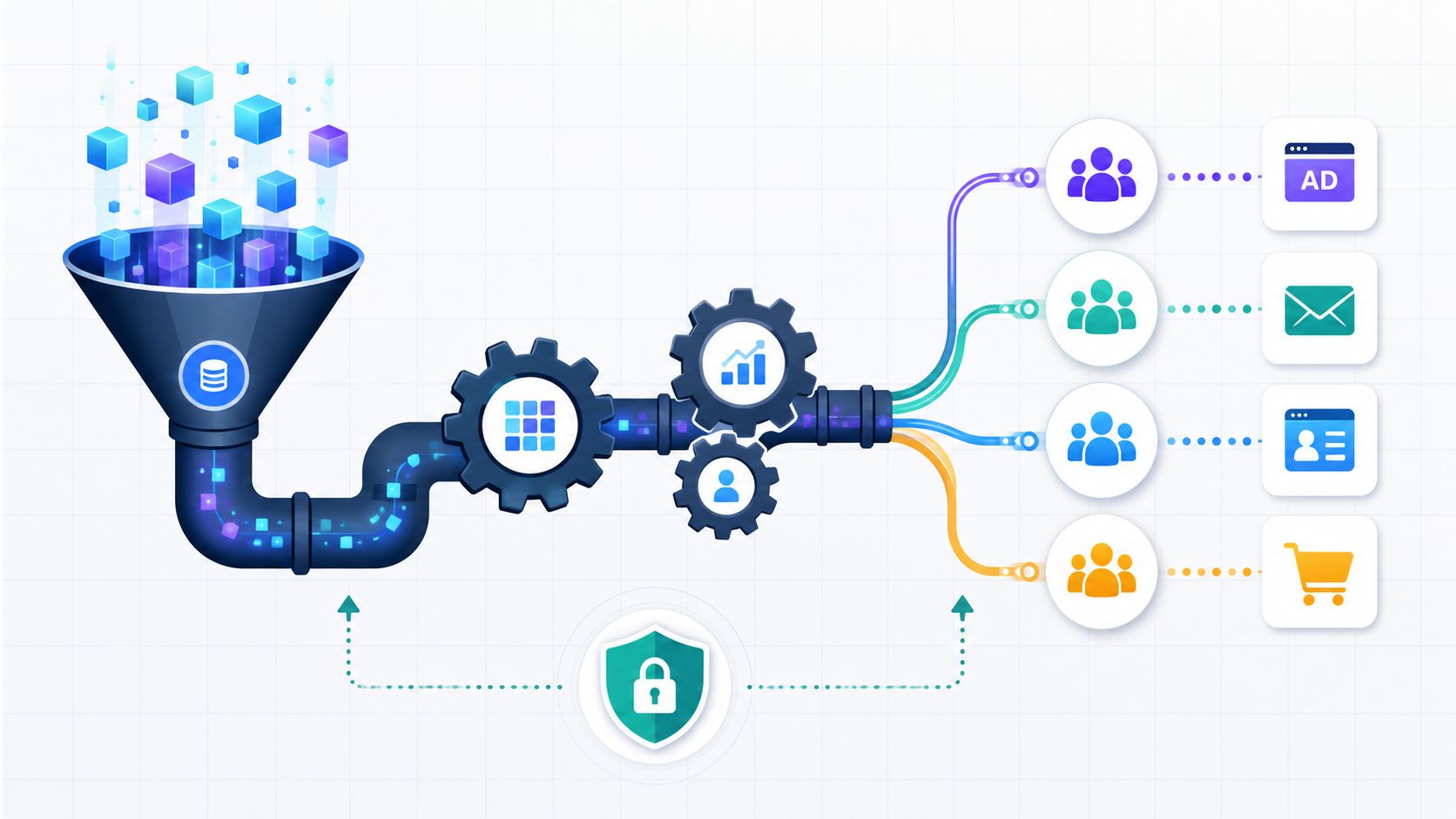
34% of collected first-party data gets activated at the median, while top-quartile teams reach 67%. That's the whole story in one line, and it's why so many “successful” data programs still feel like they're leaking money through a cracked pipe.
Most companies aren't short on data. They're short on usable identity, clean plumbing, and the discipline to push owned data into media, CRM, and personalization without turning the whole thing into a CDP science fair. The market is growing its datasets, but the activation gap is still where the waste lives.
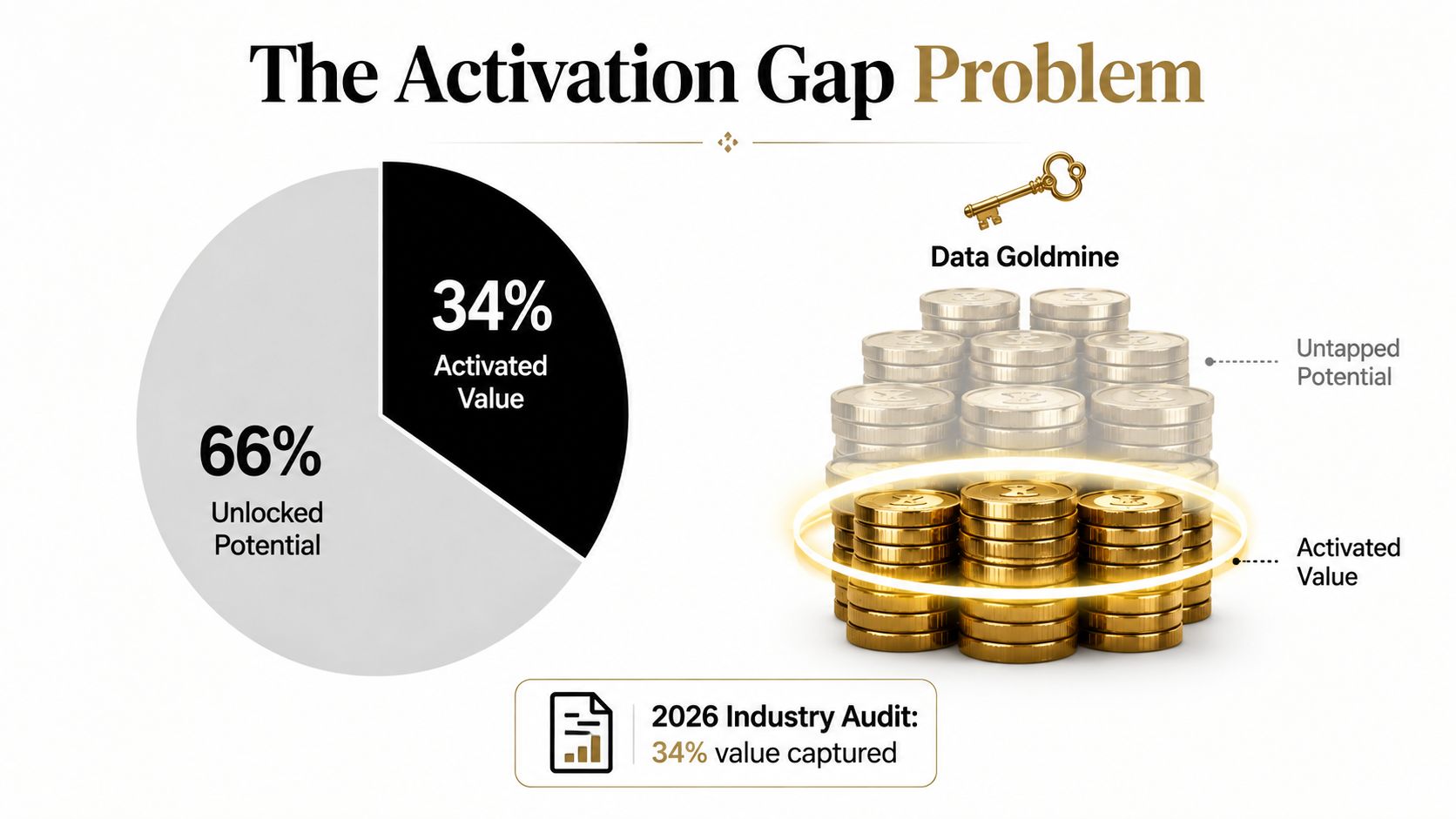
Data collection is not the prize. Activation is. In a 2026 benchmark, only 33% of companies had a mature first-party data strategy with full activation capabilities, while the median activation rate was 34% and the top quartile reached 67% as benchmarked in 2026. That means teams are still sitting on a pile of owned data and using only a slice of it for segmentation, personalization, or model training.
The gap is an operations problem. If you collect records but do not stitch identity, enforce consent, and push segments into paid media or CRM, you have built a very expensive inbox.
Practical rule: if a record never reaches a live audience, it is not an asset yet, it is a liability with a dashboard.
That is why the early BCG milestone still matters. Back in 2021, only about 30% of companies were building a single customer view across channels, and just 1% to 2% were using data to deliver a full cross-channel experience BCG milestone summary. The industry has spent years talking about ownership, but orchestration has always been the key.
A CDP can help, but a CDP by itself does not activate anything. If the data is stale, missing identifiers, or trapped behind broken governance, the platform becomes a prettier holding pen. I have seen teams spend months congratulating themselves on the new stack, then discover that no one can buy audiences from it.
The 2026 market signal is blunt. 71% of brands, agencies, and publishers are growing or planning to grow their first-party datasets, nearly double the 41% rate reported two years earlier as benchmarked in 2026. Collection is widespread. Activation maturity is not. That is the activation gap, and it is where the ROI lives or dies.
If you want first party data activation to work, start with plumbing, not polish. The stack needs to ingest owned-channel events, resolve identity, enforce consent, and move unified profiles into downstream systems. Skip any one of those and you end up with lovely reports and mediocre campaigns.
First, you need a clean ingestion layer. That can be a CDP, a warehouse-fed activation layer, or a structured data lake, but it has to reliably capture events from your site, app, and other owned properties. Without that, there's nothing to activate.
Second, you need identity resolution. The matching layer can only stitch profiles after trusted first-party events are exposed where the algorithm runs, and deterministic identifiers like email, phone, and customer ID do the heavy lifting identity-resolution guidance. Anonymous sessions are useful, but they're not audience-ready until they're connected to something stable.
Third, you need consent enforcement. If the activation layer can't see permissions, it can't safely push audiences into media or CRM. Modern CDPs embed consent and preference logic directly so opt-outs carry downstream instead of getting “accidentally” forgotten in a sync job.
A good activation stack makes bad surprises boring. That's the job.
Browser-only measurement has gotten too fragile. Google's server-side guidance is plain, if slightly unromantic. To send data in a true first-party context, scripts such as Google Analytics need to be served from your own servers, so the path becomes browser to your server to vendor Google tag platform guidance. That matters because the more control you have over the path, the less you lose to browser limits and signal decay.
For teams still guessing where the missing events went, I'd start with conversion plumbing before I touched audience expansion. A useful reference point is this conversion tracking setup guide, because if the event stream is wrong, everything built on top of it is wrong too.
That's the part people underbuild. They buy the dashboard before they buy the pipe.
Identity stitching is the least glamorous part of first-party data activation, and the part that breaks fastest. The promise looks clean on a slide, but the work is reconciling messy identifiers, uneven login behavior, partial consent records, and profiles that should have merged hours ago.
A customer can browse on mobile, convert later on desktop, and then respond by email after that. Without stitching, those are three separate interactions. With a working identity layer, they become one profile that can support targeting, suppression, and measurement.
Deterministic identifiers carry the most weight. Email, phone, and customer ID are the anchors that make unified profiles trustworthy, while probabilistic signals can fill gaps when the deterministic trail runs cold identity-resolution guidance. If you reverse that order, you are making cleaner-looking mistakes.
Consent cannot live only in the UI. Modern CDPs are expected to track consent and enforce preferences so opt-outs flow into downstream systems, including paid media CDP guidance on consent.
That shrinks some audiences, but it also improves the ones you keep. Suppressing existing customers from acquisition campaigns, or building lookalike seeds only from high-value cohorts with explicit permission, is often more effective than broad targeting. The audience gets smaller. The signal gets sharper.
Privacy constraints can create short-term fragmentation. That is frustrating, but ignoring them costs more. Guidance from Experian notes that first-party activation now requires explicit handling of permissions, opt-outs, data-use policies, and cross-platform identity gaps, especially in the EEA and various US states privacy guidance.
The blunt version is simple. A compliant audience you can reuse is worth more than a giant audience you cannot legally touch.
Once the data is clean and consented, the next question is simple. Where does it go? The answer is not “everywhere.” The answer is “where it changes money.”
The highest-impact use cases are usually in paid media. Suppression audiences keep you from paying to reacquire people who already bought. Lookalike seeds built from high-value cohorts help you scale prospecting without throwing darts at the internet. And dynamic creative gets stronger when the audience signal is real, not inferred from a wish list.
That's why I'd always prioritize media activation before I chased fancy personalization layers. CRM and on-site personalization matter, but paid media is where bad audience data bleeds fastest and where clean first-party data can pay back sooner.
| Activation Channel Impact Matrix | Implementation Complexity | Direct Revenue Impact |
|---|---|---|
| Suppression in paid media | Low to moderate | High |
| Lookalike seeding | Moderate | High |
| Dynamic creative optimization | Moderate to high | Medium to high |
| CRM personalization | Moderate | Medium |
| On-site experience tailoring | Moderate | Medium |
The ugly truth is that most teams try to activate too many segments in too many places. That's how budgets disappear into platform fees and dashboard theater.
If you want a practical reference point for organizing the strategy itself, the first-party data strategy playbook is the kind of operational checklist that keeps teams from skipping straight to “let's personalize everything” before the inputs are ready.
A clean first-party stack is pointless if you cannot see where it breaks. Activation measurement starts with pipeline coverage, then deterministic match rate, then record freshness, then activation rate. That order exposes the leak instead of congratulating the dashboard.
Coverage shows how much of the audience has a usable profile. Match rate shows whether identity stitching is doing real work. Freshness shows whether the record is current enough to trust. Activation rate shows how much clean data reaches a live campaign segment.
An independent 2026 pipeline audit found a median activation rate of 34%, top performers at 67%, and the bottom quartile at 11%. The same benchmark suggests enterprise programs should aim for 60% to 75% coverage, 80% to 90% deterministic match rates, sub-7-day freshness for active customers, and activation above 40% for data used within the last 90 days.
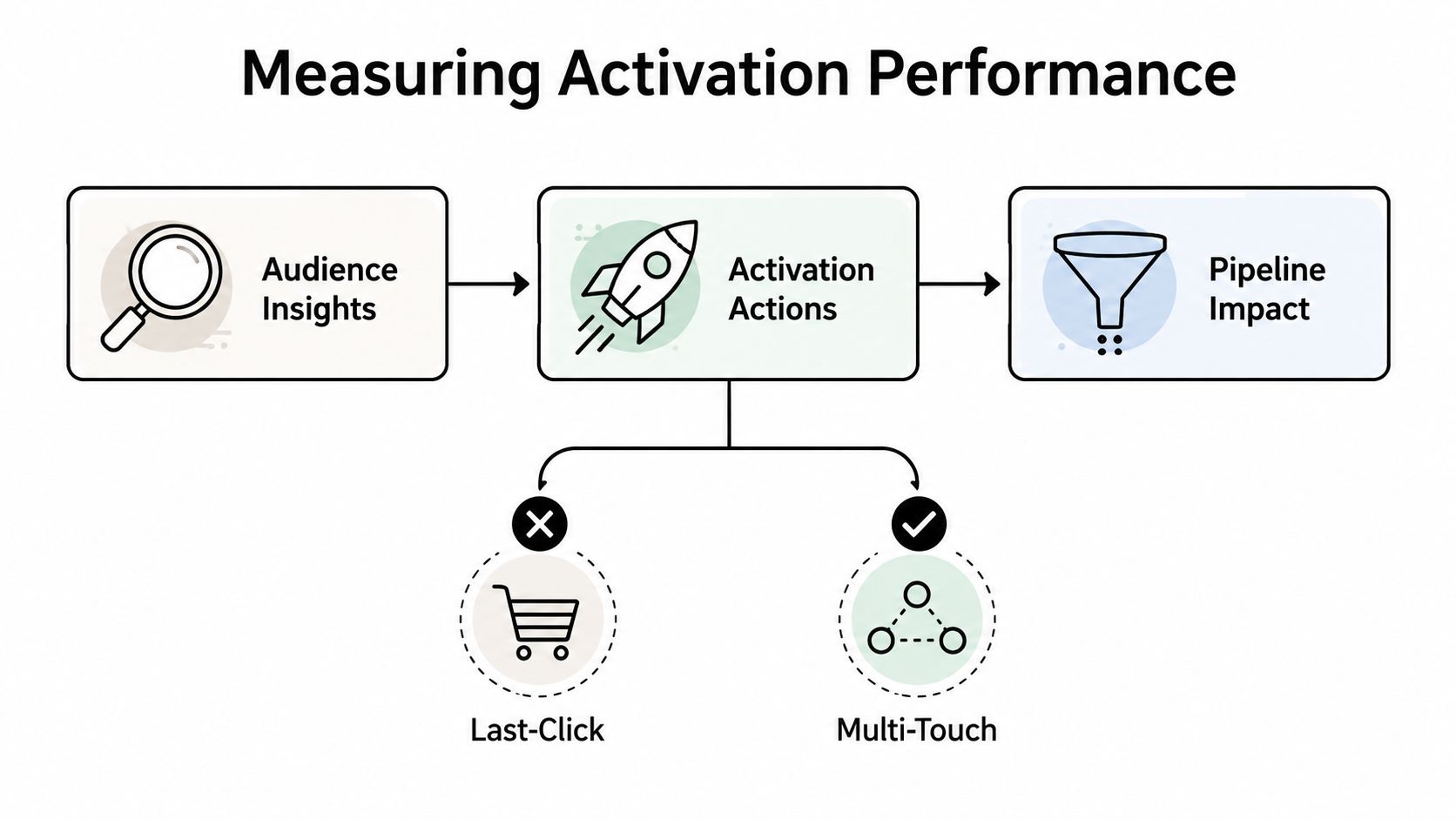
Last-click can flatter the wrong channel and hide the value of better audience quality. Multi-touch gives a fuller view, but even that can miss whether the audience changed outcomes. If a team lacks a phased activation plan, it often tries to activate too many segments at once, then calls the platform broken when the problem is control.
For a cleaner read, pair the pipeline audit with holdouts and incrementality testing. That is how you separate real lift from platform optimism.
The fastest way to kill a first party data activation project is to try to do all of it at once. I've seen teams attempt identity, consent, media activation, and personalization in one heroic sprint. It usually ends with half-finished integrations and a very expensive Slack channel.
Phase one is boring, which is exactly why it works. Fix server-side tagging, stabilize event capture, and get deterministic matching working before you chase audience scale. If your email match rates are weak, don't pretend the next problem is creative.
Phase two is where you connect the data to paid media. Start with suppression and a small number of lookalike seeds. That gives you something measurable without asking the whole org to reinvent its workflow.
Phase three is where you expand into personalization and cross-channel orchestration. By then, you've earned the right to get a little fancier.
If the first use case can't be explained in one sentence, it's probably too big for phase one.
For teams that need execution help without rebuilding the org chart, HireMediaBuyers.com is one option to source vetted media buyers who can handle paid media activation and privacy-conscious buying workflows while your internal team fixes the underlying data stack. Not glamorous, but then again neither is cleaning up a dead CDP project.
The hardest tradeoff in first-party data activation is plain enough. More compliance often means more fragmentation at the start. Less compliance means more risk, and that cost shows up later.
Recent guidance stresses that activation now depends on clear handling of permissions, opt-outs, data-use policies, and cross-platform identity gaps privacy guidance. That shifts the question. The issue is no longer whether you have enough data. It is whether you can use it across regulated markets without creating avoidable problems.
AI is making the signal picture messier before it gets cleaner. More collection tools are appearing faster than teams can consolidate them, so some are building piles of signals they cannot yet use. That is storage, not strategy.
Good compliance does not mean timid marketing. It means disciplined marketing. Teams that work with consented, hashed, or server-side signals may give up some immediate reach, but they gain durability, cleaner measurement, and fewer ugly surprises from legal or platform reviews.
That matters even more in stricter markets and in setups where identity is already thin. If your model depends on data you cannot govern with confidence, you do not have a growth engine. You have a future incident report.
The next phase of first-party data activation will not be about pushing more records into a warehouse and hoping the media team can make sense of them. It will be about tighter loops between media performance, identity, and decisioning. The teams that keep up will treat activation as an operating system, not a quarterly cleanup project.
The old adoption gap still matters. BCG's milestone summary shows how long the market can sit between collecting data and using it in channels. That gap is the point. It explains why so many teams say they have the data, yet still struggle to change bidding, suppression, or creative decisions in time.
The direction is obvious. Orchestration will get more real-time, identity work will stay messy, and privacy rules will keep narrowing the margin for error. Clean rooms will matter when collaboration has to happen without exposing raw records. AI-driven enrichment will matter where signals are thin. Neither one fixes weak plumbing.
The teams that win will not just buy better tools. They will have people who understand media buying and data engineering well enough to make tradeoffs fast. A marketer who can spot a match-rate drop and trace it back to a consent issue or a bad schema change is more valuable than a room full of people staring at dashboards.
The boring answer still wins. Better collection, better identity, better consent, better activation. That is the work.


