


Most hiring managers begin reference checks with the same question: “Would you rehire this person?” It sounds sensible. It's also one of the most overused shortcuts in hiring. Referees are self-selected, companies often limit what managers can disclose, and a polite “yes” tells you almost nothing about whether a media buyer can protect budget, diagnose performance, or make a hard call when Meta starts eating the account alive.
Paid-ads hiring needs a different standard. A useful reference check investigates what the candidate owned, what happened when results deteriorated, and who can independently corroborate the story. The resume, portfolio, skills test, and case-study interview establish capability. References test whether that capability survived contact with real budgets, real clients, and real pressure.
Most reference checks are theater because they ask broad questions about qualities nobody can measure in the moment. “How was their teamwork?” “Were they reliable?” “Would you rehire them?” The referee gives a pleasant answer, the recruiter types “positive reference” into the ATS, and everyone pretends risk has been reduced.
That script might work for confirming basic employment facts. It doesn't tell you whether someone can scale a meaningful Meta account without losing control of pacing, attribution, creative fatigue, or client expectations. A media buyer can be charming, collaborative, and punctual while still making expensive decisions with somebody else's money.
The U.S. Office of Personnel Management recommends a more defensible method, including basing questions on job analysis, asking applicants the same questions, and using standardized data collection and rating procedures in its reference-checking guidance. That principle matters even more in performance marketing, where candidates often describe the same work with wildly different levels of ownership.
A serious paid-ads reference check should answer three things.
Ask a former client, “Which decisions did this person make without waiting for approval?” That question separates an operator from a passenger. Ask a manager, “Walk me through a period when performance declined. What did they notice first, and what changed afterward?” Specific sequences beat adjectives every time.
A broad call can burn 30 to 60 minutes per candidate without producing useful evidence. That range is part of the practical problem with reference theater, not a verified industry statistic. A targeted conversation can be shorter because it stays anchored to the role and the candidate's actual claims.
Large reference-check samples show why structure matters. In one study of 100,000 employment references, only 61% were returned, 31% of returned references contained discrepancies, 81% contained only dates of employment, and 65% of referee details supplied by candidates were incorrect, according to Reed's employer reference best-practice guidance. A separate sample involving 150,000 candidates and 769,822 reference providers found an 85.3% compliance rate when references were requested, which still leaves meaningful variation in process quality.
Practical rule: Don't ask whether a candidate is “good.” Ask what they owned, what broke, and how they responded.
The antidote is simple: use references as a structured investigation, not a courtesy call. If the candidate claims to have owned strategy, make the referee define the strategy. If they claim to have scaled accounts, ask what changed in the account and who approved the decisions. Toot, toot, but this is the part that separates hiring operations from checkbox collecting.
Reference checking is not a casual backchannel exercise. It's a documented employment decision, and sloppy questions can create legal exposure even when your intentions are harmless.
Start with written candidate consent. Tell the candidate who you plan to contact, what information you'll request, and how you'll use it. Ask them to flag any current employer or client who must not be contacted without express permission. A current manager discovering someone's job search through an unexpected call isn't a minor awkward moment. It can put the candidate's employment at risk.
Several HR sources recommend written authorization before contacting references, and SHRM guidance says checkers shouldn't contact references the candidate explicitly asked them not to contact. Current-employer references require particular care. You can adapt the process language in this reference-check compliance guide to fit your jurisdiction and counsel's advice.
Your questions should connect directly to the media-buyer role. Ask about responsibilities, performance, decision-making, communication, reliability, and conduct relevant to the work. Don't wander into protected or personal territory.
Questions about age, marital status, religion, national origin, disability, pregnancy, family plans, medical history, or other protected characteristics are off-limits in the United States and the United Kingdom. “When did they graduate?” may sound like harmless timeline checking, but it can reveal age and invite discriminatory reasoning. Ask instead, “Can you confirm the period during which they worked with your organization and the responsibilities they held?”
Use this quick filter before every question:
Referees face defamation risk when they make claims that are false, malicious, or unrelated to observed work. That's one reason many companies limit responses to title, dates of employment, and eligibility for rehire. Don't pressure a referee to break policy, speculate about private matters, or provide gossip disguised as insight.
A practical consent script can be short:
“You've authorized us in writing to contact the professional references you provide for the paid-media role. We'll ask job-related questions about your responsibilities, performance, conduct, and working relationships. We won't contact your current employer without your express permission, and we'll document the information as part of the hiring decision.”
Do get consent before outreach. Do verify the referee's relationship independently where appropriate. Don't conduct secret calls through a mutual contact. Don't ask questions about protected characteristics. Don't treat a company's limited-disclosure policy as proof that the candidate is hiding something. Record the limitation and compare it with the other evidence.
Reference checks work best late in the process, after the candidate has demonstrated relevant skills. The University of Michigan and other HR guidance recommend checking references only after narrowing the field to one or two finalists or extending a conditional offer, as discussed in MRSC's reference-check guidance. That sequencing protects time, candidate privacy, and your own judgment.
Start by asking each finalist for 3 to 5 professional referees. Request a former direct manager, a peer or cross-functional partner, and a client or internal stakeholder who directly experienced the candidate's work. Ask the candidate to identify any current employer, current client, or sensitive relationship that requires explicit permission before contact.
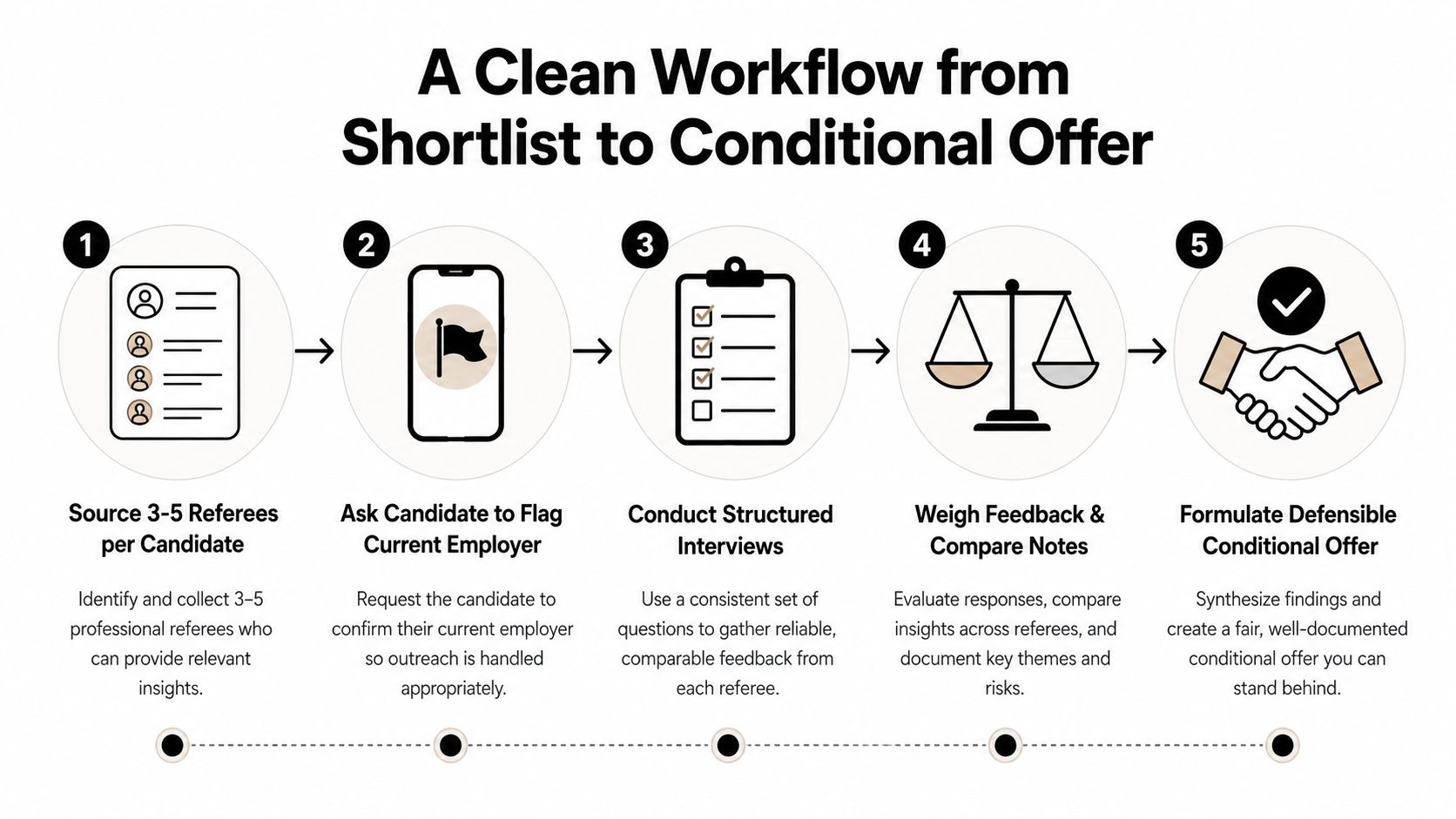
Run the calls after the skills test and portfolio review. You should already know which claims need testing. If the portfolio says the candidate restructured an account, ask the referee what the old structure looked like, what changed, and which outcomes the candidate personally influenced.
Use a shared scorecard and schedule 25 to 35 minutes per call. Take notes during the conversation, not from memory afterward. Hold a 15-minute same-day debrief while the details are fresh, then attach a reference summary to the candidate record.
A clean operating sequence looks like this:
The common mistakes are painfully predictable. Teams check references before they know what to probe, skip written consent, call the current employer without permission, or treat the conversation as a ceremonial final step. None of those behaviors makes you look thorough. They make you look like you're mortgaging your afternoon for paperwork.
The question “Would you rehire them?” isn't useless, but it's weak without context. A former client may say yes because the relationship ended amicably. A manager may say yes for a different role. Your job is to discover what the yes means.
Group questions by the behavior they can illuminate: ownership of spend, platform craft, creative judgment, and stakeholder handling. Avoid leading questions such as, “They were strong on Meta, right?” That wording hands the referee the answer you want.
Ask these conversationally, not as an interrogation transcript:
Listen for sequence, not enthusiasm. A useful referee can describe the problem, the candidate's action, and the result without turning the call into a campaign tribute.
A manager can usually speak more clearly about operating behavior:
Opening, about one minute:
“Hi, I'm calling about [Candidate Name], who's being considered for a [Role Name] position. They gave permission for us to contact you. I'll ask a few job-related questions about the paid-media work you observed, and I'm aiming to keep this to around 15 minutes.”
Core conversation, roughly 10 to 12 minutes:
Confirm the relationship and working period, then ask four or five questions tied to the role. Use silence. If the referee says, “They owned strategy,” ask, “What did that ownership look like in practice?” If they mention growth, ask which metrics they monitored and what decisions changed them.
Close, about two minutes:
“If we hired this person into this role, what support would help them succeed?” Then ask, “Knowing what you know now, would you rehire them for this kind of paid-media position? Why or why not?”
Request written follow-up only when a factual detail needs confirmation, the referee offers a material clarification, or your notes contain a contradiction. If the call goes off-script, say, “I appreciate the context. I need to keep this focused on the responsibilities relevant to the role, so I'm going to bring us back to campaign ownership and performance.”
Not every uncomfortable answer is a rejection. A referee who speaks in generalities may be constrained by company policy, may not have worked closely enough with the candidate, or may be bad at giving references. Probe before you punish.
Soft concerns include vague descriptions of team dynamics, lukewarm praise without examples, and a referee who can confirm the relationship but not the candidate's detailed responsibilities. Ask another question. Then ask for a concrete situation. If the answer stays foggy, downgrade confidence, but don't confuse low information with proven misconduct.
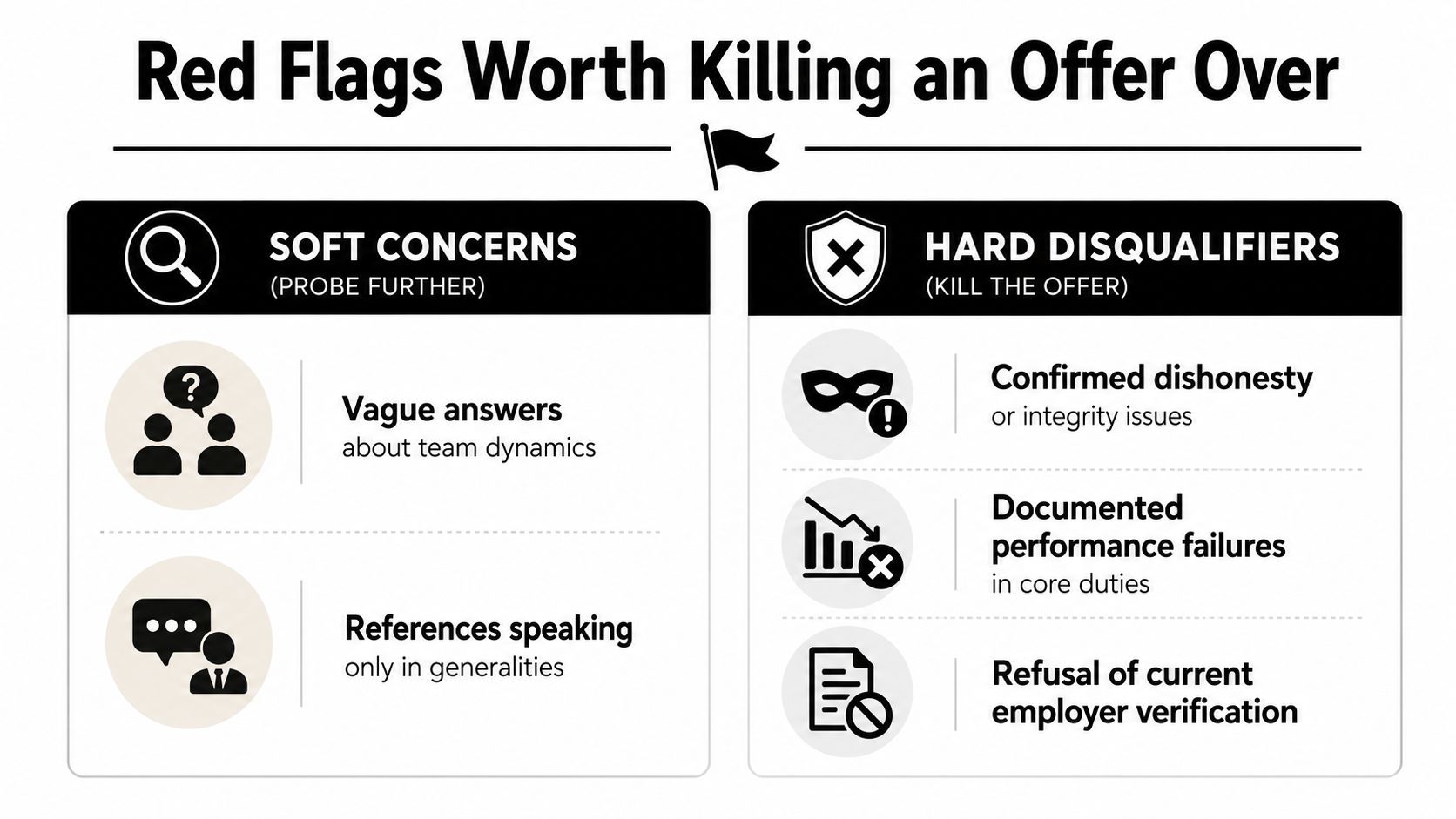
Some signals deserve a much sharper response:
A single bad reference requires investigation. A consistent story across multiple independent referees requires action. Don't average away a serious integrity concern because two friendly contacts liked the candidate's personality.
“Good with clients” is not evidence. Ask what the candidate said when the numbers were bad.
The same standard applies to identity and relationship verification. Check whether the referee held the role claimed and whether they observed the candidate's work firsthand. In remote, cross-border hiring, independent verification and a logged evidence trail protect both the employer and the candidate from a fabricated panel.
Gut feel is useful for noticing tension. It's terrible at comparing candidates consistently. Use a simple rubric that forces the team to separate platform craft from ownership, collaboration, and reliability. For paid-media roles, I'd weight the axes this way: platform craft at 35%, ownership and accountability at 30%, creative collaboration at 20%, and hireability and reliability at 15%.
Each referee gives a 1 to 5 score on every axis, with one sentence explaining the score. A direct manager's view should carry more weight on accountability and reliability. A former client should carry more weight on communication and commercial judgment. A peer can add useful context on collaboration, but shouldn't outrank somebody who approved the work or owned the budget.
| Axis | Weight | 1–3 Score | 4 Score | 5 Score |
|---|---|---|---|---|
| Platform craft | 35% | Limited evidence of sound account execution or diagnosis | Consistent technical competence with some support needed | Clear, independent command of platforms, testing, tracking, and optimization |
| Ownership and accountability | 30% | Waits for direction or avoids responsibility | Owns assigned work and escalates most risks | Anticipates problems, protects spend, and explains decisions clearly |
| Creative collaboration | 20% | Struggles to brief, assess, or iterate creative | Works effectively with occasional friction | Connects creative decisions to performance and improves collaboration |
| Hireability and reliability | 15% | Material concerns about follow-through or conduct | Generally dependable with manageable gaps | Trusted under pressure, clear in communication, and consistently reliable |
For more context on evaluating demonstrated capability alongside references, use a skills-based hiring framework.
Candidate A scores strongly on platform craft but weakly on ownership. Referees describe excellent campaign builds and clean analysis, yet say managers had to catch pacing problems and prompt escalation. That candidate may be technically impressive and still unsuitable for an autonomous role.
Candidate B receives lukewarm craft feedback but glowing reliability. They follow through, communicate early, and handle client pressure well, but need support with advanced restructuring and diagnosis. For a supported mid-level seat, Candidate B may be the safer decision. For a solo growth operator, neither candidate gets an automatic yes.
Calculate the weighted result, then apply judgment to the pattern. Use three verdict bands:
A single outlier shouldn't erase a consistent story from three other referees. It should trigger a follow-up, not a spreadsheet exorcism. But if the outlier exposes a serious integrity concern, don't bury it under an average score.
A reference check should fit inside the hiring process, not become a second hiring process. This 14-day cadence gives a founder or operations lead enough room to verify claims without leaving a finalist in limbo.
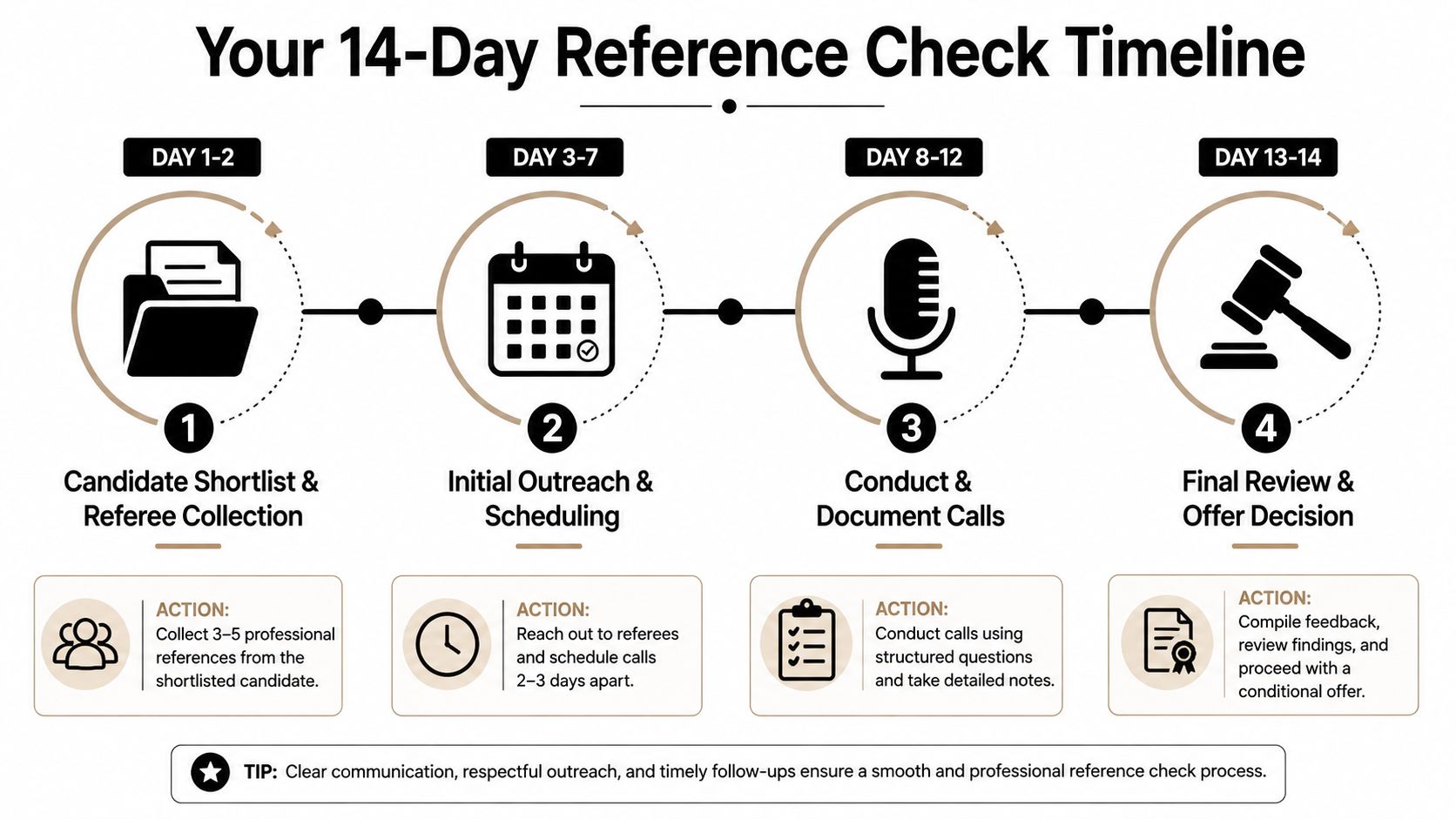
Finalize the shortlist after reviewing the portfolio, skills test, and case-study interview. Ask each finalist for 3 to 5 referees, including a former manager, a peer or cross-functional partner, and a client or stakeholder. Collect relationship details, preferred contact methods, and explicit notes about any current employer who must not be contacted without permission.
Send the consent confirmation and contact referees independently where practical. Schedule calls with 2 to 3 days between calls, leaving enough space to update probes after the first conversation. If a referee ghosts, send a concise follow-up, try the alternate approved channel, and move to another supplied referee rather than allowing one person to hold the process hostage.
Run the structured calls, using the same scorecard and role-specific questions. Document what each referee directly observed, distinguish facts from impressions, and compare claims against the candidate's work sample. A reference that contradicts the portfolio isn't automatically right, but it deserves a precise explanation.
Compile the weighted scores, discuss discrepancies, and decide whether the evidence supports a clear yes, a conditional yes with a 90-day review, or a no-hire. Attach the summary to the candidate record before issuing the final offer. The hiring timeline guide can help coordinate these steps with the broader search.
Reference checks belong after primary evaluation, not instead of it. Portfolio reviews show what the candidate can present. Platform skills tests show how they think through an account. Case-study interviews reveal how they explain decisions. References tell you whether the person behaved that way when the budget, client, and consequences were real.
If your best candidate's references are lukewarm, don't panic and don't rationalize. Find out whether the hesitation reflects a narrow role mismatch, a limited-disclosure policy, or a genuine pattern. If references say one thing and the work sample says another, investigate the contradiction directly. A polished test can reveal craft without ownership. A cautious referee can understate a strong operator. Your job isn't to pick the loudest signal. It's to determine which evidence came from someone close enough to know.
For companies that want help finding paid-media talent before reference checks begin, HireMediaBuyers.com offers a marketplace of pre-vetted Media Buyers and Paid Ads Specialists, with screening that includes interviews, skills assessments, and HR checks. Visit HireMediaBuyers.com to review talent options and build a hiring process where references confirm the decision instead of rescuing it.


