

Customer acquisition costs have risen sharply over time. One benchmarking analysis of 14,800 companies found CAC increased by roughly 60% over five years and 222% over eight years (customer acquisition cost benchmarks). So the lazy answer to “what is acquisition strategy?” is no longer good enough. A strategy isn't a list of channels, a funnel diagram, or a cheerful forecast built around cheap clicks.
It's a decision system for buying customers profitably. That means choosing audiences, offers, channels, budgets, and measurement rules based on what customers are worth after they convert. If your plan can't tell you when to scale, when to pause, and when to stop throwing money into a campaign with a heroic-looking dashboard, you don't have an acquisition strategy. You have a wish list with ad spend attached.
Most articles define acquisition strategy as a plan to attract and convert new customers. Technically, that is true. It is also about as useful as telling a media buyer to “make the ads good.”
A working definition is more practical: acquisition strategy is a portfolio decision system that maps spend to audiences, channels, and offers against unit economics. It must answer four questions:
The fourth question exposes weak acquisition plans.
A channel can produce cheap traffic and still be a poor investment. A campaign can generate leads and lose money. A blended CAC can look acceptable while one audience is profitable and another is consuming the budget.
CAC includes more than ad spend. It can include sales fees, advertising, discounts, marketing automation software, wages, and overhead. A commonly used formula is CAC = (sales and marketing costs + wages + overheads) / customers acquired, as outlined in this CAC calculation guide.
That definition changes performance analysis. A $20 lead is not cheap if sales requires extensive labor to qualify it and the resulting customer churns before recovering the acquisition cost.
Set a payback threshold before committing serious spend. CAC payback period measures how many months it takes to recover acquisition cost through gross margin. A widely cited SaaS benchmark is 12 months or less. Another framework describes under six months as excellent, six to 12 months as strong, 12 to 18 months as healthy for many sales-assisted models, and 24 to 36 months as capital-intensive (CAC payback period benchmarks).
Practical rule: If the plan lacks a target CAC, an LTV:CAC floor, and a payback ceiling, it is not ready for a budget.
Acquisition strategy is a financial decision framework first and a marketing plan second. Creative, targeting, and bidding serve the economics. That is the financial discipline that separates a strategy from a channel list.
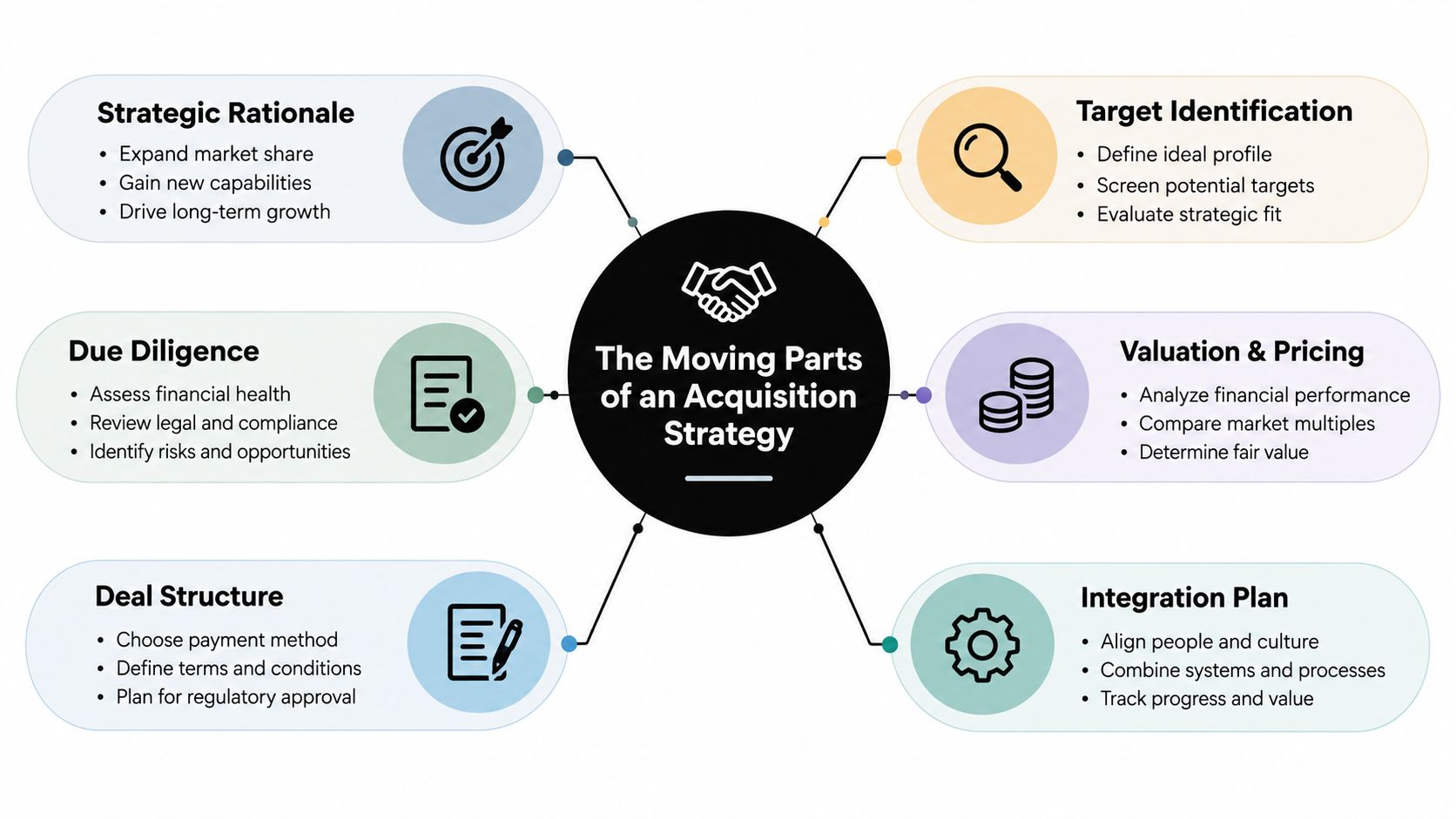
A functioning acquisition strategy has six connected parts. Treating them as separate checklist items creates the exact gaps that make paid accounts stall.
Start with the ideal customer profile, but don't stop at a broad label such as “SMB” or “health-conscious shoppers.” Define the segment by problem, buying trigger, budget, buying process, expected margin, and retention behavior.
Question: Which customer group can you acquire and serve profitably?
The ICP determines the offer and influences channel selection. A high-value B2B buyer may require account targeting and sales support. A low-friction consumer product may need broad creative testing and rapid landing-page feedback.
Channel choice isn't a popularity contest. B2B and B2C marketers use different portfolios. One analysis found that six channels are used by at least one third of B2B marketers, compared with 15 channels reaching that adoption threshold among B2C marketers. Email is used by 79% of B2B marketers and 92% of B2C marketers, websites by 73% and 87%, and paid social by 34% and 63%, respectively (B2B and B2C acquisition facts).
Question: Which channel matches the way this segment discovers, evaluates, and buys?
Cold prospects need a reason to stop. Warm prospects need proof. High-intent prospects need a low-friction path to action. Use educational content, trials, demos, guarantees, bundles, or pricing incentives according to the buyer's level of readiness.
Question: What objection does this offer remove, and what margin does it leave?
Calculate total CAC for the period, then compare it with channel- and segment-specific attribution. Last-click alone can misassign credit, especially in longer B2B buying cycles. Position-based models that weight first touch, last touch, and middle touches can produce very different ROI decisions, as explained in this B2B acquisition measurement guide.
Question: Can we connect the ad click to revenue, retention, and offline sales outcomes?
Set up conversion tracking before campaigns go live, including the relevant post-purchase or post-sale events. A broken measurement layer doesn't become reliable because more money passes through it. Teams can use this conversion tracking resource to review the implementation details that sit underneath acquisition reporting.
Use fully loaded blended CAC for the company-level view, but allocate spend using channel and cohort economics. Industry guidance notes that inbound and referral-led acquisition can be far cheaper than paid acquisition, while outbound and LinkedIn-style demand generation often carry higher CAC because of sales labor and lower conversion rates (CAC by channel guidance).
Question: What must be true before this channel receives incremental budget?
Creative isn't a deliverable you hand over once. It changes the audience's response, affects conversion quality, and supplies new hypotheses about the offer.
Question: What are we learning from each new concept, and how will that learning change the next test?
These parts form a loop. The ICP shapes the offer, the offer shapes the channel, channel data tests the ICP, and creative exposes new objections or motivations. Budget follows the cohorts that meet the payback rule. Then the loop starts again.
Paid channels earn budget for different reasons. The mistake is asking which one is “best.” The better question is which job needs doing, and whether the resulting customers can repay the spend.
Search captures existing intent. That makes it the strongest early validation channel for a problem people already know how to describe. It also has a hard ceiling. In mature categories, competition pushes CPCs upward, and the available high-intent demand can run out before your growth plan does.
Keep search funded when non-brand queries produce customers with acceptable CAC and payback, not merely form fills. Separate brand, high-intent category, competitor, and informational terms. Otherwise, a cheap brand campaign can make the entire account look healthier than it is.
Paid social, especially Meta and TikTok, is a scaling engine for prospecting. It can find demand before users search for a solution, but it punishes weak creative systems. If your team produces one polished ad every few weeks, the platform will eventually exhaust the audience's patience, and your costs will reflect it.
Scale social when new creative concepts keep producing qualified conversions and downstream cohorts remain within target economics. Don't scale because the platform reports a flattering conversion count.
Display and programmatic work best when you have enough audience data, a clear retargeting structure, and a strong post-click experience. They can extend reach and bring back people who visited valuable pages, but broad prospecting can bleed cash when impressions aren't connected to meaningful customer behavior.
Fund display when incremental conversions and assisted impact hold up against cohort analysis. Frequency, placement quality, view-through reporting, and weak landing pages can make a campaign look busy while the bank account gets quieter.
YouTube and CTV support top-of-funnel demand creation and brand response. They earn their place when the business can tolerate a longer path to conversion and has a retargeting system ready to capture viewers later.
Video is a poor choice when the business needs immediate payback and has no way to connect exposure with qualified site behavior. It becomes more defensible when brand familiarity improves conversion efficiency and customer value over time.
You can review the operational side of this work in the digital media buying guide.
| Channel | Best Stage | Primary Use | Typical Payback | Main Risk |
|---|---|---|---|---|
| Paid search | Early validation and high intent | Capture active demand | Shorter when intent is strong | Limited scale and expensive competition |
| Paid social | Scaling prospecting | Create and convert demand | Depends heavily on creative and offer | Creative fatigue and weak lead quality |
| Programmatic display | Retargeting and efficient reach | Re-engage known audiences | Strongest with qualified pools | Wasted impressions and poor post-click economics |
| YouTube or CTV | Brand-enabled growth | Build awareness and response | Usually longer | Weak measurement and delayed conversion |
The verdict is simple. Search proves intent, social supplies scale, display improves efficiency when tightly controlled, and video supports the brand layer. None gets a blank cheque.
Organic, paid, and partnership acquisition can all work. They don't work on the same clock, and they don't give you the same control.
Organic channels, including SEO, content, and founder-led social, usually offer the lowest marginal cost once the assets are working. They also take longer to validate and can be difficult to attribute cleanly. A content asset may influence a buyer long before the buyer fills out a form, tells sales about it, or clicks a trackable link.
Paid acquisition costs more, but it gives you speed and control. You can put a defined audience, offer, and landing page into market and receive a measurable signal quickly. That signal isn't automatically truth, especially when platform reporting overclaims conversions, but it gives a team something concrete to test.
Partnerships occupy the middle ground. Affiliates, influencers, integrations, referrals, and co-marketing can provide trust without requiring you to build every audience yourself. They can also introduce quality problems, since the partner controls much of the context and some of the targeting.
| Dimension | Organic | Paid | Partnership |
|---|---|---|---|
| Cost to acquire | Usually lowest over time, with substantial labor investment | Usually highest direct spend | Often shared, commission-based, or resource-based |
| Speed to signal | Slow | Fastest for measurable testing | Moderate, dependent on partner activation |
| Funnel control | Limited after discovery | High over targeting, message, and landing flow | Shared with the partner |
| Best strategic role | Compounding demand and authority | Validation and scalable reach | Trust, distribution, and referral loops |
Stage should dictate the starting mix. Pre-seed businesses should lean toward organic work and founder-led partnerships because customer feedback matters more than buying volume. Seed to Series A companies can add a disciplined paid test budget once the ICP and conversion path are clear. Series A and beyond can use paid as the main scaling lever while organic and partnerships compound beside it.
The portfolio doesn't need equal spending. It needs different jobs. Organic builds an asset, paid buys a controlled test, and partnerships borrow trust and distribution. Confuse those jobs and you'll judge a slow channel too early or let a fast channel spend too long without profit.
Clicks do not pay invoices, and platform conversions do not prove retention. Build the acquisition dashboard around metrics that decide whether a channel earns more budget, needs a tighter test, or gets cut.
CAC equals total sales and marketing cost divided by new customers acquired in the same period. Include labor, tools, overhead, discounts, and media when they belong to the operating model. Calculate it by channel, audience, geography, offer, and customer segment.
Blended CAC supports company-level financial planning, but it is a poor optimization metric. A profitable referral cohort can hide a paid channel that loses money. Organic customers can make a mediocre paid account look healthy. Set budget rules at the segment and channel level before the blended number smooths away the problem.
LTV estimates the gross-margin value a customer generates throughout the relationship. LTV:CAC compares that value with acquisition cost. The commonly used floor is 3:1, meaning lifetime gross-margin value should reach at least three times CAC. Treat that ratio as a guardrail, not a substitute for cash-flow analysis.
Margin beats applause: A campaign that produces revenue without recovering acquisition cost on a sensible timeline is not growth. It's deferred disappointment.
CAC payback period measures how long gross margin takes to recover acquisition cost. Use this formula:
Payback period = CAC / monthly gross margin per customer
A low-margin customer can produce respectable revenue and still repay too slowly. That risk matters for subscription businesses, sales-assisted SaaS, and any company managing cash carefully. Review payback by segment, because a blended result can hide an expensive enterprise motion or an underfunded self-serve opportunity.
Use the segment benchmarks as budget gates, not as decorative targets. If a cohort sits within its payback target and retains at the expected level, increase spend in controlled increments and watch marginal CAC. If payback stretches beyond the target, pause scaling, test the offer or funnel, and identify whether media cost, conversion rate, margin, or retention caused the change. A strong LTV:CAC ratio does not justify unlimited spend when cash returns too slowly.
Watch the inputs before reported CAC deteriorates:
| Segment | LTV:CAC Target | Payback Target | Notes |
|---|---|---|---|
| Ecommerce | 3:1 is a commonly used target | Under six months is a common goal | Repeat purchase and margin determine tolerance |
| SaaS | 3:1 or higher is a common benchmark | 12 months or less is widely cited | Sales-assisted and mid-market models may accept longer periods |
| B2B services | Must reflect contract value and delivery margin | Often longer than self-serve models | Longer payback only works when deal economics support it |
Set a separate spend ceiling for each segment, then change it only when payback, margin, and downstream quality support the move. Use this ad performance metrics resource to structure reporting around decision metrics rather than weekly meeting vanity numbers.
The same framework behaves differently when the customer, sales cycle, and margin structure change. A DTC subscription brand shouldn't borrow a vertical SaaS funnel, and a B2B services firm shouldn't copy a consumer brand's media mix because the ads look impressive.
A subscription brand used Meta and TikTok for prospecting, with a 30-day money-back offer as the primary conversion hook. The creative system tested five to eight new ad concepts per week, then applied a winner-only scaling rule rather than increasing budgets across every ad that produced a sale.
The messy part was attribution. Platform reporting gave fast feedback, while subscription behavior took longer to confirm. The team judged creative on initial conversion, then checked whether cohorts retained well enough to support the target payback. A creative plateau forced new angles around objections, use cases, and customer identity rather than endless edits to the same testimonial.
A vertical SaaS company paired Google Search with LinkedIn demand generation. Its free trial wasn't treated as a success by itself. Product usage qualified the trial, and the team tracked the path from lead to MQL to SQL before deciding whether to increase spend.
That extra layer protected the account from paying for interest that sales couldn't use. Search captured explicit demand, while LinkedIn helped reach relevant roles earlier in the buying process. Attribution gaps remained, especially when several stakeholders touched the account before the opportunity appeared, so channel reporting served as a directional investment tool rather than a courtroom verdict.
A B2B services firm relied on partnerships and referral loops early because trust and deal quality mattered more than immediate reach. Once deal velocity justified the added cost, the team layered account-based LinkedIn campaigns around named accounts and sales outreach.
The account didn't need every channel. It needed a credible path from partner introduction to qualified conversation, then a paid layer that reinforced the accounts already showing commercial intent. The lesson is annoyingly practical: channel choice follows business model, not fashion.
Build the strategy in this order. Reversing it is how teams end up debating TikTok versus LinkedIn before they know which customers they can afford to acquire.
Write the ICP at segment level. Define expected revenue, gross margin, likely retention, sales effort, and the maximum acceptable CAC. Set the LTV:CAC floor and payback ceiling before opening an ad account.
Then write the buying problem in the customer's language. If the offer requires a long explanation, your landing experience has work to do before media receives more budget.
Match the offer to intent. Cold audiences may need education or proof. High-intent visitors may need a demo, trial, guarantee, or clear commercial reason to act.
Make the landing page carry the same promise as the ad. Test message match, proof, friction, form length, pricing clarity, and the next step. Don't blame the algorithm for a page that asks visitors to do mental gymnastics.
Start with two or three channels, selected by audience behavior and payback target. Use search to validate existing demand, paid social to test scalable messaging, partnerships to borrow trust, or video when brand response supports a longer path.
Give every channel a role and a kill condition. More channels don't automatically create diversification. They often create more places to hide weak economics.
Track lead, trial, purchase, qualified opportunity, closed-won, activation, and retention events as appropriate. Define the attribution window before launch, connect CRM outcomes to marketing data, and compare platform reporting with channel and cohort analysis.
Use holdouts where practical, audience seeds that reflect your best customers, and post-purchase events that reveal value beyond the first conversion.
Use creative sprints rather than random replacements. Test audience hypotheses, offer angles, landing experiences, and conversion events. Change one meaningful variable at a time when you need a clean read, then combine proven elements when you need a stronger package.
Review performance on a cadence that matches the buying cycle. Short-cycle ecommerce accounts can react quickly. B2B accounts need enough time for qualified opportunities and revenue to appear. Optimizing every few hours is not discipline. It's nervousness with a login.
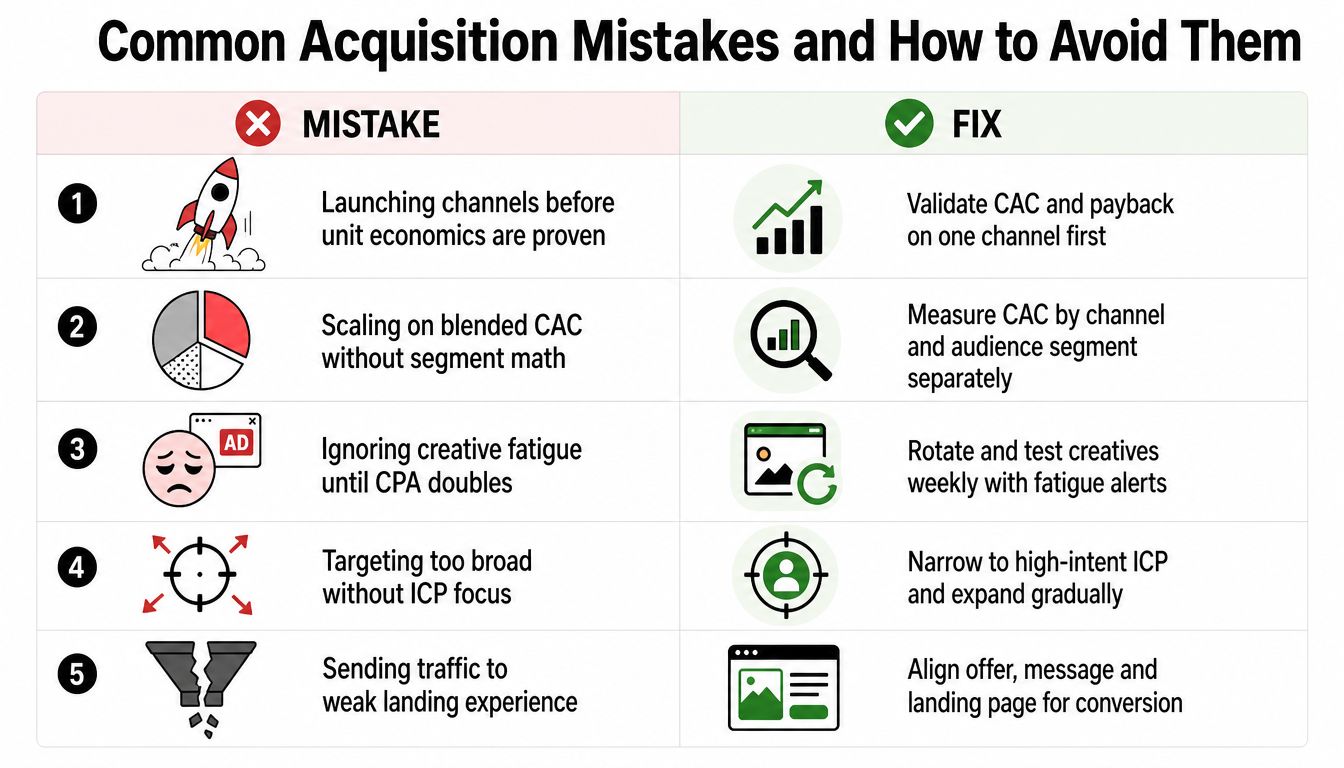
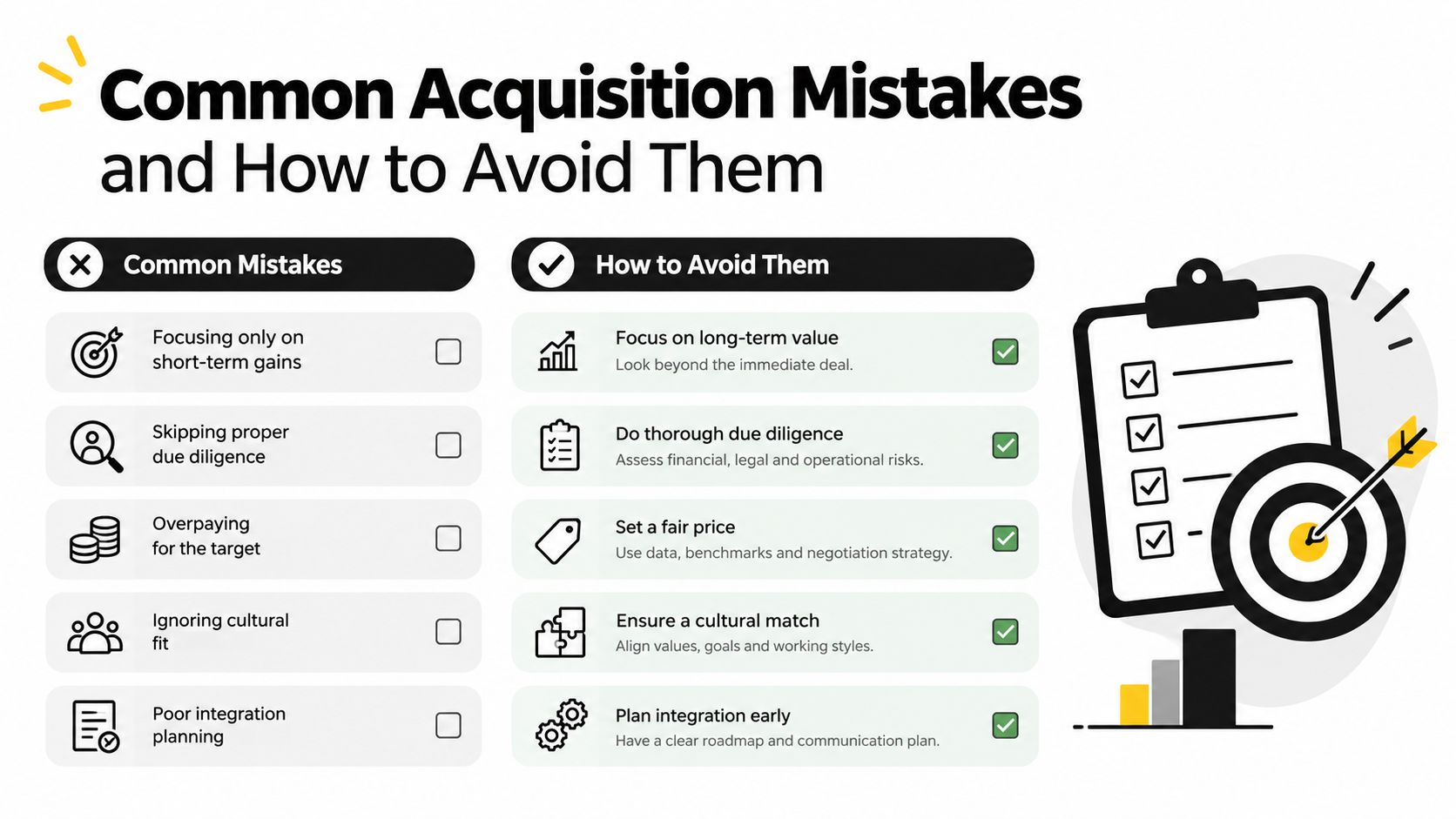
The same failures keep showing up in paid accounts:
Copying a competitor's channel mix is another expensive shortcut. You don't know their margins, retention, brand demand, sales capacity, or measurement quality. And if most of your budget sits in one network, you haven't diversified because the dashboard contains several campaign names.
Every dollar should be treated as a hypothesis with a kill date. What customer is it meant to acquire? What must happen after the click? What payback period makes the investment viable? Who owns the decision to pause it?
When execution capacity is the bottleneck, HireMediaBuyers.com is one option for finding pre-vetted media buyers and paid ads specialists across platforms such as Meta, Google Ads, LinkedIn, TikTok, and YouTube. Visit HireMediaBuyers.com to find paid media talent that can help turn your acquisition strategy into a measured, accountable operating system.


