


You know the moment. The candidate looked perfect on paper. Sharp resume. Smooth interview. Great references. You told your team, “Finally, this one's a grown-up.”
Then two weeks in, they can't own a deadline, can't explain their thinking, and somehow turn every simple task into a group project.
I've seen this movie too many times. In-house hires. Freelancers. Recruiters with glossy decks. “Specialists” who were really just good at saying “full-funnel” with confidence. If you run an agency or any marketing team under pressure, agency staffing solutions stop being an HR topic very quickly. They become a P&L topic. They answer one brutal question: how do you add capable people without setting cash and time on fire?
That's the only framing that matters.
A few years ago, I hired a supposed operator. The kind of person who says all the right things in an interview. They knew the lingo, had the logos on the resume, and gave polished answers that made everyone in the room feel smart for liking them.
Once they started, the wheels came off fast.
Campaign reviews were shallow. Client communication was shaky. Strategy was just recycled jargon with a fresh Google Doc wrapper. My leadership team spent more time cleaning up behind them than they would've spent doing the work themselves. Hope you enjoy spending your afternoons fact-checking resumes and running technical interviews, because that's now your full-time job.
That's the hidden insult of a bad hire. You don't just lose salary. You lose momentum, management attention, client trust, and the mood of the team. One weak hire can turn your best people into babysitters.
This isn't just your company being unlucky. The demand for outside hiring help is enormous. The global staffing services market is projected to reach $1,053.94 billion by 2035, growing at a 6% CAGR, according to Business Research Insights on the staffing services market. Translation: companies everywhere are struggling to find good people, and they're spending heavily to solve it.
That matters because it explains why the staffing world is so crowded with mixed-quality options. Big market. Big demand. Plenty of middlemen. Plenty of noise.
Practical rule: If a hiring model saves you money on paper but costs your team speed, focus, and rework, it's not cheaper. It's just wearing better makeup.
The fix isn't “never use agencies.” That's amateur hour. The fix is understanding which staffing model enhances your advantage and which one slowly drains your business every week.
A common question is, "What's the hourly rate?"
Wrong question.
Ask these instead:
That's where agency staffing solutions either become a weapon or a money pit. Toot, toot.
There are four common ways teams staff up. None are magical. All have tradeoffs. The mistake is pretending they're interchangeable.
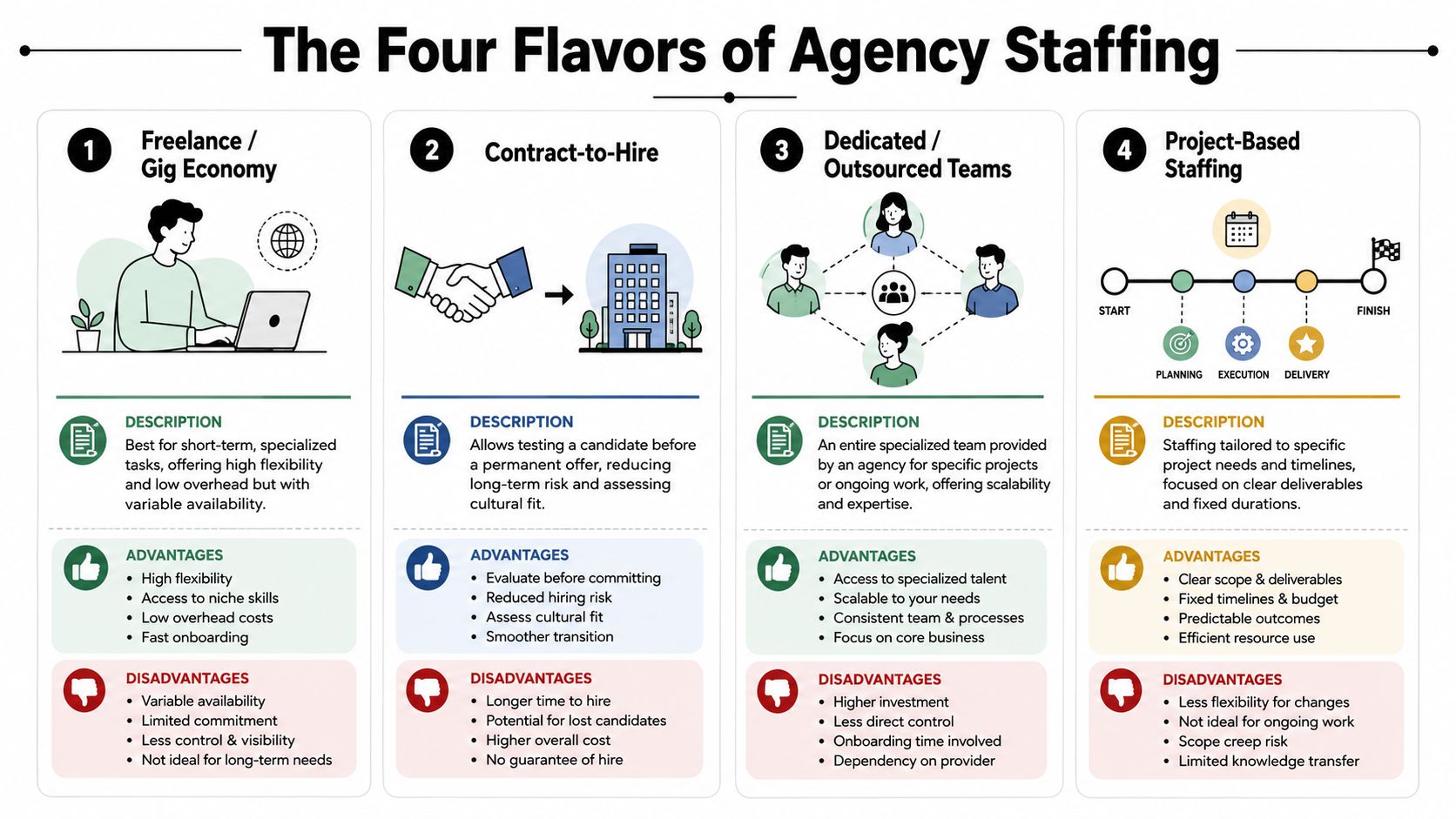
Also, let's kill a myth early. Specialized talent usually doesn't come from posting a job and waiting politely. 39% of hiring managers say staffing agencies are essential for filling hard-to-fill roles, according to IBISWorld's analysis of the U.S. office staffing and temp agency industry. That tracks with reality. The niche the role, the less job boards help.
This is the slow, expensive marriage.
You get control. You get continuity. You can build process around one person and shape how they work over time. If you're filling a core leadership role or a function that must live inside the business for years, full-time employees make sense.
But let's not romanticize it.
In-house hiring is slow to scope, slow to recruit, slow to onboard, and weirdly hard to unwind when it goes wrong. You don't just hire a person. You buy the meetings, the manager load, the software seat, the onboarding drag, and the emotional drama when they're not cutting it.
This one is the dice roll.
Sometimes you find a killer. Fast, skilled, independent, no fuss. Other times you get someone who disappears mid-sprint, works three other gigs during your standup, and thinks “communication” means reacting with a thumbs-up emoji.
The upside is flexibility. The downside is inconsistency.
A freelancer is great when the work is tightly defined. A landing page redesign. Account cleanup. A short analytics project. If you need ownership, cross-functional communication, or repeatable accountability, this model gets wobbly fast.
Freelancers are best when you can clearly define the task. They struggle when you need them to own the outcome.
This is the pricey body shop version.
A traditional staffing firm can save your team from sourcing and admin. That's useful. If your internal recruiting engine is weak or overloaded, they can absolutely help. For hard-to-fill roles, that support is often necessary.
But classic agencies vary wildly in quality. Some know your category cold. Others throw resumes at the wall and call it recruiting. You pay for speed, but if their screening is weak, your managers still do all the hard parts.
Watch for firms that brag about volume. Volume isn't vetting.
This is the modern option, and for most growth-stage teams, it's the most practical.
A good marketplace sits between freelance chaos and agency bloat. You get access to pre-vetted talent, faster matching, cleaner pricing, and less process theater. It's especially strong when you need a specialist without hiring a full in-house person before the work justifies it.
If you're weighing that route, this breakdown of fractional work models for modern teams is worth reading because a lot of companies don't actually need “a full-time hire.” They need a strong slice of one.
Here's the blunt version:
| Model | Best for | Main problem |
|---|---|---|
| In-house | Long-term core roles | Slow and expensive to fix if wrong |
| Freelance | Narrow short-term tasks | Reliability varies a lot |
| Classic agency | Hard-to-fill searches | Fees and screening quality can sting |
| Marketplace or fractional | Flexible specialist capacity | Quality depends on the platform's vetting |
If the role is strategic and permanent, hire in-house.
If the task is isolated, use a freelancer.
If the role is hard to source and you need search support, use a specialist staffing firm.
If you need speed, flexibility, and less operational drag, go with a modern marketplace model. For agencies trying to scale without adding payroll anxiety every quarter, that's usually the sharpest move.
Founders love to compare salary to contractor rates like they're judging avocados at the grocery store. That's not how labor economics works.
A salary is not the cost. A salary is the cover charge.
Benefits, insurance, and payroll taxes like FICA, FUTA, and SUTA can add 30% to 50% to an employee's total cost, according to this breakdown of staffing-related employment costs. Put differently, salary often represents only about two-thirds of what you pay.
So when someone says, “We'll just hire internally, it's cheaper,” I immediately ask, cheaper than what, exactly?
Not cheaper than:
A direct-hire staffing fee usually runs 15% to 20% of first-year salary, with some hard-to-fill roles capped between 15% and 30%, according to Doherty's overview of staffing pricing. Some founders see that fee and recoil. Fair enough. Nobody enjoys writing that check.
But the classic mistake is comparing that fee to salary alone and ignoring total employment cost.
There's also another wrinkle. In some staffing arrangements, the employer avoids carrying several burdens directly. A real-world example from Bonney Staffing's explanation of billing rate value showed $1.10 in hourly savings per employee, or more than $2,200 annually, by offloading items like workers' comp, payroll taxes, benefits, and recruiting expenses.
That won't apply to every setup. But the point stands. The “expensive” option often looks less expensive once you stop lying to yourself with partial math.
Don't compare salary to hourly rate. Compare total ownership.
Use a simple scorecard:
If your business needs predictable spend, this is the same logic behind retainer structures in business. You're not just paying for labor. You're paying for operational certainty.
Cheap hires get expensive when your best people have to compensate for them.
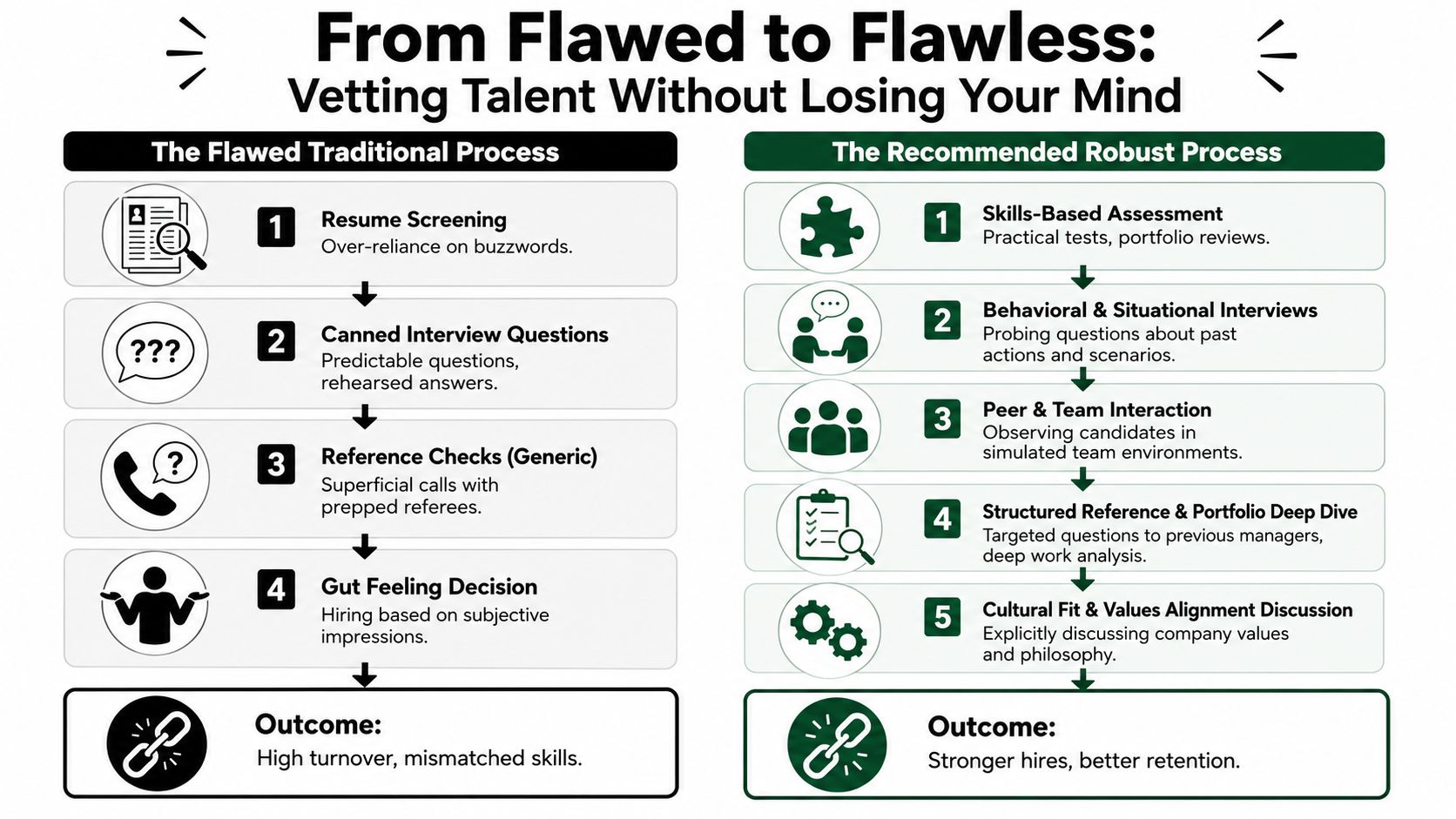
Most hiring processes are theater. Resume screening. Generic interview. “Tell me about a challenge.” A few reference calls where everyone says the candidate was “great to work with.” Then a gut-feel decision wrapped in optimism.
That's how you hire polished talkers.
I don't care how nice the PDF looks. I care whether the person can think clearly under real constraints.
The benchmark for serious technical staffing is genuine expert-level assessment, where candidates are evaluated by peers on their ability to solve complex, real-world problems, not by answering canned questions, according to V2Soft's write-up on top staffing qualities. That directly reduces mis-hires because it tests actual thinking, not rehearsed charisma.
This applies far beyond software. If you're hiring a media buyer, strategist, paid social lead, or performance marketer, the principle is the same.
Ask them to work through something real.
For marketing and agency roles, I'd want some version of this:
A lot of founders skip this because they're busy. I get it. But rushing the vetting is how you sign up for six months of low-grade pain.
Ask this instead: “You join on Monday. By Friday, what would you review first, and what would make you nervous?”
Now you're testing prioritization. Judgment. Pattern recognition. Communication.
That answer tells you more than twenty minutes of polished biography.
If you want to pressure-test a partner's credibility, ask for client references that actually help you evaluate fit. Not fluffy testimonials. Real references tied to similar role types, workflows, and expectations.
If a staffing partner can't explain exactly how they vet skill, judgment, and communication, they are outsourcing the risk to you.
Once someone starts, don't fall into the oldest trap in management. Mistaking activity for value.
Busy people are everywhere. Useful people are rarer.
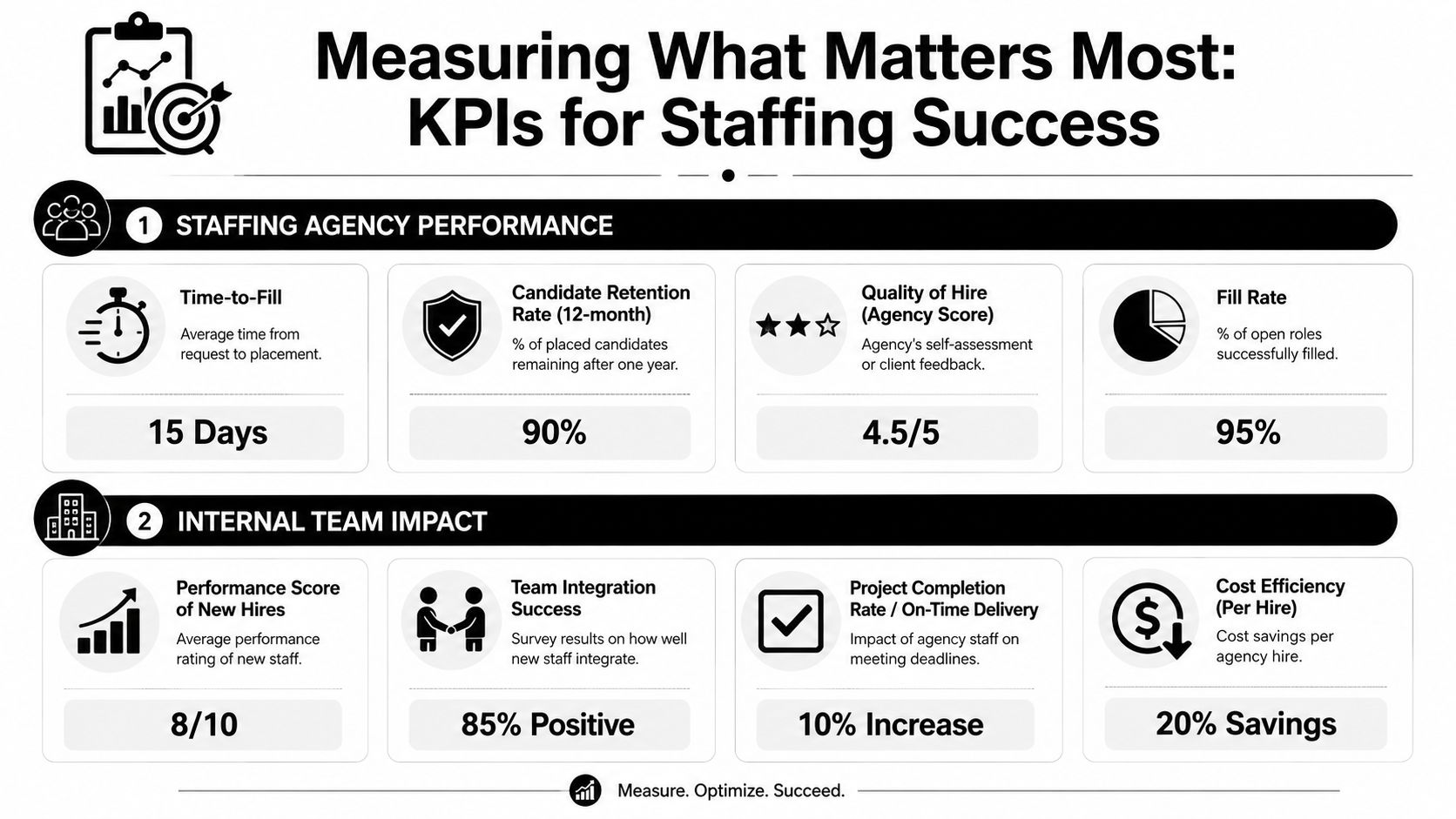
A staffing partner should earn trust with operating metrics, not vibes.
According to Tracker RMS on contract staffing agency benchmarks, high-quality agencies aim for a first submittal time of 4 days, an interview ratio of at least 20%, and an offer acceptance rate above 4%. Those aren't vanity numbers. They tell you whether the partner is moving fast, sending relevant people, and managing the process with some discipline.
Here's how I read them:
| KPI | Why it matters | What it reveals |
|---|---|---|
| First submittal time | Speed from brief to candidate | Whether they can execute quickly |
| Interview ratio | Relevance of submitted candidates | Whether they understand the role |
| Offer acceptance rate | Candidate quality and expectation setting | Whether they pre-vet seriously |
If a partner is slow, sloppy, or sends random profiles, your team pays the tax.
For the actual hire, don't obsess over “responsiveness” and “positive attitude” as your primary metrics. Nice qualities. Not enough.
Use role-specific outcomes. For paid media, that might mean account quality, reporting clarity, testing discipline, and commercial judgment. For delivery roles, it might be handoff quality, speed, and reduced client friction. For strategists, I care whether their recommendations change decisions, not whether their slides look expensive.
Try this simple framework:
Strong staffing isn't about filling a seat. It's about reducing drag and increasing useful output.
If you can't measure that, you're not managing staffing. You're hosting it.
Boring stuff gets exciting the minute a contract goes sideways.
A lot of agency staffing solutions become dangerous, not because the talent is bad, but because the paperwork is lazy.
First, worker classification. If someone looks, works, and behaves like an employee, treating them like a casual contractor can create a mess. Taxes, benefits issues, and compliance headaches aren't exactly morale boosters.
Second, intellectual property. If someone builds campaigns, writes copy, structures accounts, or creates reporting systems for your business, the agreement should clearly state that you own the work product. Don't assume. Don't “sort it later.” Later is where legal bills live.
Third, exit terms. If the fit is poor, can you replace the person quickly? Can you cancel cleanly? Are there offboarding steps for access, assets, and documentation? Flexibility matters a lot more when reality shows up.
Use this quick filter:
Classic agencies sometimes handle these details well. Sometimes they absolutely do not. Marketplaces vary too. Read the agreement like someone who expects friction, not like someone dazzled by speed.
A flexible contract is not a luxury. It's basic self-defense.
You do not need a prettier sales deck. You need sharper questions.
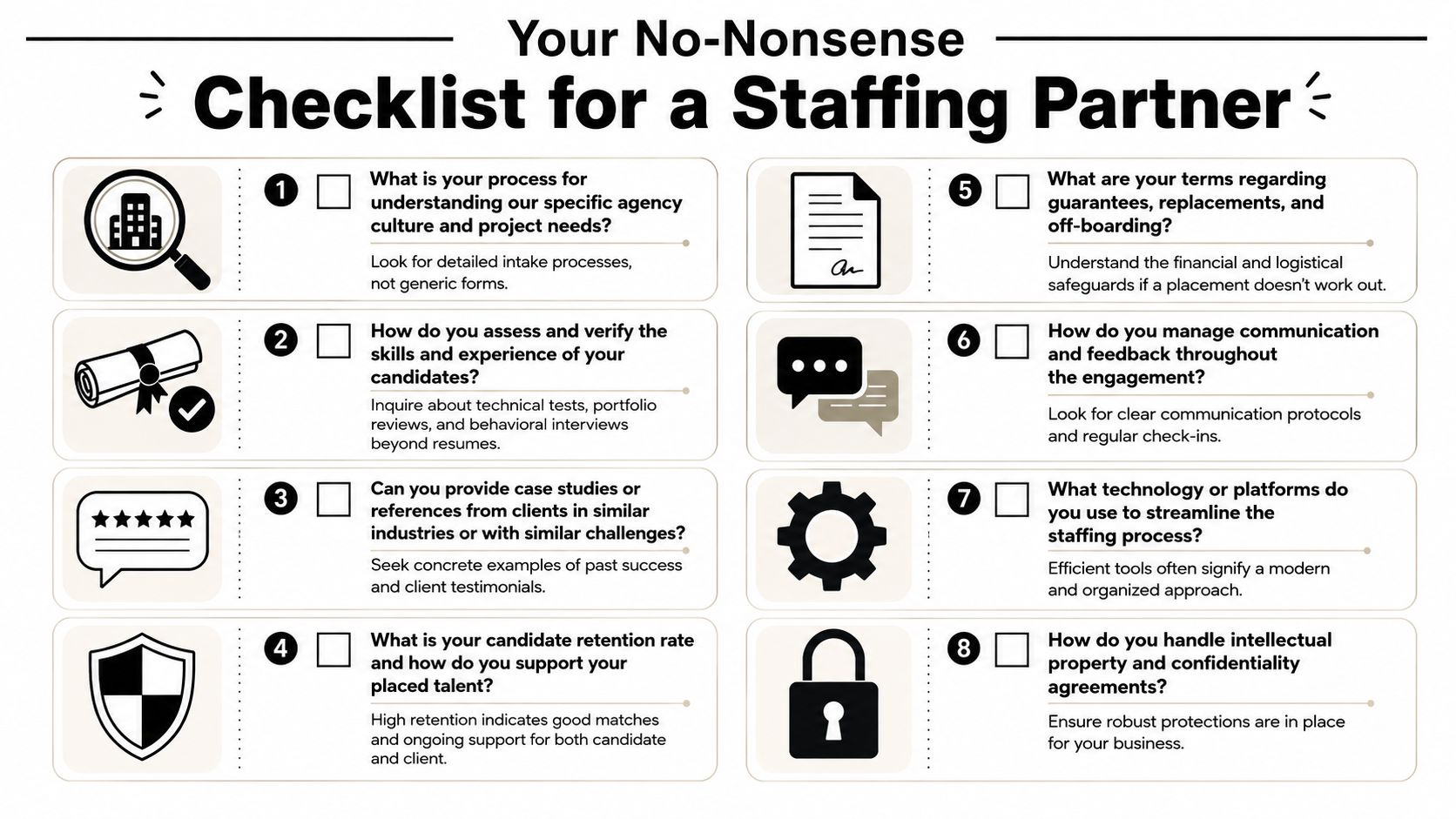
When I'm evaluating a staffing partner, I'm trying to figure out one thing fast. Are they removing operational drag, or just moving it around and charging me for the privilege?
Good partners are specific. They can explain how they assess capability, how they handle issues, and where responsibility sits. Bad partners hide behind polished language, broad promises, and “it depends.”
That's usually your cue to leave.
One more thing. If a partner talks endlessly about how many candidates they have, but can't explain how they decide who's good, you're not looking at a staffing solution. You're looking at a sorting problem with branding.
The best agency staffing solutions don't just help you hire. They protect your focus. That's the whole game.
If you need paid media talent without the usual recruiter circus, HireMediaBuyers.com is built for exactly that. You can hire pre-vetted Media Buyers and Paid Ads Specialists quickly, skip the sourcing mess, and scale with flexible terms that don't trap you in a bloated hiring process.


