

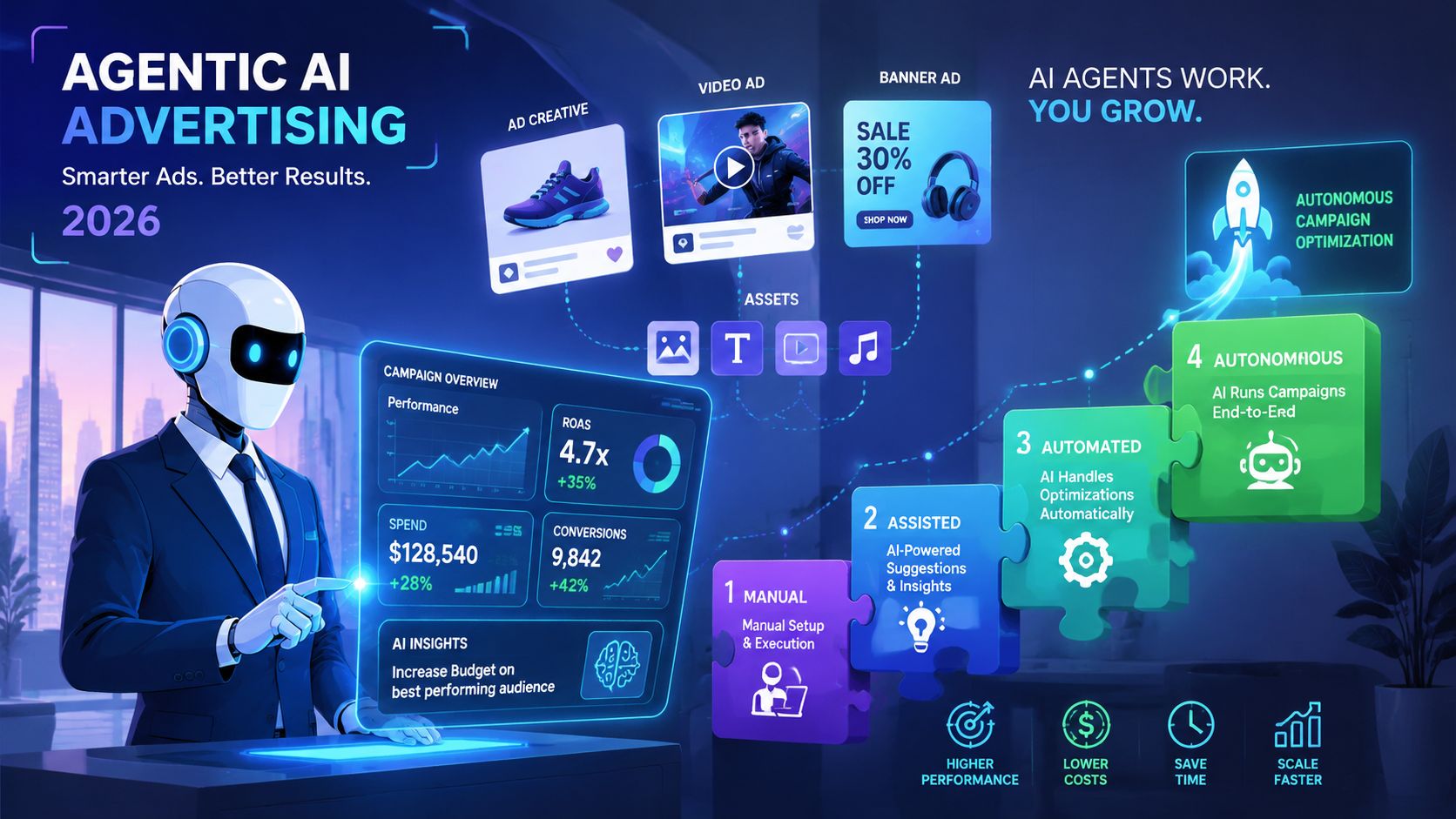
The surprising part of agentic AI advertising in 2026 isn't that software can adjust bids. Platforms have done that for years. The surprise is where the market is putting its money: U.S. AI advertising spend was forecast to reach $32.03 billion in 2026, with nearly all of that growth tied to existing paid-search and platform-adjacent inventory rather than standalone chatbots, according to Forbes' reporting on AI ad spending.
That creates a hiring problem before it creates a software problem. Your company doesn't just need an agent. It needs a media buyer who can supervise one, challenge its recommendations, inspect its data, and pull the plug before it mortgages the office ping-pong table. The teams that get this right won't remove media buyers. They'll turn them into operators with judgment, documentation habits, and the nerve to tell an algorithm it's being stupid.
A lot of “agentic” advertising is ordinary automation with a better press release.
Bid adjustments, dayparting rules, audience exclusions triggered by static conditions, and placement filters can all be useful. They can also be completely deterministic. A rule says, “If cost per acquisition rises, reduce the bid.” An agent should be able to ask why acquisition cost rose, inspect delivery and conversion signals, form a plan, take several actions, and revise that plan when the evidence changes.
That distinction matters because vendors have every incentive to blur it. A dashboard that recommends a bid change suddenly becomes an autonomous co-pilot. A creative generator becomes a campaign strategist. Before long, your spreadsheet starts calling itself a chief marketing officer.
A tool probably isn't meaningfully agentic if it has:
The 2026 field guide to agentic AI advertising defines the category more usefully. An agentic system perceives a situation, reasons through a multi-step plan, and takes action toward a defined goal with minimal human intervention. IAB's guidance describes the same basic operating model: the system can plan, decide, and act autonomously within defined objectives.
Founder rule: If the tool can't explain what it changed, why it changed it, and what it plans to check next, don't give it your budget.
This doesn't mean automation is bad. Quite the opposite. Rules-based automation is dependable when the rule is simple and the consequence is contained. The mistake is paying agent prices for a glorified if-then statement, then blaming your media buyer when the software optimizes the wrong thing.
Agentic AI advertising is software that pursues a paid-media objective through a connected sequence of decisions and actions. It reads the current situation, plans the next steps, uses approved tools, observes the result, and adjusts its behavior. Generating copy or surfacing a recommendation alone does not qualify.
The useful comparison is a junior media buyer who never sleeps, occasionally hallucinates with the confidence of a man who has just discovered tequila, and needs strict permissions. In 2026, the harder problem is often hiring media buyers who can supervise that worker, not buying the worker itself. Most guides skip that team-readiness layer, then wonder why an expensive system produces cheap decisions.
A capable agent can inspect Google Ads search terms, compare conversion events in analytics, identify a landing-page mismatch, draft revised responsive search ad variants, request approval, and update the campaign after sign-off. A static rule can pause an ad group. It cannot reliably connect those actions to a broader objective.
Goal-directed planning starts with an outcome such as improving qualified pipeline while protecting efficiency. “Lower bids when CPA rises” is a rule. An agent translates the business goal into work across audiences, creative, spend allocation, landing-page alignment, and measurement.
Multi-step reasoning lets the system diagnose before reacting. If conversions fall, it should distinguish tracking failure, delivery mix, auction pressure, creative fatigue, and landing-page friction before changing bids.
Tool use turns analysis into execution. Controlled access may include ad platforms, analytics, product feeds, creative repositories, CRM data, and reporting tools. Without those connections, it is a chatbot pretending to run a media plan.
Persistent memory gives the workflow continuity. The system should retain approved brand claims, excluded audiences, prior tests, budget constraints, and the context behind past decisions. Memory means preserving what prevents another expensive mistake, not keeping everything forever.
The AIM Agentic Marketing Benchmark evaluates systems on multi-step task completion, tool use, long-horizon execution, and self-correction. Its workflow scores use a normalized 0–100 scale, reinforcing a practical point: isolated copy quality is not enough. An agent that writes a brilliant headline but cannot complete the campaign workflow is a parrot with API access.
Call a system agentic when it can:
That vocabulary keeps the buying decision honest. Ask whether the software can manage a bounded workflow from objective to outcome, and whether your team can supervise it. Otherwise, you are purchasing automation and assigning it a job title.
Most founders make one of two mistakes. They call every platform feature an agent, or they wait for a mythical fully autonomous buyer before doing anything useful. Both approaches burn time.
Paid media sits on a spectrum. The right question is not, “Are we using agentic AI?” It's, “Which decisions are humans making, which decisions are software making, and who carries the risk?”
| Stage | Who Decides | Who Executes | 2026 Example |
|---|---|---|---|
| Manual buying | Human media buyer | Human media buyer | Campaign structure, bids, audiences, and creative changes handled directly |
| Rules-based automation | Human sets conditions | Platform executes fixed instructions | Bid rules, scheduled changes, placement exclusions |
| Assisted AI suggestions | Human chooses from recommendations | Platform performs approved changes | Meta's Advantage+ features recommend and automate within platform controls |
| Supervised agents | Agent proposes a multi-step plan | Agent drafts or stages actions, human approves | Cross-channel budget or creative workflow with approval gates |
| Fully autonomous agents | Human defines KPI and permissions | Agent executes, monitors, and revises | Emerging orchestration agents connected to ad platforms, analytics, feeds, and reporting |
Meta's Advantage+ deserves a precise description. It's a cluster of features, including Advantage+ Audience, Advantage+ Shopping Campaigns, Advantage+ Creative, and Advantage+ Placements, not one magical autonomous brain, as outlined in this breakdown of Meta Advantage+. Meta renamed Advantage+ Shopping Campaigns to Advantage+ Sales Campaigns in 2025, and new legacy Shopping campaigns can no longer be created.
That's useful automation. It isn't automatically a full agent.
For most companies, the productive zone is supervised autonomy. The agent can analyze performance, prepare changes, assemble creative variants, and coordinate data across systems. A human approves actions that affect brand claims, major audiences, or material budget shifts.
Performance Max URL expansion is a good example of why labels get slippery. The system can extend beyond the exact destination logic a buyer may have specified, which feels semi-agentic because the platform is making decisions on the advertiser's behalf. But the advertiser still operates inside a platform-defined box with limited visibility into the complete reasoning process.
Fully autonomous orchestration is more ambitious. It requires permissions, shared data, durable memory, and a clear escalation path. If your tracking is messy or your product feed is stale, autonomy won't save you. It'll just make bad decisions faster, which is the advertising equivalent of putting a turbocharger on a shopping cart.
The safest way to test an agent is to give it a workflow, not a vague mandate. “Improve performance” is how founders end up explaining unexplained spend to a finance lead. “Run this search-to-landing-page loop inside a capped budget, with these escalation rules” is an actual operating brief.
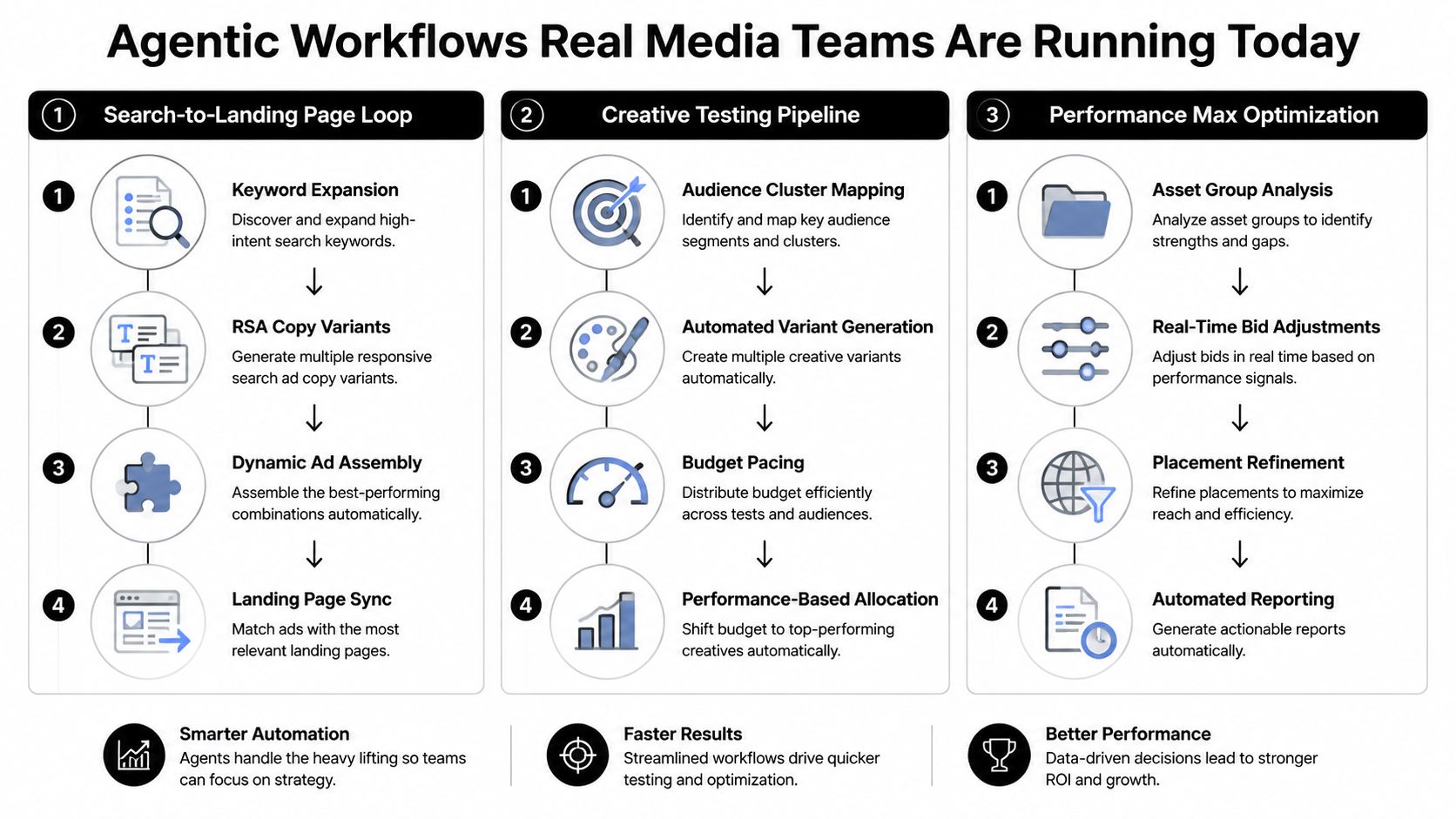
A search agent can start with query and conversion data, identify keyword expansions, draft responsive search ad variants, map the message to matching landing-page sections, and recommend budget movement toward the strongest ad group.
The agent can own query clustering, first-draft copy, internal consistency checks, and reallocations inside a pre-approved daily envelope. It must escalate new claims, regulated language, substantial landing-page changes, and any move outside the agreed budget boundary.
Its inputs should include search terms, conversion events, landing-page content, approved claims, negative-keyword lists, CRM quality signals, and conversion lag. Don't let it optimize against form fills if sales-qualified opportunities are the actual objective.
A cross-channel agent can reason across Meta, TikTok, and programmatic display to identify duplicate audiences, manage frequency, and pause creative that fails agreed health checks. A unified first-party data strategy becomes operational rather than decorative.
The agent can own audience deduplication, frequency throttling, routine creative pauses, and channel-level pacing. It should escalate identity conflicts, new audience definitions, sensitive-category decisions, and any action that changes the campaign's strategic purpose.
Inputs include consented audience data, exposure logs, conversion events, creative metadata, channel performance, and exclusion lists. Teams generally test this kind of workflow where the operational burden is meaningful and the permissions can be tightly bounded. The exact threshold depends on margin, risk, and the cost of a mistake, not on a vendor's demo script.
A creative-testing agent can turn a brief into many hooks, organize variants by message angle, monitor test results, stop clear underperformers under approved rules, and brief human designers on the survivors. Human approval still belongs before publication, particularly when claims, testimonials, or regulated categories are involved.
A Performance Max optimization workflow can inspect asset groups, bid behavior, placement patterns, and reporting anomalies. It can recommend or stage changes, but the buyer should control structural campaign decisions until the system has earned broader permissions.
The data foundation matters more than the shiny interface. Give the agent clean events, reliable creative labels, approved language, product-feed status, spend boundaries, and a reporting trail. Otherwise, you're not running an experiment. You're hosting a very expensive séance.
Write access is a privilege, not a welcome gift.
Before an agent touches live spend, define the boundaries in plain language and encode them where possible. A buyer should know exactly what the system can change, how much it can spend, what it must never touch, and who gets called when something looks wrong.
Set these controls before deployment:
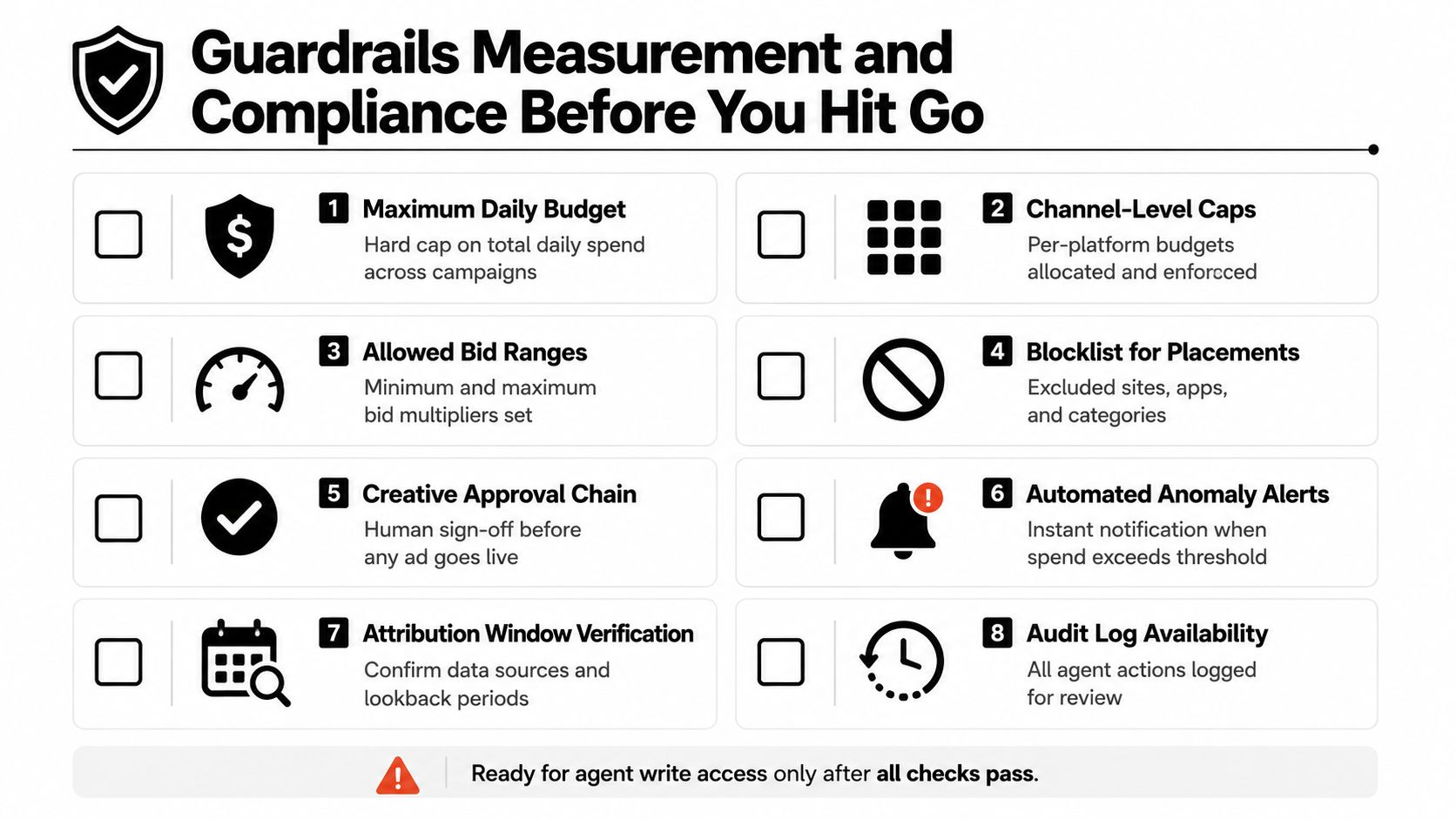
Performance comparisons become useless when the measurement conditions move underneath them. Adskate's guidance on agentic programmatic governance recommends establishing pre-agent baselines and using automated anomaly detection across spend, delivery mix, and reporting discrepancies.
Lock the baseline for CPA and ROAS, then document frequency distribution, geographic and device mix, and conversion lag. Use clean conversion events, holdout cells where practical, incrementality testing, and attribution windows that don't reward the agent for chasing easy-to-claim conversions.
Your conversion tracking foundation needs to be sound before optimization begins. If the agent can't distinguish a real purchase from a duplicate event or a low-quality lead, it will confidently optimize toward noise.
Consent signals, brand suitability, AI-generated creative disclosures, and audit trails need named owners. The FTC's Workado enforcement makes the standard clear: companies advertising AI capability or accuracy need competent and reliable evidence for those claims when they make them. The FTC's final order against Workado also required evidence retention, consumer notice, and annual compliance reports for four years.
Start in a sandbox or tightly limited campaign. Review the logs daily, inspect budget pacing, test the kill switch, and hold a weekly failure-mode review. Scale permissions only after the team can explain the agent's decisions without resorting to interpretive dance.
Agents are excellent at local optimization. They can inspect a large number of small decisions, spot routine patterns, and execute repetitive changes without asking for coffee. They're not responsible for your positioning, legal exposure, or reputation. You are.
Human approval should remain mandatory for:
A practical review model has three layers. Automated guards handle routine safety in real time. A media buyer reviews pacing, creative health, and anomalies daily. Leadership reviews portfolio direction, business outcomes, and risk weekly.
The winning team doesn't remove the buyer. It removes the buyer from pointless clicking.
That changes the hiring profile. The buyer becomes a supervisor, investigator, experiment reviewer, and translator between business goals and machine actions. If someone's entire value comes from adjusting bids manually, the role is already under pressure. If they can interrogate data, challenge assumptions, and document decisions, they're becoming more valuable.
Stop blaming the tech stack when the bottleneck is the person expected to supervise an agent at two in the morning on a Tuesday.
A capable media buyer in this environment needs to write tight prompts, read attribution output cold, understand feed hygiene and consent signals, and argue with an algorithm without flinching. They also need the judgment to kill a campaign early when the evidence says the thesis is wrong. That last skill is rare because people enjoy being right almost as much as they enjoy keeping doomed campaigns alive.
Structure the team around three functions:
Reskill junior buyers away from manual bid tweaking and toward experiment review, prompt design, data validation, and compliance verification. Test candidates with practical exercises. Ask them to reject a tempting but poorly supported recommendation, explain a tracking discrepancy, and write the documentation another buyer would need to reproduce the decision.
The skills-based hiring approach fits this shift better than a résumé built around platform badges. Skepticism, curiosity, clean documentation, and willingness to challenge a tool matter more than memorizing every menu in an ad manager.
Give a new hire a deliberate ramp before live spend. Start with account audits, sandbox work, and supervised recommendations. Let them touch production only after they can identify bad inputs, explain agent actions, and use the kill switch without hesitation.
Teams that skip this layer end up babysitting software that was supposed to replace them. That's not transformation. That's outsourcing your anxiety to a dashboard.
HireMediaBuyers.com helps companies find vetted media buyers and paid ads specialists who can work across platforms, analytics, creative testing, and supervised AI workflows. If you're building an agent-ready buying team, visit HireMediaBuyers.com to review talent options and find a buyer who can manage the software without surrendering control of your budget.


