

Most B2B demand generation advice starts with the wrong question: How do we generate more leads? That question has burned through enough ad budgets to mortgage the office ping-pong table. The better question is whether the leads are verified, reached quickly, accepted by sales, and converted into revenue.
That shift matters in 2026. Qualified pipeline ranks as the top priority for 52% of marketers, while more than 90% include pipeline, account-based marketing, or lead quality among their top goals, according to the Global State of Demand Generation 2026 insights. B2B demand generation isn't a form-fill factory anymore. It's a measurement system wrapped around buying groups, intent signals, channels, sales execution, and revenue accountability.
A swollen lead count can make a dashboard look healthy while sales wastes time on contacts that never had a buying case. The failure sits in measurement and data quality. Treating every form fill as equal disguises weak targeting, bad contact data, and poor signal from automated acquisition.
Across B2B SaaS, only 13% of MQLs convert to SQLs, so roughly 87% fail sales acceptance, according to The Starr Conspiracy's B2B lead generation benchmarks. If marketing celebrates MQL growth while ignoring that gap, the funnel gets rewarded for creating work sales cannot use.
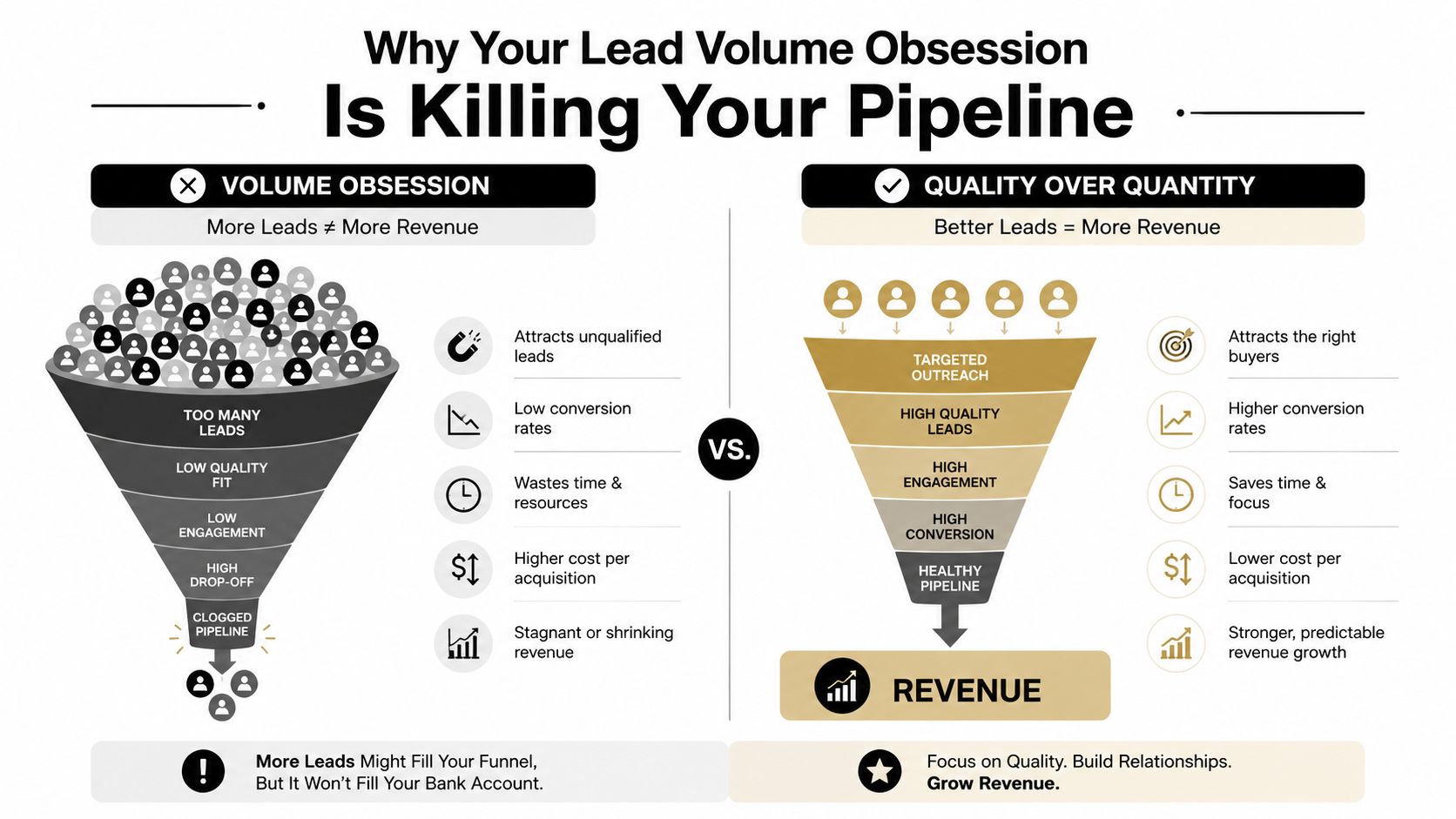
Demand generation should be managed against qualified pipeline, not cheap contacts. Ask which campaigns reached the right accounts, produced credible buying signals, and helped opportunities progress. A low-cost lead that sales cannot reach is not efficient. It is unpriced waste.
Review these measures:
Average B2B visitor-to-lead conversion is 2.4% across categories, while SaaS averages 1.8% and reaches 4.6% at the top quartile, according to Bowen AI Strategy Group's 2026 benchmark analysis. More traffic cannot repair a poor offer match, a clumsy form, or weak intent alignment. AI can help score and route records, but it degrades reporting when it fills databases with inferred identities, duplicated accounts, or synthetic intent.
Practical rule: If sales will not accept the lead, marketing should not count it as a win.
Half use revenue as their primary KPI, and 40% of organizations rank scaling account-based marketing as their second-highest focus area after pipeline creation, based on the 2026 demand generation findings. The commercial unit is the account, the buying group, and the opportunity, not the form fill.
Audit campaign efficiency with this ad performance metrics guide, then move budget from cheap activity to verified pipeline.
Most funnel diagrams are fiction with pleasant colors. They show awareness, consideration, demo, proposal, and close, as if a serious B2B buyer moves neatly through five labeled rooms. That model is useful for presentation decks and weak for budget decisions.
An average B2B SaaS deal involves about 220 interactions end-to-end: roughly 54 touchpoints to create an MQL, 87 more to convert MQL to SQL, and another 81 from SQL to closed won, according to Revnew's 2026 B2B demand generation research.
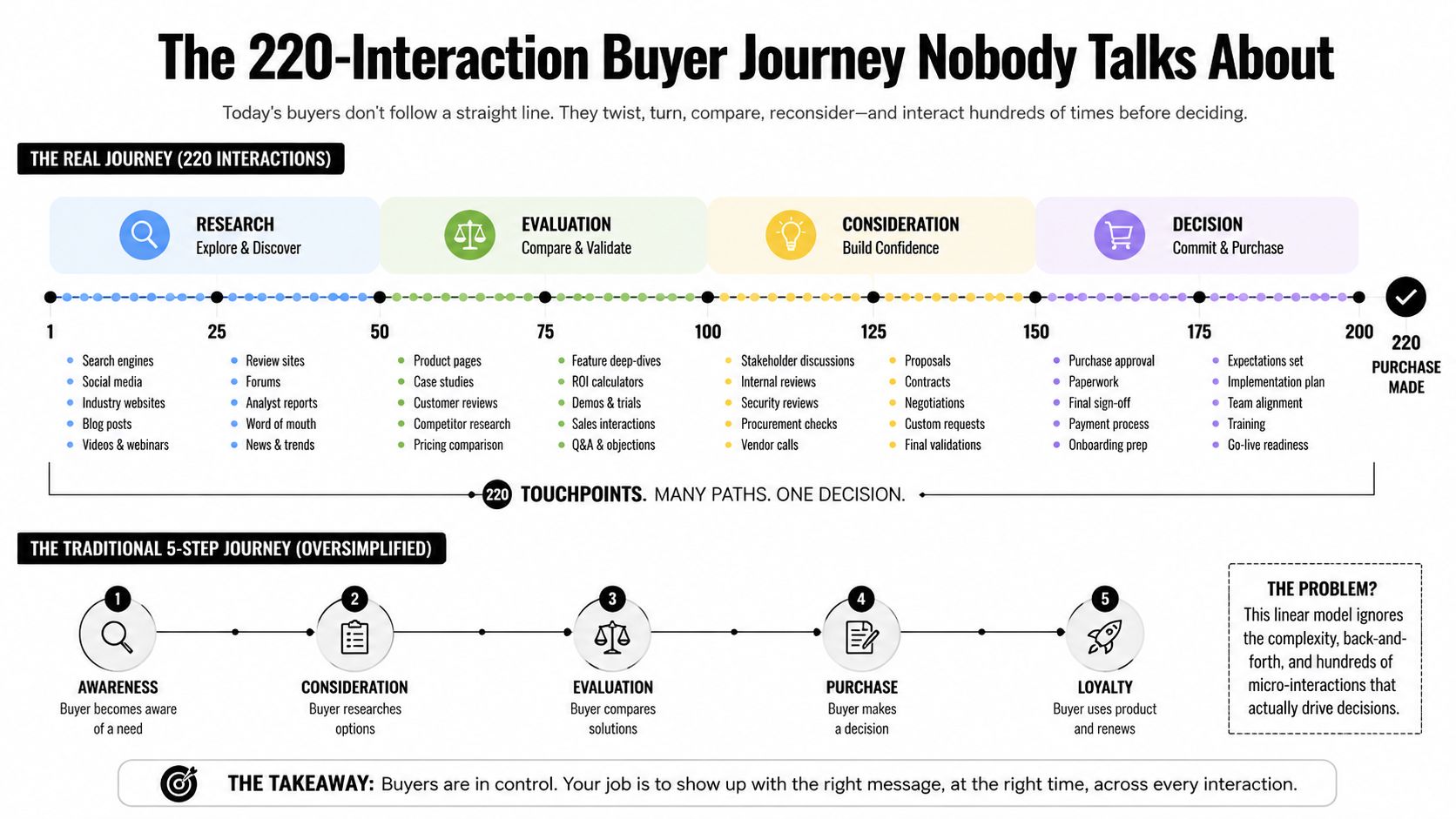
One interaction rarely explains a B2B decision. A buyer may discover a category through a LinkedIn post, read an organic article, ask an AI chatbot for alternatives, attend a webinar, revisit pricing, share material with colleagues, and eventually respond to sales. The CRM often credits whichever touch happened before the form fill. That is convenient reporting, not reliable explanation.
Separate discovery, engagement, qualification, and opportunity progression in your reporting. First touch shows where attention began. Pipeline analysis shows where activity became commercially meaningful. Neither view explains the entire decision by itself.
AI has changed discovery by inserting another layer between buyer questions and vendor visibility. Chatbot recommendations can shape which companies enter consideration, while generated summaries can flatten important differences between products. Your content must answer buyer questions clearly, and your measurement must verify whether that visibility produces qualified account activity. Automating content production without checking those outcomes increases volume while weakening the signal.
Do not tag every click as intent. That creates noise at machine speed. Group signals by commercial usefulness:
Use multi-channel attribution guidance to assign each interaction a clear purpose without pretending the model knows more than it does. Attribution supports budget decisions. It does not prove causation.
Intent data creates the same trap. 87% of B2B sales and marketing decision-makers use intent signals, yet fewer than half act on them, according to Revnew's cited research. Collecting signals without routing or acting on them is expensive hoarding. Set an owner, define the sales action, and remove signals that never improve account or opportunity decisions.
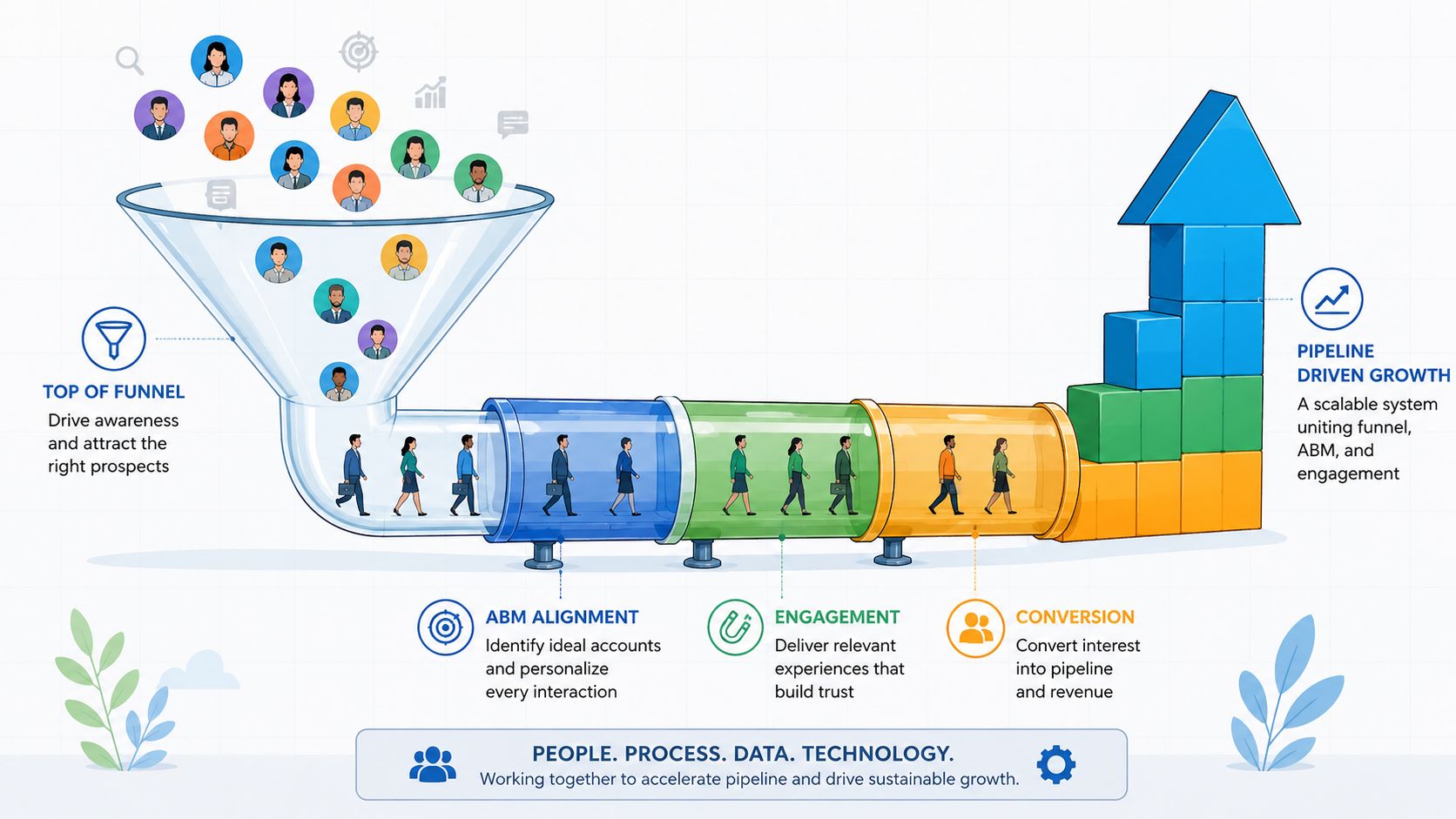
Funnel marketing, account-based marketing, and engagement-led demand generation aren't rival religions. They're different operating layers, and each fails when teams ask it to do every job.
Use funnel marketing when your market is broad, your ICP is still being refined, or buyers need education before they recognize a vendor shortlist. The job is to create useful entry points around problems, not to force every early reader into a demo.
Strong funnel programs usually combine:
Funnel marketing falls flat when it optimizes reach without checking account fit. A campaign can attract enormous attention and still produce no useful pipeline.
ABM makes sense when deal value is high, the sales cycle is complex, and your ICP is clear enough to name target accounts. It lets marketing and sales coordinate around account coverage instead of hoping unrelated contacts eventually assemble themselves into a buying group.
Don't launch ABM because the acronym looks good in a board deck. Launch it when sales can commit to account selection, relevant messaging, and follow-up. Otherwise, you've just created a personalized spreadsheet nobody opens.
Engagement-led demand generation fills the space between broad education and formal opportunity creation. It watches for meaningful account activity, then adjusts content, channel pressure, and human outreach.
The practical combination looks like this:
| Business condition | Primary layer | Supporting layer | Avoid |
|---|---|---|---|
| Broad market, unclear category demand | Funnel marketing | Engagement-led programs | Narrow ABM before the ICP is credible |
| Clear ICP, strategic accounts | ABM | Funnel education | Generic lead scoring without account context |
| Active research, fragmented buying groups | Engagement-led programs | ABM and sales orchestration | Treating one contact as the whole account |
| Strong inbound interest, weak sales acceptance | Funnel optimization | Data cleanup and routing | Buying more traffic |
A mature team doesn't run three disconnected strategies. It uses funnel programs to create and educate demand, engagement signals to identify momentum, and ABM to concentrate human effort where the account deserves it.
A channel is not a strategy. It is a way to create, capture, or validate demand. Give budget to channels that improve data quality, reach the right accounts, generate qualified conversations, and produce pipeline sales can work.
Paid media gives teams the quickest message test, and the quickest way to waste money. LinkedIn Ads can reach defined professional audiences, but loose targeting and generic creative create expensive impressions without reliable buying-group coverage. Google Ads captures active research, yet broad match without disciplined query review fills the CRM with irrelevant clicks and misleading intent signals.
Organic channels build a different kind of evidence. SEO compounds when your site answers questions buyers ask before they know your brand. Founder-led posting can build trust because a clear point of view often earns more attention than polished corporate copy. Dark social remains difficult to measure, so track useful proxies: direct-traffic quality, branded-search behavior, account engagement, and sales feedback. Treat these signals as evidence to validate, not as permission to claim attribution you cannot prove.
| Channel | Time to Pipeline Impact | Cost Efficiency | Best For | Common Pitfall |
|---|---|---|---|---|
| LinkedIn Ads | Fast testing, results depend on sales follow-up | Can be efficient with tight ICP control | Account targeting and professional audiences | Paying for broad reach without buying-group coverage |
| Google Ads | Fast for active category and problem searches | Efficient when query intent is controlled | Capturing existing demand | Funding irrelevant searches and weak landing pages |
| Content syndication | Variable, requires validation | Looks efficient until sales checks quality | Extending specialist content reach | Accepting vendor-reported leads without verification |
| SEO | Slow build, compounding impact | Strong over time when content earns relevance | Research-stage education | Publishing generic articles nobody needs |
| Dark social | Difficult to time precisely | Efficient for trust and influence | Peer sharing and untracked discovery | Treating unmeasurable as unmanageable |
| Founder-led posting | Builds gradually through consistency | Efficient when the founder has a real point of view | Category education and credibility | Turning personal posts into disguised brochures |
Match the channel to observable buyer behavior. If prospects search for a defined problem, test Google Ads with landing pages built around that problem. If the market needs education or account targeting, pair LinkedIn with useful organic material. If your founder already has earned attention, use that voice to supply the perspective paid creative usually lacks.
Set one commercial measurement path across every channel: qualified account engagement, response quality, sales acceptance, opportunity creation, and revenue influence. Platform dashboards report delivery and clicks. They do not establish pipeline quality. Your CRM should connect campaign activity to verified account data, sales outcomes, and opportunity progression.
AI can help with query clustering, creative variations, account research, and anomaly detection. Do not let it manufacture certainty. Automated enrichment can misclassify accounts, generated content can flatten a point of view, and low-quality form fills can make a campaign look productive while degrading routing and scoring. Review the underlying records before increasing spend. In demand generation, clean signals beat more channel activity.
If your demand gen report leads with MQL count and cost per lead, you're one uncomfortable board question away from a budget cut. Those metrics can diagnose activity, but they don't prove commercial value.
A durable scorecard connects data quality, sales execution, and pipeline movement. It also admits where attribution is uncertain instead of dressing assumptions in decimal places.
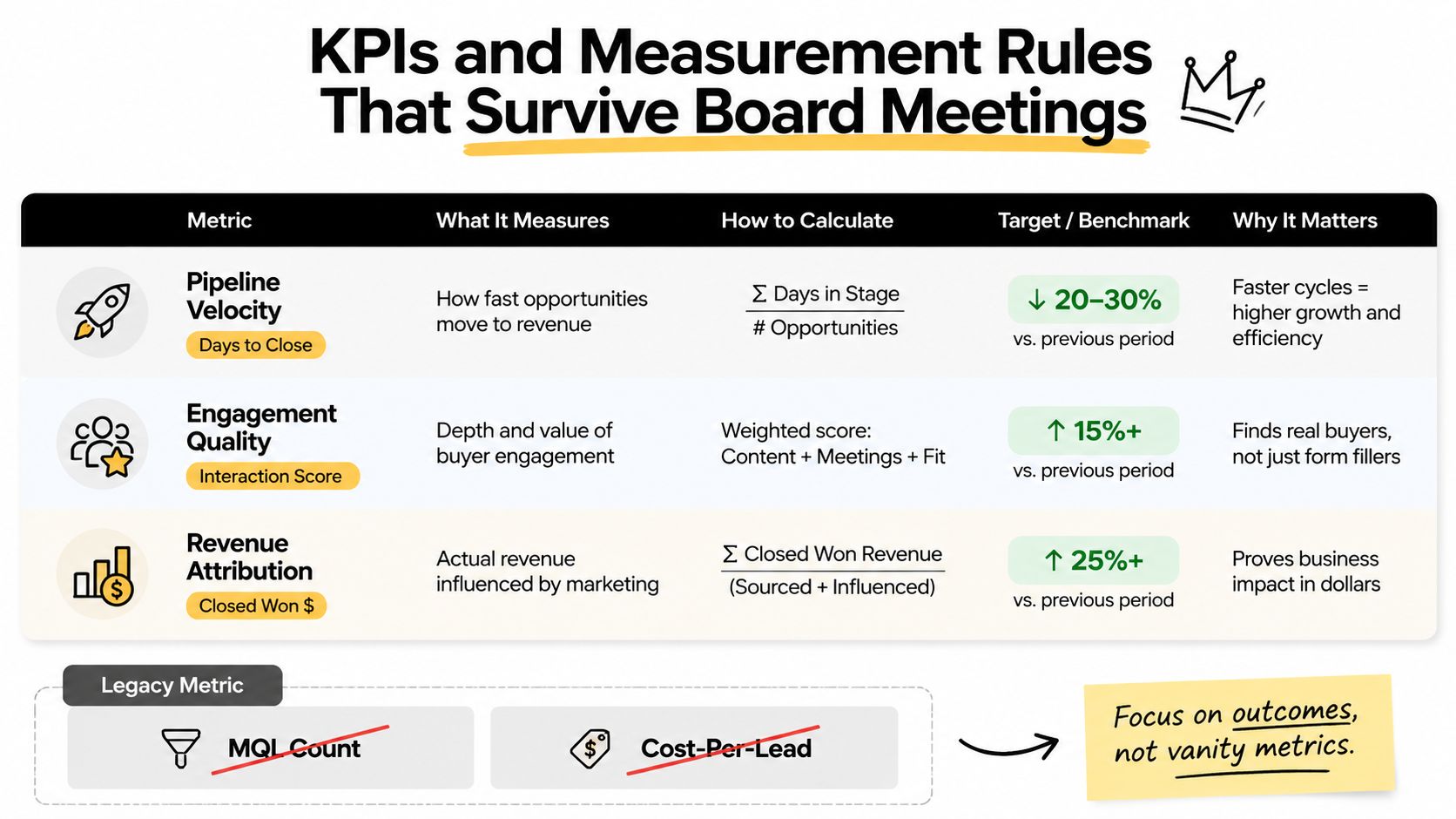
Review these metrics weekly because they can change while a campaign is still live:
Review revenue attribution confidence monthly. Assign confidence levels based on the quality of source data, the number of observed buying-group interactions, CRM completeness, and sales validation. A cautious “influenced” label is more credible than a heroic claim that every opportunity came from one ad.
Practitioners report average satisfaction with B2B data vendors at 6.0 out of 10, with 71% detractors. Reported pain points include weak intent signals at 53%, outdated data at 43%, high cost at 41%, low adoption at 37%, and painful integrations at 33%, according to LeadGenius' state of demand generation coverage.
Those aren't background annoyances. Bad records distort targeting, waste sales time, and make attribution look worse than the campaign may deserve. Audit source, timestamp, account fit, consent status, and sales outcome before you debate another dashboard color.
A strategy can be correct on paper and still fail in the ad account. The person managing spend needs to understand platform mechanics, conversion architecture, creative testing, audience quality, landing-page friction, and the difference between a lead form extension and a conversion-focused page.
Generalist marketers can be excellent operators. They can also be asked to manage paid search, LinkedIn, lifecycle email, content, analytics, and sales enablement at once. That isn't a growth system. That's one person trying to juggle knives while finance asks for a cleaner cost-per-lead chart.
A capable paid ads specialist should be able to explain:
AI can help with research synthesis, creative variations, query classification, pacing alerts, and repetitive reporting. It hurts when it produces interchangeable messaging, invents personalization, or expands an audience before the team understands which accounts deserve attention. More output isn't more precision.
For companies that need a faster hiring path, HireMediaBuyers.com presents a marketplace and vetting process for connecting companies with media buyers and paid ads specialists. The platform describes AI screening, interviews, skills assessments, and HR checks, with full-time and part-time remote hiring options.
The cost of a weak buyer isn't only wasted spend. It's contaminated data, confused sales follow-up, delayed learning, and a false belief that the market doesn't want what you're selling. Fixing that can matter more than squeezing another cosmetic improvement from a campaign.
A 90-day launch shouldn't try to dominate every channel. It should create a clean learning loop from account fit to qualified pipeline.
Start by auditing CRM fields, lead sources, duplicate records, consent details, sales acceptance, and opportunity stages. Interview sales representatives about rejected leads and recurring objections. Refine the ICP using profitable customer patterns and remove segments the team can't serve well.
Set definitions before launch:
Use this period to hire or assign a specialist who can own paid execution. Don't launch campaigns while the destination data is unreliable. That's how teams spend a month optimizing a reporting error.
Choose two channels based on buyer behavior, not internal enthusiasm. A search-led motion might pair Google Ads with landing pages and organic support. An account-led motion might pair LinkedIn Ads with founder-led content and sales outreach.
Launch a small set of tightly differentiated messages. Match each ad to one problem, one audience, and one next action. Review lead quality with sales every week, then adjust targeting, creative, forms, and routing. Watch speed-to-lead immediately because a good inquiry can cool while everyone admires the campaign dashboard.
By the final phase, keep the campaigns that attract the right accounts and produce useful conversations. Cut placements, audiences, offers, and content themes that generate activity without progression. Build nurture splits around source, account fit, and engagement quality instead of sending every contact the same cheerful email sequence.
Document the operating rhythm: weekly channel and routing review, regular sales feedback, monthly pipeline analysis, and a clear budget rule for expansion. The objective isn't a prettier funnel. It's a demand generation engine that knows what it can prove, what it needs to test, and which work deserves more money.
HireMediaBuyers.com connects companies with pre-vetted media buyers and paid ads specialists for full-time or part-time remote hiring. If your B2B demand generation needs tighter execution, better channel accountability, and faster access to specialized talent, visit HireMediaBuyers.com and start building the team your pipeline needs.


