


You've probably been there. A remote media buyer shows up with a slick deck, a couple of vanity metrics, and the confidence of a guy who thinks “ROAS” is a personality. Three weeks later, your spend is wandering around unsupervised, the account is messy, and you're staring at your screen wondering how someone who claimed to be a performance marketer also managed to confuse “scale” with “set fire to the budget.”
That's why the background verification process isn't paperwork theater. It's the boring, annoying, absolutely necessary filter between a real operator and a polished liar. For remote hires, especially in regions like Latin America, South Africa, and the Philippines, you don't get the luxury of hallway intuition. You need proof. You need sequence. You need a process that catches the stuff a shiny portfolio conveniently leaves out.
The worst hires rarely explode on day one. They leak. A little miss on naming conventions here, a fuzzy explanation about prior clients there, then suddenly your ad account is the equivalent of an abandoned shopping cart full of cash. That's the pain point with remote media buyers, they can look sharp, talk fast, and still be completely untethered from reality.
A decent background verification process stops the charm offensive from becoming a company-wide headache. It doesn't just check whether someone exists, it tests whether their story holds up across identity, employment, education, and any role-specific risk you care about. That matters more with remote talent because you're hiring on trust before you've had much chance to earn it back.
On-site hires get buffered by proximity. You see the person, hear how they work, and catch weirdness faster. Remote buyers don't give you that safety net, so your process has to do the heavy lifting.
Practical rule: if a remote media buyer can't survive a basic verification flow, they weren't “high potential,” they were high maintenance.
The smart move is to treat verification like your first line of defense, not an HR ritual. For remote ad talent, that means checking the claims that matter most to budget control, client communication, and actual platform competence. If someone says they've run seven-figure spend and can't prove the basics of their work history, you're not being cautious by asking questions. You're being late.
The background verification process is a cross-check system. Candidate-declared identity, education, and employment details are compared with employer records, institutions, and government or court databases, and AI-based discrepancy detection can flag mismatches like tenure gaps, inflated titles, or qualifications that cannot be proven before a final report lands. It is paperwork with teeth, not a polite formality. Identity is the starting point, because every later check depends on knowing the person in front of you is the person on the file. Industry guidance backs that sequence, since other checks mean very little until the legal identity is validated. That layered method is also why modern verification goes far beyond a reference call, it checks whether a résumé survives contact with records. Multi-source verification guidance
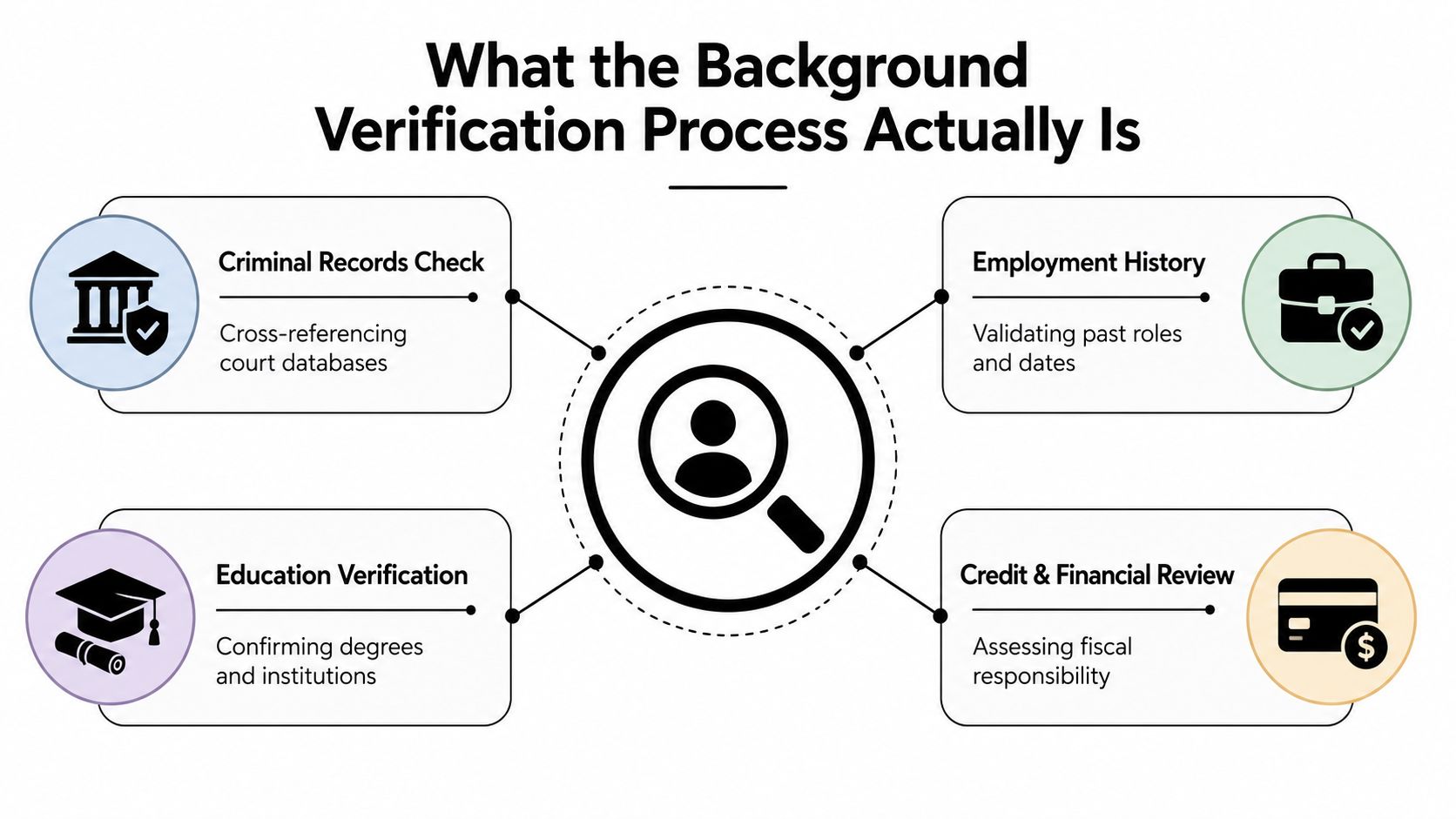
One check catches one kind of lie. That is useful, but it is never the whole story. A candidate who knows how to pass one source can still fall apart when employment history, education, and records are compared side by side.
For media buyers, that layered model matters because the job is operational, not decorative. Someone may look excellent in a portfolio review and still be unreliable where it counts, consistency. A verification system that pulls from multiple sources is built to catch timeline errors, credential inflation, and basic mismatch problems before they reach your Slack channel and start an expensive cleanup.
Identity verification is the anchor. Once that is in place, the rest of the checks mean something. Without it, you are just collecting documents from a stranger with a good Zoom background.
That is why remote hiring needs a stricter standard. You are not trying to prove someone is perfect. You are proving their story holds up against records. If you want a practical reference point for how a clean vetting flow should be organized, use this remote media buyer reference checklist. For a media buyer handling live spend, that beats “seems smart on calls” every time.
Remote media buyers fail in boring ways. They pad a résumé, invent a client, borrow a title, then fall apart the moment you ask for proof. The checks that matter are the ones that force the story to hold up under pressure.
The usual mix is simple: identity, employment history, education, references, and public-record checks. HireRight's benchmark summary points to those as the common screening categories, which makes sense because hiring teams are trying to answer one blunt question, is this person who they claim to be, and can they do the job (HireRight's benchmark summary). That matters even more for a remote media buyer, where the wrong hire can sit behind a laptop, burn budget, and hide behind polished calls for weeks.
The wider market says the same thing. Analysts in a background check statistics summary report that employment screening is widely used, with criminal-history checks, employment verification, and education verification showing up as core components (background check statistics). The same summary shows that professional-license checks surge in regulated settings, which is what happens when the risk shifts from annoying to expensive. If a credential is part of the pitch, verify it. If the person will control spend, verify more than one claim.
For remote media buyers, start with the checks that protect money and trust. Identity verification comes first, then employment history, education, references, and right-to-work status. Criminal screening can matter too, depending on the client, access level, and jurisdiction, but don't let a generic HR template drive a role that lives on judgment and accountability.
Here is the practical split I use:
| Check Type | Adoption % | Media Buyer Risk Level |
|---|---|---|
| Criminal or other public-record search | 87% (background check statistics) | Medium to high, depending on client access and jurisdiction |
| Employment verification | 76% (background check statistics) | High for full-time budget owners |
| Education verification | 68% (background check statistics) | High when a credential is claimed as a hiring signal |
| Identity verification | Common anchor step in layered screening (verification process guidance) | High for every remote hire |
| Reference checks | Included in common benchmark checks (HireRight's benchmark summary) | Medium, useful for client-facing roles |
| Professional-license verification | 89% in regulated industries, 45% overall (background check statistics) | Low unless the role is regulated |
A remote media buyer who handles spend, reporting, or client communication gets the stricter version of this matrix. Creative talent still needs proof. Pretty decks and confident talk do not cover for fake employment, inflated credentials, or a history of ghosting after launch.
Client reference checks deserve a spot here because a clean record does not tell you whether someone can operate inside a client relationship without creating mess. A good reference call exposes judgment, reliability, and whether the person makes other people do the cleanup. That is the stuff you pay for.
A candidate looks polished. The résumé is tidy. The interview sounded sharp. Then the conditional offer goes out, and now the actual work starts. The background verification process is a sequence of permission, disclosure, collection, review, and decision. Skip that sequence and you are just gambling with payroll and access.
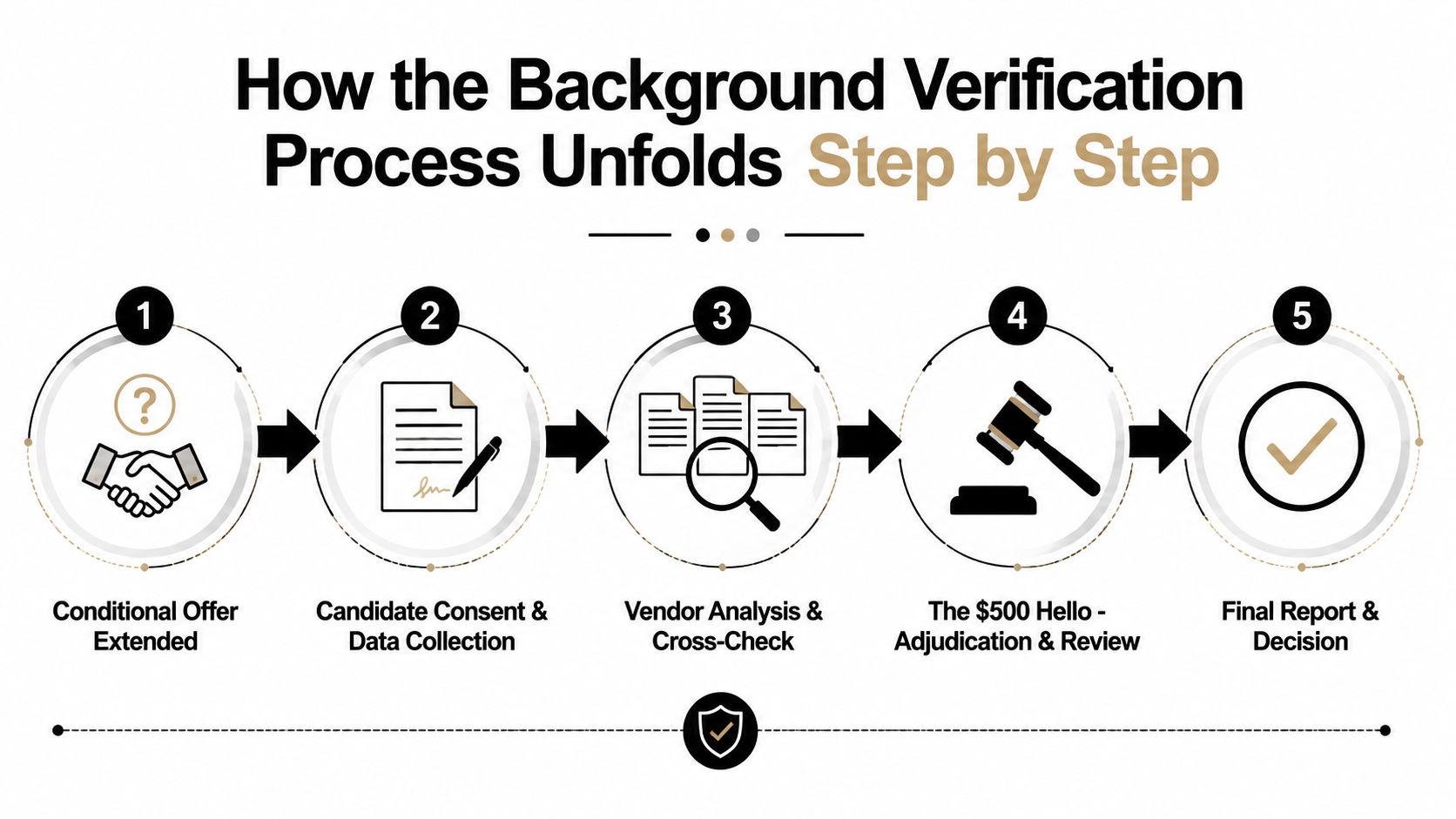
In the U.S., employers normally need written authorization before running third-party checks, and FCRA-based notices must be delivered in a stand-alone format, not buried inside the application (ADP guidance). That is the first gate. No consent, no scan. No clean disclosure, no clean process.
Once consent is in hand, the screening work begins. Criminal-history checks typically complete in 1 to 3 business days, employment verification in 3 to 7 business days, and education verification in 5 to 10 business days (background check statistics). Completion rates also vary, with 95% to 98% for criminal and employment checks versus 88% to 92% for education checks, because schools and employers do not answer on your schedule (background check statistics). That slowdown is not drama. It is dependency.
For full check packages in markets like India, reported completion times sit around 7 to 15 business days because employers are waiting on previous HR departments, universities, EPFO/UAN records, and court databases (background verification process in India). The process is held up by outside institutions, not by your hiring team. If your onboarding plan assumes instant answers, it is fantasy with a calendar.
The fastest way to break the process is to pretend every source replies on your schedule.
If you hire remote media buyers often, your internal SLA should reflect those ranges. Do not promise the hiring manager that a full verification package will land overnight unless you enjoy being wrong in front of people who already have too many fires to put out. Set the expectation early, then use automation where it helps, because document extraction and dashboard delivery can reduce manual error and shorten turnaround while preserving an audit trail (verification process guidance).
The outcome you want is not speed for its own sake. It is speed with traceability. That keeps onboarding moving without turning your team into a cleanup crew.
There are two ways to do verification. You can build the whole thing yourself, stitch together checks, chase documents, and learn compliance the hard way. Or you can use a platform that already handles the machinery and hand you the parts that matter. One path gives you control. The other gives you sleep. I've got a preference, but let's be adults about the tradeoff.
A DIY setup makes sense if you already have HR ops muscle, legal review, and a workflow that won't collapse when one university takes six days to answer an email. For everyone else, vendor support is the sane choice. The key question is whether you need a screening tool or a full vetting layer that includes interviews, skills validation, and operational handoff. The latter is what keeps a hiring manager from turning into a part-time detective.
The right setup should connect to your ATS, push results through webhooks or structured reports, and hand clean data to payroll and HR systems so your audit trail doesn't end up scattered across inboxes. If you're hiring media buyers, the goal isn't just “we ran checks.” The goal is “we can prove the hire was made against a consistent process.”
Practical rule: if the vendor can't deliver verification output in a format your team can actually use, it's not a system, it's another tab.
You also want a vendor that respects role depth. A junior media operator doesn't need the same screening posture as someone with direct access to spend, client accounts, and contract negotiation. Role risk should drive vendor depth. Otherwise you're either under-checking dangerous hires or over-checking a freelancer who only posts creative briefs and a little campaign QA.
For remote hiring, fast shortlist delivery is useful because the market moves quickly. But speed without evidence is just a faster way to regret a decision. A vendor should shorten the distance between candidate pool and decision, not skip the part where you confirm the person can do the job.
That's the practical test. Can the system surface qualified candidates quickly, keep the evidence trail clean, and reduce the amount of manual chase work your team has to do? If not, you're paying for admin theatre.
Sloppy screening creates sloppy risk. Keep the same standards for everyone, then add the extra care required when background issues may overlap with race, national origin, sex, religion, disability, or age 40+. Make room for disability-related exceptions when the situation calls for it, as the EEOC guidance explains. That is not paperwork theater. It is how you stop a hiring filter from turning into a discrimination claim with a payroll login.
Remote hiring makes the problem wider. If you are vetting media buyers across borders, privacy rules will not match your internal habits, and what looks normal in one place can create a mess in another. The answer is simple. Write the policy down and make people follow it.
A one-page rule beats a fuzzy culture memo every time. Spell out what you check, when you check it, who can see the results, and how you handle flags. Keep consent separate and plain, because buried authorization starts the relationship with suspicion.
Use a compliance checklist for hiring teams before you screen candidate one. For remote media buyers, consistency matters more than anyone's confidence in a polished résumé. Same standards. Same process. Same documentation. That is how you keep the file clean when someone asks why one candidate sailed through and another did not.
Screening can hit some people harder than others. That is the ugly part, and pretending otherwise only makes the risk worse. If a candidate raises a concern, apply the written policy, document the reason for the decision, and keep access to the results limited to the people who need it.
A basic risk matrix helps here. Low-risk roles can be checked with lighter controls, while higher-trust roles, especially the ones touching ad spend, client accounts, or approval authority, need tighter review and tighter records. That keeps your process tied to job risk instead of gut feel.
Here is the standard I would use for remote media buyers:
That is the whole job. Be fair. Be consistent. Keep the paper trail tight. And do not let a hiring manager freestyle a policy the legal team would never sign off on.
A DTC brand wants a full-time Google Ads specialist from Latin America. Good move, in principle. Strong talent pool, remote-friendly timing, and less nonsense than hiring a self-proclaimed “growth genius” who thinks a dashboard is strategy. But if the role controls spend, the verification needs more than a glance at a portfolio.
Here's the clean version. The team uses the risk matrix and requires identity verification, employment history, education validation, and references before the offer becomes real. They verify the last two employers and the highest credential claimed, because that gives enough redundancy to catch fabricated timelines or inflated qualifications without burying the candidate under friction. That basic structure lines up with the enterprise benchmark of checking at least the last two to three employers and the highest credential claimed in higher-trust roles.
Sample policy snippet: “Candidates who will manage paid media budgets must complete identity, employment, education, and reference verification before onboarding. Any discrepancy is reviewed against the same written standard, and access to results is limited to approved hiring and compliance staff.”
For the operational side, the team doesn't stop at pre-hire checks. They keep an eye on access, account handoffs, and post-hire verification points because modern screening gaps include identity-layer issues and continuous monitoring needs, not just old-school résumé checks (Security Magazine discussion). That matters in remote work, where a deepfake-friendly internet culture and loose handoffs can turn “qualified” into “who exactly approved this?”
That's the “toot, toot” version of hiring, small victory horn, no parade. Remote media buyers can absolutely be excellent. They just need to survive the same boring verification hurdles as everyone else before they get near your ad accounts.
The background verification process isn't bureaucracy. It's hiring armor. Layer the checks, get consent first, match the depth to the role risk, and keep the process fair and documented. If you're hiring remote media buyers, especially for budget-heavy or client-facing work, that's the difference between a clean onboarding and a cleanup project with a recurring monthly cost.
The smartest path is usually the one that saves you from doing the whole thing manually. A pre-vetted pipeline can cut the nonsense, shorten the wait, and keep you from wasting days on candidates who were never going to survive verification anyway. If you want a faster route, the hiring timeline at HireMediaBuyers.com is built around that reality, not wishful thinking.
Go verify first, then scale. Your future media buyer will appreciate the professionalism, and your CFO will appreciate not having to fund another expensive lesson in optimism.
If you want pre-vetted remote media buyers without turning your team into amateur investigators, HireMediaBuyers.com is built for that job. You get a tighter hiring path, a better shot at avoiding budget-burning mistakes, and a cleaner way to connect this background verification process to actual growth.


