


Most bidding advice is backwards.
Platforms tell you to trust automation early, feed the machine, and stop touching things. Cute idea. Then your campaign with shaky tracking and thin conversion volume hands control to an algorithm that bids like it found your company card in the parking lot.
I like automation. I also like brakes in a car. Same principle.
A good bidding strategy isn't about picking the fanciest option in Google Ads or Meta Ads Manager. It's about knowing when to keep your hands on the wheel, when to let the machine help, and when the platform is selling convenience more than performance. If you've ever watched CPA drift upward while the dashboard insists things are “learning,” you already know the difference.
The biggest lie in paid media is that automated bidding is “set it and forget it.”
Set it and monitor it? Sure. Set it and forget it? That's how you end up explaining to finance why yesterday's budget disappeared before lunch.
I've seen this movie too many times. A team launches a fresh account, slaps on Target CPA because Google said it was “recommended,” and waits for the robot overlord to work its magic. Instead, the campaign lurches around for days, chases bad auctions, and burns money while everyone stares at the learning badge like it's a religious artifact.
Ad platforms want more automation adoption. That part isn't mysterious. Automated bidding keeps more decisions inside the black box, and black boxes don't argue in Slack.
That doesn't mean automation is bad. It means you should stop treating recommendations as gospel. A bidding strategy is one of the few levers that can wreck performance without changing your ads, landing pages, or offer. The damage hides in plain sight.
Practical rule: If your tracking is messy, your budget is tight, or your conversion volume is thin, automated bidding usually magnifies your problems instead of solving them.
Even outside ads, timing and structure matter more than people think. In online auctions, sniping, placing a bid in the final seconds, increased win probability by about 5% and lowered the final price paid in historical research summarized in this Yale-hosted paper discussing Ely and Hossain. Different market, same lesson. How and when you bid changes outcomes. It's not just the amount.
Treat bidding like a strategic decision tied to your data quality, sales cycle, and margin structure.
A local lead gen account with spotty call tracking should not use the same bidding strategy as a mature ecommerce account with clean purchase values. A founder spending real cash from a limited monthly budget shouldn't copy the playbook of a giant brand with enough data to feed three algorithms and a data science team.
A lot of pain in paid media comes from using a “best practice” that's only best for someone else.
So no, the algorithm shouldn't drive unsupervised. Not because machines are dumb, but because they're obedient. If you give them the wrong objective, weak signals, or bad inputs, they'll follow instructions with impressive efficiency straight into the ditch.
Manual versus automated bidding gets framed like old tech versus new tech. That's lazy thinking.
This is really about control versus scale. Manual bidding is a stick shift. Automated bidding is a self-driving car. On an open highway with clean lane markings, the self-driving car looks brilliant. On a dark road full of potholes, weird turns, and half-broken signs, you'll want your hands back on the wheel.
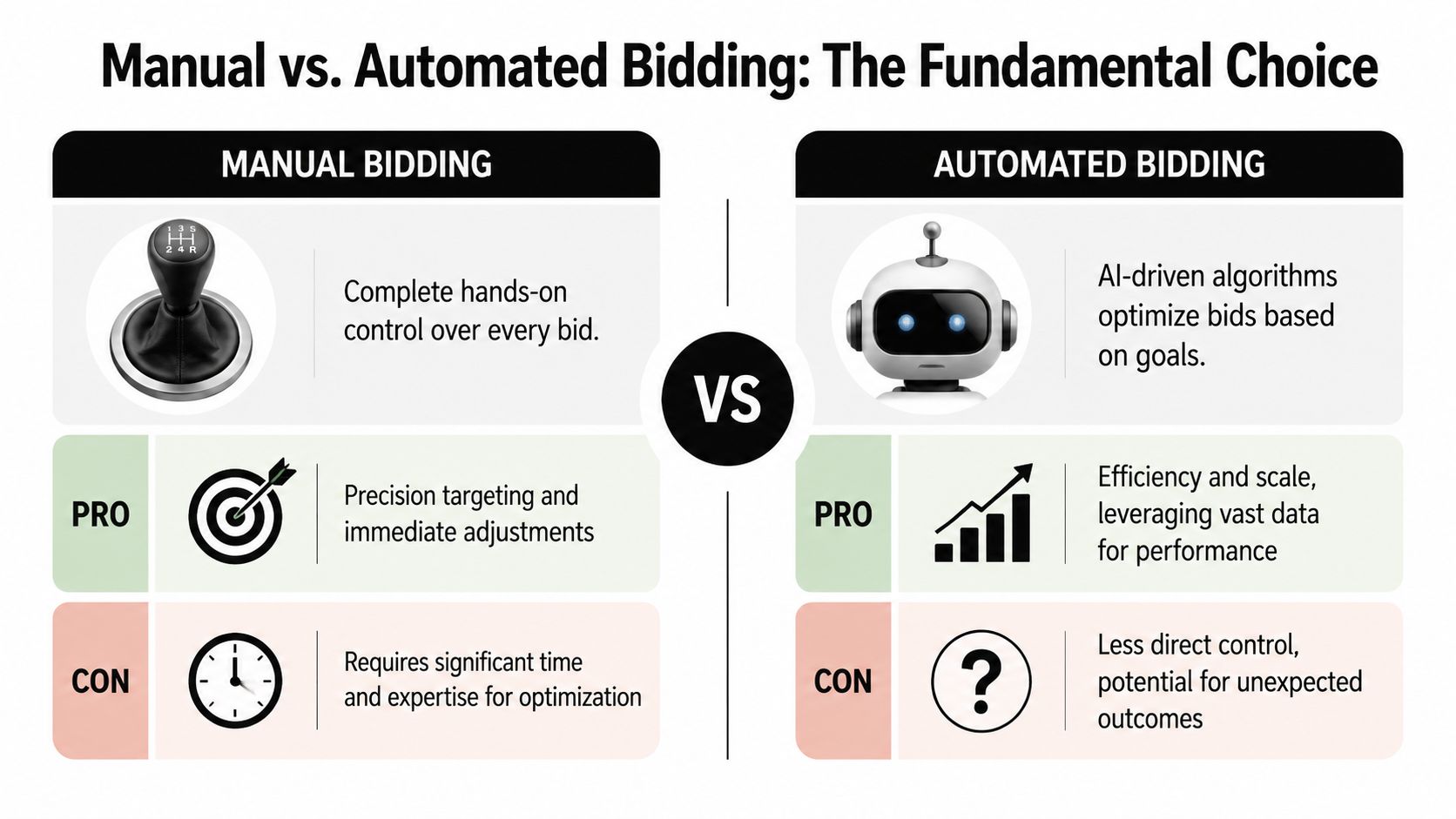
Manual CPC still matters. Not because it's nostalgic. Because it's useful.
If you're launching a new campaign, testing an unfamiliar market, or dealing with unreliable conversion tracking, manual bidding gives you precision. You can decide what a click is worth before the platform invents its own answer. You can trim waste faster. You can spot where intent is strong and where the traffic is pure wallpaper.
That's especially important when the account doesn't have enough reliable history for automation to make smart decisions. Rule-based bidding strategies like Target CPA and Target ROAS only function reliably when you possess high-quality historical conversion data; if your data is sparse or untrustworthy, these automated models will overbid or underbid because they lack the signal needed to predict future conversion probabilities, making Manual CPC the safer entry point for new campaigns, as noted by Simpli.fi's guide to bidding strategy fundamentals.
Automation shines when you've got clean tracking, enough conversion history, and more moving parts than a human can realistically manage by hand.
That means mature search accounts, larger shopping setups, complex prospecting campaigns, and portfolios where auction-level adjustments matter. In those cases, the machine can process device, audience, query, time, and context faster than any media buyer clicking around in the UI after their second coffee.
But there's a catch. There are three.
Automated bidding isn't “better.” It's better at handling complexity when the account has earned the right to use it.
Use manual bidding when you need clarity, control, or clean baseline data.
Use automated bidding when the account has enough trustworthy signals and enough scale to justify giving up some control.
And stop acting like manual bidding is for dinosaurs. Sometimes the smartest move in a modern ad account is doing the unsexy thing first, learning what the traffic does, then layering automation on top once the machine has something useful to work with.
Toot, toot.
Automated bidding menus are like airport food courts. Lots of options, expensive mistakes, and every sign makes bad decisions look convenient.
Most advertisers don't need more platform labels. They need to know what each bidding strategy is really trying to do. Once you strip away the branding, the menu gets simpler.
These are the strategies for reach, traffic, and visible activity. They're useful. They're also where a lot of people confuse movement with progress.
Maximize Clicks is for buying traffic fast. It's useful when you're launching, gathering search term data, or forcing some early volume into a campaign that has no history. It's not a profit strategy. It's a scouting strategy.
Target Impression Share is for visibility. Good for branded defense, specific SERP positioning, and those moments when politics inside the company matter as much as economics. Founder's warning: paying for visibility can turn into vanity spending with a better dashboard.
Maximize Conversions tells the platform to pursue conversions within your budget, without the discipline of a hard efficiency target.
Sometimes that's fine. Sometimes it acts like a caffeinated intern with no spending authority who somehow got access anyway.
This strategy can work when your conversion tracking is solid and your volume is building but not mature enough for tighter target-based automation. It can also get aggressive in ugly auctions, especially if the campaign has mixed-intent traffic or weak qualification upstream.
If you can't explain which conversion actions matter most, don't hand Maximize Conversions the keys.
Target CPA and Target ROAS are where advertisers go once they stop chasing activity and start chasing economics.
They're powerful. They're also picky.
Smart Bidding strategies like Target CPA require a minimum conversion volume of 30 conversions over 30 days to operate reliably; campaigns with fewer than 15 monthly conversions should begin with Manual CPC or Maximize Clicks because the machine learning algorithm lacks sufficient signal data, according to DataFeedWatch's review of automated bidding strategy requirements.
That requirement gets ignored constantly. Then people wonder why the algorithm behaves like it's guessing. Because it is.
Portfolio bidding is one of the few automation tools I think more accounts should test.
Instead of treating each campaign like its own little kingdom, portfolio bidding lets you manage bid adjustments across multiple campaigns or ad groups together. That matters because some campaigns have stronger margins, cleaner traffic, or better close rates than others. You want the system to see the whole picture.
A practical example from Strikepoint Media's explanation of portfolio bidding is assigning a +20% bid modifier to a high-margin campaign and -10% to a lower-priority campaign inside the same portfolio. That's not sexy. It is useful.
| Strategy Name | Primary Goal | Best Used When… | Founder's Warning |
|---|---|---|---|
| Maximize Clicks | Traffic volume | You need search term data, quick traffic, or a launch pad for a new campaign | Cheap clicks can still be expensive if they never convert |
| Target Impression Share | Visibility | You care about brand presence or specific ad positions | Great for being seen. Not automatically great for making money |
| Maximize Conversions | Raw conversion volume | Tracking is solid and you want the platform to push for more actions without a strict efficiency target | It can get reckless in bad auctions |
| Target CPA | Conversion efficiency | You have enough clean conversion history and a clear acceptable acquisition cost | Set the target wrong and the campaign either chokes or overspends |
| Target ROAS | Revenue efficiency | Ecommerce or value-based lead gen with trustworthy conversion values | Garbage value data creates polished nonsense |
Ask one question first. Do you want more traffic, more conversions, or better efficiency?
Then ask the harder one. Do you have the data quality to support that goal?
That second question is where most bidding strategy failures happen. The platform will happily let you order off the grown-up menu before your account is old enough to drink.
Most businesses don't need another article saying “it depends.” Of course it depends. The useful part is what it depends on.
My framework is simple. Pick your bidding strategy based on three things: data maturity, budget reality, and business model. Not vibes. Not platform recommendations. Not whatever the account rep said five minutes before quarter-end.
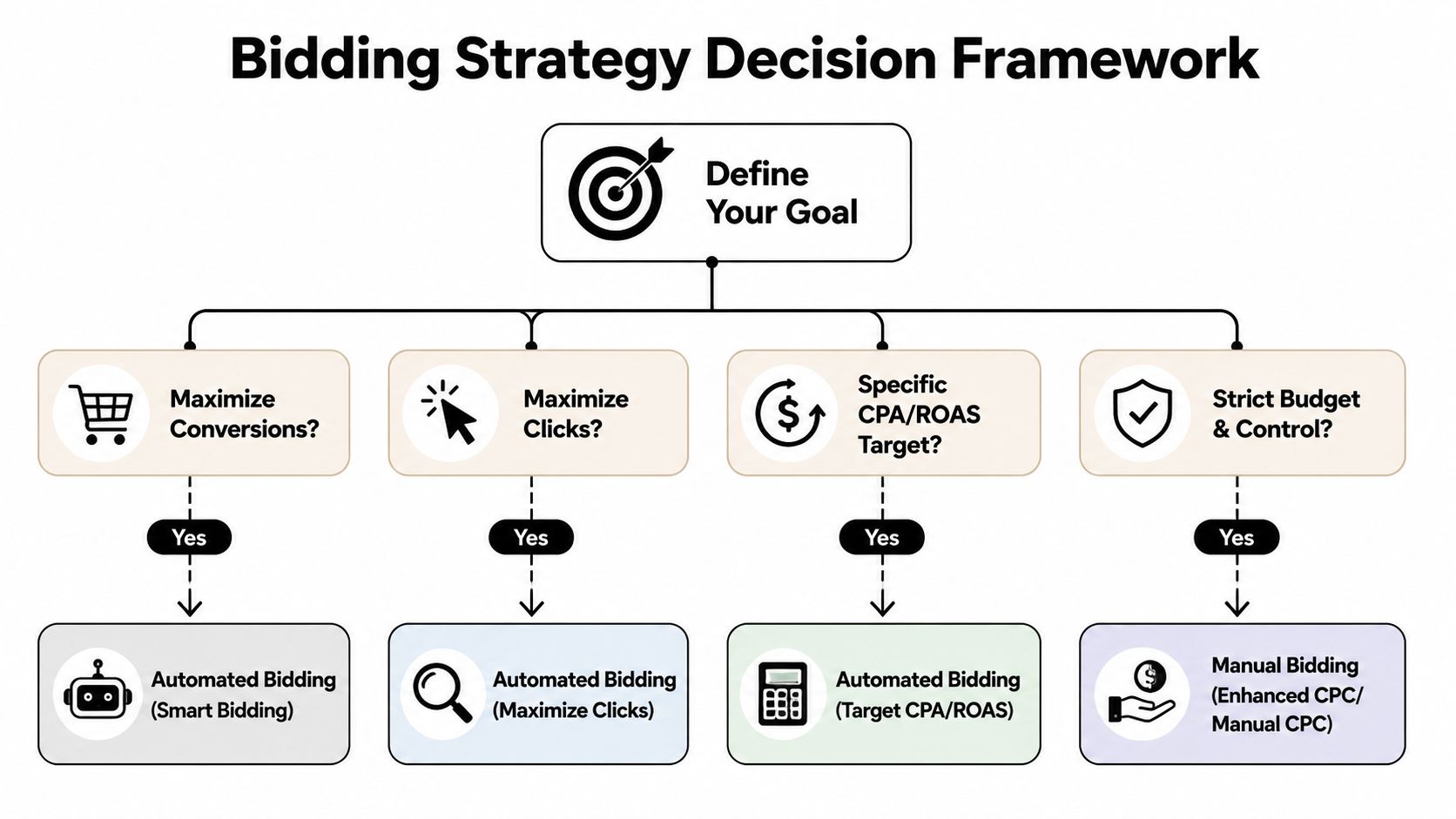
If your account has weak tracking, inconsistent attribution, or barely any conversion history, don't get cute. Start with manual control or a simpler automation layer.
Small-budget advertisers have a practical workaround that larger accounts barely talk about. Consolidating campaigns and submitting micro-conversions such as call button clicks and form interactions as secondary actions builds enough data volume to transition to Max Conversions faster, as discussed in this small-budget Google Ads thread on Reddit.
That matters because a lot of small accounts never hit the volume needed for advanced automation if they insist on optimizing only to final sales. You need signal before you need elegance.
If your reporting is a mess, fix that before changing bids. A clean view of ad performance metrics beats a “smart” bidding strategy built on fuzzy inputs every time.
A tiny monthly budget and a large monthly budget don't just change scale. They change the margin for error.
With a smaller budget, each bad day hurts more. That's why tighter control usually wins early. Fewer campaigns. Cleaner structure. More disciplined bids. Less fragmentation. You're trying to learn without setting fire to the test budget.
With a larger budget, automation becomes more attractive because the account can generate enough signal for machine learning to respond to patterns humans won't catch quickly enough. The platform gets more chances to optimize, and you get enough data to judge whether it's helping.
The smaller the budget, the less room you have for “learning phase theater.”
Different businesses need different bidding logic.
For ecommerce, value matters. Margin matters. Product mix matters. If your purchase values are tracked cleanly, efficiency-focused automation becomes more practical because the platform can optimize toward revenue quality instead of just counting transactions.
For lead generation, especially B2B or high-ticket services, the trap is optimizing to junk leads. If your CRM feedback loop is weak, stay conservative. It's better to control bids manually than to train an algorithm on fake success.
For local services, I usually prefer practical control first. Calls, form starts, booked jobs, and geographic quirks can confuse the platform if the setup is sloppy.
That's the whole game. Use the simplest bidding strategy your account can support today. Upgrade when the data earns it. Not before.
Most advertisers don't lose money because they picked the wrong bidding strategy once. They lose money because they change bidding like a raccoon on espresso.
One day it's Manual CPC. Two days later, Max Conversions. Then a panic switch to Target CPA because somebody saw one rough afternoon and decided the machine was broken. That isn't optimization. That's account vandalism.
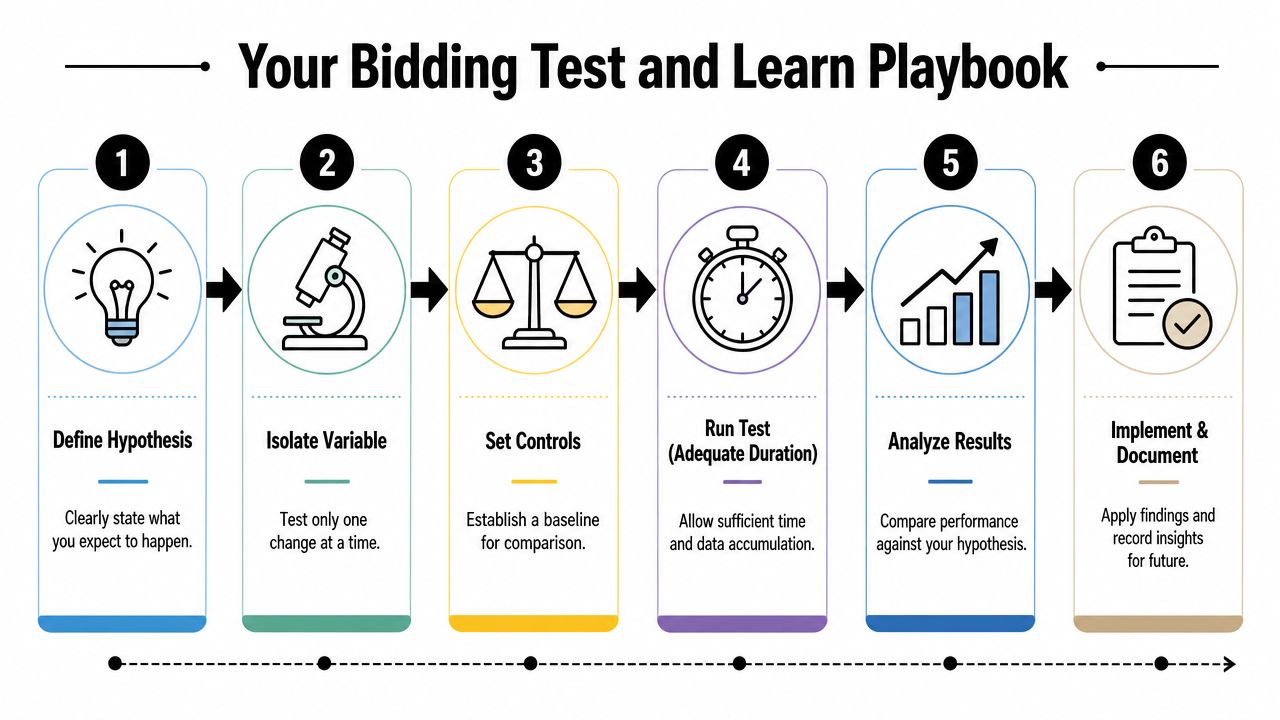
Test one variable at a time.
If you change bidding, targeting, ad copy, and landing pages together, congratulations. You've created a mystery novel, not an experiment. When running bid strategy change impact tests, you must isolate variables by keeping targeting and creatives identical, and run them simultaneously for at least two to three weeks to ensure statistical significance and distinguish real performance shifts from noise, based on 2POINT's breakdown of bid strategy impact testing.
That means same audience logic. Same creative. Same offer. Same landing page. Otherwise you're guessing.
If you're not sure your conversion setup is trustworthy, clean up your conversion tracking foundation before you trust any test result.
Write a real hypothesis
Not “let's see what happens.” Try this instead: “Maximize Conversions will increase qualified lead volume without raising cost per qualified lead beyond our acceptable range.”
Pick one KPI that matters most
CPA for lead gen. ROAS or contribution efficiency for ecommerce. Don't let a side metric hijack the test.
Hold the environment steady
No creative refresh. No new audience layer. No landing page redesign because the founder had a shower thought.
Run long enough to gather signal
Short tests lie. You're seeing weekday swings, auction volatility, and randomness, not truth.
There's a reason experienced buyers wait. To see if a bid adjustment positively impacts KPIs like conversion count or CPA, you must test bids for a minimum of two weeks, ideally up to three weeks, because shorter periods fail to capture enough data cycles to distinguish real performance shifts from noise, according to the Digital Marketing Institute's bidding best practices lesson.
Impatient teams often torch performance. They make a change on Monday, inspect the dashboard on Wednesday, hate the color of the numbers, and switch again. Then they wonder why nothing stabilizes.
Most bidding tests fail because the strategy was wrong for the account. The second most common reason is that nobody let the test breathe.
A few practical fixes:
Document every test. Keep a changelog. Date it. Write down the hypothesis, the setup, and the outcome. That sounds nerdy because it is. It also saves you from repeating the same dumb experiment six months later after everyone forgets why it failed the first time.
Every ad platform has its own bidding personality. Treat them the same and they'll punish you in their own special way.
Google is the spreadsheet valedictorian. Meta is the talented artist who ignores instructions but sometimes produces brilliance anyway. TikTok is chaos with a login screen. Microsoft Ads is the quieter operator in the room.
Google's bidding systems love clean conversion data and enough volume to detect patterns. They also reward disciplined account structure more than many teams realize. If the signal is good, Google can do impressive work. If the signal is bad, it automates your confusion.
Microsoft Ads usually feels less crowded and more forgiving. Simpler setups can still work there, and in some accounts you can get away with less complexity than you would on Google. If you're running search and want a lower-drama extension of intent-based traffic, that's why teams still use Bing Ads management support.
Meta often performs best when you give it broad room to find buyers, but that doesn't mean you should hand it a blank check and go golfing. Cost controls and rigorous creative testing matter because the platform can spend confidently on weak traffic if your event setup is sloppy.
TikTok's bidding behavior can feel volatile. Creative fatigue hits fast. Traffic quality can swing hard. You need tighter observation, faster feedback loops, and a stronger stomach. It can work. It just doesn't deserve blind trust.
A lot of “platform strategy” is really just respecting what each system is good at. Search platforms usually handle explicit intent better. Social platforms usually need stronger creative and better event signals to bid intelligently.
The rookie mistake is assuming the algorithm's label means the same thing everywhere. It doesn't. Same button name. Different beast.
At some point, DIY bidding stops being lean and starts being expensive.
If you're spending your mornings inside Google Ads, your afternoons inside Meta Ads Manager, and your evenings trying to decode attribution weirdness, you don't have a bidding strategy problem anymore. You have a focus problem. Hope you enjoy staring at dashboards and second-guessing platform recommendations, because that's now your full-time job.
A strong media buyer doesn't just pick a setting. They build the system around it. They tighten tracking, interpret ugly data, know when to ignore platform advice, and test with discipline instead of panic. That's where the actual money gets saved.
This is especially true once paid media becomes material to growth. Founders should not be spending prime operating hours tweaking bids unless they enjoy replacing product work, sales calls, and strategic planning with auction micromanagement.
You can absolutely learn this stuff. Many should. But if the cost of your time, mistakes, and missed opportunities is climbing, hire the person who already has the scars.
If you're done gambling on mediocre hires and want someone who understands bidding strategy, HireMediaBuyers.com is the practical shortcut. They help companies find pre-vetted media buyers and paid ads specialists without turning your week into a resume-sifting side quest. If your campaigns are ready for sharper execution, it's a smart place to start.


