

Most advice about connected TV advertising starts with “CTV is the future.” That's already stale. CTV is the present, and the bigger problem is that many brands are buying it with future-shaped thinking, vague audience promises, blurry reporting, and no credible answer to the question, “What did this dollar cause?”
I learned this the hard way. A polished television spot can reach a real household and still produce a useless report. A cheap impression can become expensive once supply-path fees, weak targeting, duplicate reach, and unproven attribution pile up. CTV can become a serious growth channel, but only if you treat it like an accountable media operation instead of a glamorous branding field trip.
CTV is not digital TV on a larger screen. That framing hides the operational risk. Search captures intent, social captures scrolling behavior, and linear TV delivers scheduled reach. CTV combines television's viewing environment with internet-delivered inventory, fragmented platforms, household-level signals, and reporting that can make weak evidence look precise.
The opportunity becomes clear when audience behavior is compared with budget allocation. In 2026, CTV was cited as representing 43.8% of total TV usage while receiving only about 7.7% of total ad spend, according to Digital Applied's 2026 CTV performance guide. That gap does not mean every brand should shift money into streaming. It does mean many advertisers are still budgeting from an outdated view of where television attention sits.

The market has also reached a clear inflection point. U.S. CTV upfront commitments reached $17.73 billion in 2026, compared with $16.98 billion for primetime linear TV, marking the first time CTV commitments surpassed primetime linear television, as reported by Digital Applied.
That shift does not make upfront buying automatically wise. It changes negotiating power, inventory availability, and the expectations publishers place on advertisers. You still need to ask where the ads ran, how often households saw them, whether platforms duplicated the supply, and what business outcome followed.
The broader spend forecast points in the same direction. One widely cited forecast puts U.S. CTV ad spend at $33.35 billion in 2025 and $37.95 billion in 2026, implying about 14.5% year-over-year growth, according to Adwave's CTV market overview. A growing category creates opportunity, but it also attracts vendors that can sell complexity faster than they can prove performance.
Founder rule: Do not ask whether CTV is growing. Ask whether CTV is the better marginal dollar for your next customer than linear, social, search, or keeping the money in the bank.
That distinction prevents the most expensive mistake: treating a large audience as proof of efficient acquisition. CTV can earn a place in your mix by delivering premium video in a television environment with audience and context controls. It can also become an expensive way to make existing customers recognize your brand.
Your job is to define the test, control exposure, verify delivery, and prove that the campaign created value you would not have captured anyway. If the reporting cannot answer those questions, keep the budget elsewhere.
The jargon makes CTV sound harder than it is. The buying decisions are complicated enough without letting vendors use acronyms as fog machines, so start with a clean mental model.
Connected TV, or CTV, is the screen or television setup. That includes a smart television with internet access and a traditional television connected through a streaming device such as Roku or an Apple TV. If the viewer watches internet-delivered video on that television setup, you're operating in the CTV environment.
Over-the-top, or OTT, is the delivery method. Content travels over the internet instead of through a traditional cable, satellite, or broadcast distribution path. Think of CTV as the destination and OTT as the road the content takes to get there.
Video on demand, or VOD, describes when the viewer chooses content rather than following a fixed broadcast schedule. AVOD means ad-supported video on demand. The viewer receives free or lower-cost access and sees advertising. SVOD means subscription video on demand, where the viewer pays for access, often in an ad-free environment, although individual services can offer different tiers.
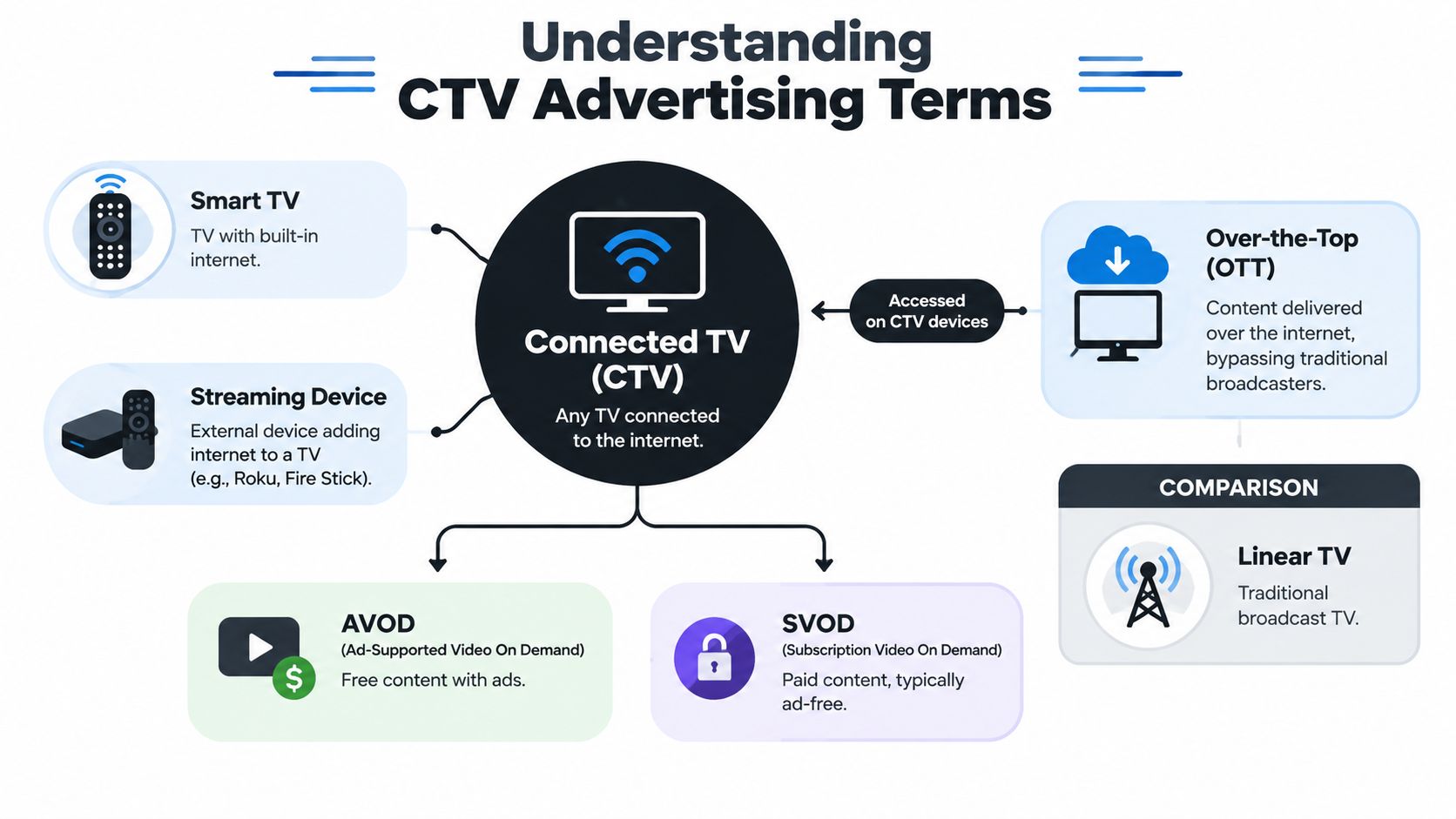
The labels matter because each one describes a different part of the transaction.
| Term | What it describes | Why you should care |
|---|---|---|
| CTV | The internet-connected television environment | It frames the screen and household experience |
| OTT | Internet delivery outside traditional distribution | It describes how content reaches the viewer |
| AVOD | Ad-supported on-demand video | It identifies inventory where ads fund access |
| SVOD | Subscription video on demand | It signals a paid content model and possible ad-tier differences |
| Linear TV | Scheduled broadcast or cable programming | It uses a different buying and measurement structure |
A vendor saying “we'll run an OTT strategy” hasn't told you enough. Ask which apps, publishers, devices, content types, audience signals, buying method, exclusions, and reporting fields are included. “OTT” can describe a sensible plan, or it can be a decorative word placed above a media plan with no useful detail.
The practical distinction is simple. You aren't buying a mystical audience called “streamers.” You're buying opportunities to place a specific creative in specific internet-delivered video environments, often across a mix of apps and devices. Your campaign needs to know which parts of that mix are available, measurable, and relevant to your customer.
If you need someone to handle the buying mechanics across digital channels, you can review digital media buying support as part of your operating model. Just don't outsource the basic questions. A partner should make the details clearer, not hide them behind a bigger acronym.
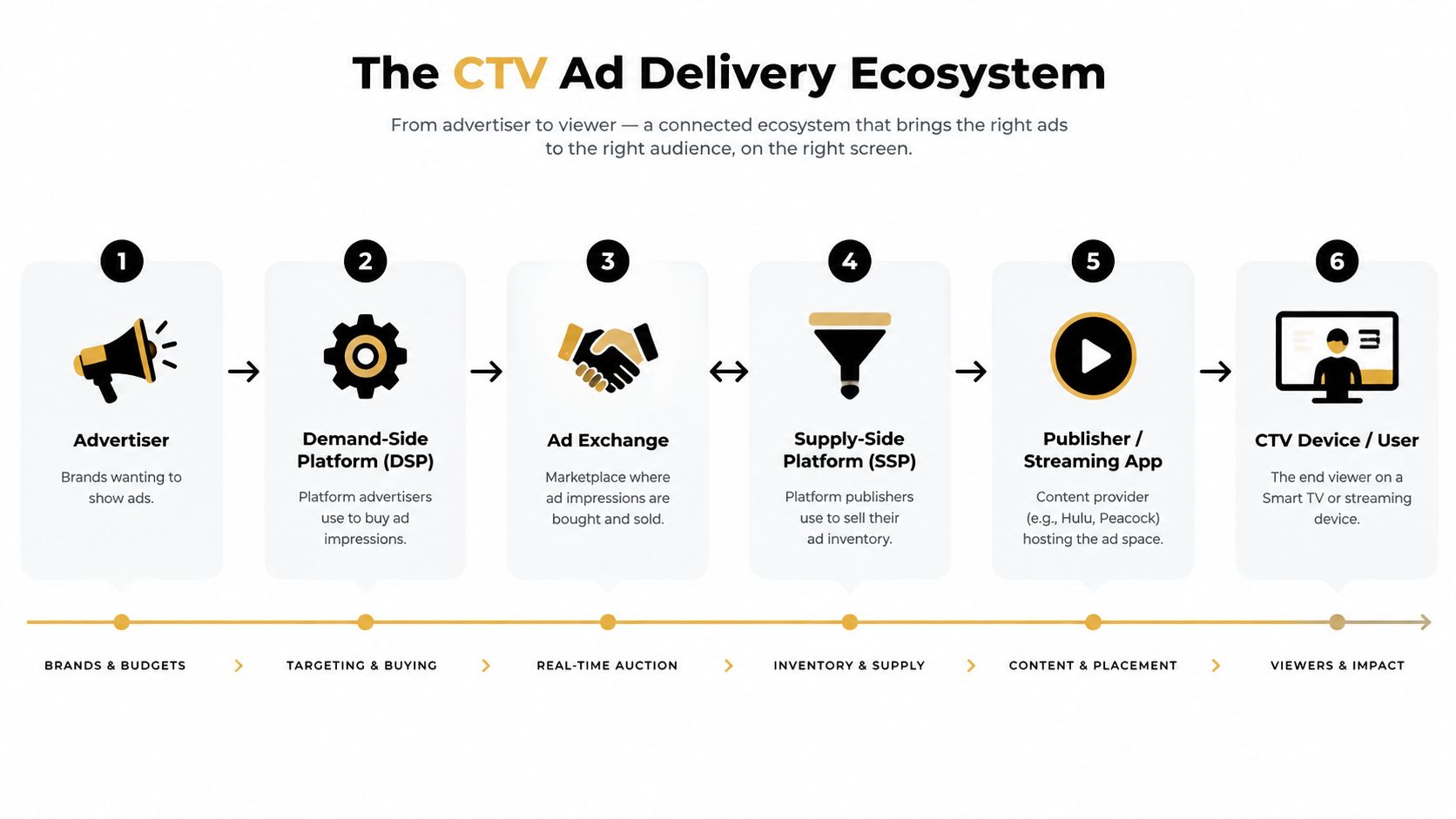
Your ad doesn't leap from your business manager to a television. It passes through a supply chain, and every handoff can affect price, transparency, delivery, and reporting.
The basic path looks like this. You, the advertiser, provide the creative and budget. A demand-side platform, or DSP, gives you the buying interface and bidding logic. An ad exchange can bring buyers and sellers together. A supply-side platform, or SSP, helps the publisher sell available inventory. The streaming app or publisher supplies the program and ad opportunity, and the CTV device displays the finished spot to the viewer.
A direct publisher deal can give you clearer placement context, premium programming access, and a more defined commercial relationship. The tradeoff is less flexibility across the broader market, potentially less unified optimization, and a higher need for hands-on planning.
Programmatic buying gives you more control over audiences, bid rules, exclusions, pacing, and reporting from one buying environment. It can also introduce additional layers between your budget and the publisher. More automation doesn't automatically mean more efficiency. It means you have to inspect the path.
Ask for a supply-path explanation before launch:
A vendor who can't answer these questions isn't necessarily dishonest. They may lack control over the chain. Either way, that's your problem once the invoice arrives.
CTV inventory often appears in ad pods, a group of ads inserted into a program break. One impression doesn't tell you whether your ad appeared first, last, beside a competitor, or inside a crowded break. Context affects attention and viewer experience, so pod-level information matters.
CTV ad delivery is technically standardized around VAST 4.x and the Open Measurement SDK, while OpenRTB 2.6 adds pod bidding signals such as ad sequence and total pod length, as explained in Keends' CTV measurement overview. Those signals help buyers make better bid decisions, manage pacing, and understand the structure of the opportunity rather than treating every available slot as identical.
My recommendation is blunt: don't buy a black box just because it has a familiar logo. Demand a sample report before spending. If the report can't show what the platform will measure, your campaign won't magically become more transparent after launch.
CTV targeting works best when you stop pretending demographics are the whole strategy. “Adults interested in fitness” is not a buying plan. It's a broad label that may include your best prospect, your former customer, and someone who hasn't exercised since the last presidential election.
Start with first-party data. Your customer list, site visitors, purchasers, high-value segments, and suppression audiences can give the campaign a more useful foundation than a vendor's generic interest bundle. The important operational questions are whether the data can be onboarded, how identity matching works, how privacy requirements are handled, and whether the same household can be excluded or capped across the campaign.
Contextual targeting deserves more attention from performance marketers. Instead of targeting only the person, you can target the content environment. Buyers can use keyword targeting to match or exclude attributes such as actor, director, sports type, mood, theme, subject, and location, according to IAB Europe's connected TV guide.
That gives you a practical lever. A meal-kit brand might want cooking, food, family, or travel contexts. A running product may want sports and training environments while excluding content that clashes with brand safety rules. The point isn't that context guarantees performance. The point is that it gives you a reason for the placement beyond “the platform said this household looks interesting.”
ACR, or Automatic Content Recognition, can add another layer by helping identify what content appears on a smart television. It can support exposure analysis and audience construction, but I wouldn't treat ACR as magic household truth. Device ownership, shared viewing, fragmented identity, and permissions still matter. A signal is only useful when you know what it represents.
Use broad targeting as a controlled starting point, not as an excuse to stop thinking. A practical structure looks like this:
You can explore audience segmentation methods if your current paid media setup treats every viewer as one giant bucket. But don't confuse more segments with better strategy. Too many narrow pools can restrict delivery, raise costs, and leave you with impressive labels attached to tiny, unstable audiences.
The best target isn't the most detailed target. It's the target you can activate, measure, and explain to someone who owns the budget.
A delivery report can tell you that an ad ran. It can't tell you that the ad caused a sale. Those are different jobs, and CTV gets expensive when teams ask one metric to perform all three.
Delivery measurement answers basic but essential questions:
Those checks protect you from buying inventory that looks available in a platform but doesn't appear in the form you expected. They also give your media buyer enough information to adjust placements, creative, and frequency while the campaign is still live.
Completion is useful, but it isn't a purchase. A viewer can finish an ad while cooking dinner, answering a text, or waiting for the show to resume. Treating completion as revenue is how a harmless dashboard becomes a dangerous financial document.
Attribution asks which exposed household, device, or identifier later appeared in a conversion record. That can help you understand the path, but CTV exposure often sits inside a broader journey involving search, direct visits, email, social, retail, and word of mouth.
Last-touch attribution is especially weak when the viewer sees a television ad, remembers the brand, and later searches for it. Search may receive the final click even though CTV created the initial demand. The reverse can also happen. A customer who already intended to buy may see your ad and later convert, allowing CTV to claim credit for a sale it didn't create.
That doesn't make attribution useless. It makes attribution insufficient.
Incrementality asks a harder question: Would the business have received the outcome without the CTV exposure? The answer requires a credible counterfactual, not a flattering post-campaign comparison.
Useful approaches include holdout audiences, geo tests, matched markets, brand-lift studies, and calibrated media mix modeling, as outlined in this guide to CTV measurement and incrementality. Each method has tradeoffs, but all are more useful than declaring victory because exposed users converted.
A holdout can show what happens when a comparable group doesn't receive the campaign. A geo test can compare markets with different levels of exposure. A brand-lift study can evaluate changes in awareness or consideration. Media mix modeling can help assess channel contribution when you have enough quality data and disciplined calibration.
For a smaller brand, the test doesn't need to resemble a research department's master thesis. It does need a pre-agreed hypothesis, a defined conversion window, clear exclusions, and a decision rule. Write down what would make you scale, pause, or change the campaign before the first impression runs.
You can also review incrementality testing options when your reporting currently stops at attributed revenue. Your CFO doesn't need a prettier chart. They need an honest answer about what the campaign changed.
A CTV campaign should begin with an operating brief, not a video upload. Decide what you want the channel to accomplish, how you'll measure it, who should see it, where it can run, and what happens when the first readout looks disappointing.
Your social video probably isn't ready for the television screen just because the file exports successfully. CTV viewers sit farther away, share the screen with other people, and may not interact with the ad at all. The brand, product, offer, and next step need to survive a lean-back environment.
Use this practical checklist:
Don't begin with every audience, publisher, device, and creative version at once. That creates a reporting soup. Start with a defined group of placements and a small number of creative hypotheses, then expand only when the delivery and measurement foundations hold.
Your pre-launch checklist should include:
IAB guidance says marketers should set frequency, monitor it across platforms, and tune it to the campaign objective, audience, and product. It also warns that poor frequency management can create creative fatigue, as described in IAB's CTV creative best practices.
An IAB and Innovid benchmark found average campaign frequency of 4.6 exposures. The same report found 85% of households saw an ad one to two times on average, 14% saw it three to nine times, and 1% saw it more than ten times, according to the IAB and Innovid measurement report.
| CTV Creative Specs at a Glance | Recommendation |
|---|---|
| Core video asset | Build a television-first version with clear branding, readable text, and strong audio |
| Opening message | Establish the product or problem immediately |
| Creative rotation | Prepare multiple versions to reduce fatigue |
| Call to action | Use a simple, memorable next step |
| Placement adaptation | Review how the asset works across apps, devices, and content contexts |
| Measurement tag setup | Confirm the ad server, VAST, and measurement requirements before trafficking |
| Frequency control | Set a campaign rule and check overlap across buying platforms |
The benchmark isn't a universal target. A high-consideration product may need a different exposure pattern from a fast-moving offer. It is a useful warning against assuming that more impressions automatically create more demand. Sometimes you're not building recall. You're just renting the same couch.
You can learn CTV. You can also learn electrical work from videos and discover the difference when the lights go out.
CTV rewards operators who understand the media plan, the DSP, the supply path, the creative file, the identity layer, and the experiment design at the same time. That's a lot of responsibility for a founder who already has inventory, cash flow, hiring, customer support, and the occasional existential crisis on the calendar.
A capable CTV media buyer should be able to answer practical questions without reaching for a brochure:
You need someone who can negotiate with publishers, interrogate platform reporting, troubleshoot VAST delivery, understand pod-level signals, and explain uncertainty in plain English. A buyer who only knows how to push buttons can spend your budget very efficiently, which is not the compliment it sounds like.
Ask candidates to critique a sample CTV plan. Give them a fictional audience, a few creative assets, a defined outcome, and a messy reporting export. Watch whether they ask about counterfactuals, supply transparency, frequency overlap, and suppression. If they jump straight to scale, congratulations, you've found a person who may turn your budget into a motivational poster.
The obvious cost of doing CTV yourself is wasted inventory. The less visible cost is delayed learning. Every weak test consumes time, creates internal debate, and makes the next budget decision harder because nobody trusts the first answer.
You can hire internally, use an agency, or find a specialist through a talent marketplace. HireMediaBuyers.com offers access to pre-vetted media buyers and paid advertising specialists, including a Connected TV and Streaming Buyer role focused on streaming platforms, smart TVs, and audience-based targeting. That gives a growing team another way to source specialist help without pretending CTV is a casual extension of social buying.
The right partner won't promise that every impression will convert. They'll show you what the campaign can prove, what it can't prove yet, and what test should come next. That's the standard I'd use before handing anyone the keys to the CTV budget.
If you're ready to test connected TV advertising without turning your budget into a guessing game, visit HireMediaBuyers.com to find pre-vetted media buyers, including specialists who work across streaming and audience-based CTV campaigns. Tell them your business goal, current media mix, and measurement gap, then hire the operator who can explain the plan before spending a dollar.


