


You're probably in the same spot businesses often reach before they start Googling for a conversion rate optimisation consultant.
Traffic is up. Ad spend is up. Slack is full of screenshots from GA4, Shopify, HubSpot, or whatever dashboard your team worships this week. Revenue, meanwhile, is acting like it didn't get the memo.
That's the moment founders and marketing leads usually make the wrong move. They buy more traffic. More campaigns. More creatives. More clicks into the same leaky funnel. Toot, toot. You've just paid to scale the problem.
A good CRO hire fixes the bucket first.
I've seen this movie too many times. A brand doubles down on Meta or Google Ads because the click-through rates look decent, the media buyer swears intent is strong, and the landing page “seems fine.” Then the month closes, and everyone starts speaking in the ancient corporate dialect of “mixed signals.”
The numbers aren't useless. They're incomplete.
A proper conversion rate optimisation consultant doesn't start by redesigning your homepage because they had a feeling. They start by digging into the ugly, unglamorous stuff your team usually skips. Scroll depth on your sales page. Rage-clicks in session recordings. Which exact field in your lead form makes people bail. Where mobile visitors hesitate. Where desktop users loop back and forth like they're trapped in a haunted house.

It's common for teams to treat conversion problems like traffic problems because traffic has a clean invoice attached to it. You can buy more of it by lunch. Fixing conversion requires patience, a method, and someone who isn't emotionally attached to the page your designer spent two weeks polishing.
That's why I think of a CRO consultant as a specialist plumber for your funnel. They don't bring more water into the building. They find out why it's leaking into the walls.
Practical rule: If revenue is flat while acquisition keeps rising, stop feeding the top of the funnel and inspect the handoff.
There's a reason businesses keep investing here. The CRO software market is projected to reach $1.932 billion by 2026, and that growth sits beside a stubborn reality: the average landing page conversion rate across all industries is 2.35%. Skilled consultants use that benchmark to spot missed opportunities and can create uplifts of up to 500% when they fix the right gaps through focused testing, according to this market-growth and benchmark summary.
Internal teams usually stare at aggregate metrics. Consultants look for friction patterns.
If you're also struggling to understand which channels deserve credit in the first place, fix that mess too. A lot of “bad conversion performance” is just poor measurement dressed up as insight. This quick guide to attribution modeling for paid media teams is worth reading before you start firing agencies out of frustration.
You don't need more dashboards. You need someone who can tell you which numbers matter, which ones are lying by omission, and which leak is worth fixing first.
“Get us more conversions” is not a brief. It's a cry for help.
If you hire a conversion rate optimisation consultant with that level of vagueness, don't act surprised when you get a pile of observations, a few test ideas, and a monthly invoice that somehow feels more specific than your goal.
Before you hire anyone, decide what win looks like in business terms. Not design terms. Not “engagement” terms. Business terms.
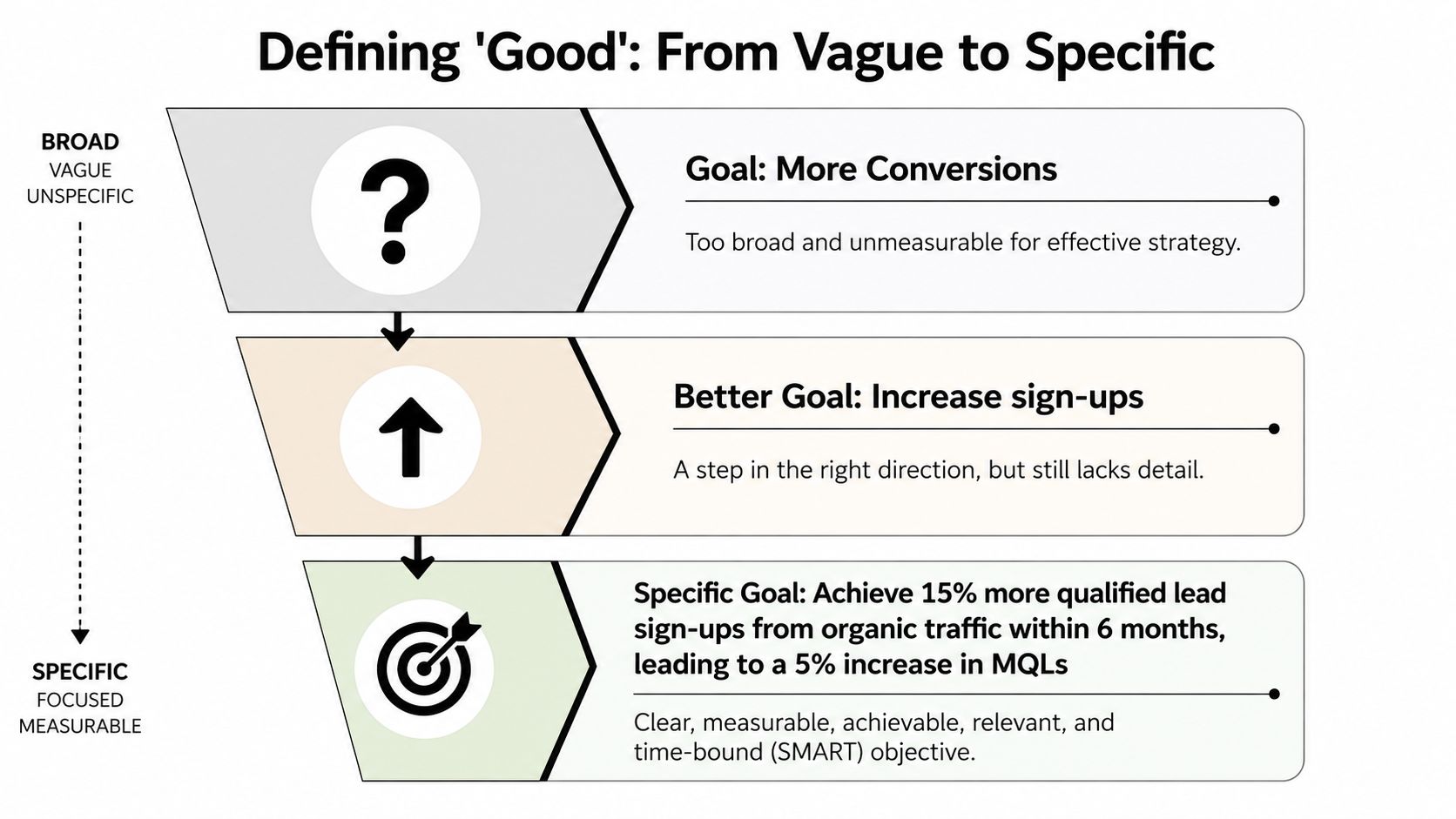
A conversion is only useful if it connects to revenue. For one company, that's a purchase. For another, it's a demo request that turns into pipeline. For another, it's a qualified lead form, not every random person who typed “gmail.com” into the work email field and vanished forever.
Write down three things:
That third one matters more than people admit.
Time on page can rise because users are engaged. It can also rise because they're confused. Scroll depth can look healthy while nobody clicks the CTA. A lower bounce rate can still produce lousy leads.
You want a consultant who asks annoying questions like:
A page that “performed well” but produced junk leads didn't perform well. It wasted sales time more efficiently.
There's a useful way to think about this. Expert CRO operators focus on getting more value from existing traffic. That matters because the average website converts at 2.35%, while companies with over 40 landing pages often see conversion lifts of more than 500%. That benchmark is summarized in this search reference on website conversion rate and landing page volume. The lesson isn't “go build 40 pages tomorrow.” It's that specificity wins. Different intent deserves different pages.
Before I hire anyone, I force the team to produce a one-page brief with these fields:
| Item | What to write |
|---|---|
| Business goal | More revenue from existing traffic |
| Primary action | The main conversion that ties to sales |
| Audience | Which visitors matter most |
| Key pages | Where the consultant should focus first |
| Success metric | The KPI that actually moves the business |
| Guardrails | Metrics that must not get worse |
Keep it ugly if you want. Google Doc. Notion page. Back of a napkin with coffee stains. I don't care.
I care that it answers one brutal question: If this consultant succeeds, what changes in the business?
If you can't answer that cleanly, you're not ready to hire. You're ready to wander.
Most companies often waste money here.
They assume there are only two options. Hire a freelancer and hope they're not just a clever person with a polished Upwork bio. Or sign an agency retainer big enough to make your finance lead start blinking twice.
There's a third option, and for a lot of SMBs and scaling teams, it's the sane one.
A freelancer can be excellent. They can also disappear for two days, hand you a nice audit, and expect your team to do all the hard implementation work. You're buying skill, but also taking on management risk.
An agency gives you more coverage. Strategy, design, dev, QA, reporting. Nice in theory. In practice, you may end up paying for layers. Account manager. Strategist. Junior analyst. Internal handoffs. Fancy slide deck with a lot of circles in it.
And then there's the modern middle ground. Fractional, pre-vetted talent on flexible contracts. Less ceremony. Less overhead. Usually faster.
| Factor | Freelancer | Agency | Vetted Platform (The Modern Way) |
|---|---|---|---|
| Cost structure | Usually hourly or project-based | Usually monthly retainer | Flexible part-time or rolling contract |
| Speed to start | Can be fast if you find the right person | Often slower due to sales process and scoping | Typically faster than traditional hiring |
| Management load | High. You manage directly | Medium. Agency manages team, you manage the agency | Lower than freelance, lighter than agency |
| Skill coverage | Depends on one person | Broad team coverage | Focused expert with screening support |
| Flexibility | Good, but uneven | Often rigid once signed | Strong, especially for changing scope |
| Risk | Single point of failure | Higher spend and process overhead | Balanced cost, lower hiring friction |
| Best fit | Small, sharp projects | Full execution with bigger budget | SMBs and growth teams that need expertise without bloat |
The biggest mismatch in CRO hiring is economic, not technical. Most businesses do not need a full agency machine every month. They need a strong operator for part of the week, with enough chops to diagnose issues, prioritize tests, and work with the team already in place.
That model is becoming more normal. 68% of US SMBs prioritize fractional talent to reduce fixed costs, and the consultant-as-a-service model can cut hiring costs by up to 80% while retaining IP ownership, according to Consultport's overview of flexible consulting models.
That's the part most guides skip. They talk like your only serious option is a hefty retainer. It isn't.
You don't need to buy the whole restaurant when what you need is a very good chef for dinner service.
Pick based on your bottleneck.
One more thing. Don't get hypnotized by labels. “Consultant,” “specialist,” “expert,” “growth strategist.” Cute. Meaningless. I've met people with every title under the sun who still couldn't explain why a form was leaking leads.
Buy the operating model. Buy the method. Buy the judgment.
The job title can keep its little cape.
A normal interview won't save you here.
Plenty of CRO candidates know how to say “hypothesis-driven experimentation” with a straight face. Fewer can explain what they'd do on your site next Monday. Fewer still can tell you when not to run a test.
That's why I don't trust charm, jargon, or a deck full of cherry-picked wins. I trust process, clarity, and whether the person gets uncomfortable when the math gets messy.
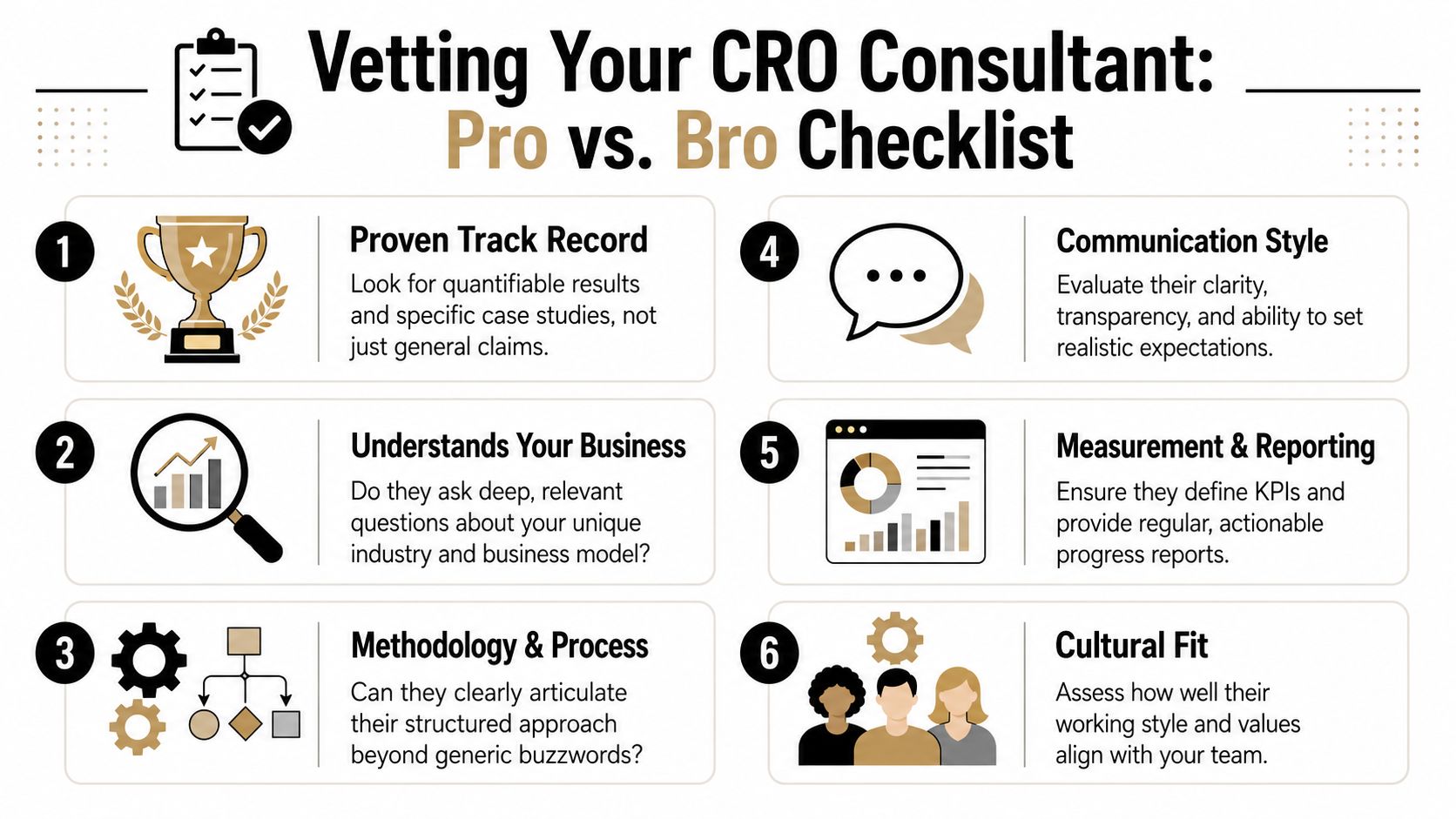
Forget “tell me about yourself.” Ask questions that force them to reveal how they think.
Try these:
That last question is the kill shot.
A lot of sites don't have enough volume for clean, fast A/B testing on every page. And a shocking number of CRO candidates pretend otherwise.
The data point worth remembering is this: 74% of A/B tests on low-traffic sites fail, and strong consultants should know when to use Bayesian inference or sequential testing instead of relying on traditional approaches that break down with small samples. If you ask how they achieve statistical validity with under 5,000 monthly visitors, their answer tells you everything, as outlined in this Livesession article on hiring a CRO consultant.
If they waffle, you have your answer.
A candidate who can't explain low-traffic testing clearly is not protecting your budget. They're gambling with it.
A credible answer usually includes some mix of these ideas:
You're not looking for a statistics professor. You're looking for someone who knows when certainty is fake.
This is my favorite filter because it kills fantasy fast.
Give the candidate a small paid project. One funnel review. One landing page teardown. One experiment roadmap. Then evaluate the output on three things:
| What to review | What good looks like |
|---|---|
| Diagnosis | Specific friction points, not generic UX comments |
| Prioritization | Clear ranking of what to tackle first |
| Communication | Plain English, no consultant fog machine |
You'll learn more from that than from five interviews and a reference call.
And yes, still do the references. Just do them properly. Ask former clients what changed, how the person handled disagreement, and whether they were rigorous or theatrical. If you need a tighter process for that, this guide on checking client references before you hire is a useful sanity check.
The market has plenty of CRO bros. Strong opinions, flashy claims, suspiciously perfect portfolios. A real pro sounds calmer. More precise. Less needy for applause.
That's usually the one worth hiring.
Let's talk about the bit people pretend is awkward. Money.
It's only awkward when expectations are fuzzy. Clear scope makes hiring easier. It also makes firing easier, which is healthy. Nothing sharpens a working relationship like both sides knowing what happens if the work turns into interpretive dance.
The useful thing about CRO pricing is that it's not a mystery. There's a real range.
Freelance CRO consultants typically charge between $75 and $250 per hour, while agency retainers run from $5,000 to $35,000 per month, according to Apexure's CRO hiring guide. Those are the numbers to anchor on before someone tries to sell you “premium strategic optimisation partnership” for the price of a used car.
Cheaper isn't always smarter. Expensive isn't always better. Bad fit can happen at every price point.
A decent CRO agreement should answer these questions in plain English:
That last point matters more than founders admit. A rigid contract traps you with the wrong hire for too long. If you prefer lower-risk arrangements, this note on cancel-anytime hiring models captures the spirit I'd push for.
Week 1 should not be “let's test button colors.”
It should look more like this:
Days 1 to 7
Deep diagnostic work. Analytics review, funnel analysis, user behavior tools, form drop-off review, message match assessment.
Days 8 to 30
Prioritized roadmap. Clear hypotheses. Required implementation list. First experiments or page changes queued.
Days 31 to 60
Launch initial tests or high-confidence fixes. Track results. Document what's inconclusive, what's promising, and what needs another pass.
Days 61 to 90
Refine. Expand learnings to adjacent pages. Build a repeatable optimisation rhythm instead of one-off stunts.
If a consultant can't explain what happens in the first month, they probably don't have a real operating system.
Don't pay for vibes. Pay for progress.
That doesn't mean tying compensation to guaranteed lift. Good consultants shouldn't guarantee outcomes they can't fully control. It means tying the engagement to deliverables, pace, and decision quality. Audit delivered. Roadmap delivered. Tests launched. Findings reported. Next actions clear.
Simple beats clever here. The cleaner the contract, the fewer weird surprises later.
And weird surprises always seem to arrive right after invoice day.
You can hire the right person and still ruin the engagement with a sloppy handoff.
A CRO consultant can't do much if they spend the first two weeks begging for GA4 access, waiting on Hotjar permissions, and trying to figure out who owns GTM. Nothing says “we value optimisation” quite like making your new expert open three support tickets and chase six passwords.

Set them up properly from the start.
The good ones can work around missing information. They shouldn't have to.
You don't need daily updates unless your company enjoys meetings as a hobby.
A better cadence is simple:
| Cadence | Purpose |
|---|---|
| Weekly sync | Review findings, blockers, next experiments |
| Shared dashboard | Keep KPIs visible without extra meetings |
| Monthly review | Tie test outcomes back to business performance |
What matters on that dashboard depends on the goal you defined earlier. I usually want to see things like conversion quality, revenue per visitor, and cost per acquisition trends. Not a pile of decorative metrics arranged like a fruit platter.
Weak CRO work becomes apparent. Anyone can produce “insights.” Anyone can suggest friction points. The key question is whether the changes improved the economics of the funnel.
A solid consultant keeps a closed loop:
That cycle matters because CRO isn't a one-time cleanup job. It's an operating habit. The consultant should leave you with better pages, better measurement, and a sharper understanding of what your buyers respond to.
If they only leave you with a slide deck, you hired a narrator.
If you need paid media talent with the same bias for rigor, speed, and sane economics, take a look at HireMediaBuyers.com. It helps companies hire pre-vetted media buyers and paid ads specialists without getting trapped in bloated retainers, clunky hiring cycles, or months of resume roulette.


