

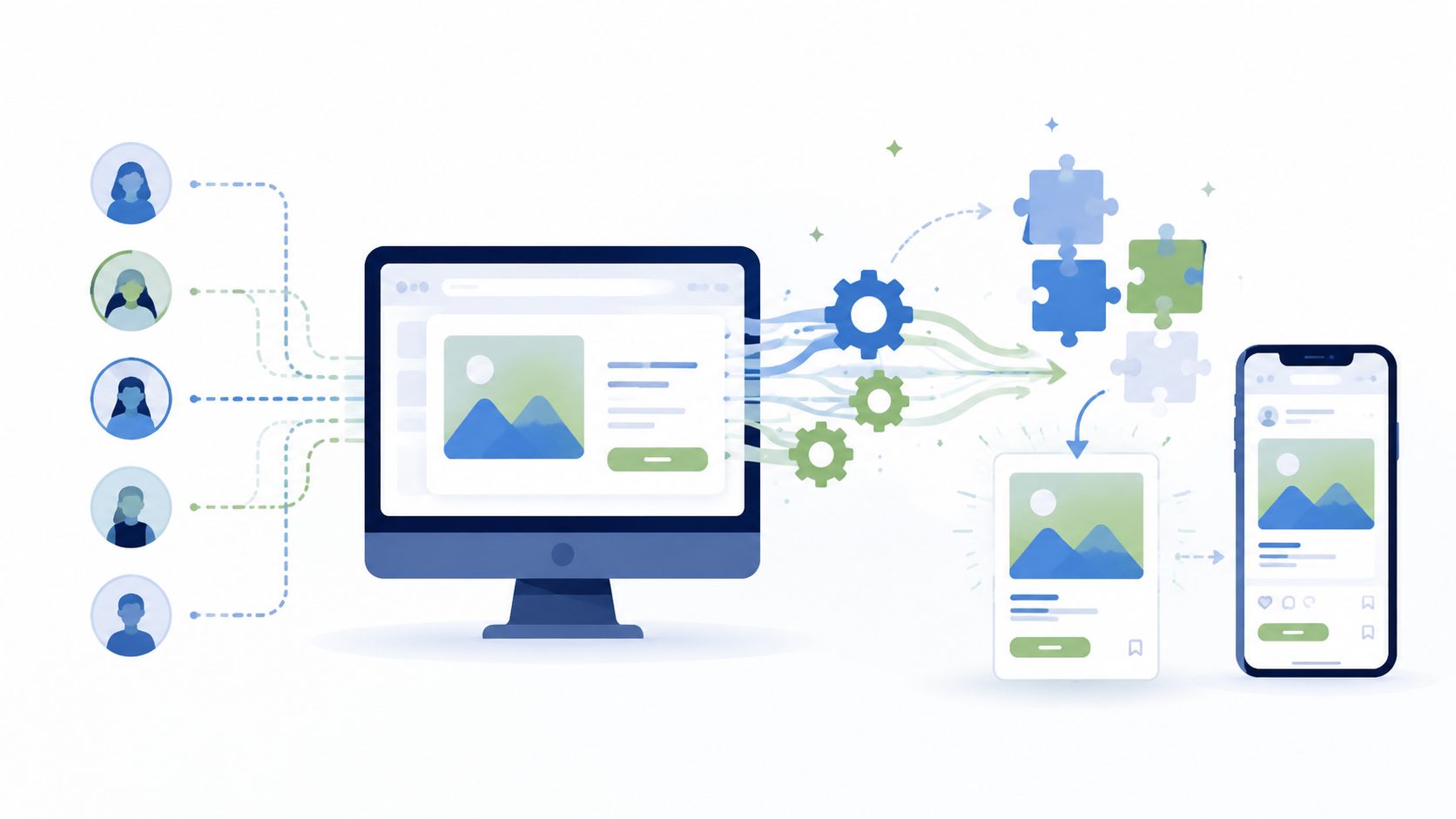
The most popular advice about dynamic creative optimization is also the advice that burns the most budget: create as many variants as possible, switch on automation, and let the algorithm figure out the rest.
That approach confuses volume with relevance. A thousand interchangeable ads don't create a strategy. They create a larger QA queue, more approval headaches, and more ways to send the wrong message to the right person. Profitable DCO is a real-time signal-to-creative matching system, supported by disciplined creative operations and a media buyer who understands both.
The technology matters. But the campaign usually fails earlier, in the handoff between data, creative, legal, and paid media. The hard part isn't making another headline. It's deciding which signals deserve a creative response, defining what can change safely, and giving the algorithm enough clean options to learn without letting it run wild.
DCO isn't “make lots of ads and hope.” It's a decisioning system that selects and assembles approved creative elements for a specific impression. If the inputs are generic, poorly tagged, or strategically disconnected from the audience, automation only helps you produce the wrong answer faster.
The 10,000-variant fantasy is particularly dangerous. More combinations can be useful when each element has a job, but undifferentiated permutations give the model noise instead of insight. Five headlines that say the same thing, four stock images with no meaningful audience relationship, and a handful of interchangeable calls to action don't form a useful testing environment. They form creative spam with a programmatic wrapper.
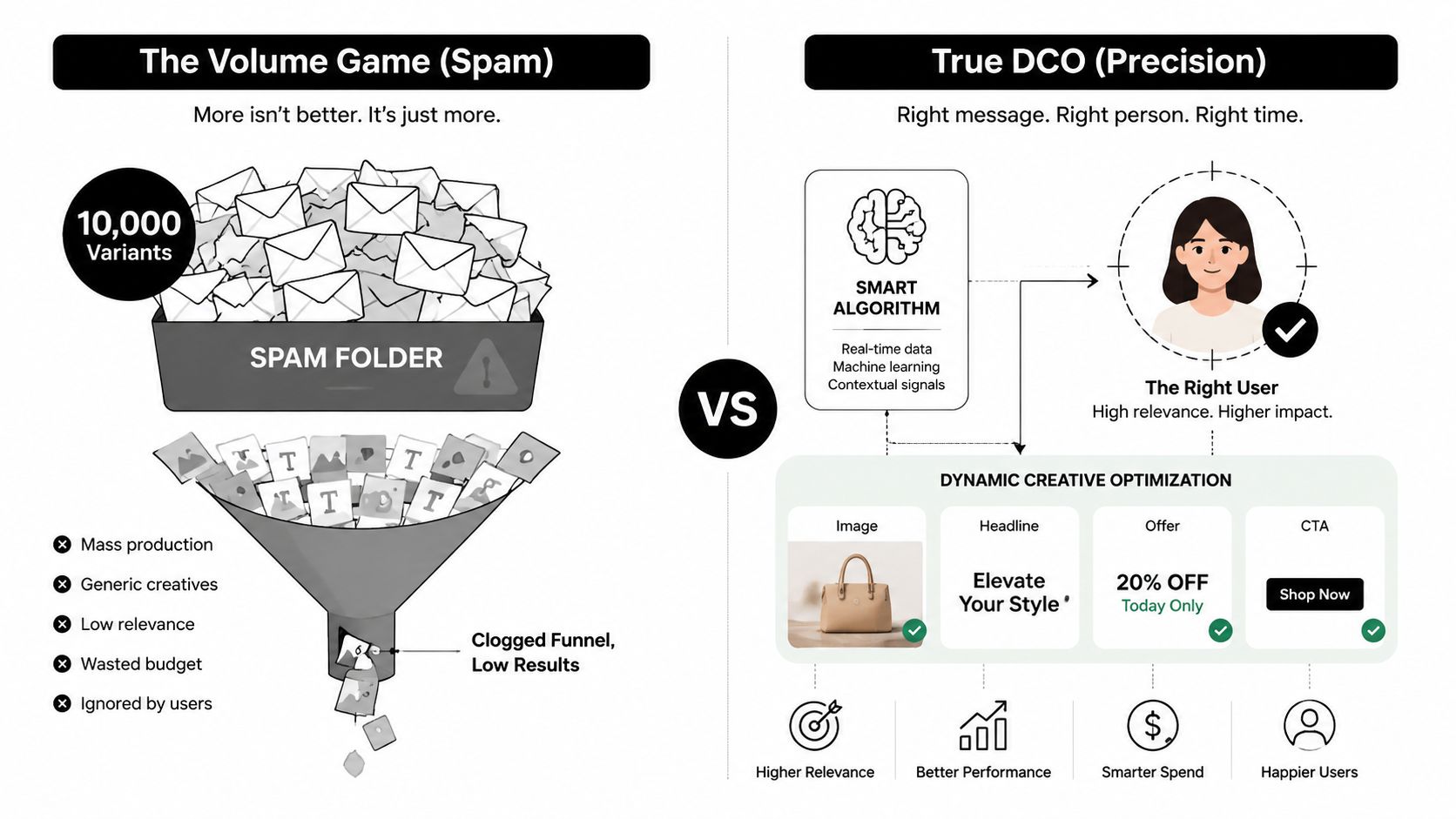
Practical rule: Every dynamic element should answer a clear question about audience, context, intent, or offer. If you can't state the question, don't add the element.
Media teams often build segments without telling creative teams what those segments should see. Creative teams produce polished assets without knowing which signals the buying system can use. Then someone connects a feed, enables optimization, and calls the project live.
That gap is why conversion tracking belongs in the planning conversation, not as a cleanup task after launch. Without reliable event definitions, value signals, and a clear path from impression to outcome, the system may optimize toward clicks while the business needs qualified leads, purchases, or revenue. Teams should audit their conversion tracking foundation before debating vendors or templates.
DCO also magnifies fatigue when teams mistake rotation for relevance. Repeating weak variations across more placements doesn't refresh the message. It gives the audience more opportunities to ignore it.
Start with a small set of meaningful creative dimensions. For example, an audience's funnel stage might determine the proof point, browsing behavior might influence the product shown, and geography might change the local context. Keep the combinations constrained by brand and legal rules.
The strongest campaigns connect one useful signal to one useful creative change. They don't personalize everything because they can. They personalize the parts that have a credible relationship with the user's situation.
A DCO setup has two jobs, and teams routinely blur them together. The first job is deciding which assets are eligible and which combination has the best expected outcome. The second is assembling and rendering that combination quickly enough to serve it at impression time.
The decisioning layer receives signals such as device, location, browsing behavior, CRM information, inventory, or audience membership. Deterministic rules can remove combinations that shouldn't run. A rules engine might exclude an out-of-stock product or prevent a regulated offer from appearing to an ineligible audience.
After filtering, a machine-learning layer chooses among the remaining options. Adobe's published DCO architecture describes this two-tier approach and cites Thompson Sampling as an example of probabilistic selection. The architecture can render personalized ads from 10,000+ product catalog items in under 25 ms, with reported performance improvements of 20–40% versus naive baselines in the cited overview, Adobe's DCO architecture summary explains the decisioning and rendering relationship.
The important point isn't the algorithm's name. It's the separation of responsibilities. Rules protect eligibility and governance. Machine learning allocates impressions among eligible creative combinations.
The assembly layer combines approved modules, such as an image, headline, product card, price, background, and CTA, inside a template. A feed-based campaign may pull product names, prices, and availability. A behavioral campaign may select a message based on a visitor's relationship with the brand.
Server-side assembly generally gives teams more control over response time and data handling. Client-side assembly can offer flexibility, but it introduces browser and network dependencies that can affect delivery. Either way, the buyer should ask how the platform handles missing feed values, expired offers, unsupported formats, and fallback creative.
Vendor demos can become suspiciously theatrical. A platform may show a beautiful personalized ad in a controlled environment while avoiding the less glamorous questions about feed freshness, approval states, and broken assets.
The basic flow looks like this:
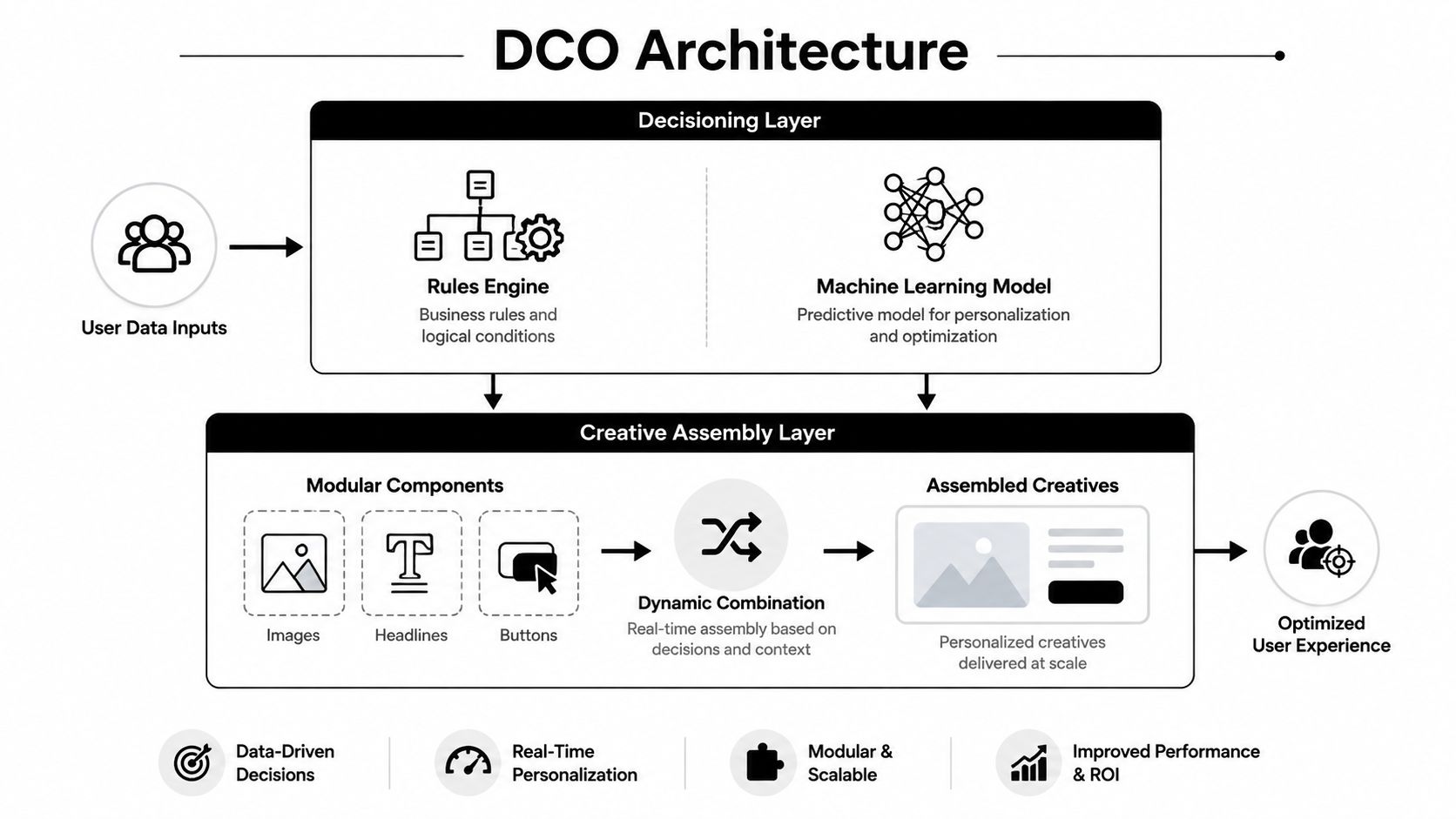
The architecture matters because latency is a performance constraint, not merely an engineering detail. Adobe's cited setup renders in under 25 ms, which supports impression-level decisioning rather than slower batch workflows. A system that can't return a valid ad quickly enough may lose the opportunity before the user sees anything.
DCO creates a production problem that static campaigns can hide. A static campaign can survive with a few polished ads and a patient approval process. DCO needs a living library of modular assets, clear metadata, version control, legal rules, and people who know when the machine is making a bad choice.
The market is expanding, but market growth doesn't remove this operational burden. One forecast estimates the DCO market at USD 4.2 billion in 2024, reaching USD 8.1 billion by 2030, with an 11.5% CAGR, while another projects USD 1.02 billion in 2025 to USD 1.92 billion by 2030. The estimates use different scopes, but both forecasts point to sustained expansion, as summarized in Strategic Market Research's DCO market forecast.
Traditional agency models often reward finished deliverables, not continuous iteration. A DCO team needs the opposite. It needs a repeatable process for briefing, producing, tagging, reviewing, launching, monitoring, and refreshing assets.
In-house teams face a different constraint. Legal and brand reviewers may approve a single ad carefully, but a modular system can create many combinations. Without predefined rules, every new headline or offer becomes another manual review cycle. The campaign then waits for governance while the auction moves on.
A practical creative operations system includes:
The algorithm can't govern your brand for you. It can only optimize inside the boundaries you give it.
| Capability Area | Immature (Failing) | Developing (Struggling) | Mature (Scaling) |
|---|---|---|---|
| Asset library | Files live in scattered folders | Shared library exists but tags are inconsistent | Versioned, tagged, and owner-managed |
| Brand governance | Every variation receives ad hoc review | Some rules are documented | Approved modular rules govern combinations |
| Feed management | Manual uploads and stale values | Scheduled updates with occasional errors | Connected feeds with monitoring and fallbacks |
| QA | Human checks after launch | Partial automated validation | Automated preflight plus live alerts |
| Creative refresh | Reactive, usually after fatigue | Planned but inconsistent | Regular refresh cadence tied to performance signals |
| Team structure | Media buyer owns everything | Creative and media share responsibility | Creative ops, media, data, and legal have clear roles |
The hiring question follows naturally. If nobody owns the system between the brief and the impression, another ad tech contract won't rescue the campaign.
Don't build the perfect machine before you launch a single useful ad. Start with a controlled system that can produce, approve, serve, and measure a small set of meaningful combinations. Then earn the right to add complexity.
Standardize the feed first. Define required fields, accepted values, product IDs, offer status, image paths, and fallback behavior. A feed that works in a spreadsheet but breaks in production isn't an asset. It's a future incident wearing a tie.
Name assets for machines and humans. Use a consistent structure that identifies audience, concept, element type, format, version, and status. Avoid filenames such as final_new_v2_reallyfinal.jpg. Your future self has suffered enough.
Build a minimum viable template library. Each template should specify where modular elements can appear, what character limits apply, and which combinations are prohibited. The first template should be flexible enough to test a clear hypothesis without requiring a designer for every text swap.
Define the primary outcome. Decide whether the system is optimizing toward qualified leads, purchases, subscriptions, revenue, or another business result. CTR can be monitored, but it shouldn't become the objective by default.
Launch once the feed, template, event tracking, fallback, and approval path work together. Don't wait for every possible audience or placement.
Create a review queue for broken combinations, rejected assets, feed failures, and unexpected spend concentration. Give media buyers authority to pause a bad combination, but define when creative, legal, or data owners must take over.
Keep a human escalation path for regulated copy, pricing, product claims, and audience eligibility. Automation should reduce repetitive decisions, not erase accountability.
For teams building a first-party foundation, a documented first-party data strategy can help clarify which signals are reliable enough to inform personalization and which should stay out of the system.
Once the core workflow is stable, connect dynamic inventory, product catalogs, CRM audiences, and contextual inputs where they add real value. Add automated QA that tests every combination against required fields and brand rules before the ad reaches the auction.
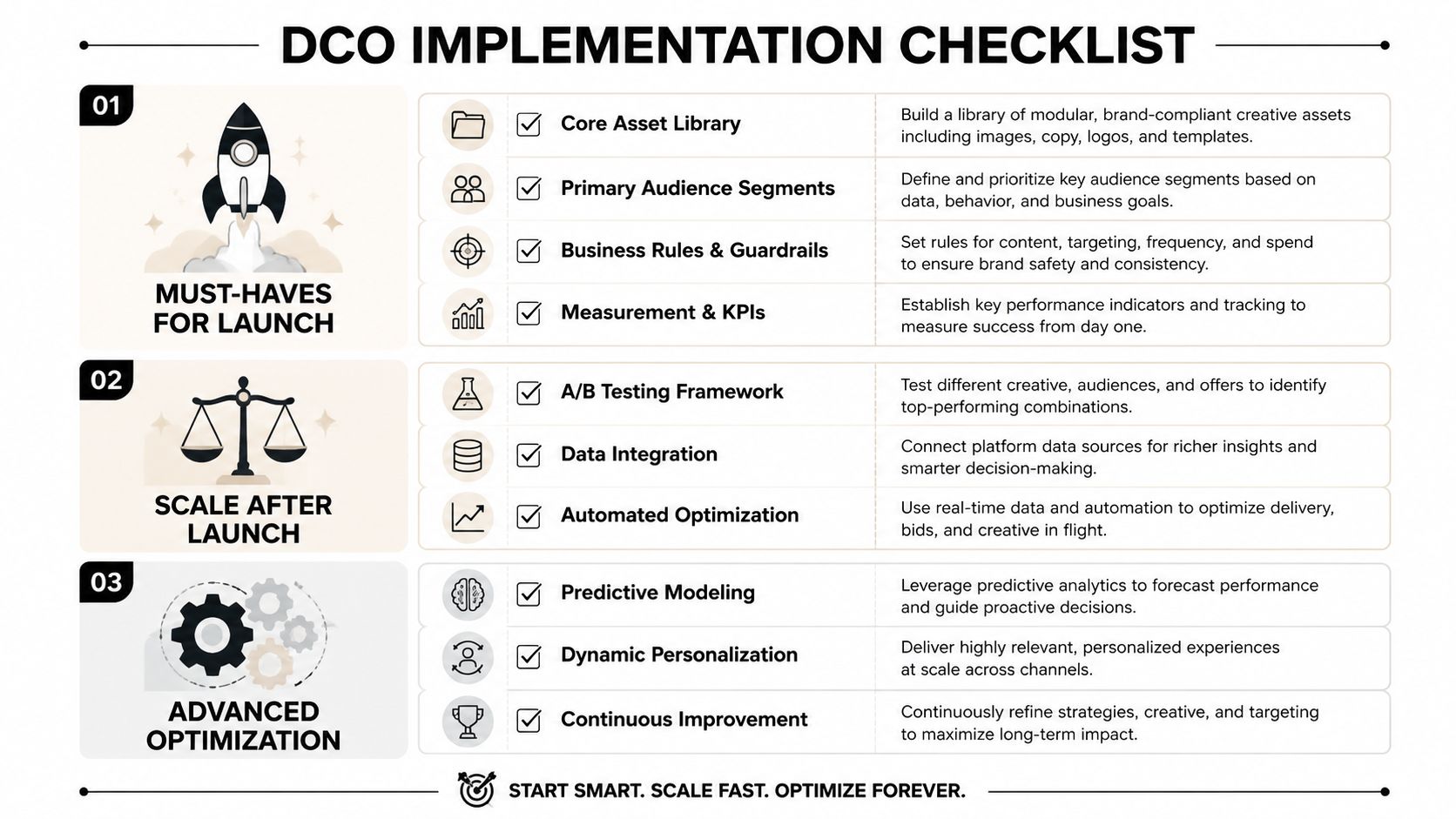
Use a simple launch sequence:
The right setup gets live quickly because it separates must-have controls from attractive distractions. Predictive modeling, elaborate identity graphs, and dozens of template families can wait. A broken offer fallback can't.
A DCO system can become very good at producing ads people click and very bad at producing customers. CTR is immediate, abundant, and easy to optimize. That convenience is exactly what makes it dangerous.
The measurement framework should follow the business outcome through the funnel. Engagement metrics can diagnose creative attention, but conversion quality, revenue, and customer value determine whether the campaign deserves more budget.
| Measurement Approach | Primary Metric | Risk of Overfitting | Best Use Case |
|---|---|---|---|
| CTR-only optimization | Click-through rate | High, because curiosity can beat intent | Early attention diagnostics |
| Conversion-weighted optimization | Conversions or CVR | Moderate, especially with sparse or delayed data | Lead and purchase campaigns |
| Revenue-weighted optimization | Revenue or value | Lower when value tracking is reliable | Commerce and variable-order-value programs |
| Holdout or incrementality test | Lift versus control | Lower, but requires clean experimental design | Proving causal contribution |
| Creative and cohort analysis | Variant performance by audience and context | Moderate if cells are too fragmented | Finding interaction effects safely |
A conversion-based DCO framework treats creative selection as an optimization problem, not a race for more impressions. Academic work on conversion-based DCO and reinforcement learning frames the objective around outcomes such as CTR, conversion rate, or revenue. The choice of objective changes what the system considers a winner.
Track the campaign-level business result first. Then inspect variant-level delivery, audience splits, placement quality, frequency, and fatigue. If a headline wins on CTR but produces weak downstream quality, the correct response isn't to celebrate the headline and blame the landing page automatically. Investigate the whole path.
Creative fatigue needs its own watchlist. Guidance from Segwise on AI creative testing and fatigue identifies a 20–30% CTR decline from baseline as a common fatigue signal, while also warning that purchases and subscriptions can arrive days or weeks after the initial interaction. Treat that range as a diagnostic prompt, not a universal kill rule.
Holdout testing is especially useful when DCO captures existing demand. A user may have converted without seeing the personalized ad, particularly in retargeting. Comparing exposed performance alone can make harvesting look like incremental growth.
A winning click is evidence of attention. It isn't proof of profitable persuasion.
Kill a variant when it repeatedly attracts low-quality action, violates brand or eligibility rules, or shows fatigue without downstream value. Scale a winner when its advantage survives audience, placement, and time checks. Rebuild the strategy when no element consistently improves the business outcome or when the campaign can't produce trustworthy measurement.
Don't let the platform's default optimization objective become your business strategy by accident.
Benchmarks are useful as guardrails, not promises. DCO performance depends on the feed, offer, audience, landing experience, measurement quality, and the discipline of the operating team. Anyone promising a universal lift is selling a deck, not buying media.
A documented Danske Spil campaign reported 40% lower CPC and 25% lower CPA year over year after applying creative optimization, according to the Global Dynamic Creative Optimization market summary. Those figures are a useful example of efficiency improvement, but they don't establish that every advertiser should expect the same outcome.
Independent benchmark summaries report static creative CTR at 0.8–1.2% compared with 2.0–4.5% for AI-powered DCO, alongside CPA reductions of 20–50% and ROAS increases of 30–80%. The figures come from the SocialRails DCO advertising benchmark summary, and they should be treated as directional because benchmark methodologies and campaign conditions differ.
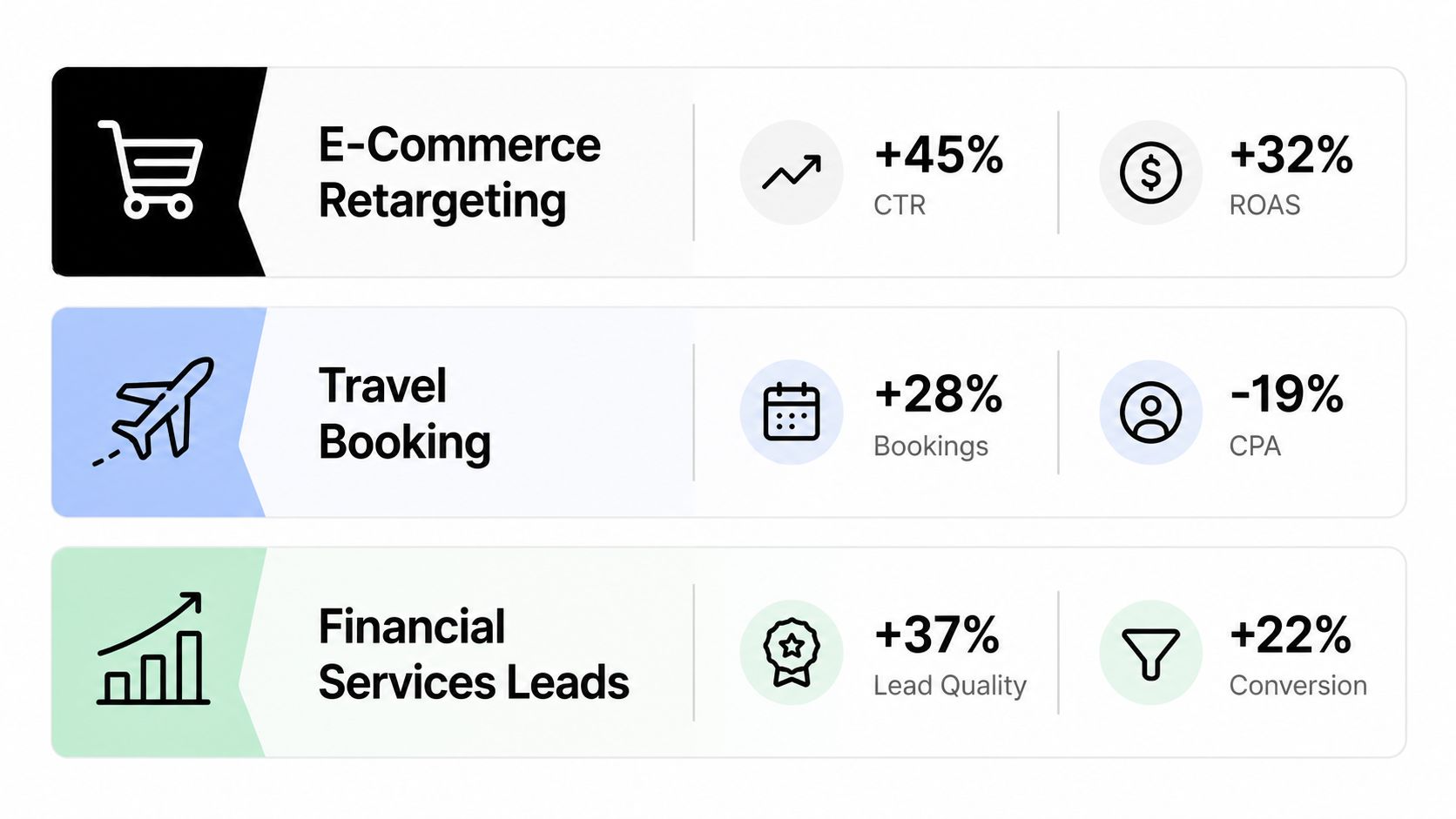
The useful lesson isn't that DCO automatically wins. It's that a modular system can widen the optimization window and reduce dependence on one exhausted ad. The SocialRails summary describes fatigue lasting roughly 7–14 days for static creative versus 21–60+ days with continuously rotated DCO combinations. That mechanism makes sense when the system has distinct concepts to rotate, not minor cosmetic edits.
Criteo's formal DCO work identifies advertising fatigue, retargeting, and user diversity as concrete constraints, and describes offline optimization through network flow and an asymptotically optimal online algorithm in its technical overview of DCO. In plain English, the system must balance what has worked, what the audience has already seen, and how different users respond.
Criteo's DCO+ materials also claim 80% higher click-through rates and 150% higher conversion rates versus image ad campaigns, as reported in Ryze's summary of AI ad personalization and DCO. That's a hard benchmark worth knowing, not a target to paste into a forecast without validation.
Early winners can regress. A variant may benefit from a temporary audience pocket, cheap placement, or curiosity that doesn't survive broader delivery. Break performance down by market, audience, device, and placement before moving budget aggressively. If the result disappears outside the original pocket, you found a local winner, not a universal one.
DCO needs a media buyer who can read the interaction between audience signal and creative element. A candidate who only knows how to toggle dynamic creative in a platform may manage settings, but they won't necessarily manage the system.
Look for someone who can explain why a product feed should influence a product card, why a retargeting cohort might need a different offer, and how a missing value should trigger a fallback. They should understand multivariate testing, conversion lag, creative fatigue, placement quality, and the operational cost of producing another round of assets.
Ask candidates to diagnose a campaign where CTR rises but qualified conversion falls. Strong buyers will ask about event quality, attribution windows, audience mix, landing-page alignment, and spend concentration. Weak candidates will suggest adding more variants and increasing budget. That answer belongs in the bin marked “expensive enthusiasm.”
Ask how they'd handle a feed update that introduces invalid products or stale offers. Ask what they review daily, what they review weekly, and which decisions require creative or legal approval. Ask them to describe a real DCO test, including the original hypothesis, the signals used, the outcome metric, and what they changed afterward.
A useful media buyer job description should include these responsibilities explicitly. If the role description only mentions campaign setup, bidding, and reporting, you're hiring for platform maintenance rather than DCO ownership.
| Competency Area | What to Look For | Red Flags |
|---|---|---|
| Feed-based logic | Can map feed fields to creative behavior | Treats feeds as simple image folders |
| Testing design | Understands interaction effects and clean comparisons | Calls every rotation an A/B test |
| Measurement | Connects creative to qualified conversion or revenue | Optimizes CTR without qualification |
| QA and governance | Has handled fallbacks, approvals, and broken combinations | Assumes the platform catches everything |
| Fatigue management | Uses delivery and outcome signals to refresh assets | Waits for the campaign to collapse |
| Collaboration | Works comfortably with creative ops, data, and legal | Blames another team for every failure |
| Commercial judgment | Knows when complexity won't pay back | Adds automation because it looks advanced |
Hire for curiosity and operational discipline. The best DCO buyer isn't the person with the most platform jargon. It's the person who can spot a bad signal, challenge a seductive metric, and keep the creative machine supplied with useful, approved inputs.
HireMediaBuyers.com connects companies with pre-vetted media buyers and paid ads specialists, including talent experienced across major advertising platforms and ongoing optimization workflows. If your DCO system needs someone who can manage spend, creative fatigue, audience overlap, and conversion behavior rather than rely on automation alone, visit HireMediaBuyers.com to review the available hiring options.


