


You're probably here because you've already paid tuition to the School of Bad Marketing Hires.
You brought in a “digital marketer.” They built a pretty dashboard, talked about brand lift, posted a few cheerful graphs in Slack, and somehow turned your budget into a smoke machine. Traffic looked busy. Revenue looked bored. Six months later, you're back in the hiring market, slightly older, slightly meaner, and much less impressed by words like “omnichannel.”
Fair enough.
A real Growth Marketing Specialist isn't a prettier version of a generalist. They're the person who treats your funnel like a system, not a mood board. They test. They cut. They learn. They care about what happens after the click, not just whether the ad got applause. That distinction matters more now because the market is crowded with marketers who can talk tactics and very few who can build repeatable growth.
I've seen this movie too many times.
Founder hires a marketer because growth has stalled. The new hire says all the right things in week one. “Content engine.” “Full-funnel strategy.” “Community-led demand gen.” Very polished. Very LinkedIn. Then month three rolls around and the company has more meetings, more reports, more opinions, and no reliable answer to a simple question: what changed in the business that moved revenue?
That's the problem. Most bad marketing hires don't fail loudly. They fail politely.
A weak marketer loves soft accountability. They'll show reach, impressions, engagement, maybe a nice cost-per-click trend if you're lucky. A real growth operator starts somewhere less glamorous. They ask where conversion breaks, what activation looks like, where retention drops, and which channel deserves more budget after actual analysis.
If that sounds stricter, good. Hiring should feel stricter after you've been burned.
The market isn't making this easier. Marketing-related jobs in the US reached 1.77 million in May 2025, with core marketing roles growing 5.7% over two years, ahead of overall job growth. At the same time, 57% of agencies report slowing entry-level hiring because of AI according to this breakdown of marketing job growth trends. Translation: there are plenty of marketers around, but the senior technical people you need are harder to land.
You're not hiring for activity. You're hiring for judgment under uncertainty.
That's why founders get stuck. They know they need someone stronger, but they don't want another full-time confidence artist with a slide deck. In some cases, a fractional work model can help you buy expertise before you buy a permanent seat. Smart move, especially if you're still figuring out whether your bottleneck is acquisition, activation, or retention.
A growth marketing specialist is what companies usually mean when they say, “We need marketing to finally act like a revenue function.”
Not a social scheduler. Not an ad account babysitter. Not a brand poet.
Someone who can find an advantage, run disciplined experiments, and tell you what's working without hiding behind vanity metrics. Hard role to fill. Worth filling anyway.
Forget the fluffy definition. A Growth Marketing Specialist is a business scientist with a marketer's toolkit.
They don't worship channels. They investigate systems. Paid search, LinkedIn Ads, onboarding emails, landing pages, SEO, referral loops, lifecycle automation. To them, those aren't separate departments with separate egos. They're testable parts of one funnel.
Here's the simplest way to think about it. A media buyer tries to get better traffic. A growth specialist tries to improve the whole machine that traffic enters.
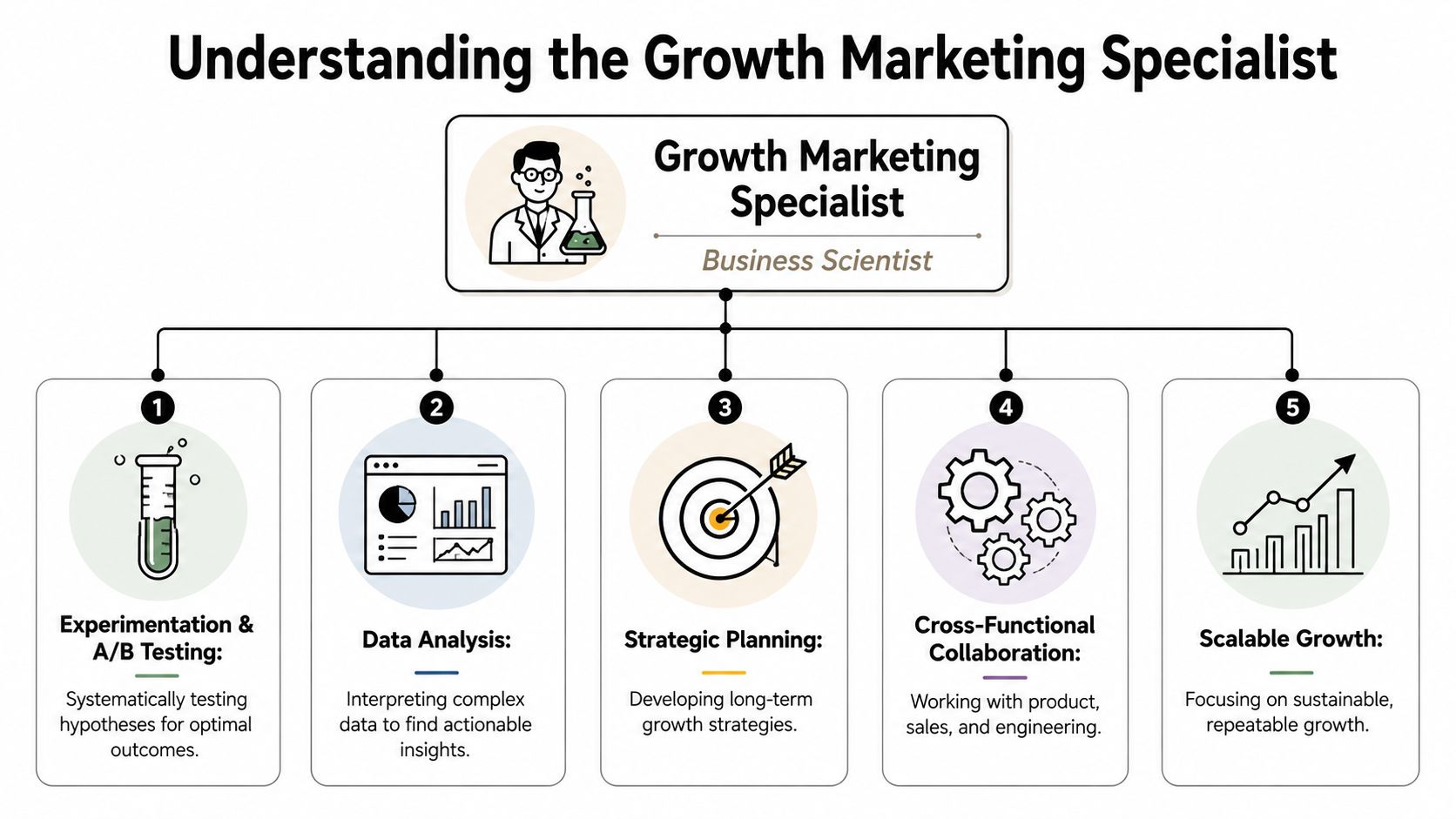
Most generalist marketers organize work by channel. Email over here. Paid over there. Content in another corner pretending it's a religion. Growth specialists don't think that way.
They organize around outcomes.
A proper one looks at your customer journey and asks questions like:
That's why the role often feels uncomfortable to traditional teams. It cuts across neat boxes. Product, sales, engineering, paid media, analytics. A growth specialist has to be annoying in all the right ways.
They run experiments, analyze results, adjust messaging, fix funnel leaks, prioritize what to test next, and keep everyone honest about what the numbers show. The best ones don't need a parade every time they launch something. They need clean data, enough authority to act, and colleagues who won't melt down when an experiment disproves a pet idea.
Practical rule: If a candidate describes growth as “creating buzz,” keep the interview short.
This role also sits below a growth marketing manager in many org charts. That matters because you should hire for the level you need. If you need somebody to own company-wide strategy, board reporting, and team leadership, you're likely looking beyond specialist level. If you need someone to execute and iterate across key funnel stages with real technical depth, specialist is the right lane.
A generic marketer asks, “What campaign should we run next?”
A growth marketing specialist asks, “What constraint is stopping growth, and what's the fastest valid test to prove it?”
That's the whole game.
If they can't explain the difference between activity and learning, they're not a growth hire. They're a marketing hire wearing a trendier jacket.
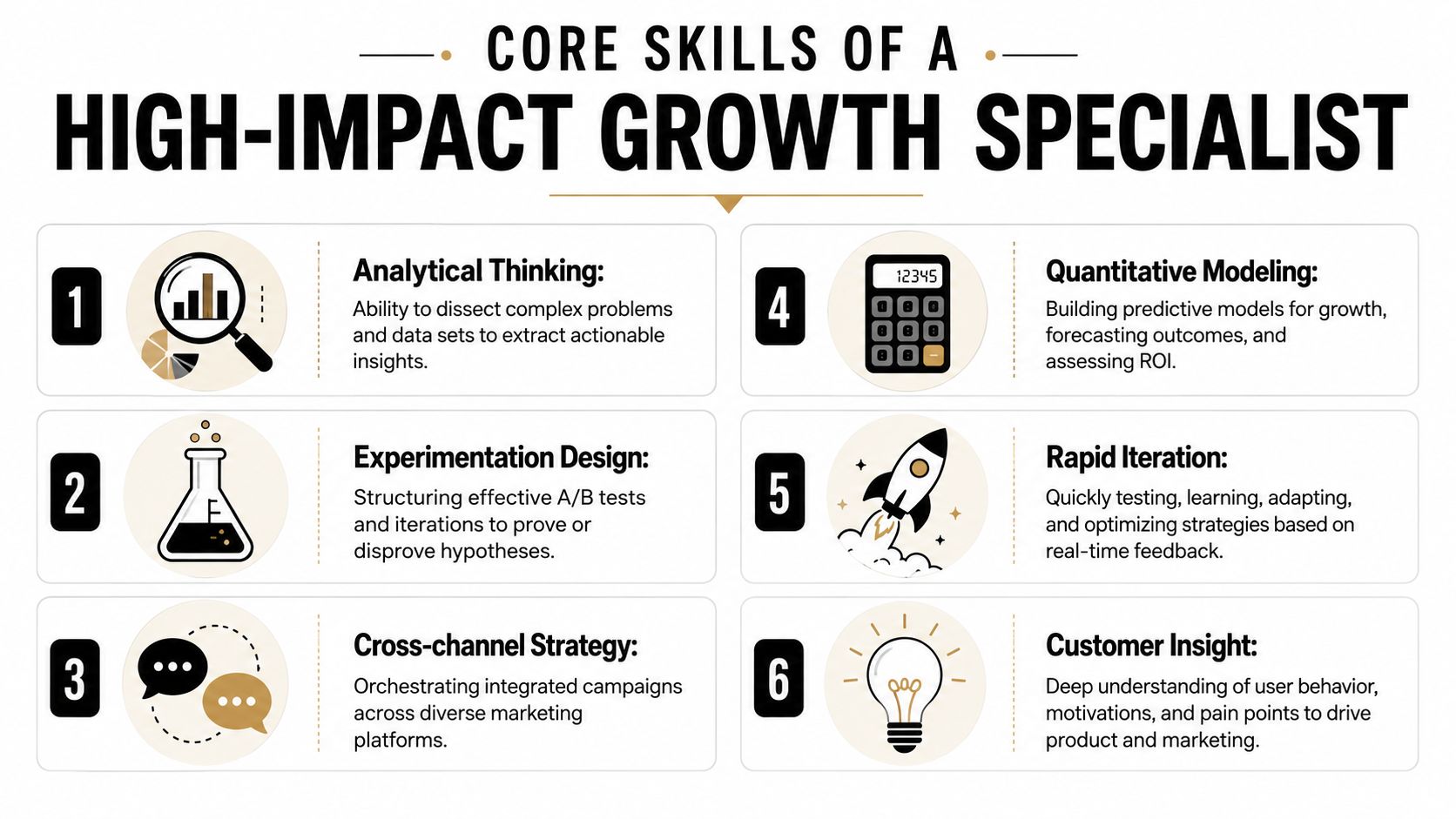
A growth marketing specialist's toolkit needs to go well beyond Canva, brand copy, and “strong communication skills.” You are hiring someone to find constraints, test fixes, and protect the company from bad reads on bad data.
That requires technical judgment, commercial instinct, and enough range to improve the whole funnel instead of polishing one channel report.
Hire for depth first. Breadth is useful, but only after the candidate proves they can do one or two hard things well.
A serious growth specialist usually brings three traits: strong analytics, disciplined testing, and one execution strength they can drive without hand-holding. That strength might be paid acquisition, lifecycle, CRO, or SEO. If they claim all of them at expert level, assume they are selling you fiction.
Here's what matters:
If you want a cleaner way to screen for this, use a skills-based hiring approach for marketing roles and stop rewarding polished CVs over proven ability.
At this stage, weak candidates usually crack.
A good growth specialist does not celebrate a lift before checking the setup. They ask whether tracking was clean, whether the sample was large enough, whether the audience mix changed, and whether the result will hold after the spike week passes. Optimizely explains in its guide to A/B test sample size and duration why underpowered tests produce misleading winners far more often than hiring managers want to admit.
That knowledge protects your budget.
If a candidate says, “We changed the CTA and conversions jumped,” your next question is simple. How did you validate it? If they cannot explain confidence, sample size, holdouts, or test design in plain English, you are listening to a campaign anecdote, not a growth operator.
AI now handles first drafts, basic research, reporting summaries, headline variations, and a lot of junior-level busywork. Good. That means your hire should spend less time producing marketing clutter and more time choosing better tests, spotting broken instrumentation, and connecting acquisition to retention.
Do not hire someone because they can prompt ChatGPT for ad copy. Hire them because they know what to test, what to ignore, and what to automate safely.
The strongest candidates use AI to increase speed. They still bring human judgment on positioning, experiment quality, and funnel economics. That is the part you pay for.
A media buyer goes deep on platform mechanics, audiences, bids, creative testing, and budget pacing. That is a real skill set. It is just not the whole job.
A growth specialist cares about the click and everything after it. Did the user activate? Did they retain? Did CAC produce revenue worth keeping? Did the funnel improve, or did the team just buy more expensive traffic and call it progress?
HubSpot's breakdown of customer acquisition cost is a useful reminder here. Acquisition only matters if it leads to profitable customers. That sounds obvious. Plenty of candidates still talk like post-click performance is somebody else's problem.
Good growth hires do not brag about being data-driven. They show you how they killed weak ideas before those ideas killed budget.
Most job descriptions for growth roles are terrible.
They read like someone dumped three marketing jobs, one analytics job, and a therapy requirement into a blender. Then they wonder why the applicants are either wildly unqualified or suspiciously available.
If you want a serious growth marketing specialist, stop writing a wish list. Write a filter.
“Manage paid campaigns” is lazy. So is “own email marketing.” Those are tasks. Tasks attract task-doers.
Stronger candidates respond to a brief that shows you understand the business problem. Tell them what success looks like in the role. Say what funnel stage needs attention. Name the channels they'll touch. Make it obvious that this is a role for someone who can diagnose and improve a system.
Use language like this:
See the difference? You're advertising for an operator, not a marketing intern with ambition.
Here's the part most companies botch. Eighty percent of job postings for growth marketers omit emerging requirements like SQL and AI-dashboard interpretation, even though those skills are now required in 65% of roles. AI automation is also replacing 40% to 60% of manual A/B testing and campaign optimization tasks according to this review of current growth marketing specialist hiring gaps.
So if your JD still asks for “hands-on campaign execution” but says nothing about AI-assisted workflows, data interpretation, or SQL, you're advertising for yesterday's marketer.
Include these signals:
| What to include | Why it matters |
|---|---|
| Primary business goal | Tells strong candidates where the real constraint sits |
| Tools they'll use | Separates actual technical work from vague “growth” branding |
| Experiment ownership | Signals that the role is accountable for learning, not just shipping |
| AI expectations | Screens for people who can work with automation instead of being replaced by it |
| Cross-functional scope | Attracts candidates who can influence beyond a single channel |
And please stop asking for “rockstars,” “ninjas,” or “self-starters with startup grit.” That language doesn't make you sound selective. It makes you sound like you'll under-resource the role and over-celebrate chaos.
The résumé is the trailer. The interview is where you find out whether the movie has a plot.
A lot of candidates can speak fluent growth. Fewer can think under pressure. Fewer still can explain a messy experiment without performing for your approval. That's who you want.
Start with a real conversation, not a corporate séance.

Good interview questions force a candidate to reveal process, trade-offs, and judgment. Weak ones invite rehearsed TED Talk answers.
Use prompts like these:
Walk me through a failed experiment.
You want honesty, diagnosis, and learning. If they present every test as a triumph, they're either lying or they've never run enough of them.
How would you choose the north star metric for our business?
Their answer should involve business model, customer journey, and trade-offs. If they jump to traffic, you've learned something useful.
What would you audit in your first two weeks here?
Listen for order of operations. Strong candidates usually start with tracking integrity, funnel performance, channel quality, and customer behavior.
Tell me about a time data contradicted your intuition.
This one catches ego fast.
The best candidates ask clarifying questions before they answer. The worst ones answer instantly because they're pitching, not thinking.
Don't send a bloated take-home assignment that steals a weekend. Give them a focused scenario.
Try something like this: your demo bookings are flat, paid spend is active, traffic quality looks decent, and trial signups aren't converting to sales conversations. Ask the candidate to outline how they'd investigate, what they'd prioritize first, what hypotheses they'd test, and which teams they'd involve.
You're not looking for perfect slides. You're looking for signs of a brain you can trust.
A strong candidate usually does a few things well:
A weak candidate does the opposite. They prescribe channels immediately, assume the problem is top-of-funnel, and bury uncertainty under confidence.
Don't skip reference checks because you're tired. Tired founders make expensive hires.
Use references to verify how the person worked, not just whether they were “great.” Ask whether they owned metrics, whether they changed course when data challenged them, and whether they needed heavy supervision. If you want a useful framework, review how to run better client references and make the calls count.
One more thing. If the candidate can't explain a dashboard they built, a test they ran, and a decision they made because of it, they're not ready. Simple as that.
Here's the trap. A founder gets burned by one weak hire, panics, and decides the fix is a full-time person sitting ten feet away. That usually buys visibility, not performance.
A growth marketing specialist is not a hall monitor. If the person needs an office to produce, you hired the wrong person.
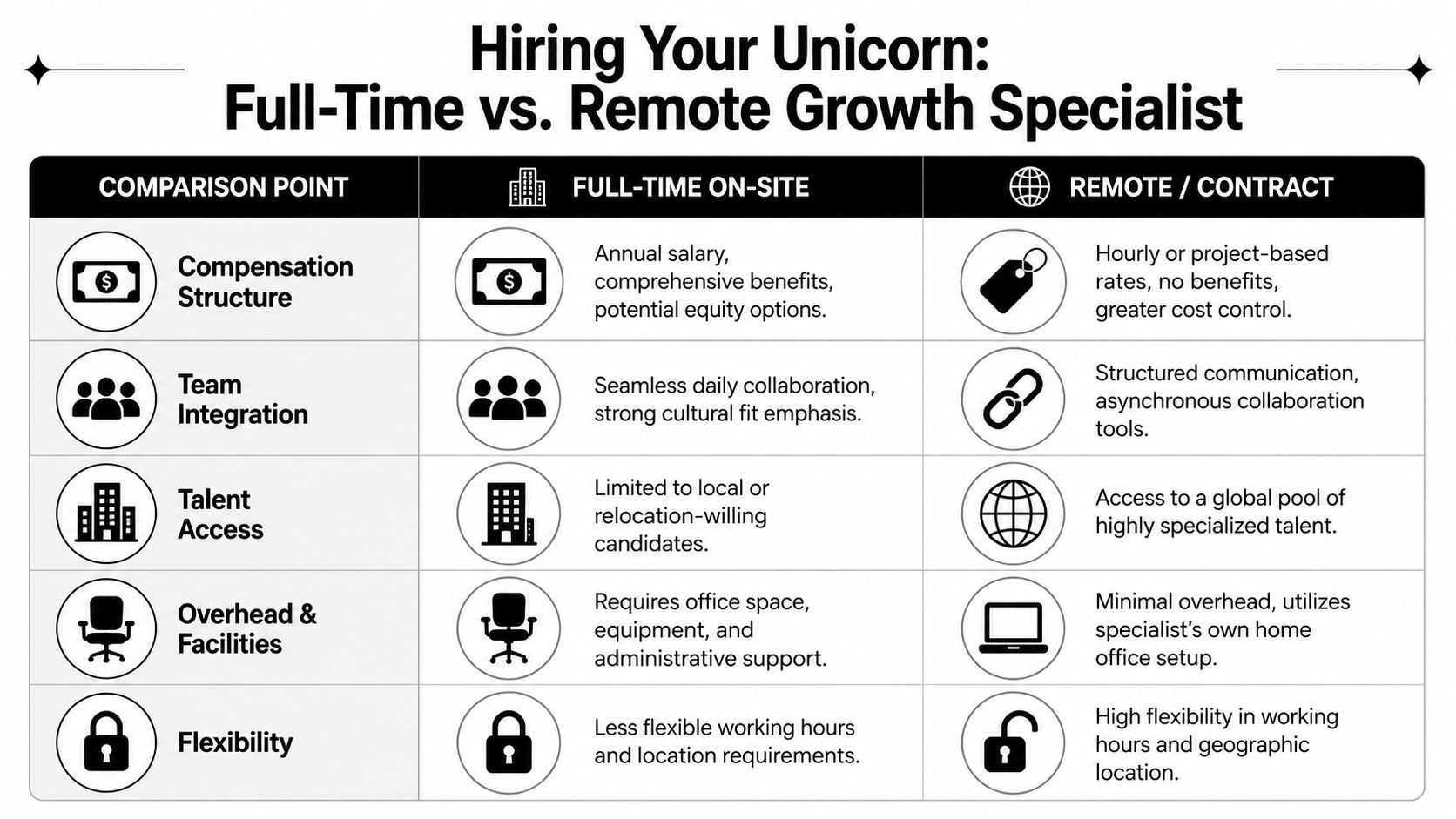
If you hire in the US, expect real payroll, not bargain-bin payroll. Salary estimates from Glassdoor's growth marketing specialist salary data show the role commonly sits in a professional mid-career compensation range, and strong candidates will expect more if they can own experiments, reporting, and cross-functional execution without hand-holding.
That cost is fine if the person can find bottlenecks, run useful tests, and improve revenue. It gets stupid fast if you're paying full-time money for a polite generalist who mainly posts updates and asks for more budget.
Use the hiring model that matches the problem.
| Model | Best for | Watch out for |
|---|---|---|
| Full-time in-house | Companies with enough growth work every week to justify embedded ownership across product, sales, and marketing | Higher fixed cost, slower hiring, and a smaller talent pool if you insist on local candidates |
| Freelancers | A channel-specific gap, a short sprint, or execution support under a clear strategy | Split ownership, patchy availability, and very little incentive to fix issues outside their lane |
| Vetted remote specialist | Teams that want strong operator talent, broader hiring reach, and faster ramp time | Weak managers struggle here because remote work exposes sloppy goals and messy communication |
My recommendation is simple. Hire full-time if you already know the role, the scorecard, and the weekly priorities. Hire remote if you need a sharper candidate pool and you can manage to outcomes.
Freelancers sit in a different bucket. They are useful for pieces of the machine. They rarely build the machine.
AI changes this decision too.
A weak marketer uses AI to flood your funnel with more junk. A strong growth specialist uses it to speed up research, draft test variants, summarize calls, clean messy datasets, and ship faster without lowering standards. That makes remote talent more attractive than it was a few years ago, because the best operators now produce more output with less overhead.
Do not confuse AI fluency with strategic judgment, though. If a candidate talks like a prompt engineer but cannot explain how they choose a metric, kill a test, or work through attribution gaps, keep looking.
If you need deep day-to-day collaboration with product and sales, and you can afford a real operator, hire full-time.
If you are still proving the function, fixing a messy funnel, or recovering from a bad local hire, a vetted remote specialist is often the smarter bet. Wider talent pool. Faster hiring. Less overhead. Same standard for results.
One warning. Remote does not mean cheap and it definitely does not mean hands-off. It means you need clear goals, clean reporting, and an adult manager. If your team cannot do that, the problem is not geography. It is management.
The smartest companies don't hire a growth marketing specialist because the title sounds modern. They hire one because they're done confusing marketing activity with business progress.
That's the shift.
You're not looking for a person who can “handle digital.” You're looking for someone who treats growth like an operating system. Someone who can inspect the funnel, frame a test, read the evidence, and improve the business without needing a standing ovation after every campaign launch.
Keep it simple.
Green lights
Red flags
Hire the person who can tell you why a test shouldn't run, not just the person eager to run everything.
My recommendation is simple. Stop gambling on broad marketing hires when what you need is a specialist with analytical teeth. If revenue matters, accountability has to sit closer to the work. A proper growth marketing specialist gives you that. Not magic. Not hype. Just a better way to build repeatable growth.
If you need paid acquisition talent with actual screening behind it, HireMediaBuyers.com is a practical place to start. The platform helps US companies hire pre-vetted media buyers and paid ads specialists quickly, with flexible remote options, time zone alignment, and support for payroll, compliance, and replacements. If your growth plan needs stronger execution on the paid side, that's a much better bet than rolling the dice on another shiny résumé.


