


Most advice on how to choose keywords for SEO is backwards.
It tells small businesses and service companies to chase the biggest numbers on the screen, as if ranking for a giant head term is some noble quest. It isn't. It's usually a slow, expensive hobby. You'll burn months creating content for broad terms, watch bigger brands sit on page one like they own the deed, and then wonder why the traffic that does arrive acts like it wandered in by accident.
If your business needs leads, sales calls, booked demos, or actual customers, time-to-ROI matters more than raw search volume. That's the uncomfortable part most keyword guides skip. They'd rather sell you the fantasy than tell you the truth.
The instruction is simple: Choose keywords that mirror real buyer problems, real buying language, and realistic ranking opportunities. Everything else is vanity with better formatting.
The rookie mistake is obvious. You open Ahrefs or Semrush, sort by volume, and start drooling over the biggest keywords in your market. “Marketing.” “CRM.” “Facebook ads.” Good luck with that.
That strategy works if you have serious authority, serious budget, and enough patience to watch paint dry for months. For everyone else, it's like trying to win a heavyweight title because you bought gloves.
For brands with limited organic history, clusters of low-to-medium-volume, long-tail keywords with explicit intent can generate measurable leads in 60–90 days, while broad terms often remain below page one for 6–12 months or more, according to AmericanEagle's keyword selection guidance.
That's the difference between a keyword strategy and a wish.
If you're an SMB or agency, your SEO plan shouldn't be built around “what gets the most searches.” It should be built around “what can rank soon enough to matter.” If you need a reality check on budget before you go all-in, this breakdown of SEO cost for small business is worth reading.
Practical rule: If a keyword looks glamorous but won't help you win business this quarter, it belongs lower on the list.
There's another reason broad-keyword obsession is dumb. Search demand is wildly concentrated. Research cited in a ScienceDirect record of Ahrefs' SERP analysis found that roughly 90.6% of pages receive no organic traffic from Google, and that top-10 ranking pages capture about 90% of clicks for many commercial queries. The same analysis also showed that long-tail keywords with fewer than 100 monthly searches collectively account for the bulk of overall search demand via this ScienceDirect reference.
That should change how you think about keyword selection.
Not every useful keyword needs to be huge. In fact, many of your best opportunities will look small in isolation and strong in aggregate. A service business doesn't need one heroic keyword. It needs a pile of buyer-intent phrases that all point toward the same commercial problem.
Here's the test I use. Ask yourself this.
Would I rather rank for a broad term that attracts curiosity, or a narrow phrase typed by someone who already knows what hurts?
A service buyer doesn't always search by service label. They search by headache. They search by failed outcome. They search by urgency. That's where the money lives.
If your keyword list makes you feel important but not profitable, toss it.
Put the tools away for an hour.
Your best seed keywords usually aren't hiding inside a dashboard. They're sitting in sales call transcripts, support tickets, lost-deal notes, onboarding docs, and Slack messages from annoyed prospects asking some version of “why isn't this working?”
That's where useful keyword research starts. Not with software. With listening.

A standard workflow is to begin with 5–10 broad seed topics based on your core offerings, then expand those into hundreds of long-tail variations using tools, as outlined in Ahrefs' keyword research workflow.
That part is right. What many overlook is where those first 5–10 topics should come from.
Not your homepage nav. Not your internal jargon. Not whatever your founder keeps repeating on LinkedIn.
Use the language customers already use:
If you're refining these audience buckets, a practical primer on audience segmentation helps keep your keyword themes aligned to actual buyer groups instead of one blob called “target market.”
Product companies have it easier. Buyers often search for the thing itself. Service businesses don't get that luxury.
A buyer looking for paid media help might search:
Notice what's happening. The search isn't “service name + city.” It's diagnosis, frustration, and implied urgency.
Customers rarely search the way your service page is written. They search the way they complain.
That's why generic keyword lists fail service firms. They over-index on broad service labels and underplay consultative search behavior.
Founders and marketers love to “clean up” customer language. Don't. The ugly version is often the useful version.
Create a simple capture sheet with three columns:
| Source | Exact phrase | Likely intent |
|---|---|---|
| Sales call | “Need someone to fix Meta ads fast” | transactional |
| Support ticket | “Google Ads stopped converting” | diagnostic |
| Lost deal note | “Wanted part-time specialist, not agency” | commercial |
Then look for repeated themes. Those become your seed topics. Clean them up later, after you've validated them. Early on, your job is not to sound smart. It's to hear clearly.
Now you can open the tools.
At this point, most keyword ideas die, which is good. They should. A list of ideas is not a strategy. It's a junk drawer until you run each phrase through a proper gauntlet.
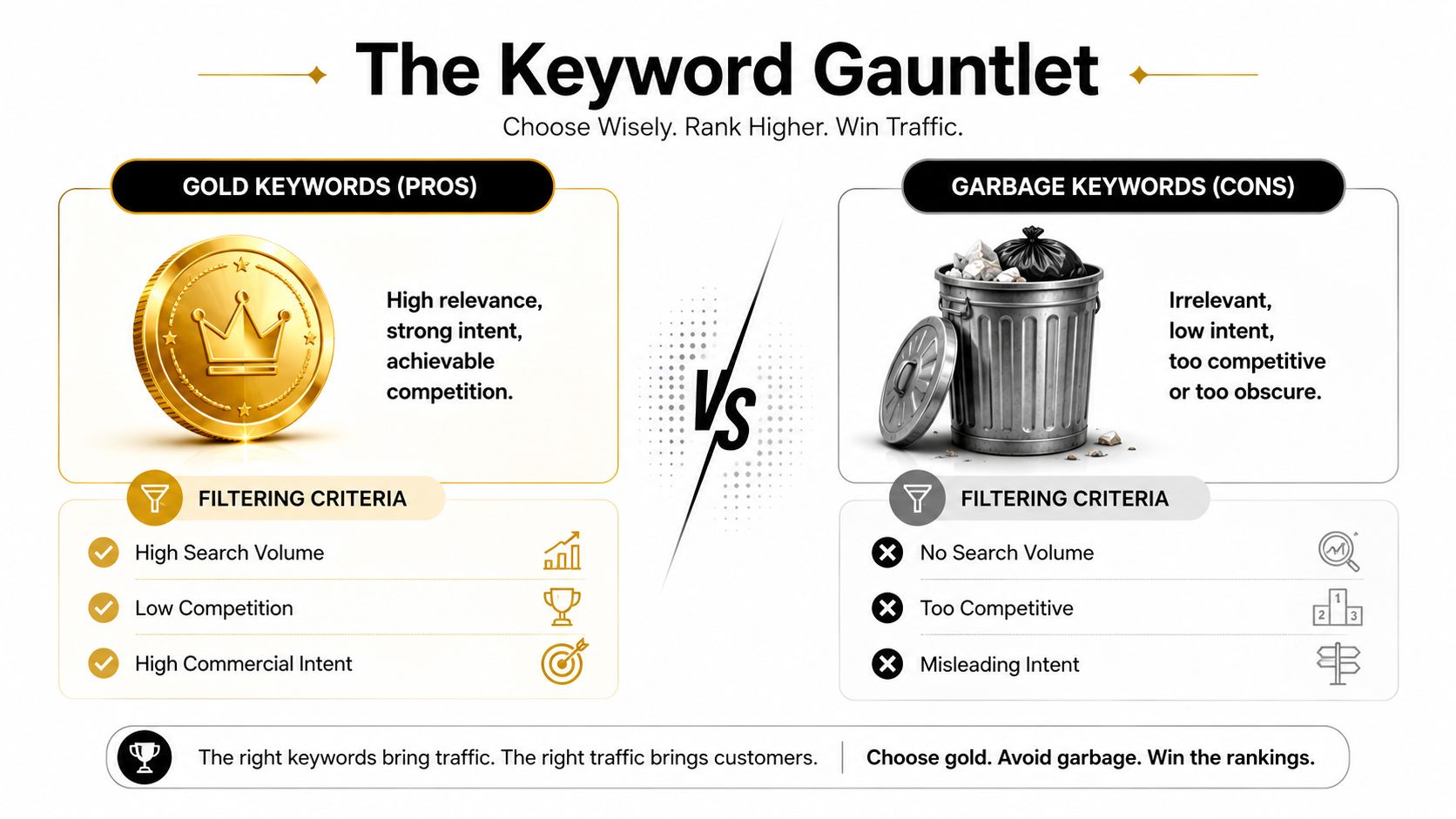
For initial traction, the practical benchmark is this: target keywords with 500–1,000 monthly searches, a difficulty score below 30–35, and SERPs that aren't dominated by rich results or a single brand. Done well, these can produce ranking success rates of 40–60% within 6 months.
That's not a law of physics. It's a useful filter.
Here's the short version:
Demand
Enough search volume to matter. Not massive. Just enough that success moves the needle.
Difficulty
If the tool shows a difficulty score in the beatable range, good. If it looks brutal, believe it.
SERP cleanliness
If Google crams the page with ads, maps, shopping boxes, giant brands, and answer boxes, your ranking upside shrinks fast.
A quick comparison makes this easier.
| Type | What it looks like | Verdict |
|---|---|---|
| Gold | Specific problem, buyer intent, beatable SERP | Prioritize |
| Gold | Commercial phrase with decent volume and manageable difficulty | Prioritize |
| Garbage | Huge volume, vague intent, giant incumbents | Avoid early |
| Garbage | Looks relevant but SERP is packed with Google features | Usually skip |
| Garbage | Sounds clever internally, nobody searches it that way | Bin it |
This is why keyword tools mislead inexperienced teams. They show search volume like it's the headline metric, when the key question is whether you can win clicks and turn them into revenue.
Don't trust the tool blindly. Search the keyword yourself.
If the results are product pages, service pages, and comparison pages, that tells you something. If the results are Wikipedia, definition posts, beginner explainers, and forum threads, that tells you something else.
A few things I look for manually:
Reality check: A “good” keyword on paper can still be a bad keyword in practice if the SERP makes organic clicks hard to win.
Founders generally demonstrate greater proficiency than junior SEOs. You know what a buying signal sounds like.
A query like “how does paid media work” may bring visitors. Fine. A query like “hire paid media specialist for ecommerce” is a different animal. One person is browsing. The other is shopping.
Here's how I sort them:
Service companies should not build a keyword plan that's all educational fluff. You need some of it, sure. But if your list lacks hiring, pricing, service, problem-fix, comparison, and alternative terms, you're building a library instead of a pipeline.
A keyword can be relevant and still be a terrible target.
“Advertising” might be relevant to your business. So is “marketing strategy.” So is “customer acquisition.” That doesn't mean you should waste a quarter trying to rank for them.
If the phrase is broad, fuzzy, and disconnected from a buyer moment, it's probably garbage for a resource-constrained team. Harsh, but helpful.
One keyword per page is not a strategy. It's a lonely little bet.
The stronger play is intent clustering. Group related queries that point to the same need, then build one solid page that deserves to rank for the whole set. Think squads, not lone wolves.
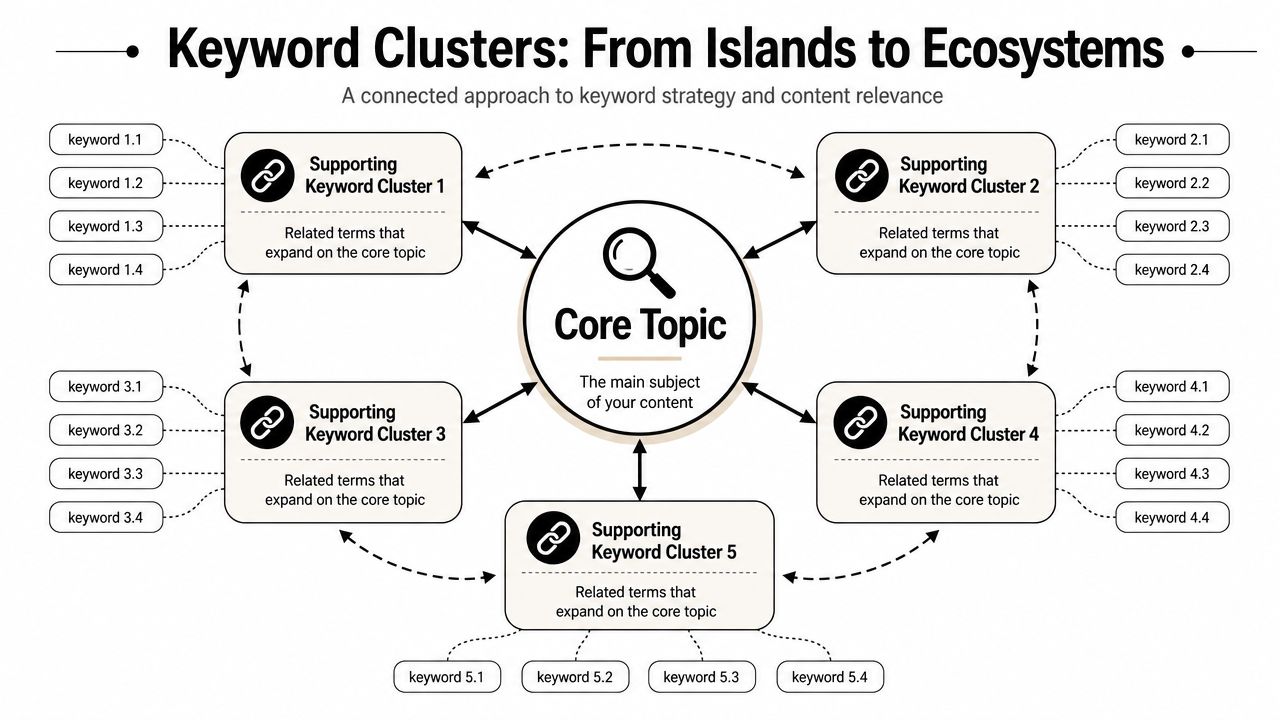
When multiple keywords share the same top search results, they usually share the same intent. Grouping those into intent clusters for one page can increase the share of pages ranking in the top 10 from 30% to 50–60% within a year.
That's a big shift, and it lines up with what many operators learn the hard way. Separate pages for tiny wording variations often create thin content, duplicate effort, and self-inflicted cannibalization.
For example, these may belong together if the top results overlap heavily:
Those are not four separate empires. They're one buying conversation wearing different hats.
I like to group keyword clusters around the job the buyer wants done.
Not around grammar. Not around every variant a tool spits out.
A clean cluster often includes:
Here's a simple model:
| Cluster theme | Primary keyword | Supporting phrases |
|---|---|---|
| Hiring help | hire paid media specialist | find ads expert, outsourced paid media manager |
| Fixing performance | why are my Meta ads not converting | reduce CPA, improve paid social results |
| Evaluating options | agency vs freelancer for Google Ads | in-house vs contractor, outsourced PPC help |
This is where discipline matters.
If a cluster points to hiring intent, build a service or landing page. If it points to evaluation, build a comparison page. If it points to diagnosis, build a strong educational piece that naturally leads toward the service.
Don't cram mixed intent onto one URL just because the phrases feel related.
If Google keeps showing different result types for similar-looking keywords, that's your cue to split the cluster.
That one habit saves a lot of pain later.
Founders usually hate hearing “create more content” because they've already paid for enough mediocre posts to wallpaper a hallway. Fair.
Clustering isn't about publishing more random pages. It's about publishing fewer, stronger pages that cover a topic completely. Then support them with adjacent assets where the SERP clearly asks for something different.
That's how you build an SEO moat for a niche service category. You stop treating every keyword like a separate campaign and start treating related intent like an ecosystem.
And yes, this also makes briefs less chaotic. Your writer knows the page's main job. Your SEO isn't inventing three near-duplicate articles because a tool exported three phrasing variations. Everybody sleeps better.
A spreadsheet full of keyword clusters is still useless if it never becomes a publishing plan. This is the part where strategy either turns into revenue or dies in a Google Sheet with twelve tabs and one color-coded legend nobody understands.
Keywords need to map to content by buyer stage and page purpose.
A core rule is simple. Assign one primary keyword per page, then support it with related long-tail variants in headings and body copy to build topical authority and avoid cannibalization, as covered in this keyword mapping guide from Wow Infotech.
That means one page, one main job.
Here's the practical version for a service business:
Top of funnel
Problem-aware searches. These usually belong in blog posts, guides, or educational resources.
Middle of funnel
Comparison and solution-aware searches. These often fit comparison pages, service explainers, or strong case-style content.
Bottom of funnel
Ready-to-buy phrases. These belong on service pages, landing pages, hiring pages, or pricing-related pages.
Let's say you run a performance marketing service.
| Funnel stage | Keyword example | Best page type |
|---|---|---|
| Top | why are my ad costs so high | blog post |
| Middle | agency vs freelance media buyer | comparison page |
| Bottom | hire paid media buyer for ecommerce | service page |
That's what “how to choose keywords for SEO” should lead to in practice. Not a giant pile of terms. A clear map from search to page type to conversion path.
This happens all the time. Someone finds a keyword, someone else writes a post, and six weeks later nobody can explain what that piece is supposed to do.
Fix it with a simple content brief template:
Primary keyword
The main phrase the page is built around.
Cluster support terms
Related long-tail phrases that belong in subheads, body copy, FAQs, and internal links.
Intent
Informational, commercial, transactional, or diagnostic.
Target page type
Blog, service page, comparison page, location page, or template.
Conversion goal
Demo request, contact form, booking, signup, or assisted conversion.
Good content plans remove ambiguity. Each page knows why it exists and what keyword job it's responsible for.
That alone prevents a lot of cannibalization and “why did we publish this?” meetings.
Once pages go live, it's a common mistake to immediately do the wrong thing. They obsess over rankings in isolation.
That's a fine way to feel busy. It's not a fine way to improve performance.
A smarter move is to look for movement, impressions, and commercial traction. Especially early on. Your best next keyword opportunities often come from pages that are already close, not from net-new ideas cooked up in a brainstorm.
A common quick-win strategy is to use Google Search Console to find keywords already sitting on positions 11–20 with impressions, then optimize those pages to push them into the top ten, as described in Semrush's guide to choosing SEO keywords.
That's one of the most impactful things you can do in the first 90 days.
Why? Because Google is already giving you a signal. The page is relevant enough to show up. It just needs a stronger push.
Here's the quick workflow:
Export queries from Google Search Console
Sort by position and impressions.
Filter for positions 11–20
Those are your near-miss opportunities.
Update the page
Tighten the title, improve headings, add missing subtopics, strengthen internal links, and sharpen the conversion path.
Watch for outcome, not ego
More impressions are nice. More leads are better.
If you're not tying SEO work to business outcomes, set up better conversion tracking before you drown in vanity reporting.
A keyword that drives traffic but no inquiries is not automatically useless, but it should earn its keep. A keyword that produces sales conversations deserves more investment.
Track performance at two levels:
| Metric type | What to check |
|---|---|
| Search performance | impressions, clicks, average position |
| Business performance | form fills, booked calls, qualified leads |
Many SEO programs often fall short. They can report visibility. They can't report commercial impact.
Rankings are a clue. Conversions are the verdict.
In the first stretch, don't wait for some perfect annual review. Review what's moving, what's stalled, and what's attracting the wrong audience.
Then make decisions:
That's how SEO compounds. Not through magical hacks. Through repeated, boring, profitable decisions. Toot, toot.
If your SEO strategy is attracting traffic but not revenue, the issue usually isn't effort. It's alignment. HireMediaBuyers.com helps companies find pre-vetted media buyers and paid ads specialists who understand performance, attribution, and what drives growth. If you need operators who can connect search, paid media, and conversion-focused execution without turning hiring into a second full-time job, it's a smart place to start.


