


Small business SEO usually lands around $1,500 to $3,500 per month. But that number is almost useless on its own, because SEO pricing only makes sense once you understand what you're paying for, how often you need it, and whether your site needs a tune-up or a full engine rebuild.
If you're reading this, you've probably got three SEO proposals open right now.
One is weirdly cheap. One costs more than your office rent. One looks like it was written by a committee of buzzwords. All three claim they'll “increase visibility,” “improve rankings,” and “drive qualified traffic.” Toot, toot. Very impressive.
The problem isn't that SEO is fake. The problem is that SEO is sold like a product when it's really a mix of labor, judgment, and ongoing maintenance. That's why the same small business can get quotes that are miles apart and all of them can sound vaguely reasonable.
You get three SEO proposals. One is cheap enough to feel safe. One is expensive enough to make you angry. One is packed with charts, jargon, and vague promises about growth.

Here's the problem. The monthly number is only half the story.
A local roofer, a Shopify store, a B2B software company, and a dentist with an old WordPress site can all get wildly different quotes for perfectly legitimate reasons. Scope changes the price. Site condition changes the price. Competition changes the price. So does who is doing the work, which matters a lot if you are weighing agency vs in-house SEO support.
Founders compare SEO quotes the way they compare bookkeeping, payroll, or internet service. That is a mistake. SEO is closer to hiring a mechanic to diagnose a car with a mystery noise. The bill depends on whether you need a quick tune-up, a parts replacement, or a full rebuild because somebody ignored the warning lights for two years.
That's why a low quote can be a waste of money, and a high quote can still be cheap.
A bargain package often means keyword tracking, a few on-page edits, and a report nobody asked for. A stronger package may include technical fixes, content production, internal linking, local SEO work, and someone who will log in and make the changes instead of sending you a to-do list. Those are different jobs with different labor behind them.
Here's the filter I use:
If a provider cannot explain those four points in plain English, the proposal is not ready to sign.
Frame the decision around the job in front of you. A small local business with decent pages and weak maps visibility needs one kind of SEO. A company with duplicate pages, slow load times, no content strategy, and zero internal linking needs another. Some businesses need a short project first. Some need steady monthly support. Some should fix their offer, website, or sales process before spending a dollar on SEO.
That is how to think about the price. You are not buying a magic ranking subscription. You are paying for specific work, delivered at a certain pace, to solve a specific growth problem. Once you see it that way, bad proposals get easy to spot.
SEO is usually sold in four flavors. Three are normal. One is often dressed up better than it deserves.
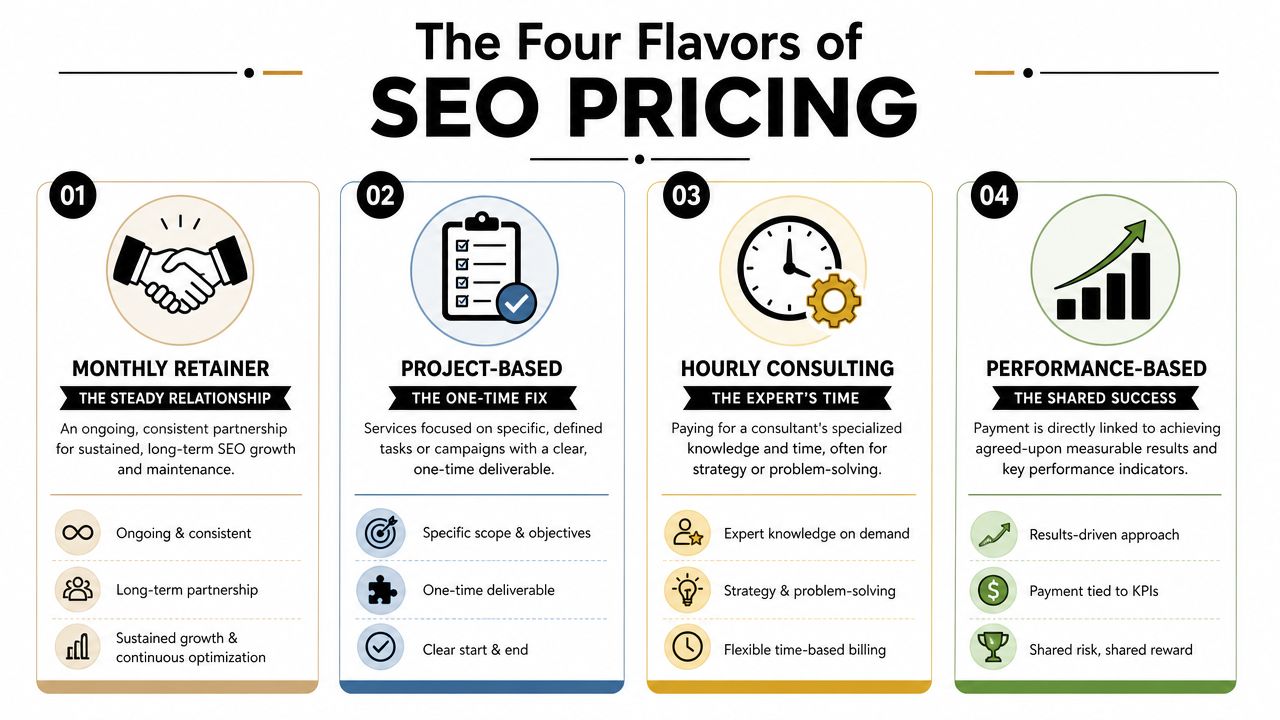
Many pricing guides push the monthly retainer as the default. But the key decision is cadence. A short setup project and an ongoing retainer solve different problems. As Arc 4's SEO pricing guide notes, one-time projects can range from $500 to $30,000 depending on scope, while monthly retainers can run from $500 to $5,000+.
This is the steady relationship. You pay every month, and the provider handles ongoing SEO work.
For some businesses, this is exactly right. If you need continuous content, link acquisition, technical fixes, reporting, and local optimization, a retainer makes sense. SEO isn't a crockpot you switch on once and ignore forever.
The catch is simple. Retainers are easy to sell and easy to bloat.
If your provider hasn't separated foundation work from maintenance work, you're probably overpaying. A lot of businesses need a cleanup sprint first, then lighter support. Instead, they get shoved into a full retainer because that's the agency menu.
This is the one-time fix. Good for site audits, content overhauls, migrations, local SEO setup, or getting a sane roadmap in place.
I like project work when the business has a clear bottleneck. Broken site structure? Messy local listings? Thin service pages? Great. Fix the thing. Don't sign a long contract just to feel “strategic.”
The downside is obvious. Once the project ends, somebody still needs to do the work that follows. Recommendations don't implement themselves. Your title tags will not update out of gratitude.
This model is useful when you already have internal help and just need a sharp brain in the room.
A strong consultant can review strategy, prioritize work, catch technical issues, and stop your team from doing dumb things. That's valuable. It can also become expensive if you're paying by the hour for basic execution that a lower-cost operator could handle.
The hidden gotcha is drift. When nobody owns outcomes, you end up buying opinions instead of progress.
This is the full-time commitment. Sometimes it's right. Usually, small businesses jump to it too early.
An in-house SEO hire makes sense when SEO is core to the company, the workload is constant, and you already know how to manage the role. If you don't, hope you enjoy spending your afternoons screening resumes and pretending you can tell the difference between a real operator and someone who watched a few audits on YouTube.
If you're weighing team structure more broadly, this breakdown of agency vs in-house marketing hires is worth a look.
| Model | Best For | Typical Cost | Biggest Risk |
|---|---|---|---|
| Monthly retainer | Ongoing growth and maintenance | $500 to $5,000+ | Paying every month for vague activity |
| Project-based | Setup, cleanup, audits, focused fixes | $500 to $30,000 | Getting a roadmap without execution |
| Hourly consulting | Strategy, oversight, troubleshooting | Qualitative, varies by scope and expert | Meter keeps running without clear ownership |
| In-house hire | Businesses with sustained SEO workload | Qualitative, salary plus management overhead | Hiring the wrong person and finding out slowly |
SEO cost isn't just about price. It's about cadence. Some businesses need continuous work. Others need a strong setup and a lighter hand after that.
You don't buy “SEO” the way you buy a laptop. You're buying labor against a specific business problem. The price moves based on how ugly the problem is.
This is the one owners underestimate most. If your site has crawl issues, duplicate pages, broken internal links, indexation messes, canonical confusion, or a giant bloated structure, the SEO bill climbs fast.
According to Impact's technical SEO pricing breakdown, a technical SEO site audit can cost about $3,000 to $5,000 for higher-end sites and can go much higher for very large or structurally complex sites. Implementation is often billed around $100 per hour on average and can rise to $175 per hour or more for stronger specialists.
That's the difference between “optimize a few pages” and “someone has to open the walls and redo the wiring.”
A local service business trying to win Google Business Profile visibility and service-area searches has a different job than an e-commerce store trying to rank category pages and product collections.
One wants better local relevance and trust signals. The other needs site architecture, collection page optimization, product content, and often a heavier technical layer. Same channel. Different workloads.
Factors that usually push scope up include:
If you want a measured pace, you can often stage the work. If you want aggressive execution, you're paying for more hours, more content, more technical attention, and tighter coordination.
A founder who says “we need SEO fast” usually means “we waited too long and now want urgency at a discount.” That's not how labor works.
A premium price doesn't guarantee premium work. It may just mean premium packaging. Still, real expertise costs more because experienced operators know where to focus and what to ignore.
That's worth paying for when the site is complicated or the stakes are real. It isn't worth paying for if all you need is a sensible local setup and someone to keep the basics clean.
You have three practical options. Agency. Freelancer. In-house.
All three can work. All three can waste your money if you pick the wrong one for the wrong stage.
Agencies are the expensive default because they sell reassurance. More meetings, more process, more decks, more people on the kickoff call than you'll ever see again.
The pricing gap is real. Ahrefs' SEO pricing analysis reports that agencies charge roughly 138% more than freelancers on average. That same analysis also notes local SEO averages about $1,557 per month, with the broader small-business market clustering around $500 to $5,000 per month.
Why the markup? Overhead, project management, account handling, and access to a wider team. Sometimes that extra structure is useful. Sometimes you're funding someone else's Slack channels and logo redesign.
Agency is a smart choice when:
Agency is a bad choice when:
Freelancers are often the best value if you know what you're hiring for.
They're usually leaner, faster, and closer to the actual work. If you need a local SEO specialist, technical auditor, or content-focused consultant, a strong freelancer can outperform a bloated agency without the account-management theater.
The risk is concentration. If that one person gets overloaded, disappears, or turns out to be better at self-promotion than execution, you're stuck.
For founders deciding whether to build externally first, this guide to outsourcing marketing companies covers the bigger tradeoffs.
Founders love the idea of in-house because it feels like control. Sometimes it is. Sometimes it's just payroll plus management plus a long lesson in hiring mistakes.
An in-house SEO can be excellent if your business has enough ongoing work to justify it and someone senior can manage priorities. Without that, you get random acts of optimization. A blog post here, a title tag there, zero commercial impact.
Hire in-house when SEO is a durable function inside the business. Don't hire in-house because one agency annoyed you.
If you're a typical small business, start here:
That's not glamorous. It's just cheaper than learning the hard way.
You own a small business. One SEO quote says $800 a month. Another says $4,500. Both promise growth. That spread is the first clue that SEO pricing is often about packaging, not logic.
Use the budget to buy the right kind of work for your business. A local service company, a niche online store, and a regional B2B firm should not buy the same SEO plan just because an agency sells one.
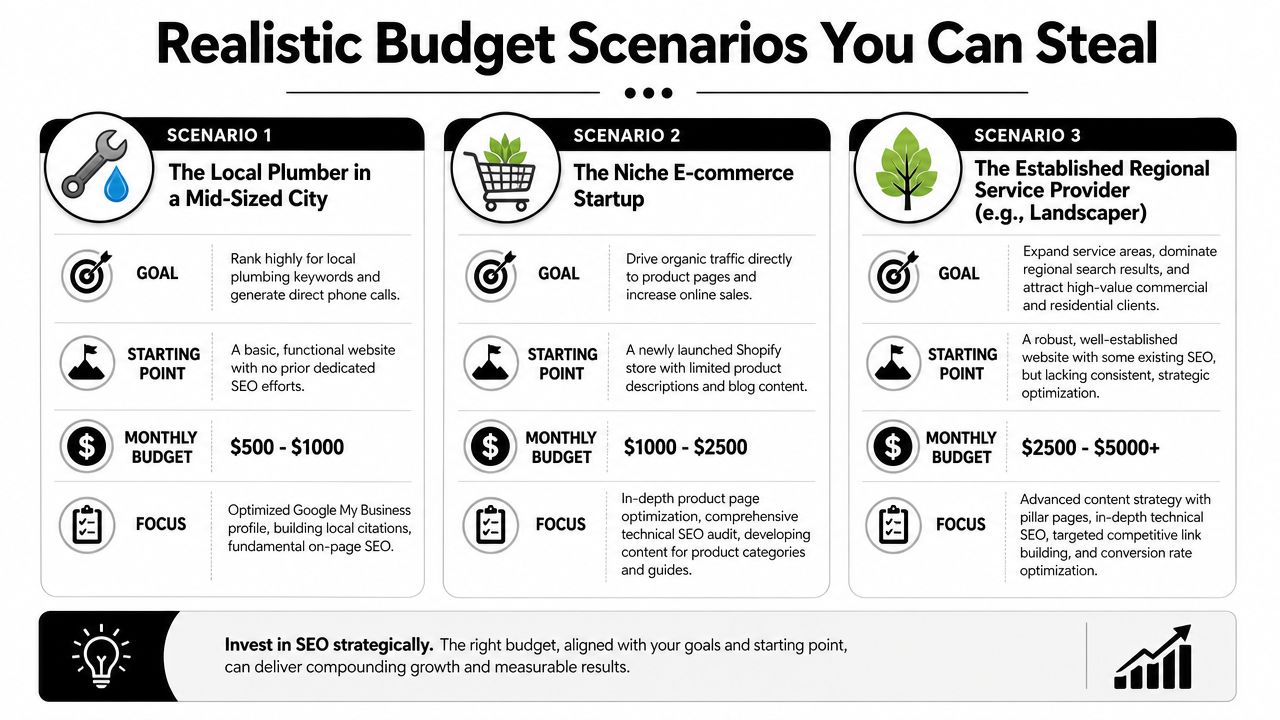
As noted earlier, small-business SEO usually lands somewhere between modest monthly support and a serious ongoing retainer. The question is simpler. Are you paying for work that can produce customers, or are you paying for activity that looks busy in a report?
This business needs calls from nearby homeowners. The target is not “more content.” The target is map visibility, stronger service pages, a clean Google Business Profile, and local trust signals that help someone pick up the phone.
Good fit: local SEO freelancer or small specialist shop.
Budget thinking: start lean. Buy local execution before you buy strategy decks.
What the money should cover: service page rewrites, Google Business Profile improvements, citation cleanup, review process help, and basic reporting tied to calls or leads.
A plumber does not need a blog calendar full of generic home-maintenance posts. They need to rank in the towns that pay the bills.
If a provider tries to sell a long retainer before fixing the core local setup, pass.
This company sells a focused product line online. The site usually needs category page work, cleaner internal linking, buying guides that support purchase intent, and technical fixes that stop the store from undermining itself.
Good fit: a boutique e-commerce agency or two freelancers with technical and content skills.
Budget thinking: expect to spend more than a simple local campaign because store SEO breaks when nobody owns implementation.
What the money should cover: technical fixes, category and product page optimization, collection structure, internal links, and content built around real buying questions.
Founders often get burned. They pay for an audit, get a pile of recommendations, then nothing goes live for two months because nobody owns the work.
For this kind of business, a cancel-anytime SEO arrangement is smarter than a long contract with vague deliverables. If the provider cannot ship changes, the relationship should be easy to end.
This company already has a website. It probably has some blog content too. The problem is that the site does a weak job turning commercial searches into qualified inbound leads.
Good fit: start with a project. Move to a retainer only after the important pages are fixed.
Budget thinking: costs rise fast if you need new service pages, city pages, supporting content, and technical oversight at the same time.
What the money should cover: stronger money pages, location or vertical expansion pages, conversion-focused page edits, internal linking, and selective content that supports sales conversations.
Do not start with “brand awareness” content if your service pages are thin, confusing, or generic. That is upside-down spending. Fix the pages that make money first.
| Business type | Best starting move | Budget posture | Main caution |
|---|---|---|---|
| Local service business | Local SEO setup plus monthly maintenance | Lower end of a small-business SEO budget | Don't buy lots of content if local pages and profiles are weak |
| Niche e-commerce store | Technical and content execution | Mid to upper range because implementation matters | An audit without follow-through is wasted money |
| Regional service provider | Cleanup project, then ongoing support | Mid to upper range depending on page count and complexity | Don't put a retainer ahead of fixing the pages that sell |
| Very small owner-led business | DIY plus limited expert help | Lean and selective | A cheap invoice can still be expensive if nothing gets done |
The right SEO budget matches your sales model, site condition, and ability to execute. Everything else is packaging.
Before you ask for a single quote, answer these questions. If you don't, the provider controls the conversation and you'll end up reacting to whatever package they want to sell.
A lot of founders say they want “SEO help” when what they really need is someone to do all the writing, editing, uploading, and technical changes because nobody on the team will touch the website.
That matters. A provider who only advises will look cheaper than one who executes. Then six weeks later, nothing has shipped.
Ask yourself:
If the answer is no across the board, buy execution, not strategy.
Traffic is not a business model. Rankings aren't either.
Pick a short list:
If your provider can't tie work back to one of those, you're funding activity.
This part gets skipped because founders are tired and just want someone competent. Fair. Still, read the terms.
A flexible arrangement is usually healthier than a trap. If you care about avoiding sticky commitments, it's worth reviewing options with cancel-anytime marketing arrangements.
Don't buy SEO until you've decided what outcome matters, what help you actually need, and what you can afford to sustain.
There isn't one clean answer to seo cost for small business, because there isn't one clean version of SEO.
Some businesses need a short, sharp foundation project. Some need steady monthly work. Some need a freelancer who knows local SEO cold. Some need an agency because the work spans technical fixes, content, and coordination. And some need to hold their wallet, fix internal bottlenecks, and come back later.
The useful way to think about price is this. SEO cost is a reflection of ambition, complexity, and execution load. Not magic. Not mystery. Labor.
If your site is simple, your market is local, and your goals are narrow, your budget can stay relatively lean. If your site is messy, your market is crowded, and your expectations are aggressive, the bill goes up. That isn't price gouging. That's workload.
My advice is blunt because it saves money.
Don't reward vague proposals. Don't buy retainers you don't understand. Don't confuse expensive with competent. And don't ask for “SEO” as if it's one thing.
Ask these instead:
Price shopping makes you a nervous buyer. Clear thinking makes you a better operator.
If you remember one thing, remember this. Stop asking what SEO costs. Start asking what level of SEO investment matches your business right now. That's the question that leads to sane decisions.
If you're sorting out growth talent more broadly and don't want to waste weeks screening random candidates, HireMediaBuyers.com helps companies find pre-vetted paid media specialists fast, with flexible monthly arrangements and no long-term drama. It's a practical option when you need real execution without building a hiring circus from scratch.


