


You finally hired that killer media buyer in São Paulo. Great instincts, sharp creative judgment, understands CAC math, and somehow replies faster than your local team.
Then payroll shows up and ruins the party.
Suddenly you're not hiring talent. You're juggling local currency rules, worker classification, tax filings, banking rails, data privacy, and a sales rep from some “all-in-one global platform” who swears everything works flawlessly. It usually isn't. International payroll companies love polished dashboards and vague promises. They become much less communicative when you ask what happens if a contractor starts looking suspiciously like an employee, or when exchange-rate timing imperceptibly shaves money off every pay run.
That's the game. Not feature lists. Not pretty screenshots. Decision quality.
Early on, you need one thing: a provider that helps you pay people correctly without turning your ops lead into an unpaid compliance intern. Later, you need a system that won't collapse the minute you hire across three regions with mixed worker types. If you're already exploring offshore hiring options for paid media roles, this is the part where enthusiasm needs adult supervision.
The first international hire always feels clever. Lower salary pressure, wider talent pool, faster recruiting. Toot, toot.
Then someone asks a very unfun question: “How are we paying them?”

Founders learn the expensive lesson: International payroll is not bookkeeping with extra tabs. It sits right on top of labor law, tax compliance, banking, contracts, and employee trust. Miss payroll once, or structure it badly, and your “smart global hiring strategy” starts looking like amateur hour.
And this mess is only getting bigger. The global payroll services market reached an estimated valuation of USD 35.32 billion in 2026, and is projected to expand to USD 52.75 billion by 2031 while growing at a compound annual growth rate of 8.35%, driven by cross-border compliance complexity and remote workforce adoption according to Mordor Intelligence's global payroll services market analysis.
That stat matters for one reason. A market doesn't get that large unless companies keep discovering the same painful truth: paying people across borders is harder than hiring them.
Here's the short version before we get into the weeds:
| Provider | Best fit | What they do well | Where I'd push hard in diligence |
|---|---|---|---|
| Deel | Startups and agencies moving fast | Broad hiring and payroll coverage, quick setup | Support consistency, hybrid-role handling, fee clarity |
| Remote | Distributed teams that want cleaner onboarding | Good user experience, simple EOR workflows | Finance workflow depth, FX handling, mixed worker models |
| Papaya Global | Larger teams needing reporting and centralized payroll ops | Analytics, multi-country payroll visibility | Add-on complexity, suitability for smaller teams |
Most guides stop there. Useless.
The ultimate decision comes down to hidden risk. Not whether the dashboard has rounded corners.
If a payroll platform can't explain how it handles your weird edge cases, it doesn't understand your business. It understands demos.
Most articles on international payroll companies recycle the same safe, sleepy advice. “Check compliance.” “Review integrations.” “Consider scalability.” Thank you, corporate horoscope.
A significant danger lives in the stuff vendors mention only after signatures.
This one bites agencies first. You hire someone as a contractor because it's fast. Then they become indispensable. They handle recurring campaigns, join weekly team calls, get folded into your delivery process, maybe even manage client accounts like a regular employee. On paper they're flexible. In reality they're drifting into employee territory.
That gray zone is the Hybrid Worker Classification Gap, and it's badly under-discussed. A critical risk is that 78% of payroll providers lack hybrid-specific compliance frameworks, even though 42% of US companies expanded globally in 2025, increasing hybrid role complexity, according to HireChore's analysis of international payroll challenges.
That should make you suspicious of any provider that frames the world as “employee or contractor, pick one.” Real teams don't work that neatly. If you're dealing with mixed-status talent, the safer move is to pressure-test the provider's payroll compliance approach for international teams before you buy the pitch deck.
Practical rule: If the platform treats classification as a one-time onboarding checkbox, assume you're carrying the liability.
Now for the quieter thief. Currency timing.
A lot of international payroll companies talk about exchange rates as if they're static. They are not. If your provider batches conversions slowly, settles late, or hides margin in the spread, your projected labor savings start leaking out before the employee even gets paid.
Emerging data from 2025 shows 65% of global payroll errors stem from currency timing mismatches, not tax calculations, with an average 2.3% loss for US companies from delayed FX settlement, based on Playroll's review of global payroll challenges.
That's not a technical footnote. That's money.
If you're hiring in markets where currency moves around more aggressively, delayed settlement can eat into the savings that made global hiring attractive in the first place.
This is the least fun part and the one that can get ugly. If your company starts operating in a country in a way that looks too much like a local business presence, regulators may decide you've created a taxable footprint there.
No, your payroll vendor won't always save you from that.
Hybrid roles, local managers, recurring in-country work, and poorly structured engagement models can all make this messier. The right provider should at least flag the risk early, explain where payroll stops and tax presence begins, and avoid giving you the fake comfort of “we handle compliance” as if that covers everything on earth.
There are two basic ways to handle international payroll. You rent the infrastructure, or you own it.
Renting means using an Employer of Record. Owning means setting up your own entity and running direct payroll in-country. That's the whole movie. Every fancy vendor deck is just remixing those two options.
An EOR is the fastest way to hire abroad without creating a local legal entity. The provider legally employs the worker in that country, handles payroll and local employment admin, and you manage the day-to-day work.
That's why EOR has exploded. The Employer of Record segment surged to $5.97 billion in 2026, marking a 35.7% increase from 2023, with projections to reach $9.6 billion by 2029. That acceleration is tied to rising cloud-based global payroll adoption, which Gartner predicted would reach 60% by 2027, as noted in this 2026 remote work and global payroll market review.
Fast setup matters when you're testing a market or hiring your first few people abroad. You don't need months of legal setup. You need payroll that works before your new hire decides you're disorganized.
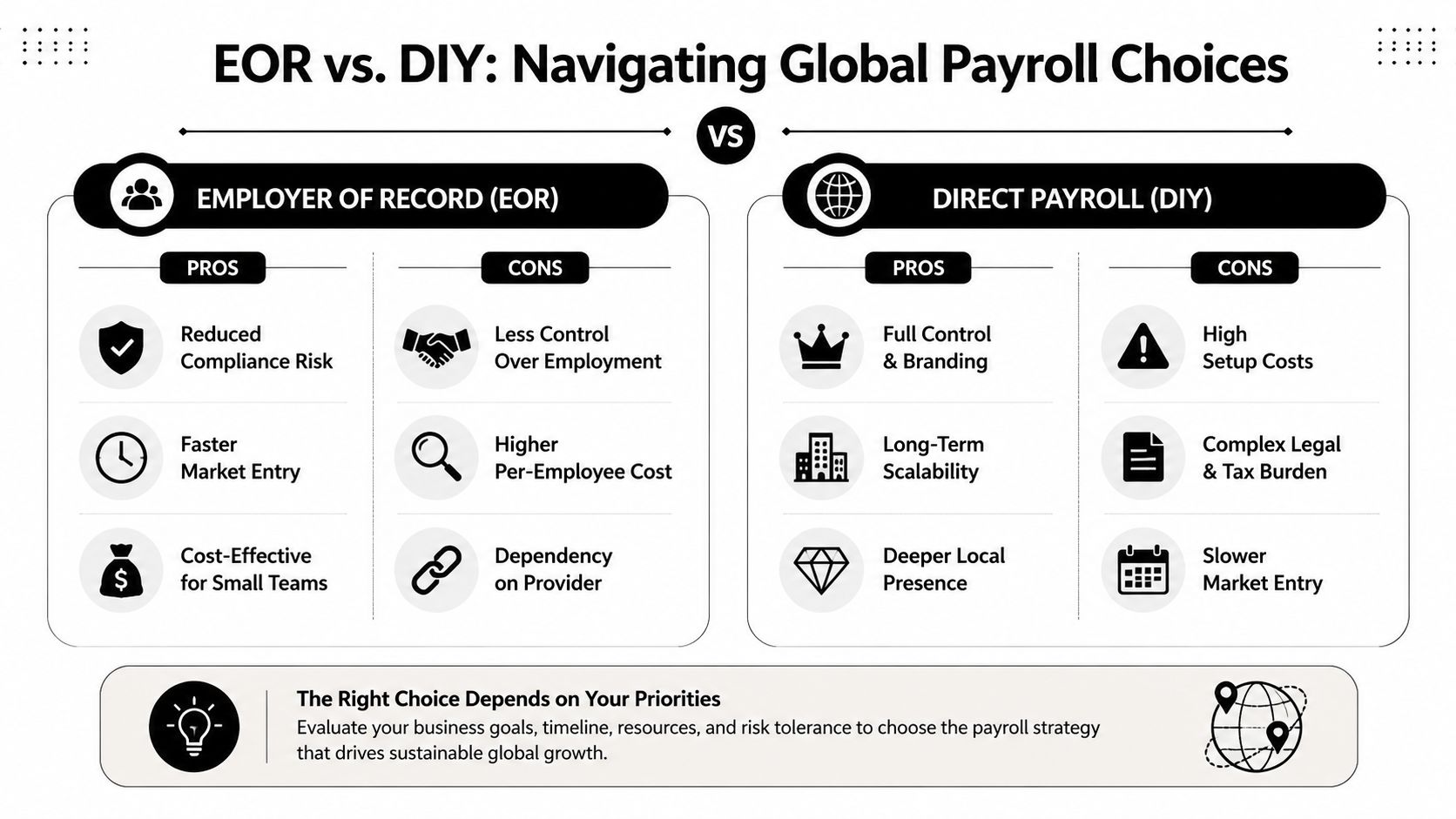
Direct payroll through your own entity gives you more control. Better branding, tighter process control, usually more economic sense once headcount grows in a specific country.
The catch is obvious. It's slower, more brittle, and soaked in legal and tax admin. Turns out there's more than one way to hire globally without mortgaging your office ping-pong table. DIY just happens to be the version where legal invoices show up first.
| Question | Lean EOR | Lean DIY |
|---|---|---|
| Need to hire fast in a new country? | Yes | No |
| Testing a market or role type? | Yes | No |
| Building a large long-term team in one country? | Maybe not | Yes |
| Want maximum local control? | No | Yes |
| Tolerate setup burden and local administration? | No | Yes |
For most agencies, small brands, and founder-led teams, start with EOR unless you already know the country will become a serious operating base.
For companies with durable headcount concentration in one market, direct payroll eventually makes sense. Not because it's glamorous. Because paying ongoing EOR premiums forever gets old fast, and your finance team will eventually stage a coup.
If you're comparing broader outsourcing models for marketing companies, this is the same logic. Rent flexibility first. Own infrastructure when repetition justifies the pain.
EOR is a launchpad. DIY is a commitment. Confuse those, and you'll either overbuild too early or overpay too long.
You shortlist three platforms, book the demos, nod along at the polished dashboards, and then six months later payroll is still blowing up over one contractor in Poland who now looks like an employee, plus a salary run in Brazil that cost more than finance forecast because FX moved at the wrong moment.
That is the true comparison.
Deel, Remote, and Papaya Global all sell global payroll. The useful question is simpler. Which one breaks least painfully for your hiring model, your finance tolerance, and your mix of contractors and employees.
| Platform | Best for | Strongest angle | Main concern |
|---|---|---|---|
| Deel | Fast-moving startups and agencies | Broad product coverage and speed | Process discipline and edge-case control |
| Remote | Distributed teams that want cleaner workflows | Straightforward onboarding and simpler day-to-day use | Less confidence for finance-heavy complexity |
| Papaya Global | Larger operations with reporting pressure | Centralized payroll visibility | Heavier setup and a steeper operating curve |
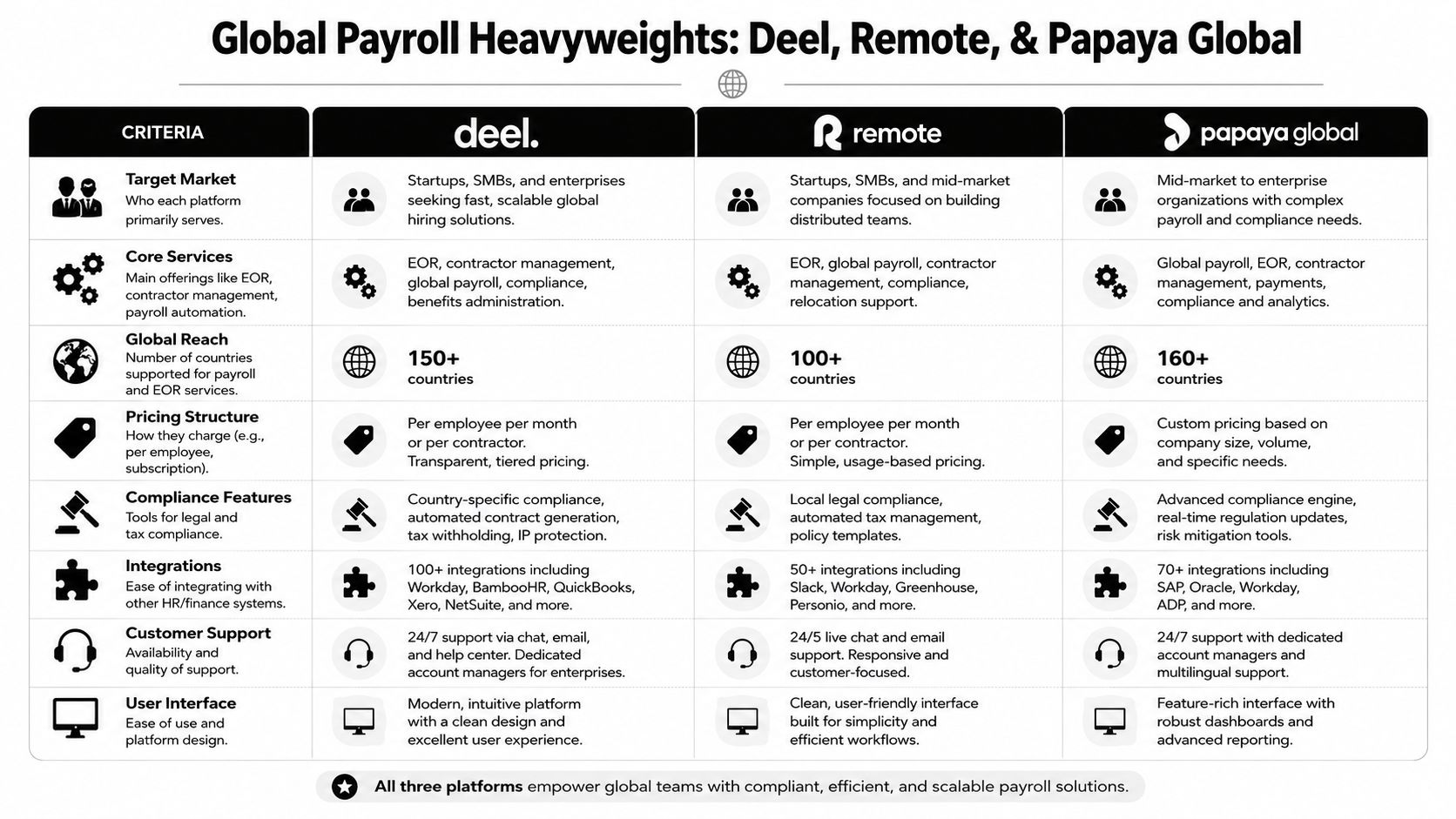
Deel became the category mascot because it solves the first global hiring problem founders feel. Speed. You can cover contractors, EOR hires, and payroll in one place without building much internal process first.
That convenience is real. So is the cleanup bill.
Agencies and mixed-model teams should grill Deel on the Hybrid Worker Classification Gap. If a contractor starts attending standups, gets a company email, and slides into a manager-controlled schedule, the platform should tell you what happens next. Ask who flags status drift, how often they review it, and what support exists when a worker needs to move from contractor to employee midstream.
Then ask about real-time currency volatility cost. Not a vague “multi-currency support” slide. Ask when rates are locked, how funding timing works, and who eats the difference when exchange rates move between invoice funding and payroll disbursement. That margin leak is how “cheaper global talent” turns into “why did payroll miss plan again?”
Deel is a strong front door. You still need to inspect the wiring behind the walls.
Remote earns its reputation on simplicity. The product feels cleaner, the onboarding flow is easier to follow, and teams without a dedicated payroll operator tend to make fewer avoidable mistakes inside it.
That matters more than vendors admit. Confusing payroll software turns your ops lead into a translator between HR, finance, and support tickets.
Remote fits companies with a relatively clean operating model. Standard hires. Clear countries. Fewer exceptions. If you want an EOR-led setup that your team can run without ritual sacrifice, it belongs on the shortlist.
It also does a better job presenting a coherent employee experience. New hires notice when contracts, onboarding steps, and payment expectations line up instead of arriving like clues in a detective novel.
Remote deserves tougher scrutiny if finance drives the decision. Ask how payroll data is structured, how reconciliation works, and whether reporting holds up once you need country-level analysis by worker type, cost center, or status change.
And do not let the polished interface distract you from classification and FX questions. Clean software does not protect you from a contractor who has drifted into employee territory. It does not protect you from currency movement between approval and payout either.
Remote is a good fit for simpler global setups. It is less convincing when your model gets messy.
Papaya Global is built for companies that have moved past “just get people paid” and into “show me payroll exposure by country, worker type, and reporting cycle without spreadsheet acrobatics.”
That is a narrower buyer than the marketing suggests. It is also a real one.
Papaya asks more from the buyer. More setup discipline. More process maturity. More patience. For a lean agency making a handful of international hires, that can feel like bringing enterprise software to a problem that needed a sharp knife, not a tool chest.
It also does not get a free pass on the two hidden risks. If your workforce mixes contractors and employees, ask how status changes are tracked and escalated. If you are paying across volatile currencies, ask how payroll timing and FX exposure are managed in practice, not in brochure language.
Papaya fits teams with process owners, reporting pressure, and little appetite for payroll surprises.
Here's the blunt version.
All three can work. None deserve blind trust.
The winner is the one that can answer three ugly questions without squirming: what happens when a contractor starts looking like an employee, when exchange rates move before payday, and when someone changes status mid-quarter. That is where the product distinguishes itself.
Generic recommendations are how people end up re-platforming six months later. Different companies need different international payroll companies. Obvious, yes. Still ignored constantly.
You probably need speed, reasonable hand-holding, and a setup your ops person can manage without developing a stress twitch.
Go with Deel or Remote. In that situation, I'd lean toward the one that feels simpler in the demo and gives clearer answers on worker classification. Not prettier. Clearer.
Why? Because your first hires usually sit in messy roles. They may start part-time, become recurring, then evolve into core operators. If the platform can't explain how to handle that transition, you're buying future cleanup.
“Easy enough” often falls short. Payroll touches finance, reporting, approvals, local compliance, and often multiple worker types at once.
I'd put Papaya Global higher on the list here, especially if your finance team wants more visibility and structure. If you still prioritize speed and mixed workforce flexibility, Deel remains viable. The right answer depends on whether your bottleneck is operational complexity or hiring velocity.
Different game.
You care less about “we launched in days” and more about whether the provider behaves predictably under scrutiny. You want process, controls, local consistency, and people who don't improvise when compliance questions get uncomfortable.
That usually pushes the decision toward the most operationally capable option in your shortlist. For many teams in this bucket, Papaya Global will feel more aligned than lighter, startup-first tools.
Buy for the mess you know is coming, not the clean org chart you pasted into the deck.
| Your situation | Best fit | Why |
|---|---|---|
| First few international hires | Remote or Deel | Faster setup and easier day-to-day management |
| Agency with mixed contractor and employee models | Deel, with hard diligence on classification workflows | Better chance of handling workforce variety |
| Multi-region scaling team with finance oversight needs | Papaya Global | Stronger centralized payroll posture |
| Large organization with mature ops | Papaya Global | Better fit for structured payroll administration |
One more thing. If a provider is clearly optimized for one use case and you are not that use case, stop trying to force it. Payroll software is not a personality test. Pick the tool built for your operating reality.
It's 36 hours before payroll. Your new provider says the Brazil employee is ready, your contractor in Poland is sitting in the same workflow like nothing could possibly go wrong, and finance has no idea which FX rate will hit the ledger. This is the part vendor sales decks leave out.
Choosing the platform was the easy decision. Migration is where sloppy teams create expensive folklore about how “global payroll is just messy.” It isn't. Your process is.
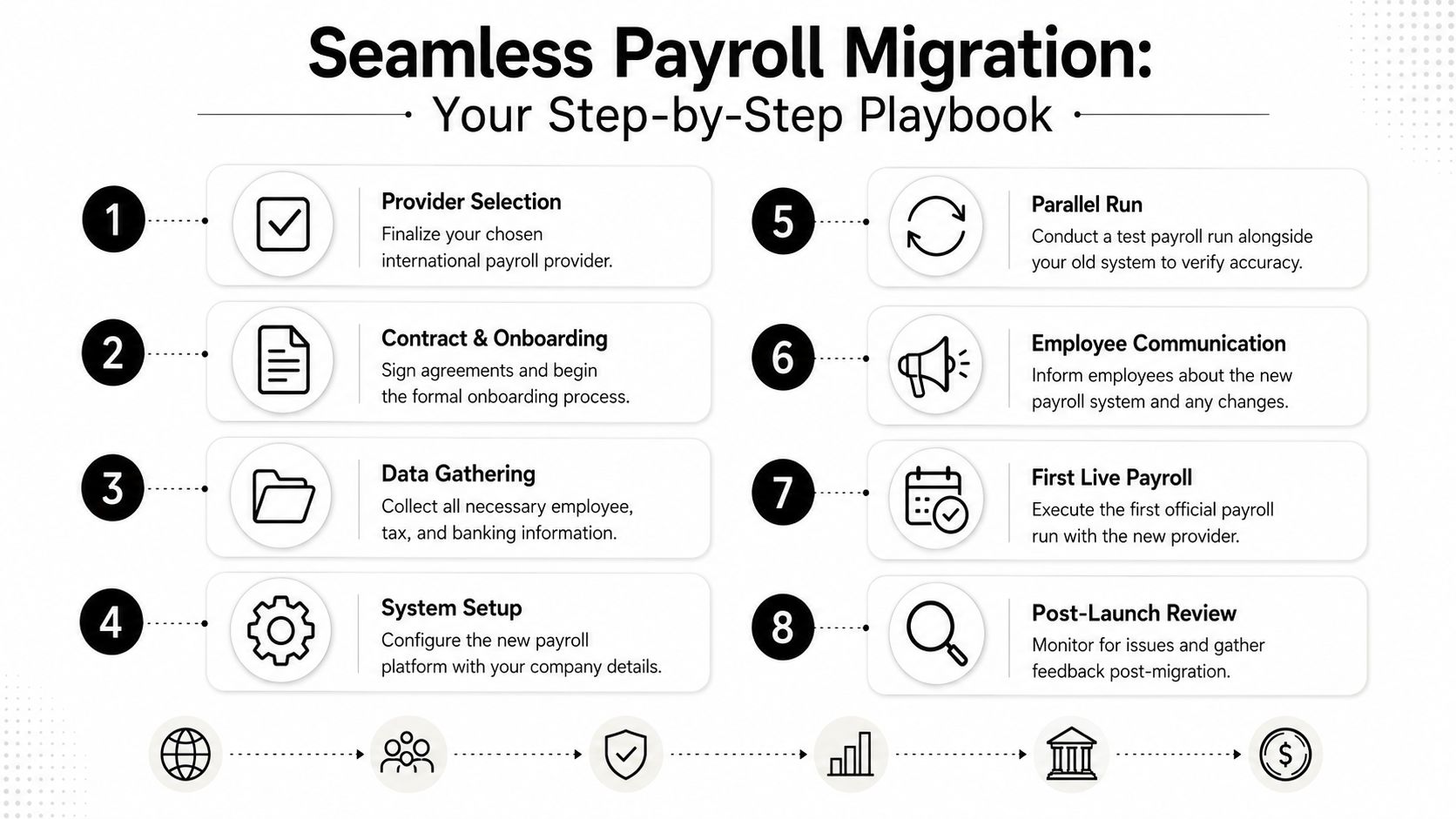
Freeze the scope before anyone gets clever
Pick the countries, worker types, pay groups, and go-live dates. Start with the cleanest group first. If you mix employees, contractors, and contractor-to-employee conversions in wave one, you are volunteering to test the Hybrid Worker Classification Gap during a live payroll run.
Clean your source data like your reputation depends on it
Pull contracts, tax IDs, bank details, historical pay data, benefit deductions, and local employment docs into one controlled file set. Bad source data gets blamed on the platform, then payroll spends two months doing archaeology.
Map worker status country by country
Do not trust a generic “we support contractors and employees” promise. Force a record-level review of who is employed directly, who sits under an EOR, who is an independent contractor, and who may need to change status soon. Agencies often get burned in these situations, especially when mixed-status talent lives in one client account but follows three different legal paths.
Lock the money movement rules
Confirm funding timelines, payout currency, invoice currency, FX conversion timing, and where the provider adds margin. Real-Time Currency Volatility Cost is not theory. If rates move between approval, funding, and payout, your “salary savings” can disappear before the payslip lands.
Configure local rules with zero guesswork
Set pay schedules, statutory deductions, holiday treatment, approval chains, and local currency requirements for each country. Assumptions create rework. Rework creates payroll apologies.
Run a parallel payroll cycle
Compare old outputs to new outputs before anyone relies on the new system for rent money. Gross pay, deductions, employer taxes, payout dates, and FX totals all need to reconcile. Close enough is how teams end up paying for corrections twice.
Test exceptions, not just the happy path
Run one-off bonuses, unpaid leave, new joiners, terminations, contractor invoices, and off-cycle corrections. Any platform can look competent when every record is clean and no one changes anything.
Assign owners for the first three cycles
Name one person in payroll or finance, one ops owner, and one escalation contact at the provider. If nobody owns approvals, variance checks, and issue triage, problems sit around wearing the costume of “someone is on it.”
Use these questions in the final implementation call, not after signature:
International payroll also comes with legal and privacy obligations that founders ignore until a regulator or auditor gets interested. This guide to international payroll data protection and record retention explains that GDPR requires encrypted payroll software with restricted access to authorized personnel, and the IRS requires payroll records to be retained for at least 3 years. Your provider is not just moving money. It is holding risk.
After launch, discipline matters more than setup.
IgniteHCM's global payroll compliance guide notes that companies need a compliance calendar for payroll deadlines, tax remittance dates, annual reporting, and regulatory reviews. Good. Build one, assign an owner, and review it monthly.
The first payroll proves the system can run. The third proves your team can run it. The sixth tells you whether you bought a tool or adopted a recurring problem.
A good migration feels boring because the hard thinking happened early. That is the goal.
Annoying, but survivable.
The actual pain isn't the software swap. It's rebuilding country settings, moving historical data, retraining internal owners, and cleaning up edge cases the old provider handled badly. That's why I'd rather spend more time in diligence than more quarters in regret.
Usually yes, but “yes” hides a lot.
Some platforms support both neatly. Others technically support both but treat one workflow like a first-class citizen and the other like an afterthought. If you rely on a mixed workforce, make them demo both paths. Don't buy the promise. Buy the workflow.
Yes. This is not optional.
Some countries require employees to be paid in their local currency, and ignoring that can create legal problems or even invalidate the arrangement. RemoFirst's overview of international payroll best practices notes that paying employees in local currency is a statutory requirement in places such as Brazil and Argentina, and that multi-currency payroll systems help automate country-specific wage computation and tax updates.
Treat this as a legal and tax coordination issue, not a checkbox feature.
Some providers can support the administration side better than others, but equity across borders gets country-specific fast. Get payroll, legal, and tax advice aligned before you promise anything in an offer letter.
Ask better questions.
Not “how many countries do you support?” Ask what happens when a contractor becomes core staff, when a pay run misses a funding cutoff, or when your finance lead needs a correction inside the same cycle. Good providers answer directly. Weak ones detour into branding.
If you're hiring paid media talent globally and want the hiring side to be as sane as the payroll side should be, HireMediaBuyers.com helps US companies find pre-vetted media buyers and paid ads specialists fast, with support for HR, payroll, and compliance built into the process. It's a practical route if you want global talent without turning cross-border hiring into your new hobby.


