

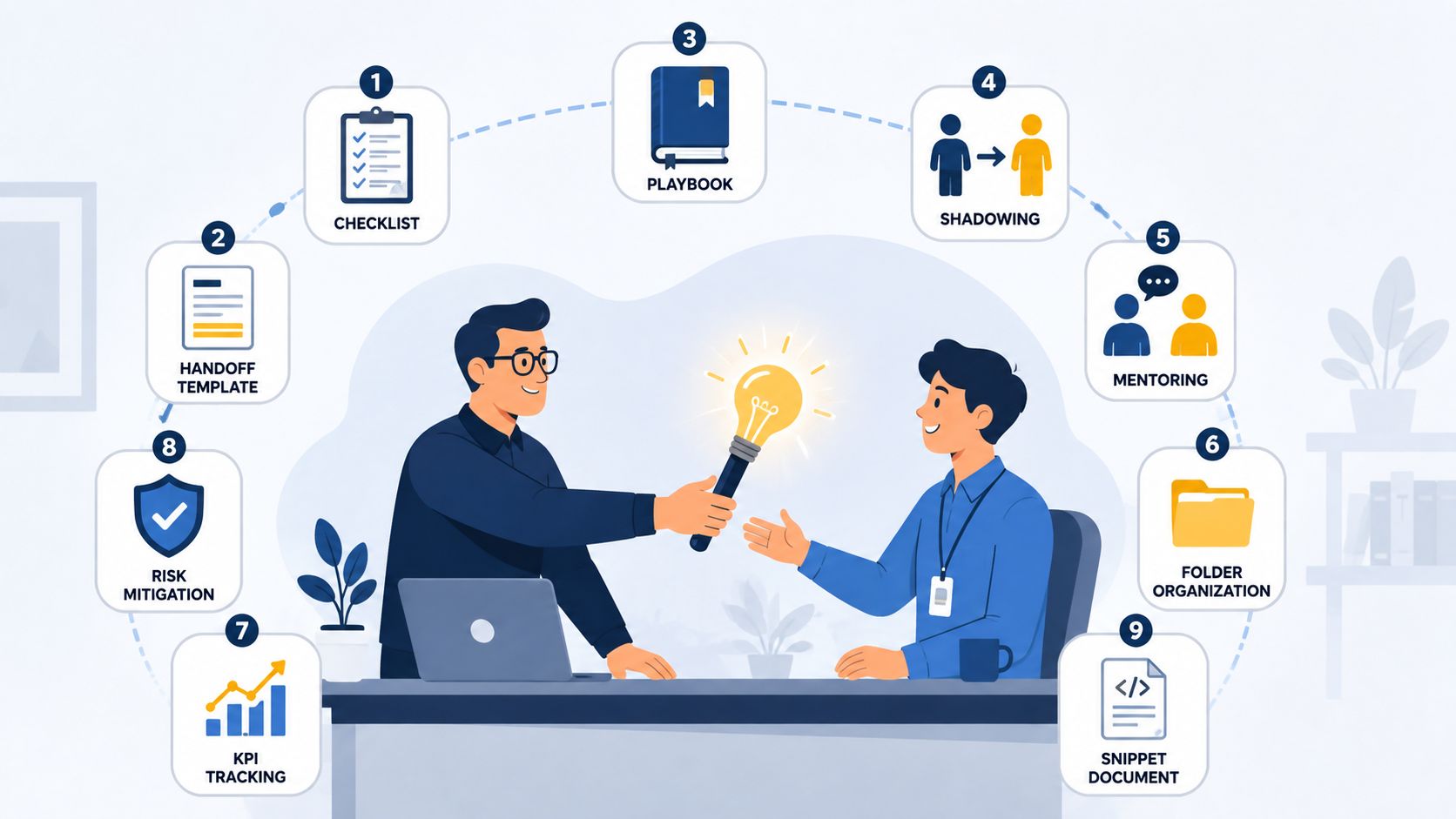
Hiring strong paid-media talent doesn't fix a weak knowledge-transfer system.
A new specialist can understand Meta, Google Ads, TikTok, LinkedIn, or Pinterest and still lose weeks decoding account history, unwritten rules, reporting habits, approval paths, and the strange little rituals your team insists are “just how we do things.” You can hire someone brilliant and still hand them a foggy map.
That's why knowledge transfer best practices need to operate like a paid-media operating system, not a pile of onboarding documents nobody opens after day one. The system should combine documentation, campaign evidence, live practice, feedback, reverse shadowing, mentoring, rotations, retrospectives, and proof that someone is ready to work independently.
HireMediaBuyers.com can shorten the hiring process and connect US companies with pre-vetted media buyers and paid ads specialists. But the client still owns the operating context that turns a capable hire into a productive one. No marketplace can magically know why you paused that audience, rejected that creative angle, or refuse to touch a reporting dashboard before Tuesday.
The nine practices below are designed for agencies, DTC brands, B2B teams, SaaS companies, and anyone tired of answering the same account-history question for the fourth time.
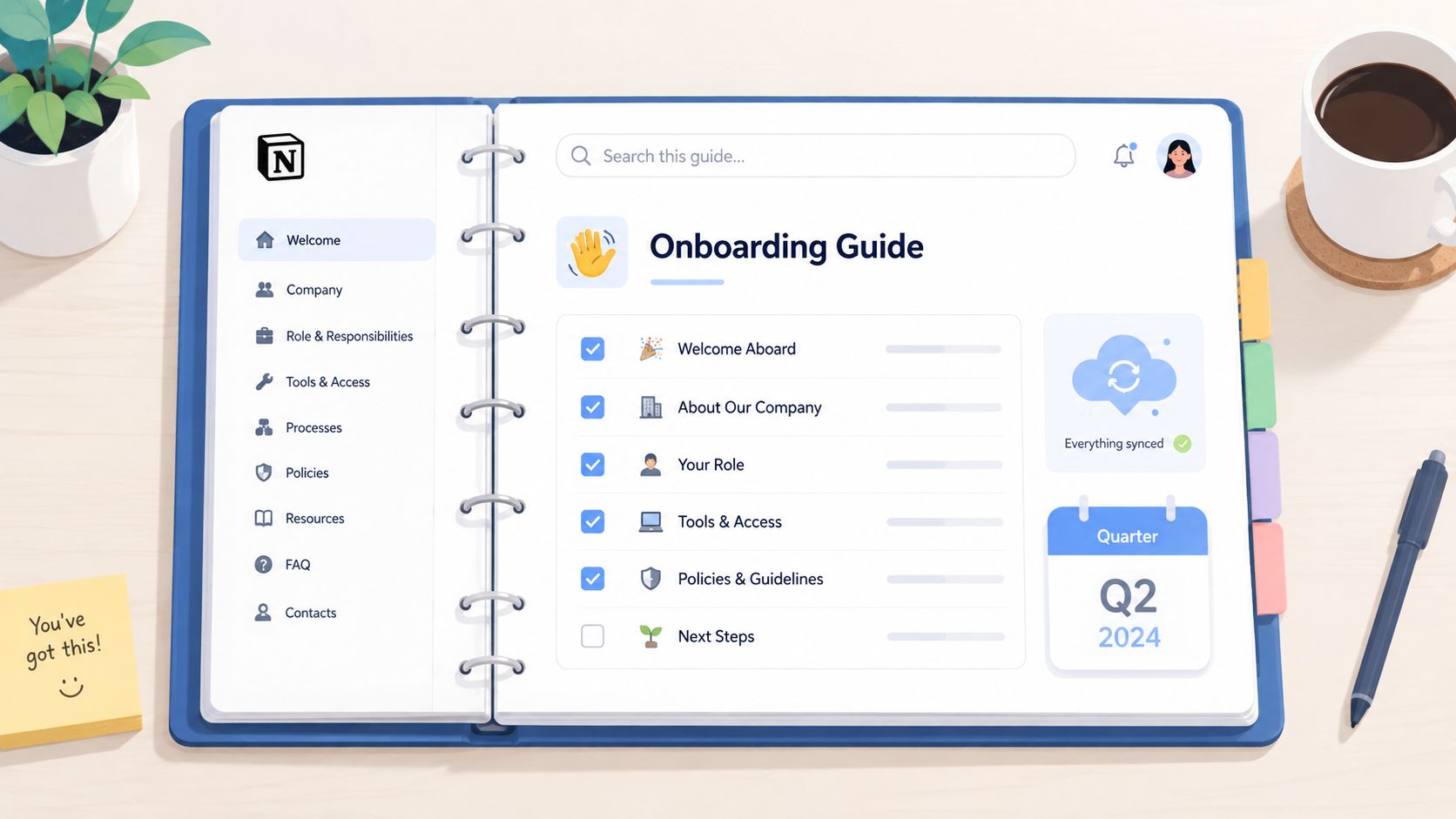
Documentation is the unglamorous foundation that keeps a new media buyer from guessing. Create a living guide covering account architecture, campaign history, audience segments, creative benchmarks, brand rules, reporting standards, approval paths, and the reasoning behind major decisions.
A useful guide isn't a transcript of every meeting you've ever held. It's a practical map of how the business buys attention. A DTC brand might document seasonality patterns, winning ad angles, historical ROAS benchmarks, and promotion rules. A B2B SaaS team may need buyer-journey stages, account-based segments, lead-quality definitions, and budget allocation logic. An agency should include client-specific exceptions, escalation routes, and the mistakes nobody wants repeated.
The NHS knowledge retention and transfer toolkit recommends identifying the knowledge being carried forward, comparing it with what colleagues need to know, agreeing priorities with a manager, assigning actions, naming a facilitator, and storing the output centrally. That translates neatly to paid media. Ask what the incoming buyer must know to make sound decisions, not what documents happen to exist.
Use Notion, Confluence, Google Docs, or another searchable workspace. Link directly to dashboards, naming conventions, creative libraries, tracking documentation, and relevant campaign records. Plain English wins. Marketing jargon is not a substitute for context.
Include a daily onboarding path, screen-share walkthroughs, a “why we did this” section, and a common-mistakes page based on actual errors. Assign one owner to review the guide quarterly and whenever the process changes.
A 2017 Training Industry report on onboarding and knowledge transfer identified peer-to-peer and team training, formalized knowledge-transfer processes, work shadowing, and coaching among useful practices. Its broader recommendation was a bundled system involving social learning, varied delivery, a monitored repository, measurement, and leadership support. A document alone is just a filing cabinet with better typography.
Past campaigns shouldn't sit in a folder as decorative evidence of your team's brilliance. Treat them like operating material. A strong case study review walks through the objective, hypothesis, budget allocation, execution timeline, results, learnings, and what the team would do differently.
The winning campaigns matter, but failed campaigns often teach more. A LinkedIn pilot that missed its CAC target can reveal a weak hypothesis, poor audience fit, slow feedback, or a reporting blind spot. A TikTok campaign that started strongly and then flattened can expose creative fatigue, pacing problems, or an audience strategy that looked clever in a spreadsheet and less clever in reality.
Ask uncomfortable but useful questions:
A searchable case-study library in Notion, Airtable, or Google Drive gives new hires access to decisions rather than isolated outcomes. Add charts showing spend over time, audience performance, and creative rotation. Include partner feedback, client reactions, and operational constraints, because campaign performance rarely comes from media buying alone.
Review one case in the first week, then add a recurring review cadence. Rotate facilitators so the narrative doesn't belong permanently to the loudest strategist. Invite the new hire to challenge the decision without turning the session into a courtroom drama.
For teams that need a clearer framework, case study analysis for paid-media hiring offers a useful way to examine how candidates reason through practical problems. The same discipline belongs inside the team after hiring.
Practical rule: Never document only what worked. Document what the team believed, what happened, and which belief changed.
That distinction teaches judgment. A new media buyer doesn't need a museum of old campaigns. They need to understand how your team forms hypotheses, interprets evidence, and admits when an attractive idea didn't survive contact with the account.
Handoffs create latency. Pair auditing removes much of it.
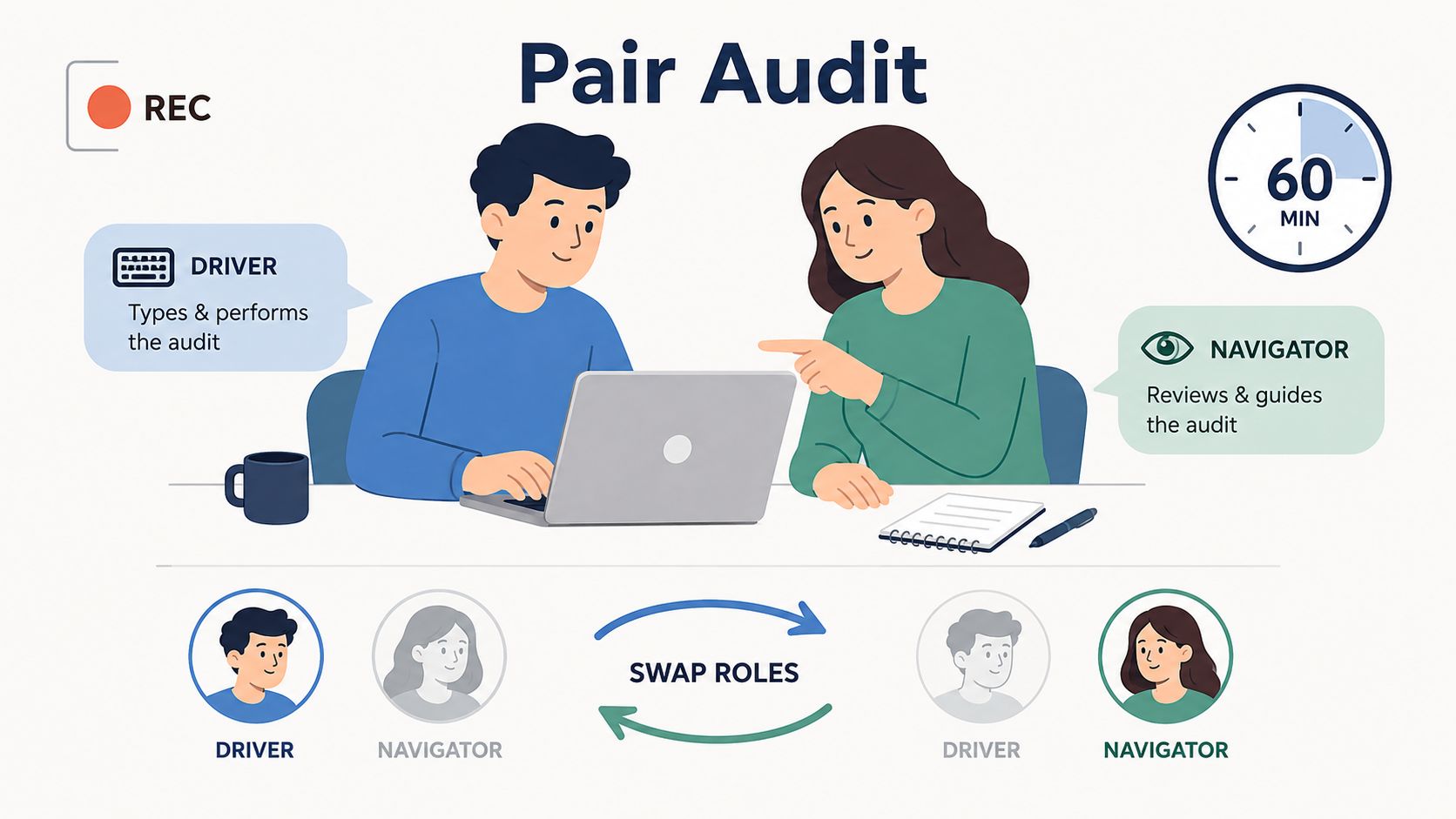
Put an experienced buyer and a new specialist in the same account, dashboard, spreadsheet, or creative testing plan. One person drives while the other questions the decisions. Then swap. The point isn't to watch someone click through Ads Manager like a guided tour. The point is to expose the reasoning behind the clicks.
A Meta audit might involve reviewing recent performance, identifying audience changes, and explaining why certain segments were paused. A Google Ads build might involve debating campaign architecture for a launch. A creative session might involve constructing a testing matrix and stress-testing its assumptions before money is spent.
Keep sessions focused. A clear agenda such as “audit campaign performance and identify three optimization opportunities” beats an open-ended meeting called “knowledge sharing.”
Use Zoom, Slack, Loom, Figma, Google Sheets, or another tool that lets both people annotate the work. Rotate driver and navigator roles during the session so the new hire doesn't become a passive spectator. Start with analysis and strategy before moving into live campaign changes. Nobody needs a high-risk account edit performed for educational theater.
Record the session and timestamp important insights. A later viewer should be able to find the explanation for a paused audience without scrubbing through an hour of mouse movement.
A 2024 peer-reviewed review of organizational knowledge-transfer procedures described a shift toward digitally supported, collective approaches that combine communication routines with shared systems. That matters in paid media because account context rarely belongs to one person. Pairing makes the context visible while the work is happening.
End with two questions: What did you learn? What did I miss? The first surfaces transferred knowledge. The second surfaces knowledge your established process may have been missing.
Meetings are useful for judgment and terrible as the only place judgment exists. Record short, focused walkthroughs that explain how your team structures campaigns, reads reports, evaluates creative, reallocates budget, and troubleshoots common issues.
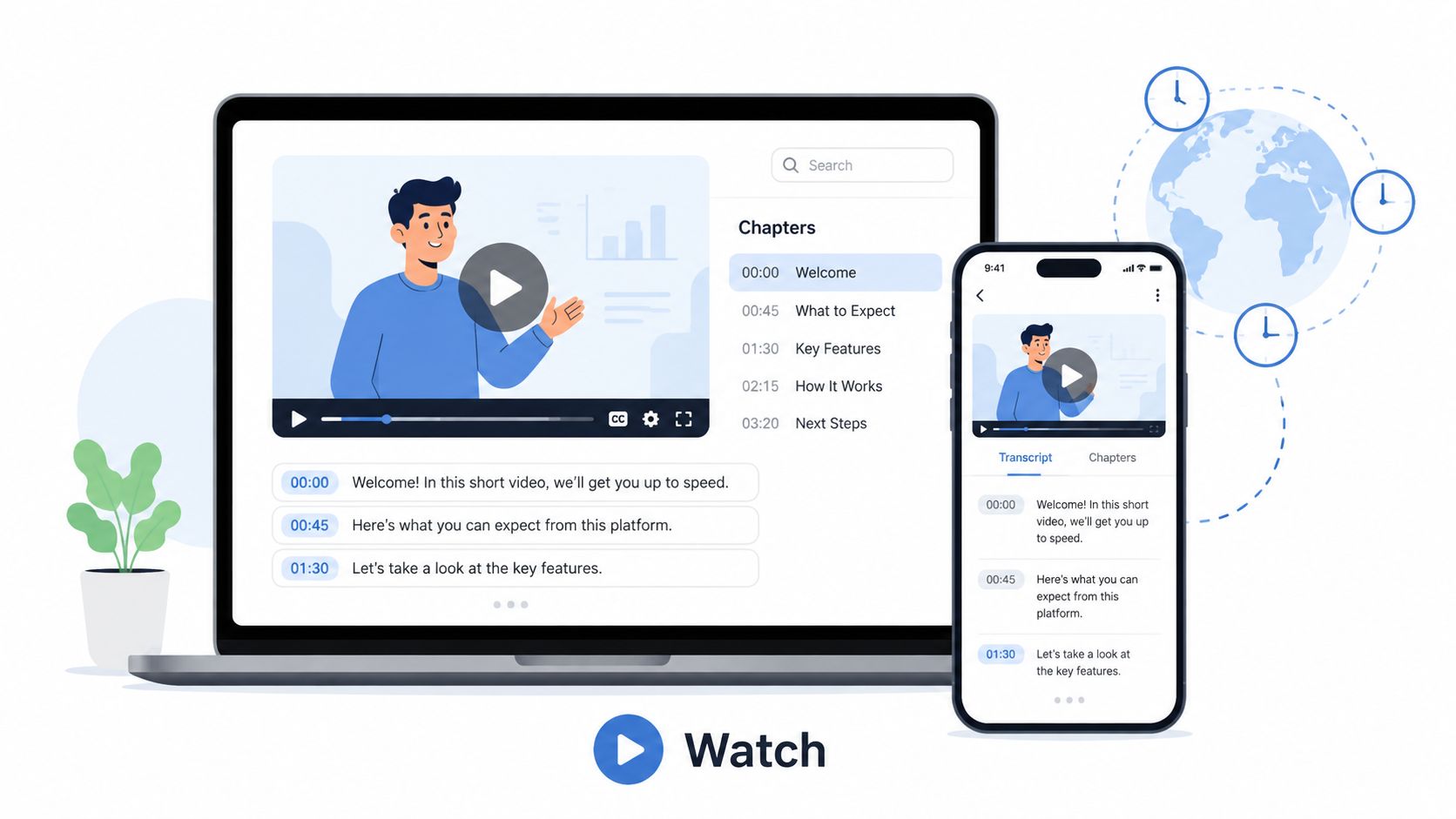
An eight-minute Meta account tour can show campaign structure, key dashboards, normal performance patterns, and naming conventions. A short budget-allocation video can explain which signals trigger a reallocation. Another can show how the team handles pacing problems, pixel issues, or audience-definition errors.
Keep each recording narrow enough that someone can find the right answer without watching an epic saga about your entire marketing department. Add chapters, timestamps, transcripts, descriptions, and an index. If a video explains three different processes, split it unless you enjoy creating search problems for your future self.
Batch-record several videos in one sitting. Use Loom, ScreenFlow, OBS, or a comparable screen recorder. Label each video with an owner, date, topic, and review status. Flag outdated recordings instead of letting new hires learn from a process that disappeared last quarter.
The 2026 State of KM and AI report lists document management systems, collaboration tools, intranets, and knowledge bases among common organizational backbones. It also reports that organizations share knowledge daily or multiple times per day, reinforcing a practical point: the video library needs lightweight collaboration around it, not just a lonely folder.
A recording doesn't replace live discussion. It handles repeatable explanation so live time can focus on ambiguity, strategy, and feedback. For distributed teams, managing distributed teams with stronger knowledge flow provides useful context for designing access across time zones.
“Record the explanation once, then spend the live session on the exceptions.”
Ask new hires which topics they searched for and couldn't find. Their confusion is your content roadmap.
Titles are a poor substitute for expertise. A new Google Ads specialist shouldn't automatically receive a Meta-focused executive as their only mentor because that person sits higher on the org chart.
Map the actual gaps first. The new hire may need a Google Ads mentor for platform strategy, a Meta specialist for creative and audience context, a culture mentor for decision-making norms, and a manager for performance and career conversations. That sounds fragmented. In practice, it stops one senior person from becoming the bottleneck for every question.
A DTC brand hiring a TikTok specialist might assign platform mentoring, ecommerce-funnel mentoring, an executive sponsor, and a peer buddy. An agency might separate client management, proposal writing, team leadership, and technical execution. The right structure depends on the work, not the reporting chart.
Write a short mentorship charter that states who owns which topic, how often they meet, what preparation looks like, and what progress means. Mentoring fails when both sides interpret “be available” differently.
Use skills-based hiring for paid-media roles as a useful reminder that capability should be evaluated against the work required. The same principle applies after the hire. Match support to demonstrated gaps, not prestige.
Review the pairing regularly. A mentor may be excellent at Google Ads but weak at explaining client communication. Another may understand the culture but lack the platform depth. Adjust without making it a personal referendum.
Recognize mentors publicly. They're doing operational work, not volunteering for a pleasant coffee chat. Rotate mentoring relationships after the initial ramp so new hires build a wider network, and create peer mentoring opportunities where specialists teach one another across platforms.
A 2026 review of tacit knowledge in onboarding highlights the harder problem: transferring judgment, context, and unwritten know-how, especially for knowledge workers. That is why mentoring, supervisor support, and live practice deserve equal status with the handbook. Manuals store information. People teach discernment.
A retrospective turns a week of scattered decisions into reusable team memory. Use a cadence that fits your operation, then keep the meeting short enough that people don't start inventing emergencies to escape it.
Discuss what worked, what failed, what the team learned, and what changes next. A paid-media retro might examine audience exhaustion, a creative hook that underperformed, a reporting dispute, or a client-request process that caused unnecessary rework. The subject is less important than the habit of naming decisions and consequences while they're still fresh.
Use a blameless format. “This happened, we think it happened because of these conditions, and we'll test this adjustment” produces better learning than a ritual search for the employee who clicked the wrong dropdown.
A simple structure keeps the meeting honest:
Record and transcribe the session for people who can't attend live. Store one key insight and one action item in a searchable database. Review last week's action at the start of the next retro. Otherwise, you're collecting confessions, not improving operations.
Research on organizational knowledge transfer identifies wikis and Web 2.0 tools alongside mentoring, on-the-job training, storytelling, department meetings, succession plans, seminars, and related intergenerational methods as frequently used procedures in practice, as documented in this review of knowledge-transfer practices. The lesson for agencies is straightforward. Capture both the artifact and the conversation around it.
A retrospective without a tracked action item is just a podcast with payroll.
New hires learn a great deal from retrospectives because they see how experienced operators handle uncertainty. That's the part nobody can fake with a polished onboarding deck.
A Google Ads specialist who spends all day inside Google Ads can become highly capable and oddly disconnected. Structured rotation exposes how paid-media decisions travel through the business.
Move the new buyer into adjacent work for a defined period. They might support Meta campaigns, join account-management calls, review creative briefs, contribute to proposal writing, or work across B2B, DTC, and SaaS accounts. The purpose isn't random variety. It's seeing how audience choices affect creative, how platform data becomes client reporting, and how business models change the meaning of performance.
A senior account manager can rotate into daily optimization to stay close to platform mechanics. A specialist can sit with client services to understand which explanations build trust and which ones create three more meetings.
Define what the person should learn, who will support them, which systems they'll use, and what they should bring back. Pair them with someone who already knows the domain. Put them into existing work rather than a make-believe project designed solely for onboarding.
Use a rotation checklist covering systems, people, concepts, decisions, and recurring workflows. At the end, ask what surprised them, what they'd change, and what insight they'll take back to their primary role.
The trade-off is obvious. Rotation temporarily reduces specialization and adds coordination. That cost is worthwhile when it creates redundancy, improves handoffs, and prevents a buyer from optimizing a narrow platform while missing downstream consequences. It isn't worthwhile when leaders use “cross-training” to avoid hiring enough people for the work.
A 2024 review found that organizations generally favor collective approaches for transferring both tacit and explicit knowledge, with communication and digitalization playing important roles. Rotations make that collective approach tangible. People understand the wider system because they participate in it.
Traditional shadowing puts the new hire behind the veteran. Reverse shadowing puts the veteran behind the new hire.
That reversal is useful because experienced teams carry assumptions they no longer notice. A new TikTok specialist may question a creative testing habit that the Meta team treats as obvious. A Pinterest expert may identify audience opportunities that translate to Google Shopping. A specialist working in another time zone may spot changes during a period the US team rarely monitors.
The new hire presents how they would approach a familiar problem. The experienced buyer watches, asks questions, and learns the method rather than correcting every difference on sight. If you turn the session into an audition, you'll get cautious theater. If you frame it as exploration, you may discover a better way to work.
Schedule reverse-shadowing sessions rather than hoping they happen spontaneously. Ask specific questions:
Have the new hire present findings in a team meeting and record the discussion. Act on a suggestion when the evidence supports it. You don't need to adopt every idea, but you do need to show that listening isn't a ceremonial activity.
A 2017 Training Industry report recommended work shadowing and coaching within a broader knowledge-transfer system. Reverse shadowing extends that logic in both directions. The new person learns your context, while the existing team tests whether its habits still deserve to survive.
Fresh perspective isn't automatically correct. Neither is seniority. The account gets better when both are treated as hypotheses.
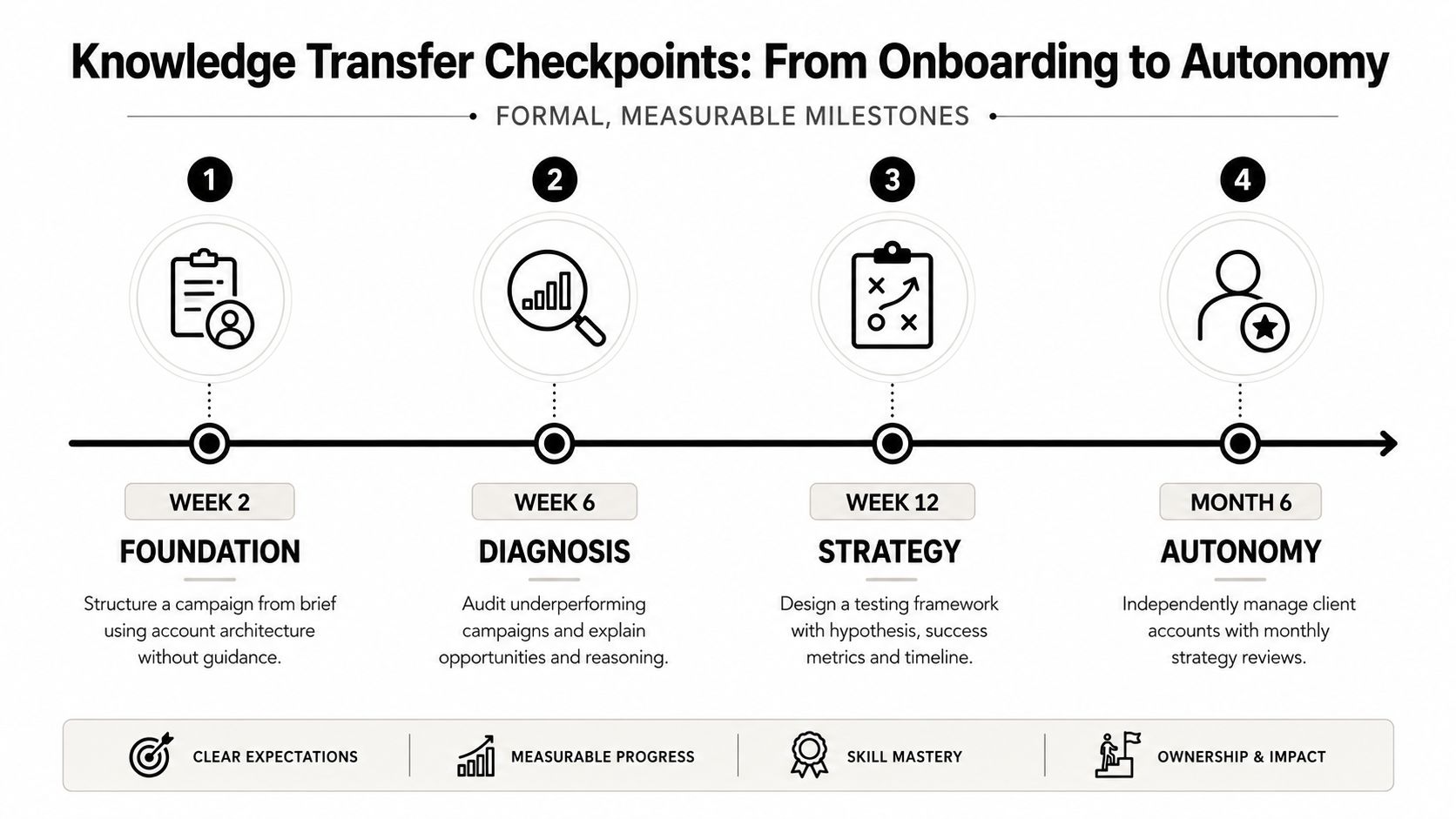
Onboarding shouldn't end with “seems to be settling in.” Define evidence-based gates that show whether knowledge has transferred and whether autonomy is safe.
A checkpoint might ask a new hire to structure a campaign from a brief using your account architecture, diagnose an underperforming campaign, or design a testing framework with a clear hypothesis, success criteria, and timeline. The work sample matters more than a confident explanation of what they would do in theory.
Set the milestones before hiring so the team knows what readiness means. Tell the new specialist on day one. A checkpoint isn't a trapdoor or a disguised performance review. It's a shared reference point for deciding what support remains necessary.
Assess whether the person can:
Document demonstrated strengths and open gaps. Adjust the timeline based on evidence, not a calendar that assumes every hire learns at the same speed. Celebrate progress visibly, then increase autonomy when the work proves ready.
The INPO knowledge-transfer guidance emphasizes leadership endorsement, knowledge-loss risk assessment, and capture methods such as cross-training, coaching, mentoring, apprenticeships, job shadowing, simulations, and walk-throughs. It also stresses that knowledge should be accessible, current, and available in the right format when users need it. Checkpoints test whether your system delivered that access in practice.
| Approach | Implementation complexity | Resource requirements | Expected outcomes | Ideal use cases | Key advantages |
|---|---|---|---|---|---|
| Structured Onboarding Documentation | Medium, upfront build, low ongoing | Documentation owner, tools (Notion/Confluence), time for audits | Faster ramp-up, consistent processes, reduced single-point risk | Remote hires, frequent onboarding, complex accounts | Centralized, searchable institutional knowledge; repeatable onboarding |
| Deliberate Case Study Analysis | Medium–High, synthesis & facilitation needed | Analyst/time to prepare, data access, presentation cadence | Deeper reasoning, pattern recognition, learnings from failures | Teaching decision-making; post-mortems; experienced hires | Teaches real-world logic; exposes business-specific lessons |
| Pair Programming / Pair Auditing | Low–Medium, scheduling and structure | Synchronous time, collaboration tools, session recordings | Rapid nuance transfer, real-time fixes, integrated contributors | Immediate troubleshooting, tactical onboarding, complex builds | Fastest transfer of tacit skills; live mentorship; recorded artifacts |
| Asynchronous Video Documentation | Medium, production and indexing work | Recording/editing tools, hosting, transcripts, taxonomy | Scalable self‑paced learning, fewer meetings, persistent knowledge | Distributed teams, time-zone differences, reference libraries | Scales knowledge capture; preserves tone/nuance; rewatchable on demand |
| Mentorship Matching by Expertise Gap | Medium, coordination & role mapping | Multiple mentors' time, mentorship charters, check-ins | Targeted skill growth, reduced bottlenecks, engaged mentors | Specialized hires, multi-platform roles, skill development plans | Expertise-focused learning; avoids hierarchical mismatch; more mentor bandwidth |
| Recorded Weekly Retrospectives | Low–Medium, cadence and facilitation | Weekly meeting time, recorder, transcript, action tracker | Continuous improvement, early issue detection, documented decisions | Active campaign teams, iterative ops, remote collaboration | Regular learning loops; searchable history; builds psychological safety |
| Role Rotation & Cross-Training Projects | High, planning and coverage required | Rotation plans, paired mentors, checklists, temporary coverage | Broader context, redundancy, increased team flexibility | Building T-shaped teams, succession planning, resilience building | Reduces silos; reveals hidden talent; improves organizational agility |
| Reverse Shadowing (Expert Learns from New Hire) | Low–Medium, cultural buy-in required | Time for sessions, psychological safety, recording capability | Adoption of fresh tactics, prevents groupthink, mutual learning | Bringing external specialists, innovation-focused teams | Two-way knowledge flow; rapid infusion of external best practices |
| Knowledge Transfer Checkpoints | Medium, define and assess milestones | Checkpoint criteria, reviewers, documentation system | Measurable onboarding progress, earlier autonomy, gap detection | Remote hires, compliance-sensitive roles, structured onboarding | Objective milestones; clear expectations; evidence-based progression |
The nine practices work best as a sequence, not a buffet where someone grabs a Notion template and calls it transformation.
Before day one, prepare the account guide, access map, reporting definitions, campaign history, brand rules, and approval paths. Assign owners. Identify the knowledge that could disappear if one person left tomorrow. A 2024 review of knowledge-transfer procedures found that large companies dominate formal retention and procedure-design efforts, while digitalization has become a critical part of effective protocols. Smaller agencies shouldn't wait for enterprise scale before adopting the discipline.
During the first weeks, use campaign case studies and paired audits. Let the new buyer see how your team makes decisions, then let them perform the reasoning with someone beside them. Record the session. Capture the explanation. Make the account history searchable instead of forcing every future hire to interrogate the same veteran.
Add short videos and expertise-based mentoring for repeatability. A video handles the common walkthrough. A mentor handles the ambiguity. Those are different jobs, and pretending one artifact can do both is how teams end up with beautiful documentation and confused employees.
Use rotations and reverse shadowing to widen the transfer. The new buyer needs to understand how paid media connects to creative, client communication, budgets, lead quality, and business models. Your existing team needs opportunities to challenge inherited assumptions. Knowledge flows in both directions, or it becomes another hierarchy disguised as training.
Keep weekly retrospectives as the learning loop. Record what happened, why the team thinks it happened, and what changes next. If the same error appears repeatedly, don't write a more enthusiastic reminder. Fix the workflow, the permissions, the naming convention, the review step, or the training material that failed.
Finally, use checkpoints to decide when autonomy increases. Track ramp-up milestones, independent-work readiness, documentation freshness, recurring errors, unresolved questions, and the time mentors spend supporting the hire. The purpose isn't to bury the team in measurement. It's to distinguish a transfer system that works from one that merely produces activity.
Formal knowledge-management adoption has grown, with 73% of organizations reporting formal systems compared with 61% in 2020. Yet only 22% of employees rate their knowledge-management tools as easy to use, according to the same source. That gap is a warning for agencies. Don't keep adding repositories when people can't search, access, or trust the ones already available.
The blunt takeaway is simple. A pre-vetted hire can bring paid-media expertise, but deliberate context transfer is what converts that expertise into performance. Hiring solves access to talent. Operating discipline determines whether the talent can make good decisions inside your accounts.
HireMediaBuyers.com offers US companies access to pre-vetted Media Buyers and Paid Ads Specialists across Meta Ads, Google Ads, TikTok, LinkedIn, Microsoft Ads, Pinterest, YouTube, and more, with full-time and part-time remote options. Visit HireMediaBuyers.com to find qualified specialists, then pair the faster hiring path with the knowledge-transfer system that gets them productive without making everyone else repeat the past.


