


You're probably here because a candidate just asked for a salary that made you stare at your spreadsheet like it had personally betrayed you.
I get it. You need someone to run Meta, Google, maybe TikTok. You're not trying to recruit the next Fortune 500 CMO. But once you start digging into media buyer salary numbers, the whole thing gets slippery fast. One site says one thing. Another says something else. Then a candidate with actual chops wants a package that looks a lot less like “mid-level marketer” and a lot more like “please approve another budget revision.”
That's not you being cheap. That's the market being messy.
The bigger problem is this. Most companies think they're comparing apples to apples when they're not even in the produce aisle. They're lumping traditional buyers, digital specialists, performance marketers, freelancers, and channel experts into one bucket. Then they wonder why hiring feels expensive, confusing, and weirdly high-risk.
Let's fix that.
A founder emails me something like this at least once a week.
“We need a media buyer. We found one. They want a number that sounds insane. Are we getting ripped off?”
Sometimes yes. Sometimes no. That's the annoying answer.
The sticker shock usually starts because a business owner googles “media buyer salary,” sees a broad range, and assumes the market is relatively sane. Then they talk to a real performance marketer who manages paid acquisition like a profit center, not a dashboard hobby, and the number jumps hard. Suddenly your “reasonable hire” starts looking suspiciously close to six figures.
The big trap is that most salary guides blend old-school media buying with modern paid acquisition roles. That creates a fuzzy average that sounds manageable but tells you almost nothing about what you'll pay for someone accountable for revenue. As Payscale salary coverage shows, many guides collapse “traditional media buyers” and “digital paid ads specialists” into a broad $58k to $75k average, while missing the 30 to 50 percent premium attached to buyers managing Meta, TikTok, or Google with direct ROI responsibility.
That distinction matters more than people think.
A person buying legacy media placements is not the same as a person inside Meta Ads Manager and Google Ads every day, reallocating budget, diagnosing creative fatigue, and deciding whether your cost structure still works. One is a purchaser. The other can be a growth operator.
Practical rule: If the role owns revenue outcomes, don't benchmark it against generic “media buyer” averages.
This is why businesses get blindsided. They post for a “media buyer,” but what they need is a paid media strategist, platform specialist, analyst, operator, and business translator rolled into one. Cute title. Expensive reality.
Here's the simple filter I use:
And advantage costs money.
That doesn't mean you should blindly overpay. It means you should stop using lazy salary ranges that were never built for the role you need. That's where most hiring mistakes start.
A founder sets aside $75,000 for a media buyer and thinks the budget is covered. Then the hiring market's true conditions emerge. The candidates who can protect spend, read platform noise correctly, and make profitable decisions often price far above the number finance had in mind.
Start with ranges, not wishful thinking.
Across the U.S., entry-level media buyers sit far below senior operators, and the gap exists for a reason. Junior hires can handle production work. Senior hires carry judgment. That judgment is what keeps a six-figure ad budget from bleeding out through bad targeting, weak creative rotation, sloppy attribution calls, and late optimizations.
Take a look at the benchmark spread.
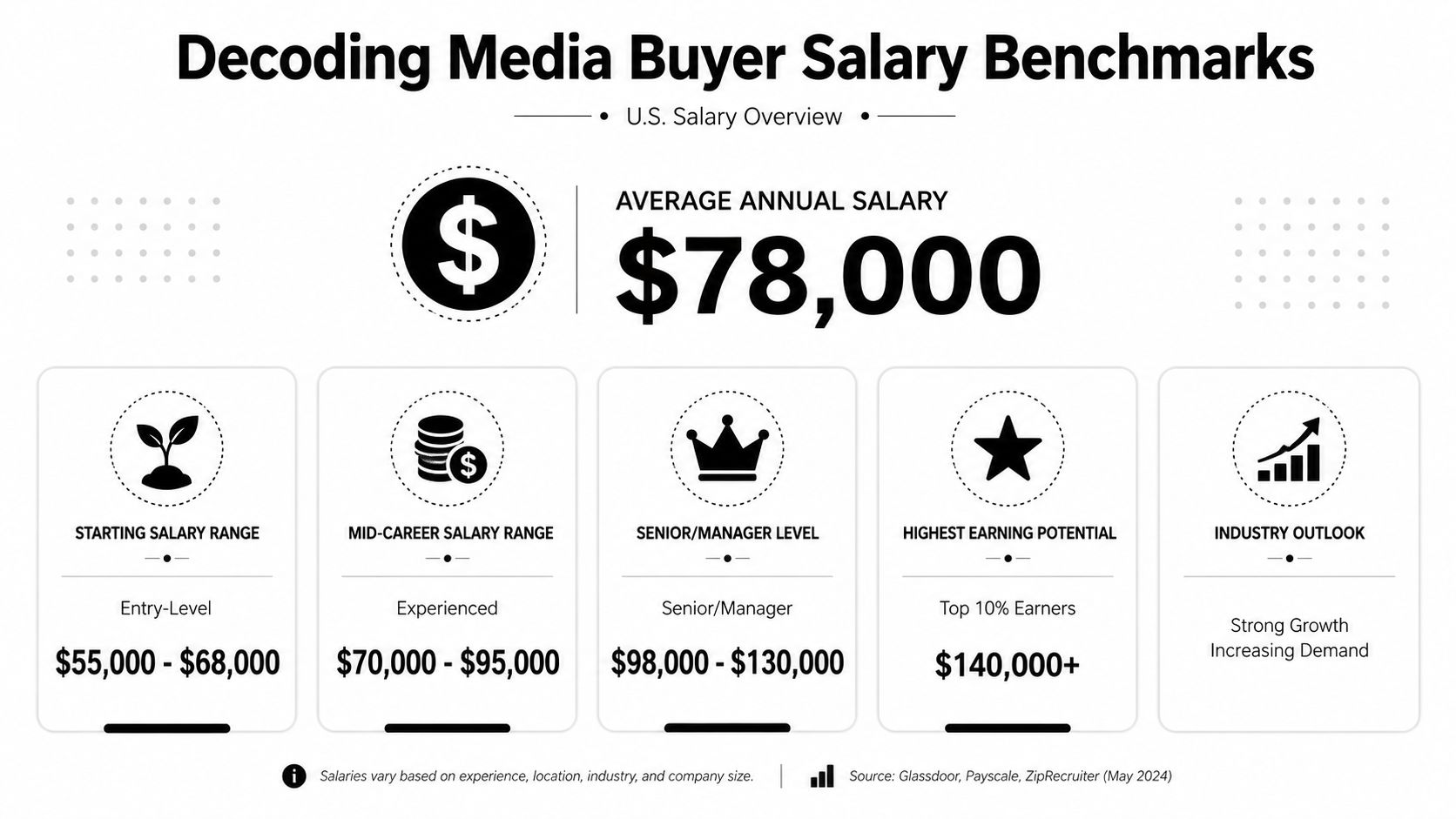
A junior buyer is useful if the role is built correctly. They can launch campaigns, pull reports, manage routine changes, and support someone more strategic. Give that same person full ownership over performance and you are paying for mistakes with ad spend.
Senior buyers cost more because they do more than click through platform workflows. They catch broken account structure early, question reporting that looks clean but hides inefficiency, and connect performance problems back to offer, creative, landing page, and conversion flow.
That is the pay gap.
Here's the practical read:
| Experience level | Salary reality |
|---|---|
| Entry-level | Lower-cost support hire |
| Early-career | Can execute, still needs direction |
| Senior roles | Expensive, because they carry judgment |
| U.S. average | Too generic to use alone |
If you are writing the role now, get specific before you talk compensation. A fuzzy scope attracts the wrong applicants and inflates cost fast. This media buyer job description guide helps define what the person should own, which is the only sane way to set salary.
Salary benchmarking only works if the role is scoped honestly.
Companies try to cram five jobs into one salary band. They want strategy, hands-on execution, reporting, testing, forecasting, attribution judgment, and stakeholder communication. Then they act surprised when strong candidates either quote a high number or walk.
That is not a salary problem. It is a role design problem.
And it gets worse once you calculate total cost instead of base pay alone. A U.S. full-time hire brings payroll taxes, benefits, software, management overhead, and ramp time on top of salary. So the benchmark you start with is rarely the number you end up paying.
That is why raw salary tables mislead people. They look tidy. Your actual cost will not.
There isn't one market rate because there isn't one media buyer.
Some profiles command more money for good reasons. Others command more because they wrote “growth” in their LinkedIn headline and learned how to say “full-funnel” with confidence. Your job is knowing the difference.
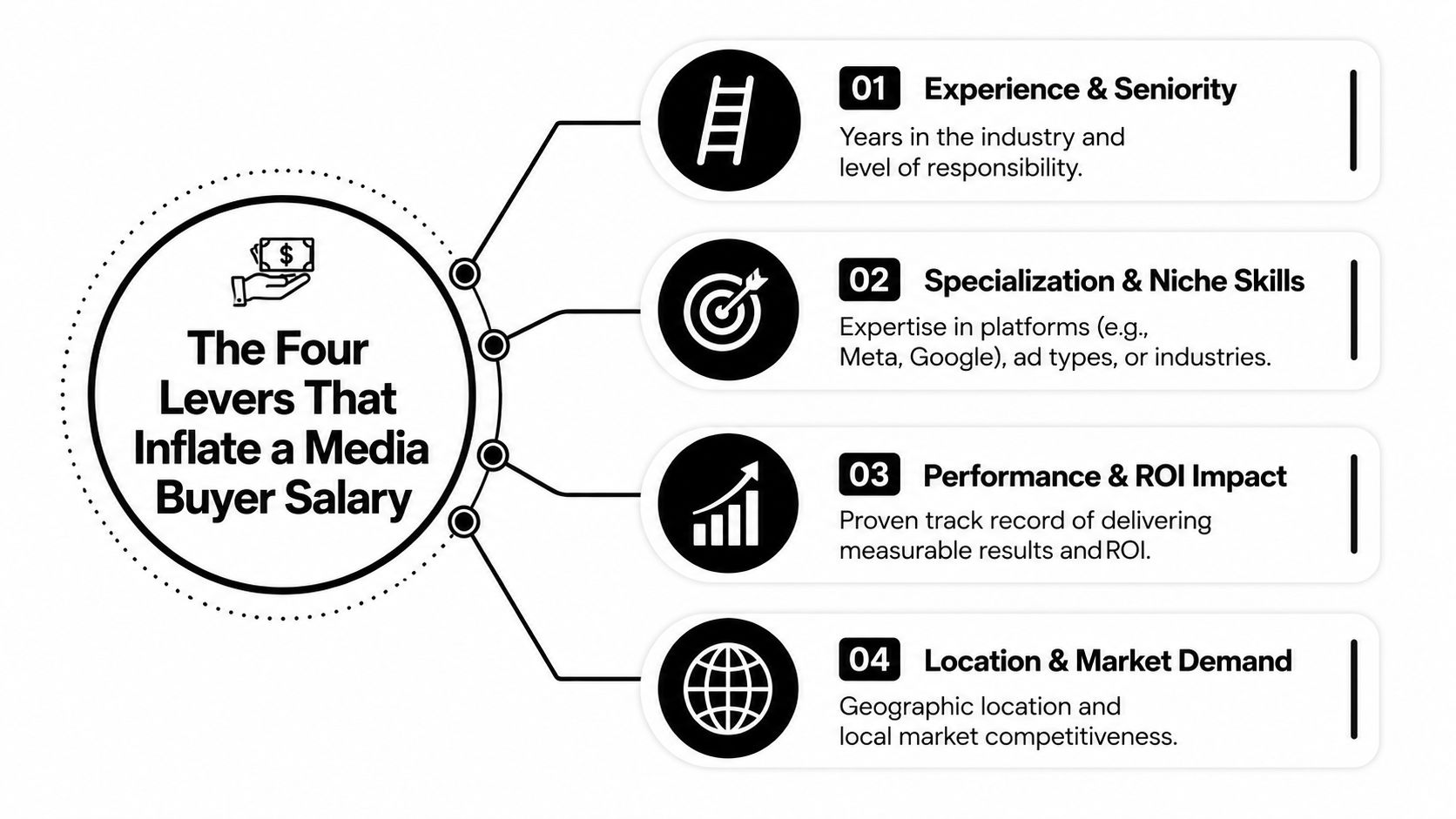
The first lever is platform specialization. A buyer who really knows Meta or Google usually earns more than a broad generalist. And that tracks with the salary data. As Remotely Talents reports, Meta or Facebook Ads specialists earn $70,000 to $120,000, while Google Ads specialists run $65,000 to $110,000 in the U.S.
The second lever is budget responsibility. Same source, same hard truth. Buyers managing more than $500,000 in annual ad spend command more because the job changes when the spend gets real. Tiny budgets let you experiment slowly. Bigger budgets punish sloppy decisions faster.
A candidate who has only managed modest spend may still be good. But they're not automatically qualified for scale.
The third lever is performance track record.
Not “I improved engagement.”
Not “I built campaigns across multiple verticals.”
Not “I'm passionate about data.”
I mean actual ROI accountability. Did they have to make the economics work, or were they mostly just inside the platform pulling levers someone else defined?
The fourth lever is location and market demand. A buyer based in a major U.S. metro often expects more because the local market supports it. That doesn't make them better by default. It just makes them more expensive by default.
A high salary often reflects cost structure, not magical talent.
When I review candidates, I mentally score them on four things:
In practice, hiring gets more artful than HR likes to admit. A buyer with one strong platform, clean execution habits, and serious commercial thinking can outperform a higher-priced “omnichannel” résumé that's all garnish and no steak.
The point isn't to cheap out. The point is to stop paying premium rates for the wrong premium signals.
Most companies think they have two choices. Hire full-time or hire a freelancer.
I think both options are overrated when used lazily.
A full-time hire looks clean on paper. You get focus, consistency, and someone who's supposed to care about your business beyond this month's invoice. Nice in theory. In practice, you're carrying salary, internal management burden, onboarding, and the risk that you hired someone who interviewed like a killer and operates like a tutorial video.
The salary is just the obvious line item. The hidden cost is everything around it.
You need process. Clear ownership. Performance management. Someone senior enough internally to judge whether the buyer is making good decisions or just narrating them confidently in Slack. If you don't have that, a full-time media buyer can become a very expensive black box.
And if the hire is wrong, the pain lingers. Bad campaigns can be paused. Bad payroll decisions stick around.
The freelancer route looks safer because the commitment feels lighter. But top freelancers don't price like budget help. They price like specialists who know exactly what your alternatives cost.
As covered in this discussion of fractional work models, the structure matters as much as the rate. A lot of companies think they're buying flexibility. They're really buying partial attention.
The market has also moved toward performance-based deals. According to the YouTube breakdown on media buyer compensation models, top-tier buyers may charge $3k to $8k per month as a base plus 1 to 5 percent of managed ad spend or profit share. It also notes that freelancers often stack 3 to 5 clients at $2k to $3k per month each.
That model can work. It can also get messy.
If you hire a freelancer to avoid complexity, you may just be renting a different kind of complexity.
The trap isn't full-time. The trap isn't freelance. The trap is choosing a model before you define what you need.
Need daily ownership, deep integration, and long-term process building? Full-time can make sense.
Need senior judgment without carrying a huge fixed salary? Fractional or contract can make sense.
Need results but hate recruiting, vetting, and supervising random operators from the internet? Then your problem isn't employment type. Your problem is talent access.
Different issue entirely.
You approve a U.S. media buyer at a salary that feels normal for the market. Six months later, you are paying the salary, payroll taxes, benefits, recruiting cost, management time, and the price of slow execution while they ramp. The problem was never the person. The problem was buying from the most expensive labor market by default.
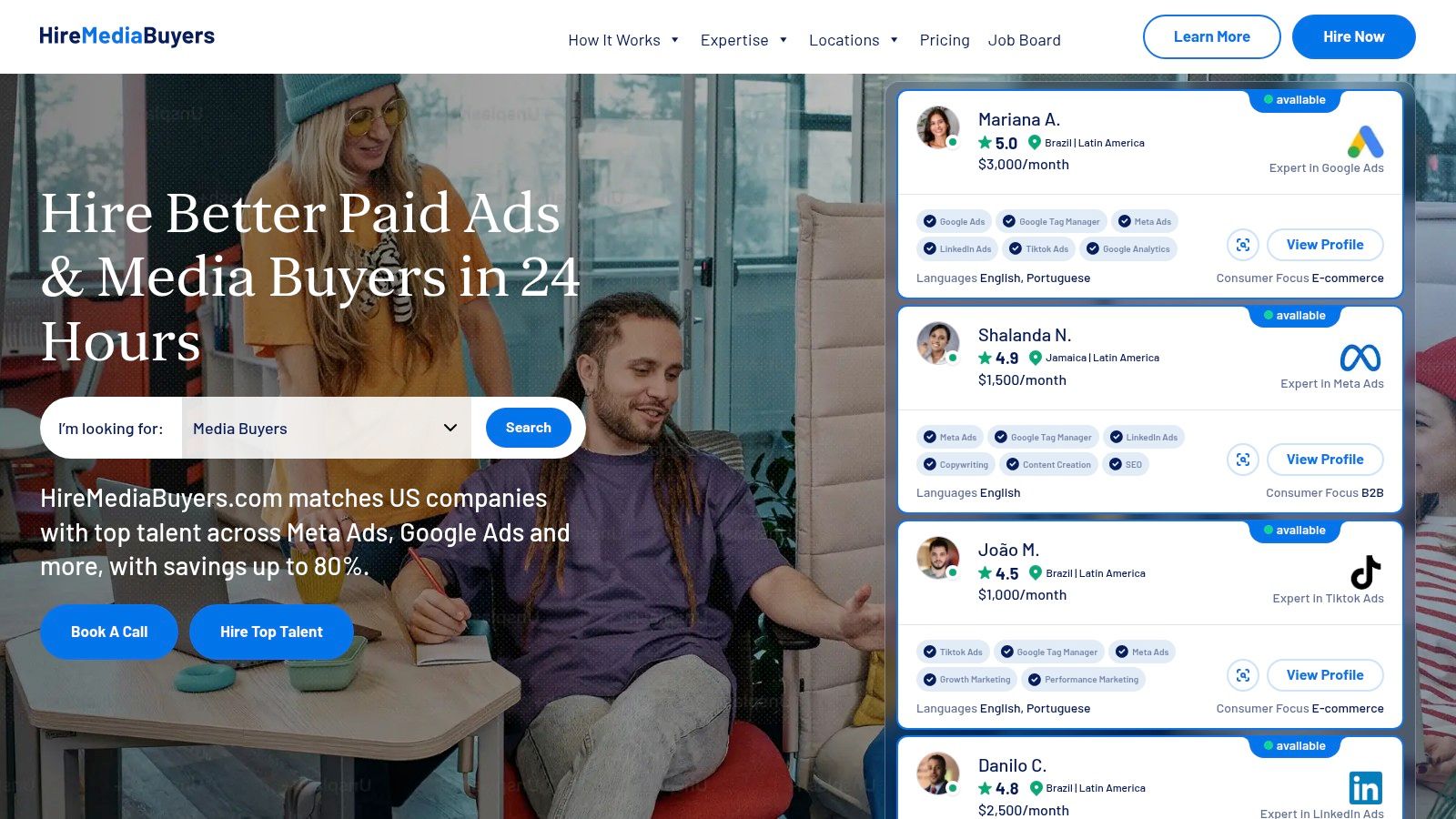
A lot of U.S. companies still treat domestic hiring as the safe option and global hiring as the risky one. That is backwards. Geography affects compensation far more than it affects skill. Great media buyers exist outside the U.S., and the price gap is wide enough to change the economics of the role.
That gap is the arbitrage.
Cheap labor is the wrong frame. Market inefficiency is the right one.
If a media buyer has the judgment to manage budget, the communication habits to work with your team, and the time zone overlap to move fast, you do not get extra ROI because they live in a higher-cost city. You just pay more for the same output. That is why more companies are using offshore hiring options for paid media roles instead of forcing every search into the U.S. salary band.
The full extent of savings does not stop at cash compensation. They show up in recruiting speed, payroll admin, replacement flexibility, and lower fixed exposure if the hire misses.
Here is the cleaner way to look at it.
| Cost Component | US-Based Hire (Average) | HireMediaBuyers.com Hire (Average) |
|---|---|---|
| Base compensation benchmark | Senior U.S. roles often sit in the higher five figures to low six figures, as cited earlier | Latin America remote compensation sits far lower, as cited earlier |
| Recruitment effort | Internal sourcing, screening, interviews, and negotiation | Pre-vetted marketplace and managed matching |
| Payroll and compliance admin | Usually handled internally or through added vendors | Included through the platform model |
| Replacement risk | You own the failed hire problem | Easier replacement path through the platform |
| Time zone coverage | Strong if domestic | Often aligned across Latin America for U.S. working hours |
You do not need fake spreadsheet theatrics to see the answer. Once salary is lower and the operating burden drops with it, the total cost picture changes fast.
Global hiring works when the talent is vetted. Random hiring from job boards does not.
If you hire the cheapest applicant you can find, you will spend the savings on rework, missed deadlines, weak reporting, and constant supervision. If you hire a pre-vetted operator who already understands paid media execution, you get the cost advantage without importing chaos.
That is the hiring hack. Do not chase cheap. Buy proven capability from a lower-cost market.
A cheaper hire who can't manage spend is not a bargain. It's a controlled burn.
The only hiring framework that matters is whether the person can turn ad dollars into profitable outcomes. Résumés can help. LinkedIn can help. Fancy agency names can help. None of them prove the one thing you care about, which is whether this person can make smart decisions inside your business.
This is the checklist I'd use if I had to do it from scratch again. And yes, I've learned some of it the expensive way. Toot, toot.
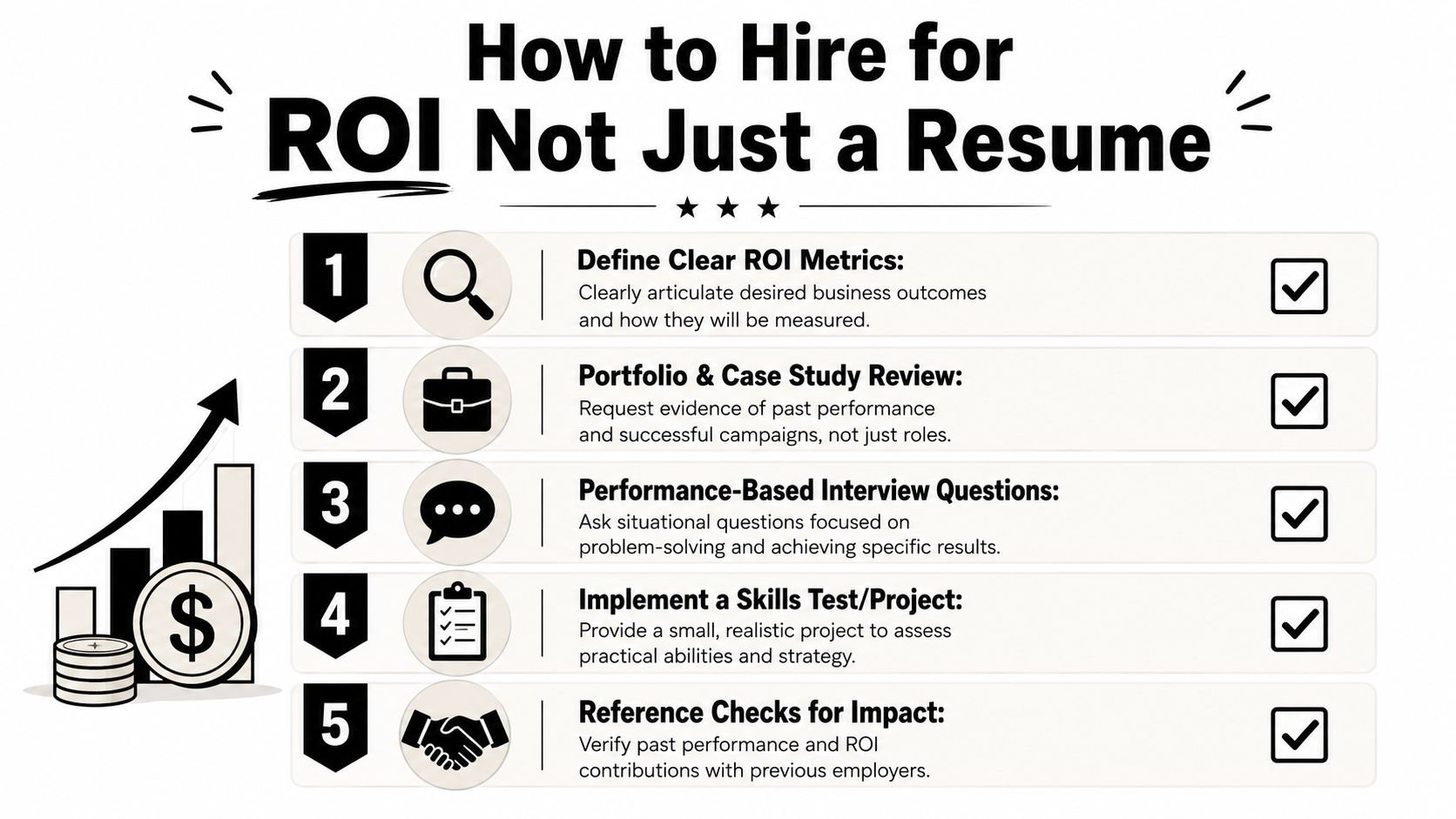
The weak ones talk in platform jargon and broad claims. The strong ones explain tradeoffs.
They tell you when they'd cut spend, not just scale it. They can discuss creative fatigue without pretending creative alone solves everything. They don't hide behind metrics that sound good but don't connect to the business.
This is what I'd listen for in an interview:
| Signal | What it tells you |
|---|---|
| They ask about margins, sales cycle, or lead quality | They think beyond clicks |
| They explain testing logic clearly | They know how to learn, not just launch |
| They admit what they wouldn't do yet | They have judgment |
| They can simplify platform complexity | They can work with real stakeholders |
Hire the buyer who can explain a bad month clearly. Not the one who only sounds smart in a good month.
A lot of teams still hire for polish. Nice logos. Clean LinkedIn. Smooth interview rhythm. Then they act surprised when campaign performance feels average.
Don't hire for posture. Hire for decision quality.
If you can identify someone who thinks commercially, communicates well, and has real pattern recognition inside ad platforms, you've got something valuable. Whether they're in New York, Bogotá, or somewhere your finance team has to look up on a map is beside the point.
The core argument isn't about media buyer salary. It's about what kind of cost structure gives you the best shot at profitable growth.
A big salary can buy experience. It can also buy overhead, ego, and very polished excuses. A lower-cost hire can save money. It can also create more work if you hire badly. The smart move is to stop obsessing over the title and start optimizing for ROI, accountability, and flexibility.
If you can get strong paid media talent without locking yourself into bloated fixed costs, do that. Then put the savings where they belong. Into testing, creative, and more efficient growth. That's the game.
Why pay premium U.S. rates by default if equivalent skill exists in global markets at a better price? That's not being cheap. That's being awake.
If you're done sorting through overpriced candidates and vague résumés, HireMediaBuyers.com gives you a faster path to pre-vetted media buyers and paid ads specialists who can work in your time zone, at a much saner cost structure. You can browse talent, get a shortlist quickly, and stop treating paid media hiring like a side quest.


