


You're probably reading this with three tabs open. One is Meta Ads. One is Google Analytics. One is your bank account, judging you.
Clicks are coming in. Spend is definitely happening. Revenue is acting like it didn't get the memo.
That's usually the moment founders start searching for a media buying service. Not because they want another vendor. Because they're tired of paying tuition to ad platforms and “growth experts” who treat budget like confetti.
The ugly truth is simple. Paid media rarely fails because the buttons were hard to click. It fails because the person behind the buttons didn't understand your economics, your customer, or your tracking. And when that happens, you don't just lose money. You lose time, momentum, and confidence in a channel that might've worked just fine with the right operator.
Monday morning. You open Ads Manager expecting traction and get a finance problem instead. Spend climbed all weekend. Sales did not. Your agency says performance is “volatile.” Your freelancer wants more time. Your in-house marketer is waiting on creative, tracking, and approval from three people who barely look at the numbers.
I've lived this. The money rarely disappears because paid media is impossible. It disappears because the person managing it does not understand your margins, your attribution, or how fast small mistakes turn into expensive habits.
The market is big enough to hide a lot of bad operators. IBISWorld's media buying agency industry data notes that global ad spend is projected to pass $1 trillion by 2026, digital keeps taking a bigger share, and the US media buying agency industry is projected to generate $14.4 billion in revenue in 2026. Bigger budgets and bigger agencies do not protect founders. They often bury accountability under layers of process.
Founders usually frame this as a talent problem. It is an operating model problem first.
Agencies protect their margin with junior staff, templated reporting, and slow feedback loops. In-house hires look cheaper until you add salary, benefits, management time, tools, and the cost of a bad hire sitting on your largest acquisition channel. Freelancers can work, but one person usually breaks at scale. They get sick, disappear, or stay in their lane while your tracking, creative testing, and channel mix drift off course.
What you need is clear ownership of revenue, fast execution, and someone who can tell you why performance changed before the week is gone.
Practical rule: If your buyer cannot explain spend, sales quality, and next steps in plain English, they are not in control of the account.
Tracking is usually where the leak starts. If attribution is wrong, every optimization call after that is built on fiction. Clean up your conversion tracking foundation before you scale. Otherwise you are training platforms on bad signals and paying for the privilege.
You want someone who can look at Meta, Google, TikTok, LinkedIn, Shopify, HubSpot, and your P&L, then show you where money is leaking and what gets fixed first.
That is why the hiring model matters so much. The wrong setup costs more than the wrong campaign. A talent marketplace solves a lot of this mess because it cuts out agency overhead, avoids the fixed cost of a full-time hire, and gives you access to specialists with a track record you can inspect.
Find the leak. Fix the operator problem causing it. Then scale.
A strong media buyer is part trader, part analyst, part therapist for founders who've been burned before.
They do not “just run Facebook ads.” If that's the pitch, run.
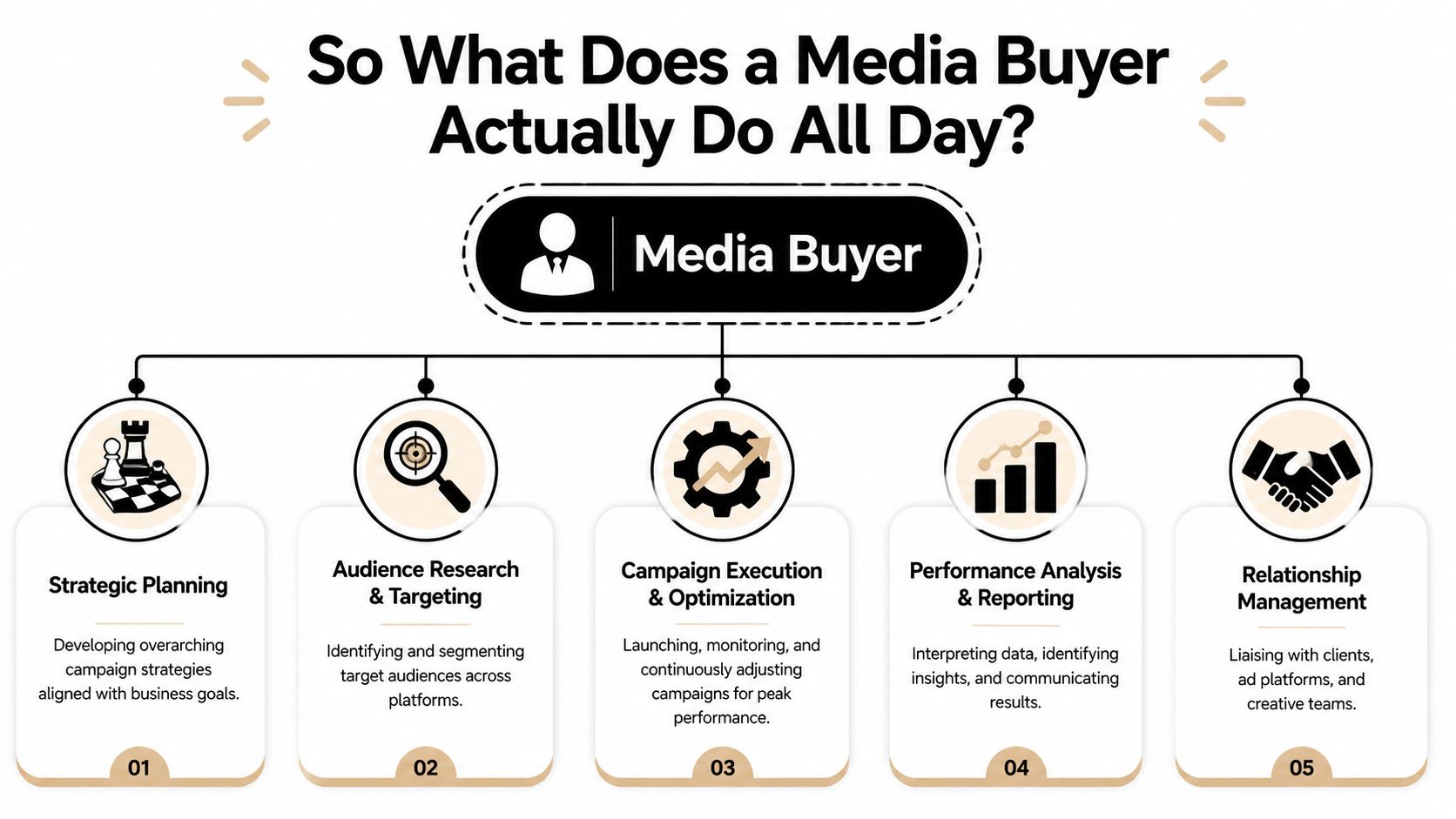
A good buyer looks at channels the way a portfolio manager looks at assets. Meta might give you scale. Google might catch demand that already exists. TikTok might open cheaper attention if your creative doesn't stink. LinkedIn might make sense if your deal size supports it. Same business, different economics by channel.
A weak buyer treats every account the same. Broad targeting, recycled creative, default attribution window, and a prayer.
The core work usually includes:
The best operators are moving away from set-and-forget campaign management. The most effective media buying services are shifting to AI-supported, continuous optimization and centralized data hubs, which can cut budget waste from audience duplication by 10–15% according to Fact.MR's media buying services market analysis. The same analysis notes that these teams use smart asset templates that reduce creative production time by 40%, which means they can test more angles without turning your design team into roadkill.
That's what experienced founders should want. Not more dashboards. Better feedback loops.
A media buyer earns their keep when they shorten the distance between “we launched” and “we learned something useful.”
Ask yourself this. When performance drops, does your buyer have a diagnosis, or just a list of excuses?
A strategic buyer will tell you whether the issue is creative mismatch, weak offer-market fit, noisy attribution, a broken funnel handoff, or bad channel intent. They can talk to designers, copywriters, sales, and finance without sounding lost.
A mediocre buyer lives entirely inside Ads Manager. That's like trying to run a restaurant by only watching the fryer.
Founders usually have four options. Build in-house. Hire an agency. Roll the dice on a freelancer. Or use a dedicated talent marketplace.
I've tried versions of all four. Three come with very predictable pain.
The dream is seductive. One person. Full focus. They know the brand. They sit close to product and creative. Great.
Then reality strolls in wearing muddy boots.
You have to source candidates, review portfolios that all say “scaled brands,” run interviews, test actual skill, check references, and hope they're good across strategy, creative judgment, tracking, and reporting. Hope you enjoy spending your afternoons fact-checking resumes and running technical interviews, because that's now your second job.
And if they're wrong for the role, you don't just lose media performance. You lose months.
Agencies sell senior strategy and often deliver junior execution. You meet the A-team in the sales process. Then your account gets passed to someone who's smart enough, overloaded, and juggling too many brands to care like an owner.
That doesn't mean agencies are useless. Some are excellent. But founders need to understand the structural problem. Agencies optimize for account coverage and margins. Your company optimizes for profit and speed. Those goals overlap, but they are not married.
One more thing. A real media buying department should look like one. If an agency's team is mostly creatives with one lone Media Director, that's a warning sign. My Marketing Doctor's agency vetting guidance makes a blunt point I agree with: if the workforce is 80% creative with only one Media Director, you should question whether there's real buying capability there at all.
I like freelancers. Some are killers.
The problem is not talent. It's reliability and verification. Freelance platforms are resume roulette. You're trying to infer strategic depth from a profile picture, a few reviews, and a proposal that somehow mentions “data-driven scaling” four times in two paragraphs.
If you find a great one, fantastic. But founders should go in with eyes open. You're betting on one person's capacity, communication habits, and stability. If they get sick, get overloaded, or ghost, the account doesn't care.
A dedicated talent marketplace is the pragmatic option. You still get an embedded operator, but without taking on the full recruiting burden, the agency layers, or the freelancer chaos. It de-risks speed, screening, and replacement.
Here's the clean comparison.
| Model | Cost | Speed to Hire | Risk | Best For |
|---|---|---|---|---|
| In-house | Higher fixed commitment and hiring overhead | Slow | Hiring mistake is expensive and slow to unwind | Brands with stable volume and strong internal management |
| Traditional agency | Variable, often bundled with management fees | Medium | A-team pitch, B-team delivery, split attention | Companies that need broad channel coverage and can manage the agency hard |
| Freelancer | Flexible on paper | Fast if you get lucky | Quality variance, availability risk, weak redundancy | Short tests, niche channel work, founder-led oversight |
| Dedicated talent marketplace | More controlled and transparent | Fast | Lower hiring friction and easier replacement | Teams that want embedded talent without building recruiting from scratch |
Founder test: Choose the model that fails gracefully. Not the one that looks best in a sales call.
That's the part people miss. You're not just choosing talent. You're choosing failure mode.
Most interviews for media buyers are awful.
“What platforms do you know?”
“How many years have you done paid social?”
“What was your biggest budget?”
None of those questions tell you whether the person can make you money.
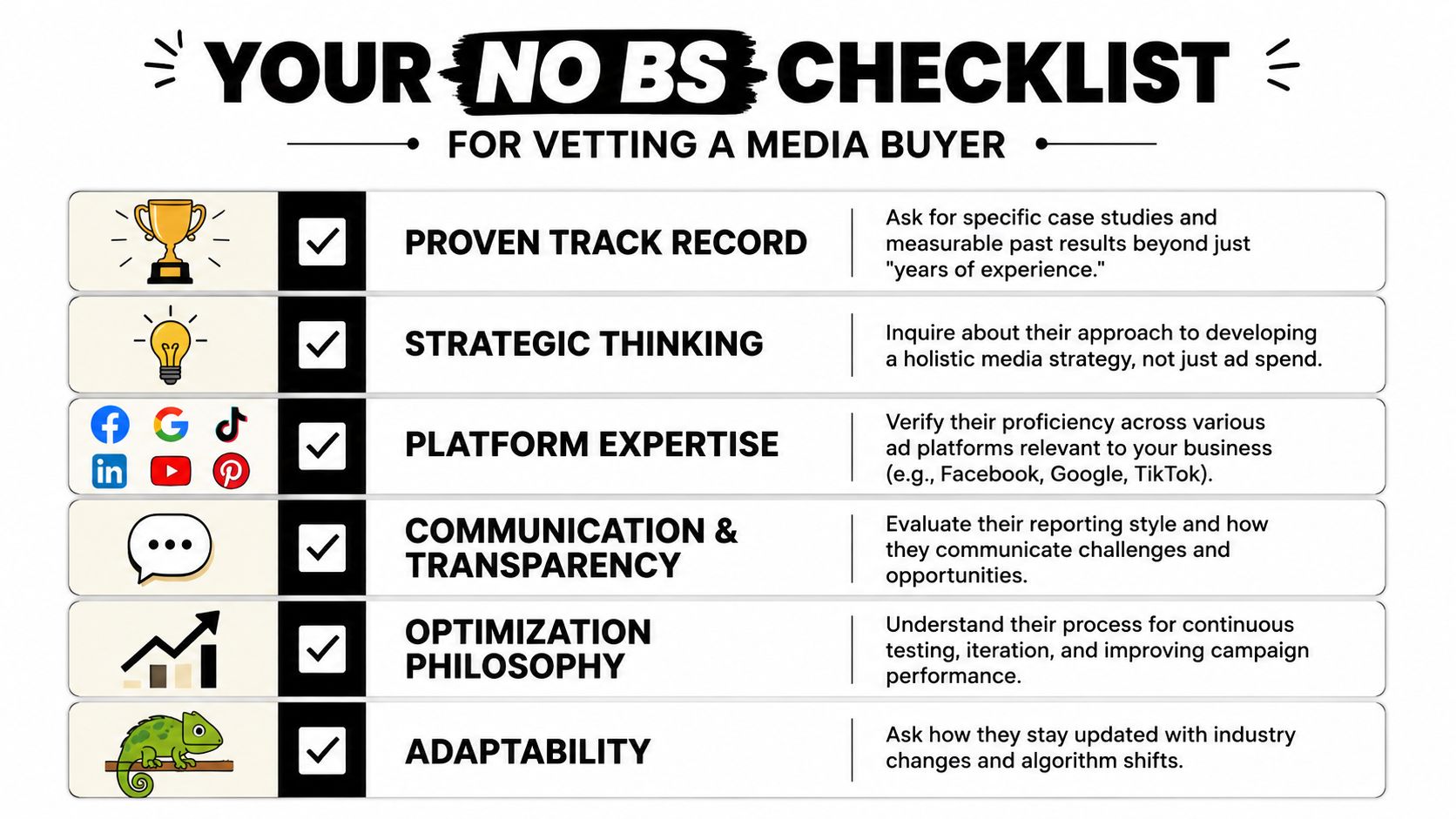
The right interview questions force a buyer to reveal how they think under uncertainty.
Try these:
Here, most candidates fall apart.
Too many buyers talk demographics because demographics are easy. The sharp ones go deeper. Most media buying guides focus on surface-level demographics. Elite buyers now use customer service emails, DMs, and reviews for hidden motivation mining, pulling out the deeper reasons people buy, as discussed in this video on media buyer research methods.
That's the stuff you want in an interview.
Ask:
If they answer with age bands and interest stacks, you've got your answer.
Good buyers know the click is the end of a thought process that started long before the ad appeared.
Everyone wants to hear about scaling. Few want to hear about process discipline. Shame, because discipline is where money gets saved.
Use a reference process that checks client communication, ownership, and consistency. A polished interview can fool you. A structured client reference check process usually can't.
And yes, ask them to open an account and talk through what they'd audit first. Watch how they move through. Watch what they ignore. You'll learn more in ten minutes of live review than in an hour of self-congratulation.
If your media buyer reports impressions, clicks, CTR, and ROAS without tying any of it back to business health, you're being entertained, not informed.
The KPI set has to match the business model. For e-commerce, that usually means looking past front-end platform metrics and into blended efficiency, repeat purchase behavior, and margin after ad spend. For lead gen, it means caring whether leads turn into pipeline and revenue, not whether the form fill was cheap enough to make a spreadsheet smile.
A smart founder asks questions like these:
You'll want a practical reporting rhythm around the metrics that connect ad spend to business outcomes. If your team needs a cleaner framework, this guide to ad performance metrics that actually matter is a useful starting point.
This part is mandatory. Before launch, validate tracking across platforms. Pixels. UTMs. Server-side events. Landing page behavior. Mobile flow. Event mapping. All of it.
A mandatory pre-launch validation of cross-platform tracking is critical. Failure to standardize this setup leads to data noise where the algorithm can't optimize effectively, causing CPA to spike by 15–25% in the first 48 hours, according to Keends' breakdown of the media buying process.
That's not a tiny issue. That's the difference between a promising launch and a fake lesson.
If onboarding feels casual, the account will pay for it later.
A buyer can't optimize what the system can't measure. That's why onboarding is not admin. It's part of performance.
You hire an agency because you want speed. Three months later, you have a weekly call, a polished slide deck, and no clear answer for why spend went up while contribution margin got worse.
I have seen this play out across DTC, SaaS, and local lead gen. The hiring model usually causes the mess before the campaigns do.
Agencies spread senior attention too thin. Your account gets sold by the strategist and run by whoever has room on the pod. In house hires look safer, but salary, benefits, ramp time, and management overhead make one bad hire painfully expensive. Freelancers can work, but the good ones are booked, the average ones disappear under pressure, and the cheap ones usually buy traffic without building a system.
That leaves founders with the same problem. Too much risk upfront. Too little proof.
The wins are usually boring. That is why they last.
A strong buyer cuts waste fast, simplifies the account, and makes the economics visible. One e-commerce brand got traction after the buyer fixed the offer and message match instead of chasing click-through rate. A B2B company improved lead quality after the buyer used sales feedback to tighten targeting and qualification rules. A local business stopped reacting to every bad day once the buyer set a real testing cadence and explained which signals mattered over a full decision window.
Good operators do not rescue accounts with magic. They remove bad decisions, one by one.
The market is getting bigger, which usually means more noise. Dataintelo reported that the global media buying services market was estimated to be valued at approximately $9.16 billion in 2025 and projected to reach $17.99 billion by 2034, according to its media buying services market report. More money in the category attracts more vendors, more recycled advice, and more people selling confidence instead of judgment.
Platforms also change faster than weak operators can adapt. A good example is Meta's Andromeda update in 2025, where experienced buyers started advising against splitting creatives by angle into separate ad sets and instead recommended using 6 to 8 varied ads in one consolidated setup, based on this Andromeda update discussion. Buyers who only know one playbook break when the platform stops rewarding it.
That is the true hiring trap. You are not just paying for execution. You are paying for someone to keep making sound decisions after the platform shifts.
From a founder's seat, a talent marketplace is the most practical option because it lowers the two risks that matter. Hiring risk and delay.
You do not need a full agency retainer before you have proof. You do not need to carry the fixed cost of a full-time hire before the channel earns it. You also do not need to roll the dice on a solo freelancer with no bench, no vetting, and no process. A vetted marketplace sits in the middle. You get access to specialists with a track record, faster matching, and less downside if the fit is wrong.
That is the smarter way to buy media talent.
Ask who can protect cash, learn fast, and operate within your margins. Ask who can explain tradeoffs without hiding behind jargon. Ask who has done the job under constraints that look like yours.
Experience helps. Judgment pays.
Media platforms are tools. Useful tools, expensive tools, occasionally infuriating tools. But still just tools.
Your edge doesn't come from having access to Meta or Google. Everyone has that. Your edge comes from the person deciding what to test, what to kill, what to scale, and what to ignore.
That's why hiring is the primary growth lever here. Not another dashboard. Not another agency pitch. Not another “framework” from someone whose main skill is posting on LinkedIn before breakfast.
If your current setup is burning cash, stop trying to outwork a broken model. Fix the talent problem. Get someone who understands tracking, creative iteration, channel economics, and the difference between looking busy and producing revenue.
That's the move.
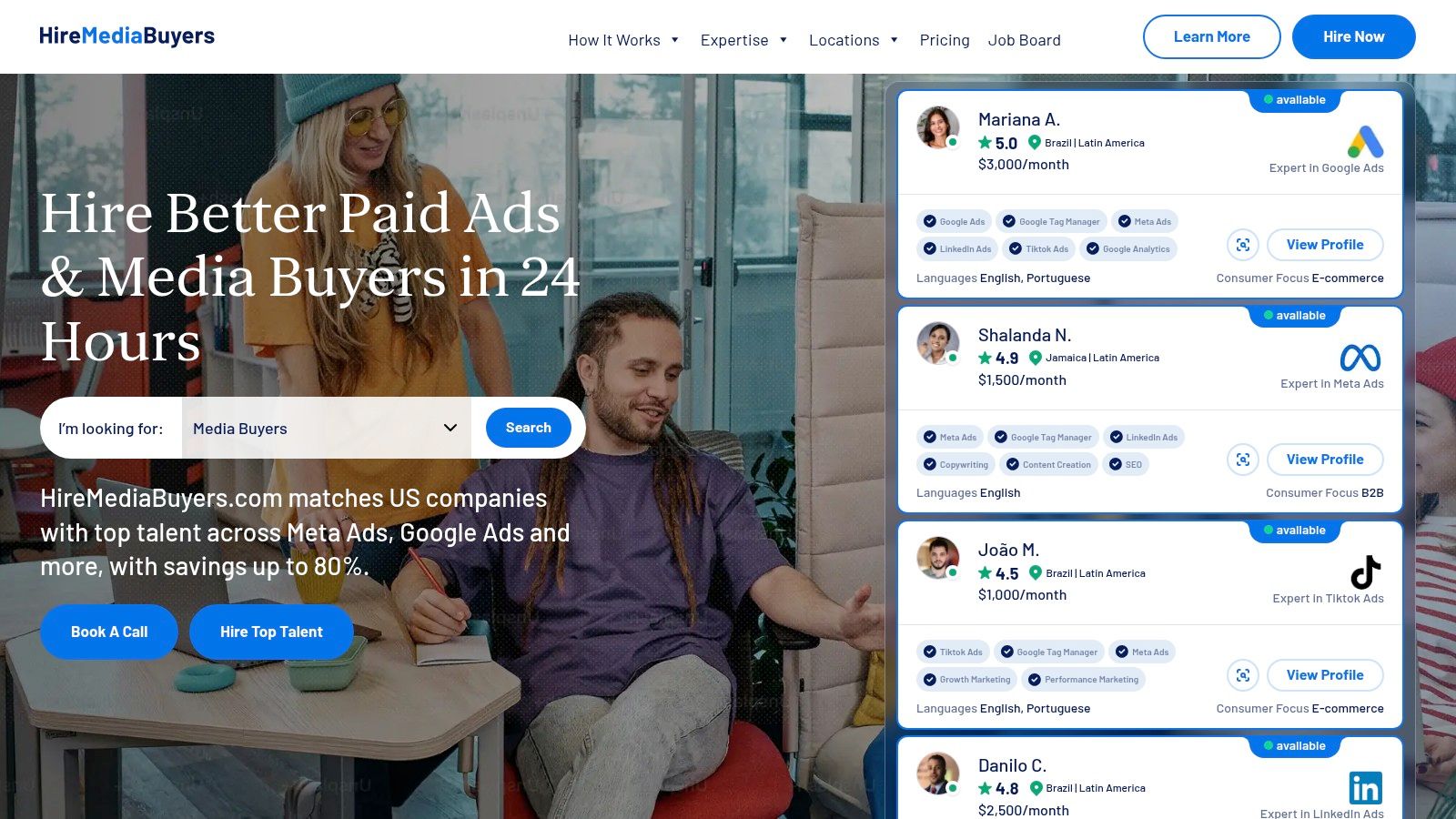
If you want to stop gambling on paid media hires, start with HireMediaBuyers.com. It gives you access to pre-vetted media buyers and paid ads specialists without the usual hiring circus, so you can find someone who knows how to turn ad spend into growth.


