


Your campaign is spending money, the creative team is waiting on a new brief, and your only senior media buyer just gave notice. Lovely. Nothing sharpens your opinion on hiring like watching a hot account drift while the seat sits empty.
That's the case for on demand hiring. Not theory, not HR jargon, not a cute little “talent strategy.” It's the move that gets you a pre-vetted specialist fast enough to stop the bleeding, which matters a lot when performance marketing has a learning phase and every day of delay costs real ad spend. Traditional hiring is still lumbering along at 44 days on average in one industry report, while median U.S. time-to-fill hit 45 to 50 days in 2025, so if you're trying to patch a paid media gap with a standard recruiting process, good luck and bring snacks. Recruitment timing data
The market is telling the same story. The global on-demand staffing market was valued at $74.6 billion in 2025 and is projected to reach $178.4 billion by 2034, with temporary staffing the largest service type at 41.3% of revenue, or about $30.8 billion. That's not a fringe workaround anymore, that's a serious labor market with real demand for speed and flexibility. On-demand staffing market data
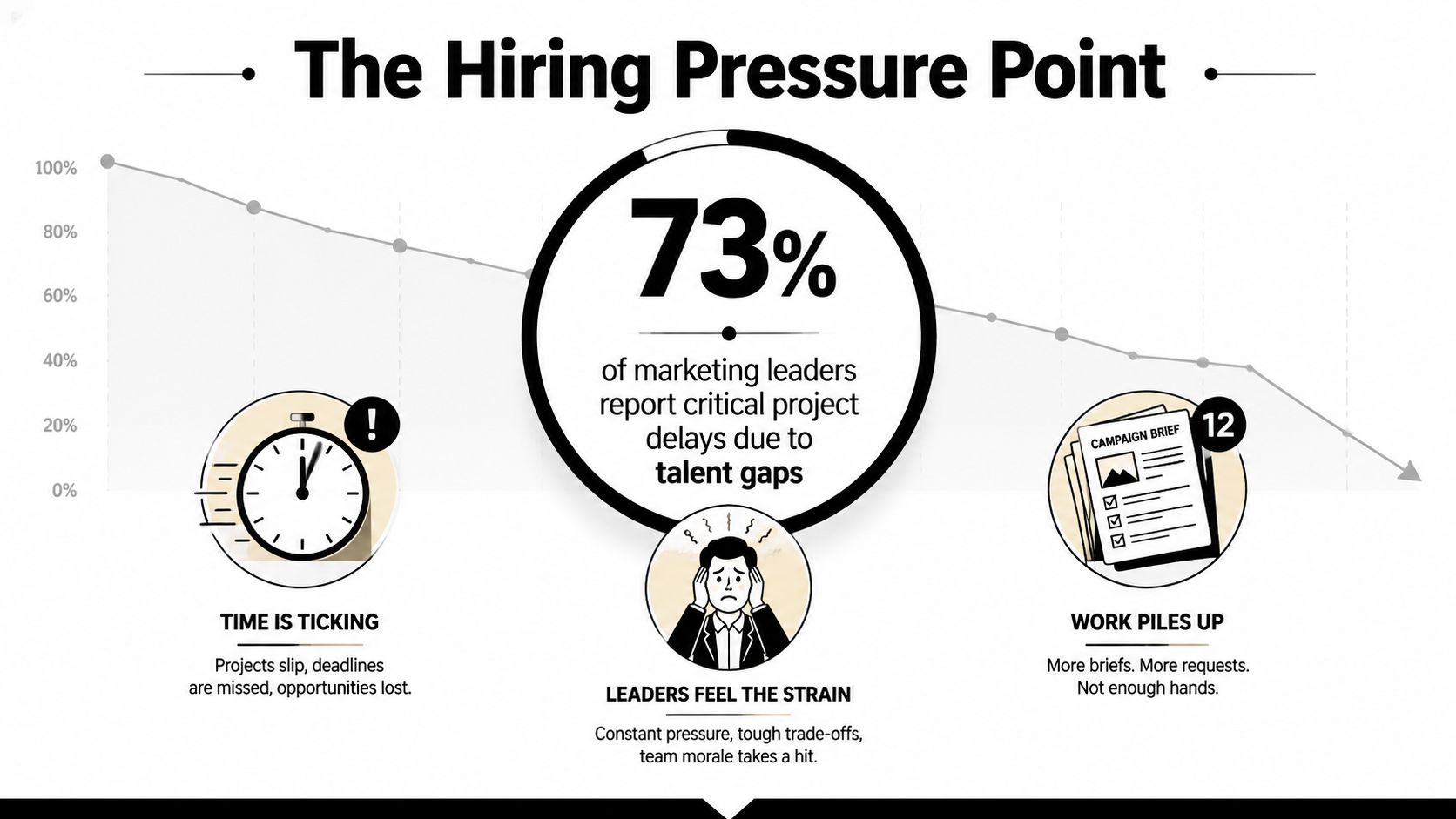
The pain usually shows up in a very boring way. A Meta campaign starts slipping, the agency wants a creative refresh, and the one person who knows the account inside out has already moved on. Now you're sitting there with a dashboard full of excuses and no operator to do the unglamorous work of fixing them.
That's when on demand hiring stops sounding trendy and starts sounding practical. It means sourcing pre-vetted specialists through a marketplace or partner who can hand you a working professional in 24 to 48 hours, not after a month and a half of résumé ping-pong. In paid media, that speed is not a nice-to-have. It's the difference between keeping a campaign in its learning phase and letting it burn budget while nobody competent is steering.
If you run performance marketing, you already think in timelines. Creative testing windows, pixel hygiene, audience fatigue, platform learning, attribution lag. Hiring should sit in that same mental model.
The labor market makes the case for speed pretty clearly. Employers reported 7.2 million job openings in August 2025 and 5.1 million hires in the same month, while unemployment averaged 4.3%, which tells you the market still has a mismatch problem. Another dataset put applicants per posting at about 46 in 2021 and 95 in 2025, while completed hires fell from 1.34 million to 1.05 million from 2022 to 2025. Labor market and recruiting data
So yes, speed matters. But not because speed sounds sexy in a deck. It matters because an empty seat in media buying, creative ops, or demand gen turns into delayed optimizations, late tests, and campaigns that keep spending while nobody is learning anything.
Practical rule: if a role touches paid spend directly, treat hiring time like a waste line in the budget, not an HR inconvenience.
The good version of this process is clean, not mystical. You submit a brief, the platform screens talent, real humans interview the shortlist, the best candidates prove they can do the work, and you get someone live fast enough to matter. The bad version is a vendor who says they “have a strong bench” and then forwards six LinkedIn profiles like they're doing you a favor.
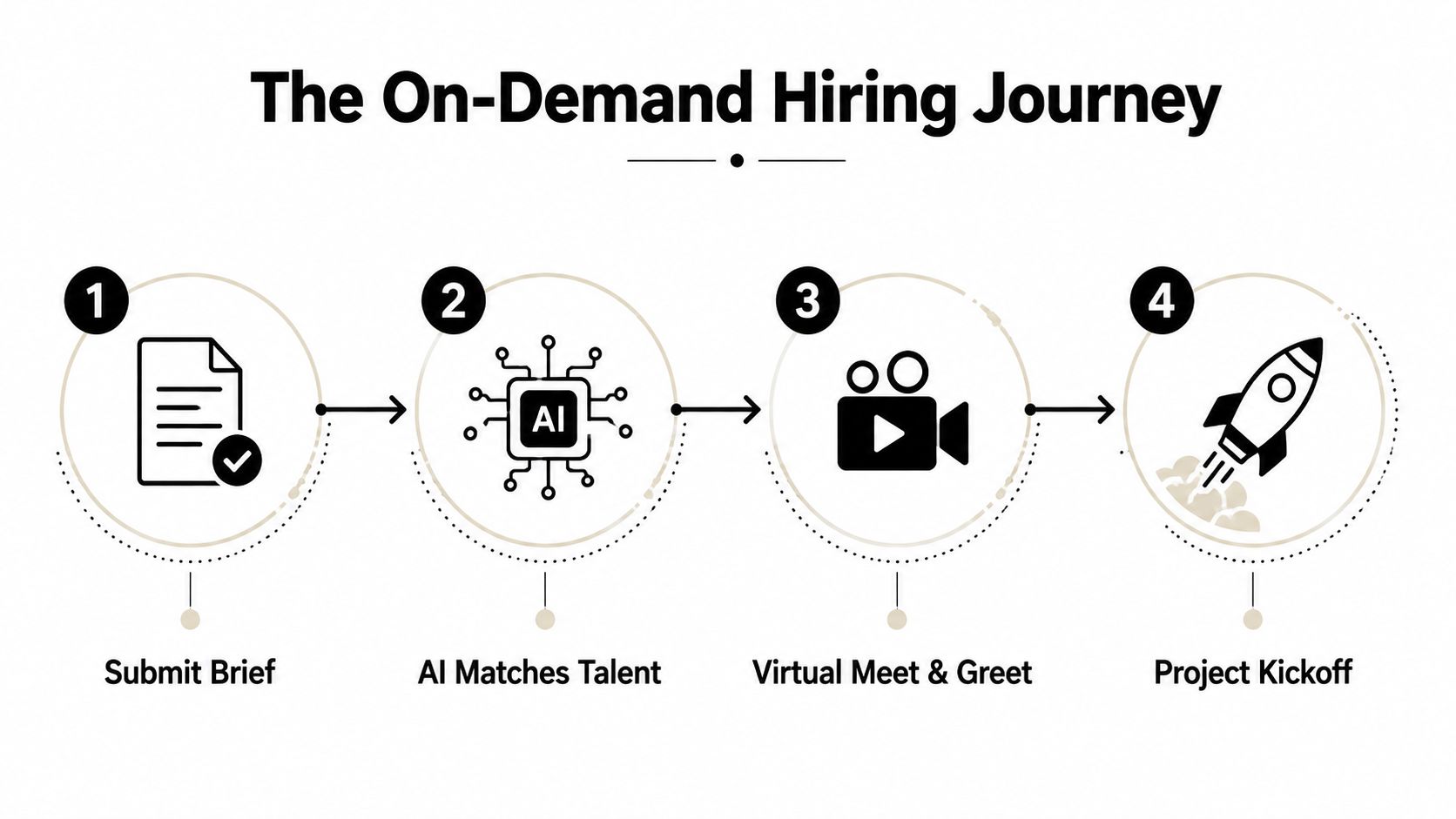
Start with a real brief. Not “need a good media buyer.” That's lazy and vendors love lazy because it gives them room to send whatever's on the shelf. Say what channel, what account size, what KPIs matter, what tools the person will touch, and what kind of autonomy they'll have.
A serious marketplace then runs structured screening, often combining AI screening, human interviews, and skills assessments. That matters because hiring guides recommend practical tests, case studies, portfolio review, and verified references instead of trusting a résumé to tell the whole story. Structured assessment guidance In paid media, a work sample beats a polished title every time. I'd rather see how someone audits a Google Ads account than how they describe themselves on paper.
Once a candidate clears the gate, the best setups don't leave you alone to wrestle onboarding, payroll, and compliance like it's some weird side quest. For scalable operations, serious platforms need always-on infrastructure. A government procurement spec for an eRecruitment ATS required 7×24 SaaS uptime, support for 4,000 job postings, and 1,000 AI interviews per year, which is a good reminder that high-volume hiring depends on automation and throughput planning, not manual scheduling. Always-on hiring infrastructure
That's the part most bad vendors underplay. If they can't explain how the brief turns into a vetted shortlist, or they skip the practical assessment step, they're not a hiring partner. They're a résumé forwarding service with a nicer logo.
Competitor posts usually turn here and start singing hymns about “agility.” Cute. Let's do the grown-up version instead, because every hiring model comes with a bill, whether it's on the invoice or hidden in cleanup work later.
The strongest upside is speed-to-seat. When you need someone for a campaign launch, a creative testing pod, or a channel turnaround, waiting six weeks for a traditional search is just managerial self-harm. The second win is flexibility. You can scale support up or down by campaign, which is exactly how paid media behaves.
There's also a practical talent argument. Harvard Business School research on hidden workers found 84% say the application phase is difficult, while only 26% of employers prioritize the channels these workers use. That gap is ugly, but it's also an opportunity. If you build a better application path, you get access to underemployed, disabled, returning-to-work, and otherwise overlooked talent that standard recruiting misses. Hidden worker research
You do lose some organic culture fit when the process is fast and remote. That's just reality. On demand hiring also puts more pressure on your onboarding, because a great specialist still needs context, access, and a manager who can make decisions quickly.
Then there's contract hygiene. If your IP language is sloppy, or your replacement terms are vague, you'll regret it. Vendor lock-in is another one people ignore until it bites them. If you only ever use one marketplace and never build an internal bench or a second source, you're not being strategic, you're just outsourcing your memory.
Bottom line: use on demand hiring for roles where speed, flexibility, and campaign continuity matter more than long socialization periods.
Different buyer, same headache. A workload spike doesn't care whether you're an agency with twelve client accounts or a scrappy founder trying to make Google Ads do more than politely burn cash.
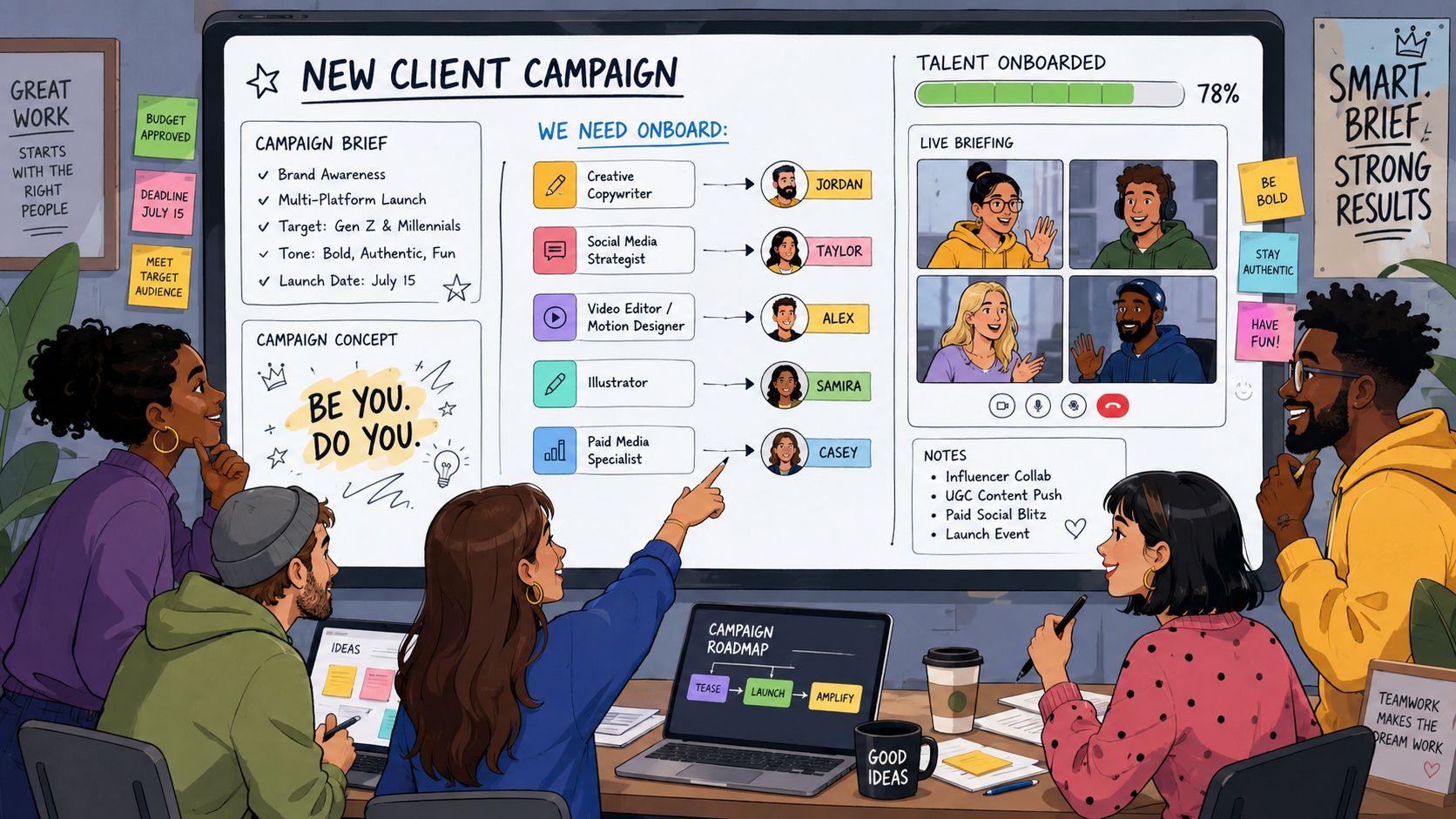
Agency life is always one account away from chaos. When a new client signs, the brief is usually urgent, the scope is muddy, and nobody wants to admit the team is already stretched. On demand hiring works here when you need a paid media specialist who can plug into existing SOPs, audit the account, and stabilize launch work while your core team keeps selling and reporting.
The metric that matters is simple, did the new hire reduce backlogs without turning every Slack thread into a therapy session? If you're still wondering whether to keep a role in-house or go flexible, this comparison can help, agency vs in-house hiring.
DTC teams usually need creative testing muscles first. If Q4 is coming and you need someone to spin up new angles, write sharper ad variations, and keep the testing cadence alive, a full-time search can be way too slow. On demand hiring fits best when the brief is tied to a single growth window, a product drop, or a channel reset.
You want proof in faster test cycles and cleaner learnings, not just more “output.” More assets is not the win. Better signal is the win.
For SaaS, the need is often more surgical. A LinkedIn demand-gen specialist, a paid search operator who understands longer sales cycles, or someone who can clean up lead quality without wrecking volume. The ramp is less about platform mechanics and more about knowing how marketing and sales shake hands in the world.
Small businesses don't need enterprise cosplay. They need someone part-time who can manage Google Ads without turning the founder into an accidental campaign manager. On demand hiring makes sense here because the business can buy precision without committing to a full salary before the channel has even proven itself.
One option in this lane is HireMediaBuyers.com, which connects companies with pre-vetted media buyers and paid ads specialists for full-time or part-time hiring. That's the kind of specialized marketplace that fits the model instead of pretending every role needs a months-long search.
Vendor demos are where optimism goes to die, or at least where it should. Don't fall for pretty dashboards and vague talk about “quality talent.” Ask annoying questions, because bad vendors rely on buyers being polite.
First, ask how they vet. Not in abstract terms, in actual stages. Do they use structured screening, work samples, interviews, and reference checks, or are they mostly matching keywords and hoping for the best? If they can't explain the gate, they probably don't have one worth trusting.
Then ask about time-to-shortlist, replacement terms, timezone coverage, and what happens if the first match misses the mark. You also want straight answers on payroll, compliance, and who owns the bench if the relationship ends. That last one matters more than people think. If the vendor disappears and takes the talent network with them, you've bought dependency, not capability.
Ask this in the demo, "If I need a replacement in the first month, what exactly happens, who pays what, and how fast does the handoff take?"
If the vendor avoids talking about contracts, that's a smell. If they can't explain IP ownership in plain English, that's a bigger smell. If they promise magic without showing the actual screening flow, they're selling confidence, not access.
Also watch for lazy generalists. A vendor that hires everyone from accountants to yoga instructors is probably not great at paid media. Specialization matters because media buyers need different judgment than generic digital marketers. You want someone who understands channel mechanics, not just someone who can post a job and pray.
This is the part most founders skim and then regret later. Cost isn't just the sticker price, it's the shape of the commitment, the exit terms, and whether you've accidentally bought a low-friction nightmare.
| Pricing Model | Typical Cost Range | Best For | Watch Out For |
|---|---|---|---|
| Hourly | Varies by specialist and scope | Short bursts, audits, overflow support | Costs can drift if the brief is fuzzy |
| Monthly retainer | Predictable monthly commitment | Ongoing channel management and steady output | Easy to overpay if the role is undersized |
| Success-fee or performance-linked | Tied to agreed outcomes | Narrow, measurable projects | Attribution fights and incentives that get weird |
If I'm being blunt, I'd rather have a clear monthly arrangement than a clever-feeling success-fee setup that turns into a spreadsheet cage match. Paid media outcomes are affected by budget, creative, seasonality, and offer quality. The operator should be accountable, yes, but don't pretend one person can control everything in the funnel.
Use the same discipline you'd use when reviewing a media buying agreement. Notice periods need to be short enough to give you flexibility. IP ownership needs to be explicit. Replacement windows should be written down, not implied by a cheerful sales call.
And if the contract says “cancel anytime,” make sure the process is clean, cancel-anytime terms. The phrase only matters if the exit is painless and the work product is still yours.
The best contract is boring. The worst one is full of hand-wavy language about partnership while loading risk onto the buyer. You want direct wording, obvious ownership, and a clean off-ramp if the fit is off.
A warm intro and a nice interview are not proof. If the hire is useful, the work will show it. If not, you'll know fast enough to stop paying for the experiment.
In the first 30 days, I want a real audit, clear quick wins, and working access across accounts, dashboards, and creative tools. If the hire can't identify the obvious bottlenecks quickly, that's a problem. If they can, you should already see cleaner prioritization and less chaos.
By 60 days, the person should have launched structural improvements, not just busywork. Think better test cadence, sharper naming conventions, cleaner account hygiene, and a more disciplined creative refresh process. That's also the point where you should start judging whether the operator can explain performance shifts without hiding behind jargon.
By 90 days, the baseline should be clear enough to judge whether the engagement is worth extending. That means dashboard hygiene is in place, the team knows what the new hire owns, and the replacement cost if they leave is now a real business question, not a hypothetical.
For measurement discipline, especially in ads and attribution, this conversion tracking guide is worth keeping nearby because bad tracking makes good hiring look bad.
If you want a simple scorecard, ask three things, did the person diagnose the account faster than your team could, did they launch meaningful tests without hand-holding, and did they make the channel easier to manage for everyone else? That's the stuff that matters. Everything else is decorative.
Is on demand hiring only for big budgets? No. It's often more useful for smaller teams because they can buy the exact capability they need without swallowing a full-time salary too early. The trick is matching the engagement to the work, not using a sledgehammer where a wrench would do.
What happens to your IP and data? That should be spelled out in the contract, not implied by good vibes. If the provider can't explain ownership, access, and termination cleanly, walk away. You're hiring talent, not donating your playbooks.
How do you avoid low-quality overseas talent? Stop making geography the only filter. Timezone fit, verified skills, and work samples matter more than a passport-shaped assumption. The issue isn't where someone lives, it's whether they can do the job, communicate clearly, and keep your accounts moving.
What's the difference between a marketplace platform and a recruiting agency? A marketplace tends to give you faster access to pre-vetted specialists and more flexibility on engagement type. A traditional agency often spends more time on sourcing and less on operational fit. My rule is simple. Hire full-time when the role is core and stable, go on demand when speed, flexibility, or burst capacity is the deciding factor.
If you're tired of slow searches and vague vendor promises, HireMediaBuyers.com is built for the exact kind of hiring pain marketing teams keep repeating. It connects you with pre-vetted media buyers and paid ads specialists for flexible, fast-moving roles, and it's worth a look if you want to stop treating hiring like a quarterly emergency. Visit HireMediaBuyers.com and see whether your next media hire should come from a marketplace instead of a months-long search.


