

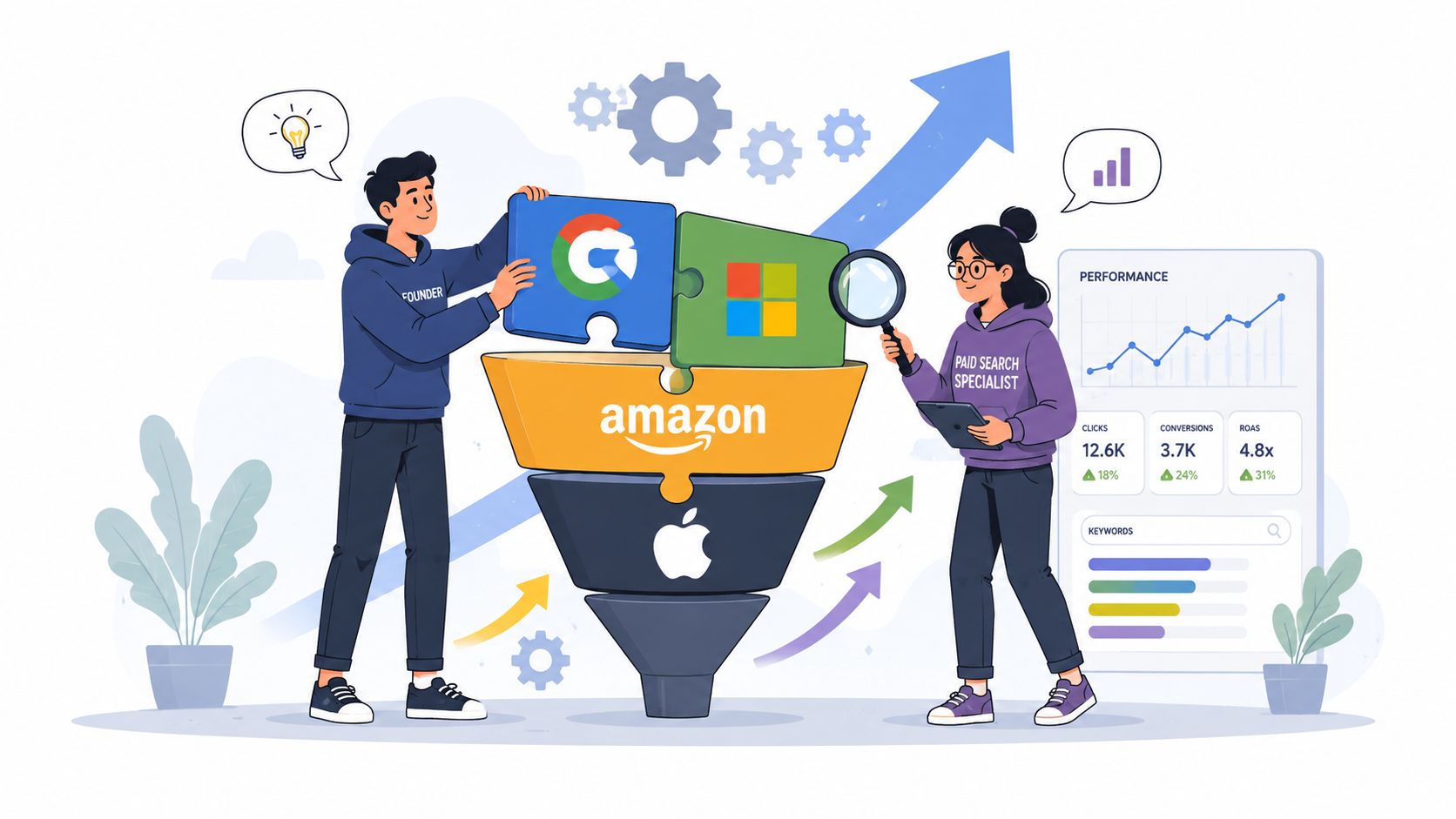
You're probably here because your ad account has that special smell. Burnt cash, stale optimism, and a dashboard full of “promising signals” that somehow never turn into profit.
I know the smell.
It usually starts the same way. Someone on the team says Google Ads is easy enough to manage in-house. A generalist marketer takes a crack at it. An agency promises “full-funnel performance.” A freelancer waves around a few certifications and says all the right acronyms. Then a month later, you're paying for clicks from people who were never going to buy, your conversion tracking is sketchy, and everyone is suddenly very interested in explaining why click-through rate is “looking healthy.”
Healthy for who?
Paid search is not a side quest anymore. The global paid search market is projected to reach $306 billion in total spend in 2026, with the United States accounting for $128 billion of that total, according to Digital Applied's 2026 paid search data roundup. That's not a toy budget category. That's a giant, expensive auction where amateurs get mugged politely by better operators.
So let's skip the “what is PPC” nursery rhyme. This is the founder-to-founder version. The one for people who've already learned that bad paid search hires don't just waste money. They waste time, momentum, and your patience.
Tuesday, 8:17 a.m. You open Google Ads, half hoping the numbers finally make sense. Instead, spend is up, conversions are sideways, and the report reads like a hostage note written by someone paid to stay optimistic.
You have seen this movie before. I have too. It ends with a founder paying premium prices for low-intent clicks while someone insists the account is “gathering data.”
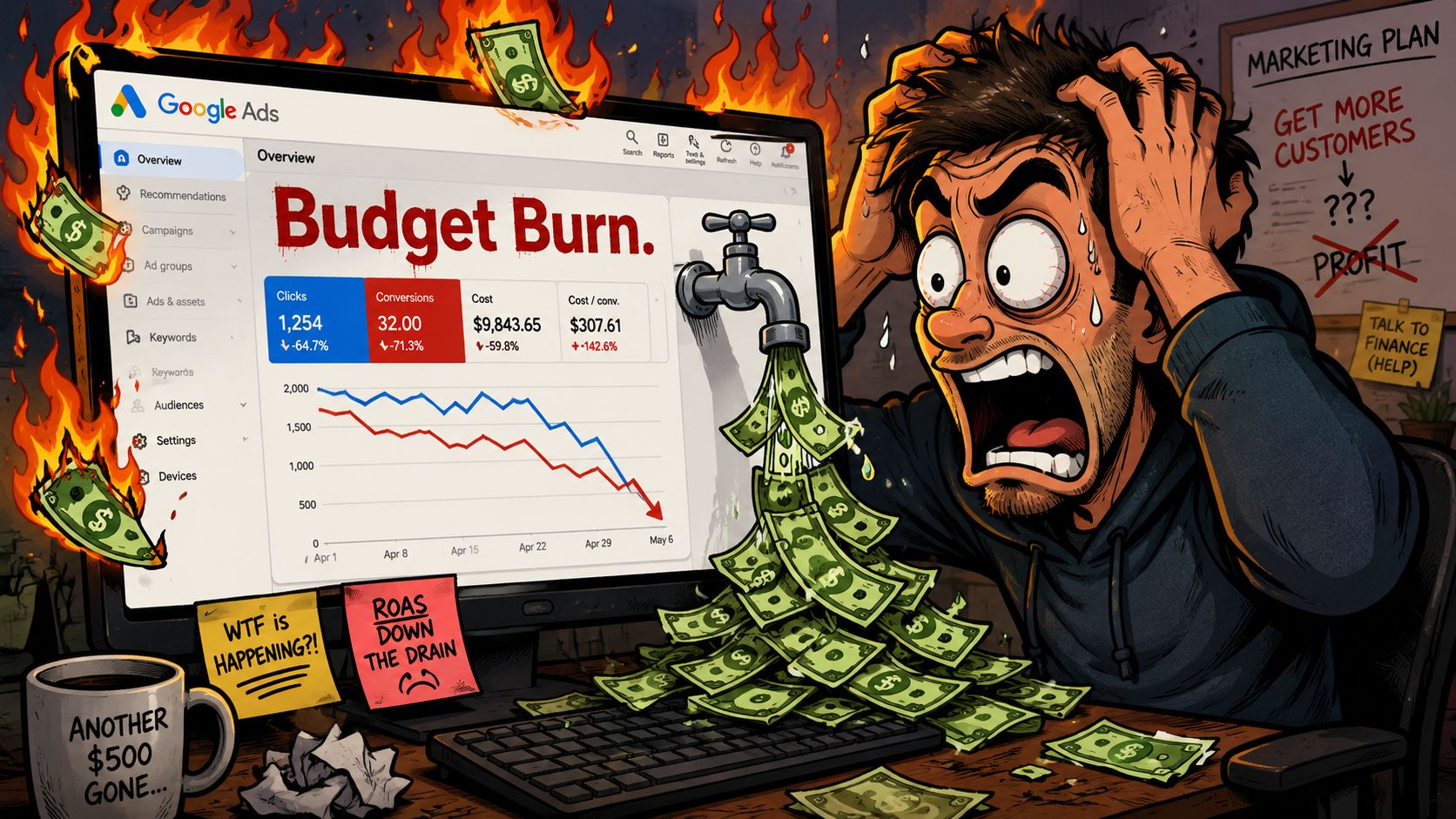
Here's the blunt truth. Paid search does not forgive sloppy operators. A bad specialist can burn cash faster than a sales rep with no quota and a corporate card. Loose match types, missing negatives, bad geo settings, junk conversion actions, weak landing page alignment. None of that stays contained. Every mistake buys more bad traffic, dirtier data, and worse decisions.
That is why founders hire the wrong way so often. They look for someone who can run ads. They should look for someone who can stop waste, protect signal quality, and explain exactly why money is leaking out of the account.
The interface loves activity. Clicks. Impressions. CTR. Conversion volume that looks decent until you ask one rude question. Did any of this turn into revenue?
Bad hires survive on that gap. They show motion and call it progress. Meanwhile branded search props up performance, sales rejects half the leads, and broad-match queries wander into parts of the market you never wanted to pay for.
A strong operator treats the dashboard like a crime scene, not a trophy case.
Here's the pecking order:
Rule I use: If a candidate cannot explain wasted spend in plain English, they will not reduce it. They will just rename it.
Founders are wired to save money. Fair. I am too. But once spend gets meaningful, managing paid search yourself is like doing your own dental work because you watched three tutorials and own a mirror.
The issue is not button-clicking skill. The issue is judgment. Search terms, bidding strategy, device splits, audience exclusions, ad copy, landing page match, tracking setup, CRM feedback loops. These choices stack on each other. One bad decision rarely stays one bad decision.
That is also why generic marketers struggle here. Paid search rewards specialists who can see the whole machine. If you want a cleaner picture of the role, this breakdown of a Google Ads specialist who actually handles the job beyond surface-level campaign tweaks is closer to reality than the fluffy job-description nonsense floating around online.
Wasted spend hurts. Bad learning hurts longer.
Every month with the wrong person poisons the account with junk signals. You train bidding systems on weak conversions. You make budget calls using bad attribution. You build landing pages around the wrong intent. Then when you finally hire someone competent, they spend the first month cleaning out the pipes instead of growing the account.
That cleanup bill is why I treat this role as budget protection first and growth second.
If your account feels like a leaky faucet, stop swapping buckets. Hire the person who can find the crack in the pipe and fix it properly.
Most job descriptions for paid search specialists read like they were written by someone who has never opened a messy account. “Manage campaigns.” “Optimize bids.” “Monitor performance.”
Sure. And a surgeon “works with tools.”
The useful version is this: a good paid search specialist turns business goals into account structure, measurement, and decisions. A mediocre one just pushes buttons inside Google Ads and hopes the machine is in a generous mood.
The job starts before ad copy, before keywords, before budgets. A strong specialist asks questions most weak candidates skip.
What counts as a conversion? Which leads are junk? Are you optimizing for demo requests, qualified pipeline, booked appointments, first purchases, or repeat buyers? Is the sales team fast enough to handle high-intent lead flow? Are margins strong enough to support non-brand acquisition?
Those questions shape the account. If the business goal is wrong or fuzzy, the campaign will be too.
That's why I'd rather hire someone who understands commercial tradeoffs than someone who brags about memorizing every platform tab. If you need a more platform-specific benchmark for the role, this breakdown of a Google Ads specialist is closer to reality than the generic “PPC manager” fluff floating around online.
A real operator thinks in layers:
Weak hires treat these as chores. Strong hires treat them like a control system.
Here's where the economics matter. According to Valve+Meter's PPC statistics roundup, businesses earn an average revenue of $2 for every $1 spent on Google Ads, paid search results generate 1.5 times as many conversions from click-throughs as organic search results, Google Ads visitors are 50% more likely to make a purchase than organic visitors, and the average Google Ads search CPC is $2.69 with an average conversion rate of 3.75%. They also note that Google Ads matters because 93.9% of global mobile search occurs on Google and Google holds over 91.4% of the global search engine market share.
That's exactly why the role can't be reduced to campaign babysitting. Tiny decisions across targeting, intent filtering, and post-click experience affect whether those economics work in your favor or punch you in the throat.
I don't hate CTR. I hate what people do with it.
A weak paid search manager sees CTR and thinks, “Great, people clicked.” A good specialist asks whether the clicks were from buyers, whether the page converted, and whether the customer was worth acquiring. The top people look past vanity metrics and anchor on economics.
Stop rewarding your paid search hire for making charts move. Reward them for making the business move.
When performance drops, weak operators blame seasonality, auctions, or “platform volatility.” Sometimes that's true. Often it's cover.
A serious specialist investigates. They check search terms, auction shifts, ad strength, page speed, funnel friction, tracking breaks, sales feedback, geo leakage, and conversion lag. They don't just say the engine sounds funny. They pop the hood.
That's the actual job. Not just making ads appear. Making the account produce reliable commercial outcomes.
A killer hire doesn't look impressive because they know the Google Ads interface. That's table stakes. They're valuable because they combine platform control, technical fluency, analytical judgment, and enough business sense to know when “best practice” is a trap.
That combination is rare. Which is why average candidates talk about optimizations, while the best ones talk about tradeoffs.
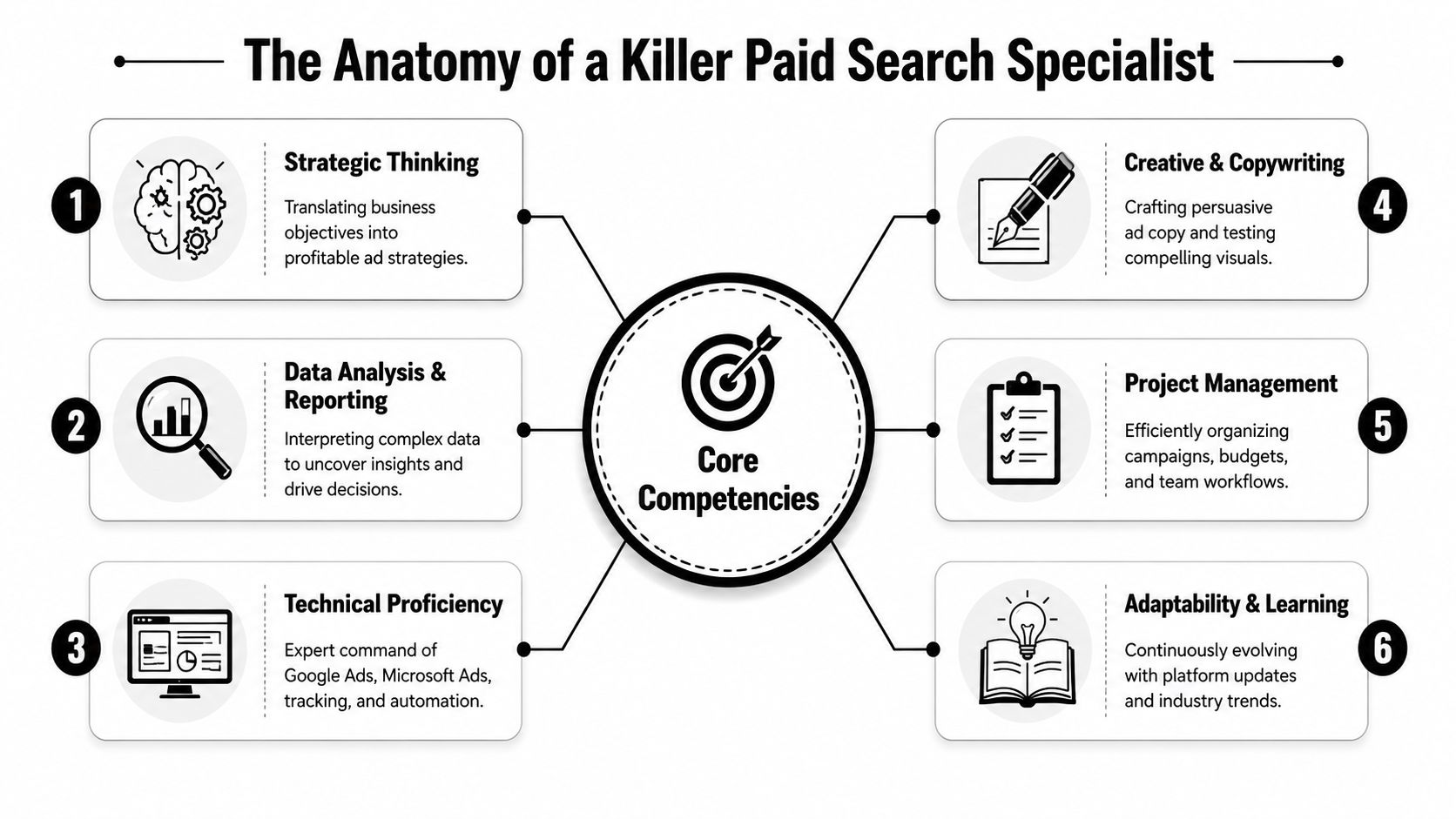
The old version of paid search was more manual. Pull bids up. Pull bids down. Tinker with match types. Hand-tune everything like a watchmaker with too much coffee.
That version is fading.
Benchmark data from 2026 indicates that data literacy and AI literacy are now the primary technical skills employers value most, surpassing traditional PPC management, as specialists must now audit and guide proprietary AI models rather than merely manually adjusting bids, according to this discussion of top paid search skills in 2026.
That's the whole game now. The specialist isn't replacing the machine. They're feeding it better inputs, structuring campaigns so the algorithm gets cleaner signals, and knowing when automation is helping versus hallucinating confidence.
If a candidate still talks like success comes from endless manual bid tweaks, they're selling yesterday's playbook.
This part gets ignored because it's less sexy than bidding strategy. It matters anyway.
Robert Half notes that expert-level paid search specialists should have foundational proficiency in HTML, CSS, and JavaScript, along with advanced analytics skills, because that technical stack helps them engineer and troubleshoot landing pages, validate tracking, and improve implementation speed. Their write-up also says that technical autonomy can reduce campaign launch latency by 20 to 30% and that professionals with these coding and analytics capabilities demonstrate higher ROI by 15 to 25% compared with peers lacking technical implementation skills, according to Robert Half's paid search specialist profile.
That doesn't mean your hire needs to be a full-stack developer. It means they shouldn't freeze the moment a tag misfires or a landing page needs a fast test. If every small fix requires a ticket, a designer, a developer, and a moon phase, performance work slows to a crawl.
For a broader benchmark on what modern media roles should cover, this media buyer job description gets much closer to the practical skill stack than the usual vague hiring template.
You want depth somewhere and competence everywhere else.
A strong paid search specialist usually has one dominant platform where they're dangerous. Often that's Google Ads. Around that, they need enough breadth to work with Microsoft Ads, analytics tools, landing page tests, conversion tracking, audience strategy, and reporting. They don't need to be a magician in every channel. They do need to understand how paid search fits into the larger acquisition system.
That T-shape matters because paid search doesn't live in a vacuum. Search traffic hits pages. Pages convert or fail. CRM data confirms whether those leads were real. Revenue tells you if the campaign deserved to keep breathing.
When I'm hiring, I'm looking for this stack:
A candidate who says “I optimize campaigns” is saying nothing. A candidate who explains how they improve signal quality, control waste, and align traffic to sales outcomes is probably worth your time.
The market also rewards this skill gap. Paid Search Specialists in the US earn an average base salary of $92,315 annually as of July 2026, with a typical range of $87,863 to $116,655, while entry-level roles sit around $50K to $70K, mid-level around $70K to $100K, and senior talent around $100K to $140K, based on Salary.com salary data for Paid Search Specialists.
That spread exists for a reason. Some people run ads. Some people drive growth.
Resumes in paid search are comedy. Everyone is “data-driven.” Everyone has “managed large budgets.” Everyone “improved ROAS.” Conveniently, half of them become allergic to specifics the moment you ask what they changed.
You can't hire this role on vibes. You need a vetting process with teeth.
That's even more important now because hiring has gone wider and looser. A frequently asked but poorly answered question is how to verify a paid search expert's actual skills before hiring, beyond resume claims. Emerging data shows that 68% of US companies now hire remote media buyers, yet there is minimal guidance on validating technical mastery, according to this discussion on verifying paid search expertise.
So yes, the talent pool is broader. Great. It's also noisier.
If your interview starts with “Can you explain Quality Score?” you're setting yourself up to hire a smooth talker with a fresh certification and no judgment.
Good candidates can answer trivia. Great candidates can think through a messy account with incomplete information.
Ask questions that force reasoning.
These expose whether the person understands the chain from query to revenue.
You don't need a three-hour gauntlet built by a committee. You need enough friction to reveal whether they're real.
My preferred test is simple. Show them a stripped-down account snapshot or a short scenario. Ask them to identify likely waste, missing information, and first-step actions. Then have them explain their reasoning live.
What you're listening for:
| Signal | Good answer | Bad answer |
|---|---|---|
| Problem framing | Starts with business goal and tracking confidence | Starts with cosmetic platform changes |
| Priorities | Fixes measurement and intent leaks first | Wants to rewrite ads before diagnosing root issues |
| Communication | Explains tradeoffs clearly | Hides behind jargon |
| Judgment | Distinguishes noise from pattern | Reacts to every metric twitch |
Don't ask references if the candidate was “great to work with.” That's useless. Ask whether the person improved decision quality, whether they could explain performance to non-specialists, and whether they handled bad months like an adult.
A mediocre operator looks clever when things are easy. A strong one gets sharper when performance gets ugly.
Hire for decision quality under uncertainty. Anyone can look polished in a stable account with branded search doing all the heavy lifting.
I pay attention when a candidate does these things in an interview:
Some signs aren't yellow. They're red.
You're not hiring a narrator for your ad spend. You're hiring a mechanic with commercial instincts. Interview accordingly.
Once you know what good looks like, you hit the staffing fork in the road. Full-time employee, traditional agency, or vetted marketplace. Each can work. Each can also annoy you in its own special way.
My blunt view is simple. Pick the model that matches your stage, budget, and tolerance for management drag. Don't pick based on habit.
| Attribute | Full-Time US Hire | Traditional Agency | Vetted Marketplace (e.g., HireMediaBuyers) |
|---|---|---|---|
| Control | High | Medium to low | High |
| Speed to start | Slower | Medium | Faster |
| Flexibility | Lower | Medium | High |
| Cost predictability | Medium | Often murky | Usually clearer |
| Direct access to operator | Yes | Not always | Yes |
| Risk of junior handoff | Low | Higher | Lower |
| Best for | Ongoing in-house ownership | Teams needing broader service mix | Companies wanting specialized talent without full in-house overhead |
A full-time US employee makes sense when paid acquisition is core to your growth engine and you have enough work to justify a dedicated owner. You get attention, context, and tighter internal collaboration.
You also get payroll, management overhead, recruiting friction, and all the fun little costs people forget when they quote salary as if that's the whole meal.
Regional pricing makes this even messier. A Paid Search Specialist in San Jose, CA earns $151,716 on average, which is 97% higher than the US national average of $76,950, according to Comparably's salary comparison. That gap isn't abstract. It changes what kind of talent you can afford and how much inefficiency your business can tolerate.
And yes, geographic arbitrage is real. If you ignore it, you're choosing the expensive route on purpose.
Agencies can work well when you need multiple disciplines around paid search. Creative, analytics, landing pages, strategy. In theory, you get a team.
In practice, you often get the pitch team during sales and a more junior account manager once the ink dries. That's the agency shell game founders learn to recognize after the second or third bruising. You're paying for institutional depth, but the actual operator on your account may not be the one you thought you hired.
That doesn't make agencies bad. It makes them variable.
If you hire an agency, ask who will touch the account every week. Not who sold you. Who will actually touch it.
A vetted marketplace model works when you want direct access to specialist talent without committing to a full local salary or the agency layer cake. It's especially useful if you need part-time help, rapid hiring, or someone in your time zone who can execute rather than “coordinate.”
The obvious appeal is flexibility. The less obvious one is fit. You can usually find someone whose experience matches your exact problem, lead gen, DTC, B2B, healthcare, app growth, instead of buying a broad service package and hoping the account gets enough senior attention.
If paid search is mission-critical and large enough to justify a dedicated owner, build internal capability. If you need broad marketing support and can stomach some distance from execution, an agency can work. If you want specialized execution, faster hiring, and better cost control, a vetted marketplace is usually the sanest choice.
I've tried all three. The best model isn't the fanciest one. It's the one that gets a competent operator into the account without turning the hiring process into a side hobby.
Smart founders still blow this. Not because they're careless. Because paid search has a way of making bad assumptions look reasonable right up until the invoice lands.
Lots of candidates can click around Google Ads. Fewer can decide what matters. I've seen people with every badge imaginable chase low-intent traffic because the dashboard looked busy and the CPCs felt “efficient.”
Cheap clicks are how you end up proudly buying attention from people who were never going to pay you.
“Get more traffic” is not a strategy. It's how teams avoid accountability with polite language and colorful reporting.
Give your specialist a real target. Qualified leads. Purchase efficiency. Booked calls that sales wants. If your goal is fuzzy, your optimization will be too.
Some founders still treat paid search like a vending machine. Press more buttons, get better results. Then they hover over bid changes while conversion tracking is questionable, landing pages are weak, and the offer is doing the equivalent of sleeping through the meeting.
A strong specialist needs room to work the system, not just the settings.
This one hurts because it's so common. You can have good targeting, strong intent, and solid ads, then ruin the whole thing by dumping visitors onto a generic page built by committee.
The ad got the click. The page still has to close.
Paid search doesn't fix weak offers or clumsy pages. It exposes them faster.
You hired an expert, then gave them no access to sales feedback, no visibility into CRM quality, and no authority to challenge landing pages. That's not a performance setup. That's decorative hiring.
If you want elite output, give the person context, data, and room to make calls. Otherwise you've hired a pilot and locked them out of the cockpit.
By now the pattern is obvious. Hiring paid search specialists the wrong way is expensive in boring, predictable ways. You overvalue certifications, under-test judgment, confuse platform fluency with commercial skill, then act surprised when the account underperforms.
There is a shorter route.
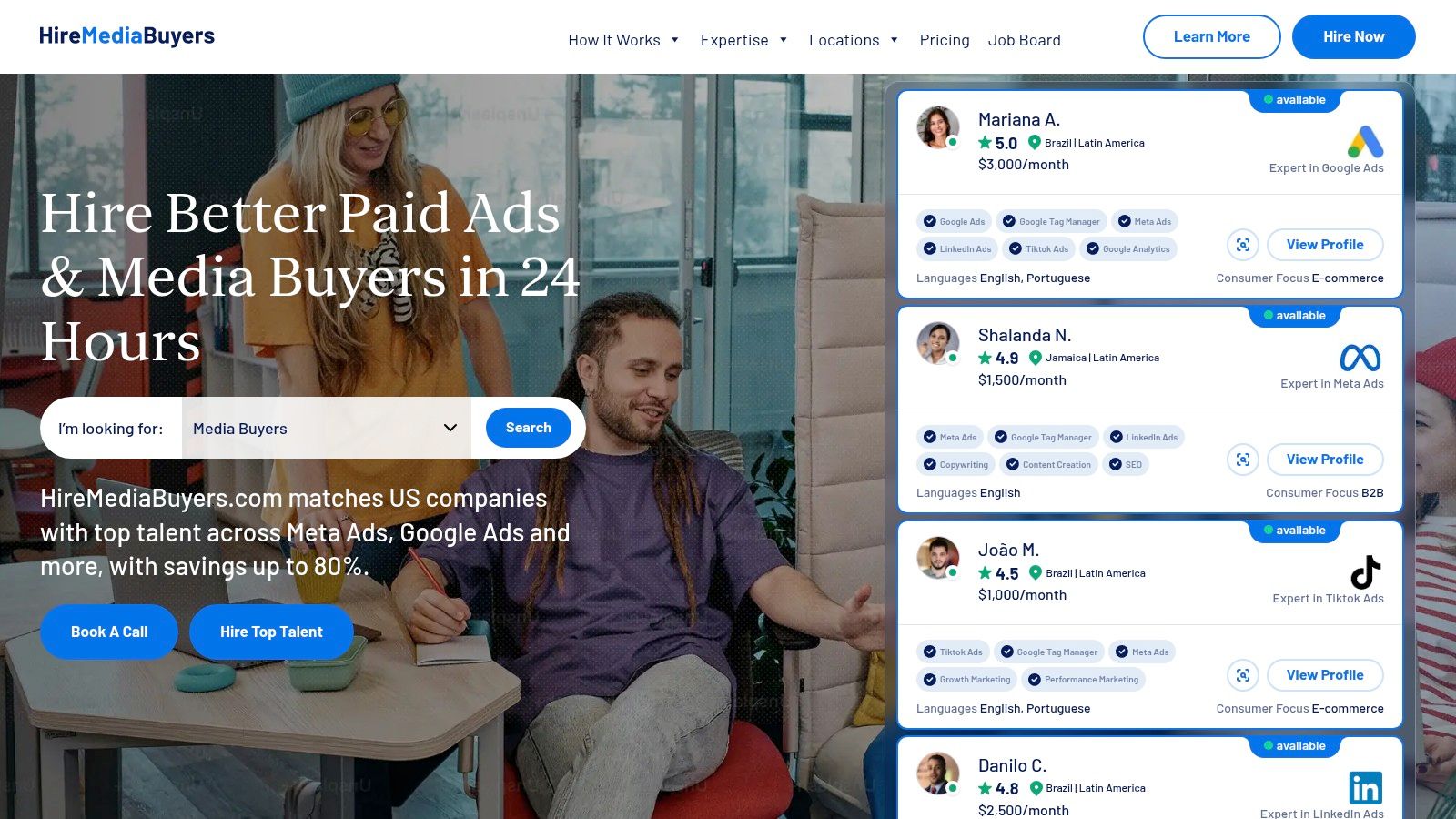
The most practical solution I've seen is using a marketplace that pre-vets talent hard enough that you're not spending your week playing amateur detective. That matters because the painful part isn't just finding candidates. It's proving they're real before they touch budget.
A strong vetted marketplace solves three problems at once.
The first win is filtering out people who know the buzzwords but can't reason through an account. If the platform screens for strategic thinking, technical skill, communication, and execution, you skip a pile of nonsense before interviews even start.
That's not glamorous. It is useful.
Some companies need a full-time operator. Others need someone part-time, inside their time zone, who can clean up campaigns and own performance without a six-week recruiting parade. Good marketplaces support both.
That flexibility matters more than people admit. Hiring shouldn't feel like adopting a tiger because you needed pest control.
When your campaigns are leaking money, speed matters. Not reckless speed. Clean speed. The right setup gets you from “we need help” to “this person can do the work” without making your team spend days filtering weak applicants.
If you want the timeline piece spelled out, this overview of the paid media hiring timeline is a useful benchmark for how quickly the process should move when someone has done the hard screening upfront.
If you're serious about growth, stop treating paid search hiring like a casual admin task. It's not. This role sits too close to revenue, too close to margin, and too close to wasted spend.
You can absolutely hire great paid search specialists. But you need a sharper process than “seems smart” and “used to manage ads for a startup.” I learned that the expensive way. Toot, toot.
The cleaner answer is simple. Use a hiring model that already assumes candidates must prove they can think, not just talk. Then spend your time choosing between strong options instead of excavating competence from a mountain of resumes.
If you want a faster, lower-risk way to hire paid ads talent, HireMediaBuyers.com is built for exactly this problem. It connects US companies with pre-vetted media buyers and paid search specialists, supports part-time or full-time remote hiring, and handles the ugly parts like screening, shortlisting, payroll, compliance, and replacements. If you'd rather skip the resume circus and meet operators who can manage spend responsibly, it's the sensible place to start.


