


You've hired a media buyer who sounded sharp in the interview. Monday arrives, and they're staring at a live Meta account with no creative brief, no naming conventions, no pixel QA history, and a cheerful message that says, “Go scale it.”
That isn't onboarding. That's handing someone the keys to the company car and hoping they notice the brakes.
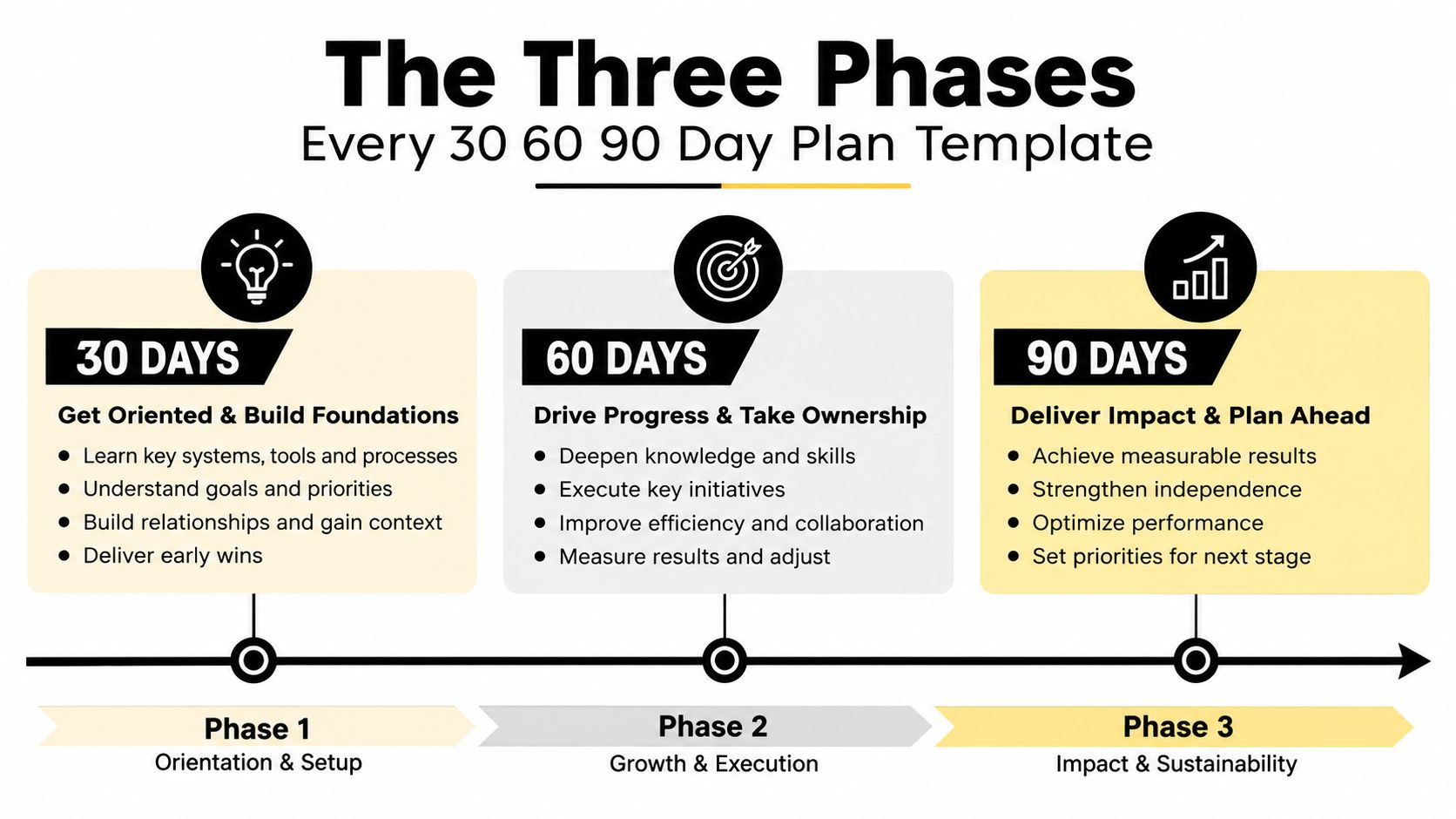
A 30 60 90 day plan template gives the hire a sequence of milestones, but a media buyer's version needs to do more than list introductions and software training. It should protect revenue by defining what the buyer can touch, which metrics matter, how much learning budget is available, and who approves a risky change. The standard three-phase model moves from learning and orientation, to contribution, to ownership across the first three months, turning a vague ramp period into trackable outcomes, as outlined in this 30 60 90 day planning framework.
For paid media, that structure becomes useful only when it meets the accounts where they are. Meta, Google Ads, TikTok, LinkedIn, and Microsoft Advertising each produce different signals. A buyer who can explain those signals, document decisions, and earn more budget is progressing. A buyer who celebrates cheap clicks while the attribution setup is broken is merely decorating the dashboard.
Managers forget to provide the account map, creative history, tracking documentation, audience exclusions, approval rules, and reporting definitions. The buyer spends days rebuilding basic context, then faces pressure to launch before understanding attribution windows or the brand's tolerance for risk.
That creates two expensive outcomes. A cautious buyer pauses campaigns while learning the business. An overconfident buyer changes a live account before checking tracking, budget controls, or prior test results. Both choices put performance at risk.
Practical rule: A new buyer earns access to more spend through demonstrated judgment. A senior title alone does not justify control of the budget.
Treat onboarding as a revenue-protection document. Record the account's starting state, define the learning envelope, and specify the evidence required before anyone changes campaign structure. The plan should connect account access to proof: clean measurement, documented decisions, sensible tests, and clear reporting. Each phase needs concrete deliverables, review points, and measurable outcomes instead of a vague promise to “get up to speed.” SMART goal guidance for 30 60 90 day plans reinforces the same standard: goals should be specific, measurable, achievable, relevant, and time-bound.
Your template should answer the questions generic HR checklists skip:
Add the employee's name, role, manager, start date, milestone blocks, action steps, deliverables, and review timelines. Those fields appear in common 30 60 90 day plan templates. They matter because the file should run the onboarding process, capture decisions, and support manager reviews. It should never become an inspirational poster that nobody opens after the first week.
Use the first three months to move from diagnosis to controlled contribution and then independent ownership. Tie each milestone to channel evidence, documented handoffs, and approval boundaries so a small mistake stays small.
A useful plan follows learn, contribute, own, but paid media gives each word sharper meaning. The first phase protects the account from premature optimization. The second proves that the buyer can make disciplined changes. The third tests whether they can manage trade-offs when performance, creative capacity, and budget pressure collide.
The standard framework assigns the first 30 days to learning and orientation, days 31 to 60 to applying skills and contributing, and days 61 to 90 to ownership and measurable results. That phased operating model is also recommended in this guide to structuring a 30 60 90 day plan, which emphasizes distinct objectives and formal check-ins.
The buyer should audit pixel and event health, naming conventions, UTMs, historical creative, attribution settings, audience exclusions, landing pages, and reporting logic. They should shadow live account reviews, document unknowns, and create a testing tracker with hypotheses, owners, dates, budgets, and kill criteria.
Keep managed spend deliberately contained during this phase. The point isn't to prove that the buyer can press “publish.” It's to prove that they understand what the account is measuring and where the existing performance story might be misleading.
Now the buyer can launch structured tests on Meta and Google, each with a clear hypothesis, defined budget, intended audience, primary KPI, and stop condition. They should join a weekly creative review cadence and connect performance findings to briefs that the creative team can use.
A test without a hypothesis is just a lottery ticket with better typography. Require the buyer to state what changed, why it changed, and what result would justify the next decision.
By this phase, the buyer should own a dedicated channel, campaign group, or budget pool. Ownership includes defending the commercial result, explaining the limitations of attribution, improving the operating process, and proposing a next-quarter scaling roadmap.
The phases can overlap. A senior hire may contribute earlier, while a junior buyer may need longer supervision. Freelance and part-time buyers follow the same sequence inside smaller scopes and tighter budget envelopes. The calendar changes, but the evidence standard shouldn't.
A junior buyer who receives a senior buyer's plan will either wait for permission or make expensive guesses. A senior buyer given a junior plan will spend the first month proving they can follow instructions instead of protecting revenue. Managers who give every hire the same plan create bottlenecks with juniors and reckless autonomy with seniors.
A junior full-time buyer needs structured exposure to the account's measurement and operating rhythm. Their early milestones should cover pixel QA, naming and UTM documentation, supervised launches, and regular mentor reviews. Give them ownership of preparation first, then approved decisions. That sequence builds judgment without handing over budget before they have demonstrated it.
A senior hire needs a harder commercial test. By the first month, they should be moving toward ownership of net-new budget, channel strategy, and a defensible testing roadmap across the channels in scope. On Meta and TikTok, that can mean identifying creative and audience risks. On Google and LinkedIn, it can mean connecting intent, lead quality, and budget allocation. If a senior buyer still needs someone to explain CTR by the second month, the hiring process has already sent you a memo.
Use the media buyer job description guide to match milestones to the responsibilities attached to the role. Then set the approval limits, reporting duties, and handoff expectations that fit the person's actual scope.
| Buyer Type | Day 30 Goal | Day 60 Goal | Day 90 Goal |
|---|---|---|---|
| Junior full-time | Complete account, pixel, UTM, naming, and creative audits. Shadow reviews and prepare supervised launch materials. | Run approved tests with mentor oversight, maintain the testing tracker, and explain performance changes. | Own a defined campaign set with documented decisions and a reliable reporting rhythm. |
| Senior full-time | Audit the business and channel economics, identify material risks, and present an initial strategy direction. | Lead structured tests, coordinate with creative and lifecycle teams, and manage a meaningful budget pool. | Own channel strategy, defend the commercial result, and present the next-quarter scaling roadmap. |
| Part-time | Learn one channel, one audience structure, and the account's reporting rules within the agreed scope. | Deliver a defined test and reporting package without expanding beyond approved responsibilities. | Run the assigned channel or campaign scope independently with clear handoff documentation. |
| Freelance | Complete a rapid audit, identify immediate tracking or creative blockers, and agree on deliverables. | Ship agreed tests, produce usable creative feedback, and report accurately against the brief. | Demonstrate repeatable test velocity, clean reporting, and a recommendation for continued work. |
Part-time buyers need a narrow lane. Assign one channel, one audience family, or one clearly bounded deliverable set. Their plan should specify the weekly output, the approval owner, and the exact evidence required before scope expands.
Freelancers are often judged more on speed, creative feedback, and reporting accuracy than on building internal process. Keep meetings limited to decisions, blockers, and handoffs. Require clean documentation so a remote team can understand what changed, why it changed, and who owns the next action.
Define “independent” in operational terms. For one buyer, it means launching a campaign after approval. For another, it means defending a channel PnL line, explaining KPI movement, and negotiating the next budget move. That definition belongs in the plan before Day 30, not after the first reporting failure.
“Drive more revenue” isn't a KPI. It's a wish wearing a blazer.
A media buyer needs a hierarchy of signals. The primary KPI describes the commercial outcome, the diagnostic KPI helps explain movement, and the guardrail KPI prevents the buyer from improving one number by damaging the business elsewhere. Account maturity, attribution quality, margin, sales cycle, and creative volume all affect interpretation, so don't copy benchmarks from another advertiser and call it strategy.
Use conversion tracking guidance for paid media to make sure the reporting foundation is sound before judging the person operating it. A buyer can't defend CPA or ROAS if the conversion event counts the wrong action.
| Channel | Foundational KPI, Day 30 to 60 | Growth KPI, Day 60 to 90 | Diagnostic / Guardrail Metric |
|---|---|---|---|
| Meta | CPA, ROAS, or qualified conversion volume, depending on the account objective | Incremental budget efficiency, blended ROAS, or MER alongside stable conversion quality | CTR, CPM, frequency, creative fatigue, audience saturation |
| Google Ads | CPA or ROAS by campaign and search intent group | Contribution to blended ROAS or MER, plus scalable impression coverage where relevant | Search-term quality, CTR, conversion rate, impression share, query waste |
| TikTok | CPA or qualified lead volume with creative-level comparisons | Repeatable creative winners and efficient budget expansion without quality decay | Hook rate, thumb-stop behavior, completion signals, frequency, creative fatigue |
| CPL, qualified lead rate, or cost per opportunity | Pipeline contribution and lead quality by audience or campaign | CTR, CPM, audience saturation, lead-to-opportunity quality | |
| Microsoft Advertising | CPA or ROAS against comparable search intent | Incremental efficiency and dependable contribution to the broader search mix | Search-term quality, CTR, conversion rate, impression share, query waste |
The buyer should report the primary outcome first, then explain the diagnostic movement, then disclose guardrail risks. Raw reach and vanity impressions may help describe delivery, but they don't answer whether the buyer protected revenue or improved acquisition quality.
When a boss asks, “How is the new buyer doing?” don't answer with a platform screenshot. Ask whether the buyer has:
The best answer combines performance with judgment. A buyer who hits an attractive platform metric while creating tracking confusion isn't performing. They're borrowing credibility from a broken measurement system.
Remote onboarding exposes every lazy handoff. In an office, someone might notice that the new buyer lacks billing access or doesn't know which Slack channel contains the creative archive. Across time zones, that missing context becomes a silent work stoppage.
Prepare the access package before the start date. The manager should transfer ownership and permissions deliberately, not send a string of emergency invites after the first campaign request.
Keep these items in one shared workspace:
Distributed teams need explicit asynchronous rituals, not more meetings for the sake of feeling coordinated. The practical issues of timezone overlap, manager visibility, and account access are often missing from generic plans, a gap discussed in guidance for managing distributed teams.
Use a short daily standup during the first two weeks. The buyer posts what changed, what they learned, what's blocked, and what decision they need. Follow that with a weekly performance review using a shared dashboard, a bi-weekly strategy sync, and a monthly business review tied to MER or blended ROAS.
For the first Slack message, keep it concrete:
Welcome message: “Your workspace contains the account map, access checklist, tracking notes, creative archive, and current test log. Please confirm access, list blockers, and post your first audit questions in the onboarding channel.”
Spend changes need a written approval ladder. The buyer should know which edits they can make independently, which require manager approval, and which require finance or executive sign-off. Don't use a vague rule such as “be careful with budget.” Define the threshold in the plan, name the approver, and record the decision.
Consider a fictional skincare brand spending roughly $80,000 a month across Meta and Google, with TikTok in pilot. That figure belongs to the scenario, not every DTC account. The buyer's first responsibility is to make the account understandable before increasing its size.
The buyer begins with an account audit covering campaign structure, conversion events, UTMs, attribution settings, creative history, landing pages, audience exclusions, and reporting consistency. They complete a competitive teardown, interview the email and lifecycle owners, and document conflicts between platform reporting and the company's blended view.
The first live test stays small and uses strict guardrails. Before launch, the buyer records the hypothesis, audience, creative angle, budget owner, primary KPI, stop condition, and review date. Restructuring every campaign to demonstrate activity wastes budget and creates noise without adding value.
During week two, the pixel misfires and over-attributes conversions. The buyer catches the discrepancy during reconciliation, pauses conclusions from the affected period, documents the event issue, and works with the tracking owner to validate the corrected signal. The account needs a clean measurement decision before anyone treats the reported result as a win.
The buyer concentrates on the top three campaigns by ROAS while checking whether conversion quality and blended performance support the platform story. They launch structured Meta and Google tests, prepare creative briefs from observed hooks and objections, and share findings with the email and lifecycle team.
TikTok stays a pilot with a defined decision rule. The buyer documents what evidence would justify expanding it and what evidence would keep it contained. Every test enters the same tracker, giving the team a clear record of the idea, change, result, and reason for its winner or loser label.
The buyer scales validated winners, sunsets underperformers, and presents a next-quarter test roadmap. The roadmap names creative needs, measurement dependencies, channel priorities, budget assumptions, and risks that could invalidate the plan. For a remote team, the buyer also packages the evidence in a written decision record so the next owner can understand the account without relying on a live explanation.
Budget discussions now require evidence rather than optimism. Ownership means explaining where additional spend belongs, which campaigns need more creative supply, and where attribution remains noisy. A strong buyer can also state the conditions that would make the recommendation change, then connect each condition to a KPI the team can monitor.
Most plans fail when the manager treats the document as complete after the new hire signs it. Plans that are never reviewed gather dust in shared drives, while account risks keep accumulating.
| Failure Mode | What You See | Fix by Day 14 |
|---|---|---|
| Learning, then launching without test budgets | The buyer moves from audits to live changes with no defined risk envelope. | Approve a bounded test plan with a hypothesis, budget, owner, and stop condition. |
| Silent KPI drift | The team starts with CPA, then celebrates CTR or cheap traffic. | Hold a KPI debrief and confirm the primary, diagnostic, and guardrail metrics in writing. |
| Over-trust in platform auto-bidding | The buyer blames or credits automation without checking conversion quality or tracking health. | Require a measurement review and a documented explanation of what the bidding system can and cannot infer. |
| Scope creep into creative without naming rights | The buyer rewrites briefs, changes brand direction, and creates confusion about approval. | Define the buyer's role in creative recommendations, approvals, and final ownership. |
| The 90-day review never happens | Nobody knows whether the buyer earned more responsibility. | Schedule the review before the plan begins and attach it to explicit ownership criteria. |
The first-14-day review should be a focused 30-minute call. Score ramp-spend accuracy, creative iteration velocity, learning-document completeness, account hygiene, and unresolved red flags. Focus the review on verified knowledge, confirmed assumptions, and decisions that need better evidence.
Ask what the buyer knows, what they have verified, what they still assume, and which decision they would change with stronger evidence. Those answers reveal whether the buyer can protect revenue while increasing spend across Meta, Google, TikTok, or LinkedIn.
The manager must own the review. Read the tracker, inspect the dashboard, and challenge assumptions before approving broader access or budget. Pin the first review date before the offer letter is signed, then record decisions and owners so a remote hire can act without waiting for another meeting.
HireMediaBuyers.com helps US companies find pre-vetted Media Buyers and Paid Ads Specialists for full-time or part-time remote roles across Meta, Google, TikTok, LinkedIn, Microsoft Ads, and more. Visit HireMediaBuyers.com to find a buyer whose skills and working style fit the milestones, access requirements, and revenue safeguards in your 30 60 90 day plan.


