

Your traffic has flattened. Your organic team says “content takes time.” Your sales team wants better leads yesterday. Meanwhile, your last agency sent a pretty dashboard, spent your money, and called a spike in clicks “momentum.”
That's usually when founders start shopping for a paid ads specialist.
Fair. But this hire goes sideways fast. The internet is full of people who can launch campaigns, toss around acronyms, and rearrange budgets with the confidence of a Vegas dealer. Far fewer can look at your account, your funnel, your offer, and your landing page and tell you where the core problem lives.
I've made this mistake more than once. The expensive agency mistake. The cheap freelancer mistake. The “they have all the certs” mistake. The “they seem smart on Zoom” mistake. Hope you enjoy buying the same lesson repeatedly.
A good Paid Ads Specialist can become one of the most commercially important operators in your growth stack. A bad one just gives your burn rate a hobby.
Monday morning. Your agency sends a clean report. Clicks are up. CPC is down. Everyone wants credit. Then you check the pipeline and see the part that matters. Sales did not improve, lead quality is shaky, and the money you spent bought activity more than progress.
That is usually the moment a founder starts looking for a paid ads specialist.
Good instinct. Bad hiring category, if you are careless. A mediocre specialist can keep campaigns live and spend every dollar on schedule. A great one can tell you whether your account has a targeting problem, a tracking problem, a landing page problem, or an offer problem before you waste another month.
You need this hire when paid acquisition has become too expensive to run on instinct and too important to delegate to whoever has spare time.
That usually shows up in a few ugly ways:
The role exists because paid media gives you immediate feedback and punishes sloppy decisions fast. Once spend becomes material, you need someone who can interpret signals, not just push buttons.
Sometimes ads are not the problem. Your business is.
If the offer is weak, the positioning is fuzzy, or the landing page creates friction, a paid ads specialist will not rescue you. They will just help you pay to learn the same lesson faster. Plenty of founders hire media talent when they still have a product, pricing, or messaging problem. That is how you turn ad spend into a diagnostic bill.
Use a simple rule. Hire a paid ads specialist after you see proof of demand and need a repeatable acquisition system. Do not hire one to manufacture demand for something the market does not want.
Founders usually miss in one of two directions.
They hire too late, after an agency burned budget, pixel data is messy, and the team is exhausted. Or they hire too vaguely, with a job post that says “manage Google and Meta” as if channel access is the hard part.
It is not.
The hard part is finding someone who can make sound decisions under uncertainty. Someone who knows when to scale, when to cut, when to challenge your landing page, and when to tell you the account is fine but the offer is not. That is the difference between an average operator and someone who can change the trajectory of the business.
This is why vetting matters so much. Resumes, certifications, and polished case studies filter for people who know the language. They do not reliably identify the person who can step into your funnel, spot the constraint, and fix the right thing first. If you have already been through bad agencies, cheap freelancers, or full-time hires who needed too much hand-holding, you know the cost of getting this wrong.
A vetted marketplace can cut a lot of that pain. It is the cheat code founders use after they are done gambling on interviews and hoping confidence equals competence.
If you are hiring just to get campaigns live, you are buying labor. If you are hiring to make paid acquisition more predictable, accountable, and profitable, you are making an actual business decision.
Monday morning. Spend is up, lead quality is down, and your last report says CTR improved as if that pays the bills.
This is the job.
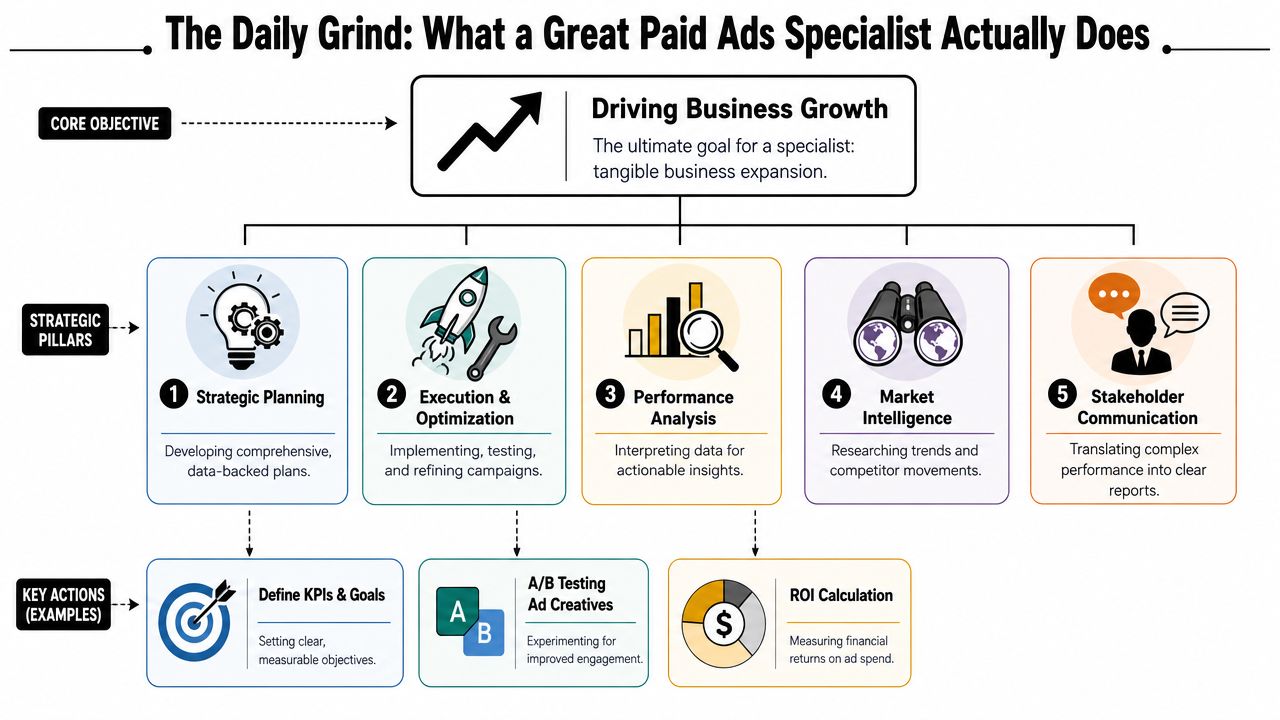
A strong paid ads specialist is not there to keep campaigns busy. They are there to find the constraint, fix it in the right order, and protect your budget from bad decisions. If you are hiring for this role, stop reading generic templates and review an actual media buyer job description with clear ownership lines. The difference between “runs ads” and “owns paid acquisition” is where founders waste a lot of money.
Plenty of people can log into Google Ads or Meta Ads Manager, tweak bids, swap creatives, and send over a dashboard. That work keeps the account alive. It does not tell you why performance changed, what to test next, or whether paid traffic is exposing a deeper problem in your offer, funnel, or sales process.
That is the daily grind. Diagnosis, prioritization, and pressure.
They build the account with intent. Campaigns, ad sets, keyword clusters, audiences, creative angles, and landing pages should connect to a specific business goal. If the structure is sloppy, the learning is sloppy too.
They manage budget with judgment. A good specialist does not spend harder because a platform recommendation says so. They know when to protect efficiency, when to buy data, and when to cut a channel before it drains another week of budget.
They run tests that mean something. New copy, new hooks, new audience segments, new landing page variants, offer framing, bid strategy shifts. Each test needs a reason, a clear variable, and a decision tied to the result.
They connect ad metrics to business outcomes. Clicks and CPMs matter, but only in context. The useful questions are harsher. Are these leads closing? Are these purchases profitable after discounts, refunds, and fulfillment? Is retargeting making the account look smarter than it is?
They catch problems outside the platform. Broken tracking. Weak mobile pages. Bad CRM handoff. Sales teams ignoring follow-up speed. Creative that gets clicks from the wrong people. This role touches all of it because paid ads amplify whatever is already true in the business.
Founders get burned here all the time. They hire for “paid ads specialist” and end up with three possible versions of the role. A junior executor who needs instructions. A channel manager who keeps things organized. Or a sharp operator who can look across traffic, conversion, and feedback loops and tell you where growth is getting stuck.
Those are not the same hire.
If you do not define ownership up front, the specialist will default to whatever is easiest to measure inside the ad account. That usually means platform metrics, surface-level optimizations, and very polished explanations for mediocre results.
A great paid ads specialist buys traffic, explains why it is or is not converting, and tells you what needs to change next.
Performance drops for two straight weeks. What happens next?
A weak operator sends a report about rising CPMs and seasonality. A strong one comes back with a point of view. Audience fatigue is setting in. The offer lost urgency. Mobile conversion rate fell after the landing page update. Lead quality dropped after broadening targeting. Here is what to cut, what to test, and what needs your decision today.
That is who you hire when you are done gambling on average.
You can hire the candidate with every Google and Meta badge on the planet and still end up with someone who burns cash politely.
Certifications prove platform familiarity. They do not prove judgment under pressure, testing discipline, or the ability to look at a messy funnel and say, “This is the core problem, and here's what we fix first.” Founders confuse those things all the time, then wonder why reporting looks clean while revenue stays flat.

Start with the baseline. If a candidate cannot do these things, they are not a specialist. They are a trainee with nice vocabulary.
| Skill area | What good looks like |
|---|---|
| Platform fluency | Works confidently inside Google Ads, Meta Ads Manager, LinkedIn Campaign Manager, and the reporting tools around them |
| Tracking awareness | Understands conversion tracking, attribution limits, offline conversion gaps, and common setup failures |
| Spreadsheet competence | Can analyze performance without hiding behind dashboards or screenshots |
| Copy and creative judgment | Explains why a message works, who it attracts, and where it breaks |
| Funnel awareness | Reviews the path from click to sale and spots friction outside the ad account |
Those skills get someone through the first filter. They do not tell you if this person can produce profitable growth.
The difference shows up in how they test, how they diagnose, and how they make decisions with incomplete information. Directive's overview of PPC specialist work describes the core job as ongoing optimization across targeting, messaging, bidding, landing pages, and budget allocation, not one-time campaign setup or platform maintenance alone, as explained in Directive's breakdown of PPC specialist work.
That matters because average hires live inside the ad account. Great ones work the whole system.
Hiring gets expensive if you get lazy. Plenty of candidates can talk platforms. Far fewer can explain tradeoffs, defend a testing plan, and show they know the difference between more leads and better leads.
If you are still defining the role, use this media buyer job description guide to pressure-test what the person should own before you start interviewing.
Strong candidates answer with logic. Weak candidates answer with routines.
A strong candidate says, “I'd split branded and non-branded intent, check whether lead quality changed by audience segment, verify tracking before touching bids, and test the offer before scaling spend.” That answer shows prioritization, diagnosis, and control.
A weak one says, “I optimize daily, monitor KPIs, and refresh creatives often.”
That answer is filler dressed up as competence.
Hire the person who can explain what they would test first, what result would prove them wrong, and what business action should follow.
That is the hire that moves the needle. The rest are just better at passing platform exams.
Let's skip the fantasy where this role is cheap.
If someone can reliably turn ad spend into revenue, they are not bargain-bin talent. And if they are bargain-bin talent, they usually prove it with your money.
In the U.S., Salary.com reported an average annual salary of $94,278 for a Paid Advertising Specialist as of May 1, 2026, while Glassdoor listed $88,967, according to Salary.com's salary summary. The same source also notes other variation by experience and geography, including a U.S. range of $50,000 to $83,000 annually and New York averaging $77,227.
Those numbers tell you something useful. The market does not treat this as a throwaway support role.
Paid search isn't a side quest for many businesses. The same salary summary cites HubSpot PPC statistics showing that 45% of small businesses have a paid search strategy, 74% of brands say PPC is a huge driver for their business, and paid search can account for 12.3% of B2B traffic and 23.6% of retail/ecommerce traffic. That's why employers are willing to pay serious money for someone competent.
If a person influences a channel tied directly to pipeline or sales, they will be priced like revenue talent. Because they are.
Founders love a deal. I get it. Nobody wants to overhire. But a cheap paid ads specialist can cost you in at least three ways:
Here's founder math. The fee is visible. Waste is sneaky.
Use this lens instead of obsessing over the lowest rate.
| Budget question | What to ask |
|---|---|
| Cost | Can I afford competent ownership, not just task execution? |
| Risk | How much money can this person waste if they're mediocre? |
| Time | How much management will I personally need to provide? |
| Impact | Will this person influence revenue, lead quality, or just dashboard aesthetics? |
If you're nervous about paying a premium for proven talent, compare that premium to three months of unmanaged ad waste. The premium usually looks cheap.
That's why I'd rather pay more for someone with judgment than less for someone who “knows the platform.” Platforms are easy to learn. Judgment isn't.
You post the role on Monday. By Friday, you have 143 applicants, 19 people who say they “scaled accounts,” 6 agencies in your inbox, and one freelancer who promises immediate wins. Two months later, you still do not know who should own the channel.
That is the actual hiring problem. Not access to candidates. Misreading the hiring model.
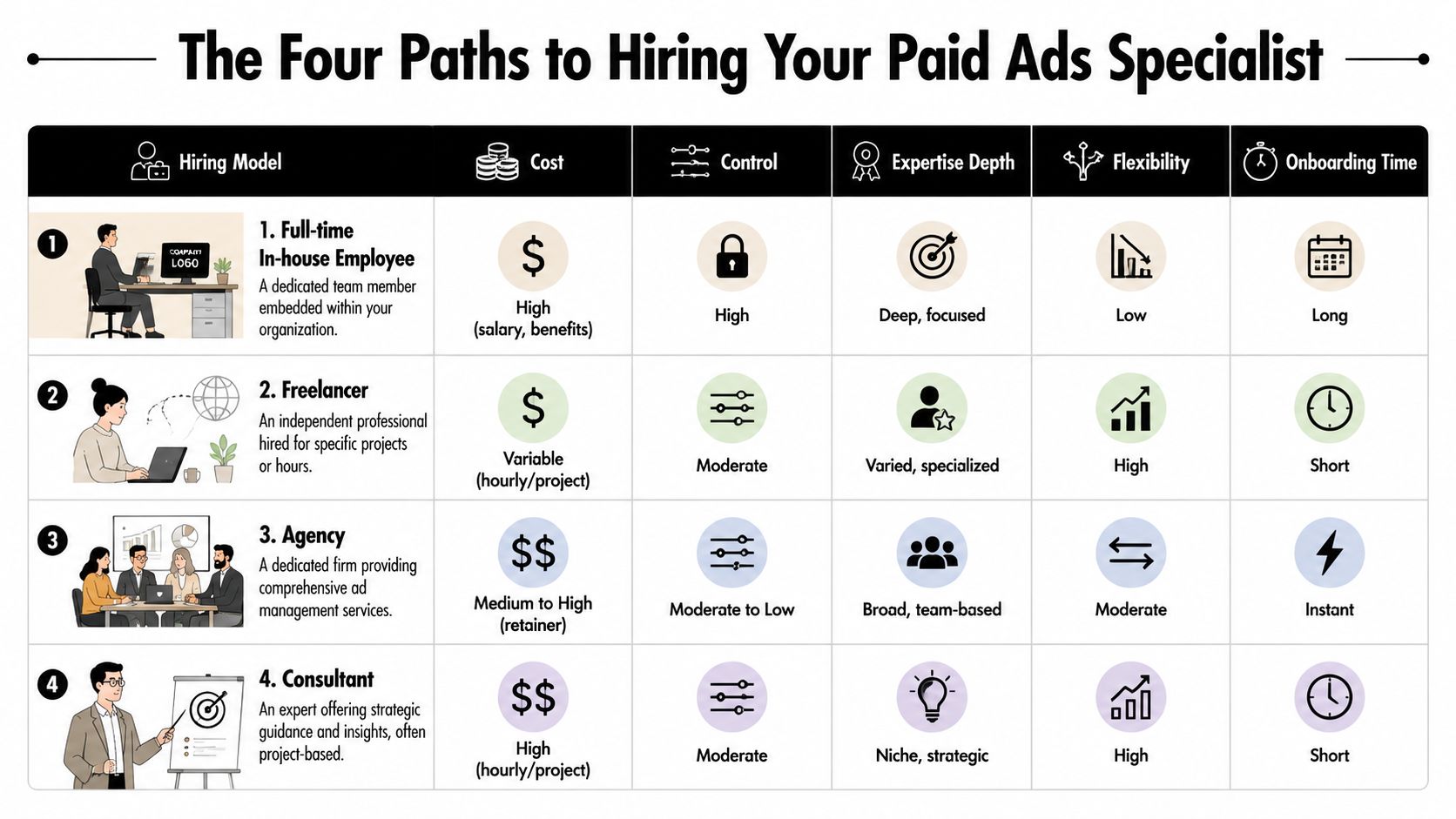
A paid ads specialist is not one thing. Sometimes you need an operator. Sometimes you need a strategist. Sometimes you need an account surgeon. If you choose the wrong path, you pay for activity and still end up doing the thinking yourself.
| Hiring Model | Cost | Speed to Hire | Vetting Burden | Flexibility |
|---|---|---|---|---|
| Full-time in-house | High | Slower | High | Lower |
| Freelancer | Variable | Faster | Very high | High |
| Agency | Medium to high | Fast | Moderate | Moderate |
| Vetted marketplace | Variable | Fast | Lower | High |
Hire in-house if paid acquisition is a real growth engine and you need someone close to product, sales, creative, and finance.
This path gives you context and continuity. A strong in-house specialist sees the same customer feedback, the same margin constraints, and the same launch calendar as the rest of the team. That usually leads to better decisions over time.
It is also the hardest hire to get right.
You are committing to salary, benefits, onboarding, management time, and backfill risk if the hire misses. The search also drags. If you have not planned for that, review a realistic paid media hiring timeline before you open the role.
Freelancers are useful for speed, narrow channel work, account audits, and short-term coverage.
They fall apart when the business needs ownership.
A good freelancer can clean up tracking, launch tests, and keep campaigns moving. An average one needs constant direction, avoids hard decisions, and disappears the moment the account gets messy. If you hire a freelancer, define the scope hard. Platforms owned, KPIs tracked, meeting cadence, reporting format, response times. Write it down before they touch the account.
Agencies work if you want a team around the channel and can tolerate some distance from the work.
That tradeoff is expensive more often than founders admit. You buy process, design support, and broader channel coverage. You also risk getting sold by the senior person and managed by whoever has room on the roster. Communication slows down. Context gets lost. The account starts to sound like every other account.
Use an agency if breadth matters more than direct accountability. Skip it if you want one person who will own outcomes and explain every major decision without hiding behind a slide deck.
This is the option more founders should test first.
A focused marketplace cuts out the worst part of hiring. Sifting through generalists, inflated resumes, and candidates who know ad jargon but cannot diagnose a broken funnel. You start from a smaller pool of people who already work in paid media and have been screened for it.
That does not remove due diligence. It makes due diligence worth doing.
For a lot of growing companies, this is the cheat code. Not because someone else magically hires for you. Because you stop starting from the worst possible pool.
Consultants are for diagnosis and correction.
Bring one in when the account is underperforming, attribution is a mess, tracking is suspect, or your current team keeps changing tactics without a clear reason. A strong consultant can find the expensive mistakes fast and give you a tighter operating plan.
Do not hire a consultant and expect daily execution unless that is explicitly part of the engagement. Many of them are there to fix the system, not run it.
Use the hiring path that matches the problem.
If you need long-term ownership and paid media is core to growth, hire in-house. If you need short-term execution and can manage tightly, use a freelancer. If you need broad support across channels and do not mind layers, hire an agency. If you need speed, flexibility, and a better shot at meeting real specialists instead of polished applicants, start with a vetted marketplace.
Average hiring methods produce average hires. That is the whole problem.
You post the role, get 80 applicants, and half of them sound impressive. Then you get on calls and realize a depressing number of paid ads candidates are just good at talking about platforms they never really controlled.
That's the hiring trap. Average candidates sell confidence. Real operators show judgment under messy conditions.

A strong paid ads specialist does not panic when attribution gets noisy, tracking has gaps, or sales starts arguing with platform reports. They know how to work through conflicting signals, find the choke point, and make a decision you can defend later.
They also know how to study competitors without copying random creative they saw in the feed. Good operators look at patterns, not screenshots. They compare offers, landing pages, angles, funnel structure, and ad repetition over time, the same kind of process outlined in this guide to researching competitor ads.
That is why resume polish means very little here.
Stop asking candidates to walk you through their background. Ask questions that force them to diagnose, prioritize, and commit.
Listen for order of operations. Good candidates start with tracking, funnel drop-off points, audience quality, search intent, sales feedback, and conversion path friction. Then they form a hypothesis and test it.
Weak candidates dump a pile of tactics on the table and hope one sounds smart.
You can reject a lot of people before the interview.
If a candidate cannot explain how they handle contradictory data, they are probably over-relying on dashboards and guessing the rest.
Make it paid. Keep it short. Tie it to the job itself.
Give the candidate one account snapshot or one campaign brief. Ask for the top issues, the first few actions they would take, the tests they would run, and the changes they would avoid for now. You are screening for judgment, not slide design.
A useful test looks like this:
| Test element | What you want to see |
|---|---|
| Audit summary | Can they find the biggest problems without getting lost in trivia? |
| Prioritization | Do they know what to fix now, what to monitor, and what to leave alone? |
| Test logic | Are the proposed experiments structured, measurable, and tied to a clear hypothesis? |
| Communication | Can they explain the account in plain English to someone who does not live in Ads Manager? |
This step saves money. Bad hires usually reveal themselves fast when they have to make tradeoffs instead of reciting best practices.
Bad job descriptions attract bad applicants.
Spell out what the role owns. Budget pacing. Channel scope. Creative feedback. Landing page input. Reporting cadence. Revenue accountability. Collaboration with sales, design, and leadership. If you leave that vague, you will get generic marketers applying to a role that needs a real media operator.
References matter too, but only if they come from people who saw the candidate make decisions under pressure. A polished case study proves very little. Client reference checks for paid media hires tell you a lot more about how someone handled budget, performance drops, deadlines, and disagreement.
Ask this near the end:
What is one conclusion you pulled from account data that turned out to be wrong?
Real pros answer quickly. They have scars. They can tell you what they missed, why they missed it, and what they changed after.
Inexperienced candidates act like they have never been fooled by performance data.
That usually means they have not been accountable for enough spend to learn the lesson.
A paid ads specialist is not just another marketing hire. This person sits close to revenue, close to spend, and uncomfortably close to your mistakes.
That's why average doesn't cut it.
The difference between an average operator and a strong one isn't cosmetic. One gives you campaign activity. The other gives you sharper decisions, cleaner tests, better accountability, and a clearer path to scale. One helps you understand the business. The other helps you misunderstand it faster.
If this process sounds exhausting, that's because it is. Sourcing, screening, testing, reference checks, role scoping, compensation, onboarding. Hope you enjoy turning your calendar into a part-time recruiting desk.
You can do it yourself. Plenty of founders do. Some even survive it.
My advice is simpler. Be brutally clear about what the role owns. Hire for judgment over jargon. Test thinking, not confidence. And don't cheap out on a role that can waste budget every single day.
The right Paid Ads Specialist won't just launch campaigns. They'll help you build a growth engine you can trust.
If you want to skip the worst parts of the search, HireMediaBuyers.com is a practical option for finding pre-vetted media buyers and paid ads specialists without running the entire vetting process yourself.


