


You're probably here because you hired someone who sounded brilliant on Zoom, said “full-funnel” a lot, and then promptly lit your ad budget on fire.
I've seen the movie. Fancy deck. Vague strategy. Screenshots of engagement spikes that had nothing to do with revenue. Then the slow, painful realization that you didn't hire a social media operator. You hired a stress subscription.
This is the fundamental problem with social media contracting. Most companies treat it like hiring a creative freelancer when they're handing over access to ad accounts, brand assets, audience data, and a channel tied directly to sales. Casual hiring here gets expensive fast.
The fix isn't complicated, but it does require being less nice, more specific, and a lot harder to impress.
A bad social media contractor rarely looks bad on day one.
They look enthusiastic. They have “proven frameworks.” They talk about hooks, funnels, UGC, omnichannel, and whatever else was trending on LinkedIn that week. They might even be cheap enough to feel like a smart test.
That's the $500 hello.
Then comes the expensive part. They ask for broad access, launch campaigns with shaky tracking, report on soft metrics, and blur the line between content, community, paid media, and strategy until nobody knows what they're accountable for. By the time you cut them loose, you haven't just lost fees. You've lost time, momentum, clean data, and often a chunk of ad spend you won't get back.
A weak contractor doesn't just waste money. They poison your decision-making because now you can't tell whether the channel failed or the operator did.
Social isn't some side project anymore. Social media ad spending was projected at $219.8 billion in 2024, and the average user interacts with 6.7 different social networks each month, according to Market.us social media statistics. That's not a playground. That's an operational environment with fragmented audiences, platform-specific formats, and enough complexity to punish amateur hour.
Most founders and marketing leads make one of three mistakes:
And then they wonder why every “quick test” turns into a costly cleanup.
If you want elite paid media talent, start acting like you're hiring for a revenue function. Because you are.
Most hiring disasters start before the first interview.
The role is usually nonsense. Companies ask for one person to shoot content, write copy, edit videos, run Meta Ads, build landing pages, handle attribution, manage influencers, answer comments, and somehow also be “strategic.” That person does exist. They're called an agency with five employees. Or a liar.
You need a role a real human can do well.

Don't begin with platform names. Begin with the bottleneck.
If your issue is inconsistent lead flow, you may need a paid social operator with landing page instincts and decent reporting habits. If your issue is that the founder is still approving every caption at midnight, you may need a distribution specialist and tighter workflow. If your issue is stale creative, a media buyer won't save you.
Ask the blunt question: what exactly is broken right now?
A few examples:
Here, people get cute and lose money.
A senior contractor should define strategy, audit what's broken, decide what to test, and explain tradeoffs without sounding like a horoscope. A mid-level operator should execute a known playbook well. A junior hire can support production and reporting, but they shouldn't be inventing your acquisition model on the fly.
Practical rule: If you can't explain the strategy yourself, don't hire someone junior to “figure it out.”
This one is simpler than people make it. Keep the authentic raw material close to the business. Outsource the technical execution.
Recent contractor guidance from 2026 recommends a hybrid model: keep raw content creation in-house to protect authenticity and brand voice, while outsourcing posting, scheduling, and ad amplification to a specialist, as noted in this contractor guidance on in-house content and outsourced distribution.
That's the model I'd use almost every time.
Your team knows the product, the customers, the weird little details buyers care about. A contractor knows how to turn that into distribution, testing, and channel execution. Don't ask the outsider to fake authenticity. Don't ask your internal team to master media buying by osmosis.
Write the role around these points:
Primary outcome
Revenue, qualified leads, booked calls, or pipeline support. Pick one main thing.
Channel ownership
Name the platforms. Meta Ads is not “all social.”
Scope boundary
Paid distribution only. Or paid plus reporting. Or organic scheduling plus amplification. Be exact.
Creative responsibility
Who provides briefs, raw footage, copy, and final approval?
Decision authority
Can they launch campaigns independently, or do they need approval before budget changes?
If that feels too rigid, good. Vague roles are expensive. Clarity is cheaper.
Resumes are theater.
A polished LinkedIn profile tells you someone can write about media buying. It does not tell you they can manage spend, diagnose creative fatigue, or stop a campaign from bleeding money for two weeks while they “monitor performance.”
The old hiring routine is broken. You skim a portfolio, ask a few soft questions, get charmed by confidence, and make a hire based on storytelling ability. Then you spend the next month figuring out whether the person is skilled or just fluent.
That's backward.
I don't care if the deck is pretty. I care whether the person can explain decisions.
A useful portfolio shows thinking. Why did they change the structure? What was broken in the account? How did they decide what to test first? What did they stop doing? A contractor who only shows polished creatives and says “I scaled campaigns” is giving you marketing cosplay.
Look for these signals:
If they can't explain the system, they probably didn't build it.
Ask this:
“Walk me through the first two weeks after getting access to a messy account.”
Then shut up.
The good ones get concrete fast. They'll talk about account structure, tracking checks, creative review, spend concentration, audience overlap, reporting cleanup, and what they'd pause immediately versus leave alone until they have baseline data.
The weak ones go foggy. They'll say they'd “review performance,” “analyze the funnel,” and “align with business goals.” That sounds lovely. It also says nothing.
Unpaid take-home work is a great way to attract desperate candidates and annoy the good ones.
Give finalists a small paid exercise instead. Keep it realistic. For example, share a redacted account snapshot or campaign summary and ask for:
You'll learn more from that than from three rounds of “tell me about a challenge.”
And yes, references still matter. Just don't ask lazy questions. Ask former clients whether the contractor communicated clearly, respected scope, handled feedback well, and took ownership when things went sideways. If you want a benchmark for what strong reference validation can look like, review how client references are handled in a structured hiring process.
Some warning signs aren't subtle. People ignore them because they want the hire to work.
I'd rather hire someone slightly less charismatic and far more exact. Charming incompetence is still incompetence.
A social media contract isn't paperwork. It's a control system.
If the agreement is vague, the contractor will fill in the blanks in ways that benefit them. Not always maliciously. Sometimes they're just trying to survive your chaos. Either way, you lose. Scope expands, messages come in at all hours, account access gets messy, and everyone acts shocked when the relationship turns sour.
The fix is boring, direct, and wildly effective. Put the operational rules in writing.
The biggest contract mistake is pretending everyone shares the same definition of “social media management.”
They don't.
One person thinks it means paid social only. Another thinks it includes content calendars, DMs, caption writing, reporting, and community management. A third thinks “just posting” also includes video editing, creative briefs, and emergency weekend fixes because the founder had an idea in the shower.
That's how you end up funding unpaid work with your own confusion.
Practitioner guidance from 2026 emphasizes that contracts should explicitly define communication channels, response times, and access rules to prevent unpaid work and 24/7 expectations, treating them as enforceable service terms, not casual habits, as discussed in this guidance on contract boundaries for social media work.
If it matters operationally, it belongs in the contract. “We'll figure it out as we go” is how scope creep introduces itself.
I'd insist on six things before anyone touches an ad account.
Spell out what gets delivered and how often. Weekly report. Monthly strategy memo. Campaign launch setup. Creative test matrix. Platform coverage. If it's not listed, assume it's not included.
No, your contractor is not your on-call social intern.
Name the communication channels. Slack for normal communication. Email for approvals and formal updates. No text messages unless there's a real emergency. Define response windows and office hours. This protects both sides and keeps your team from drifting into chaos.
Your business should own the ad accounts, pixels, pages, creative files, and analytics access. The contractor gets permissions, not ownership. If they insist on running everything through their own Business Manager or private logins, stop there.
This one gets ignored until a breakup gets ugly.
Your contract should say that all approved ad creatives, copy variants, campaign structures created for your business, reporting documents, and work product belong to your company once paid for. If they use third-party templates or licensed assets, that should be disclosed clearly.
You want clean rules. Fee, billing date, what triggers extra charges, and what happens when you request work outside scope. Don't leave room for “small asks” to become a shadow retainer.
Every contract needs an exit ramp. Notice period. Offboarding duties. Handover of files. Access removal. Final invoicing. If you're using a platform or service arrangement, flexibility matters. That's one reason some teams prefer cancel-anytime hiring terms for specialist talent rather than getting trapped in a long, painful mismatch.
| Clause | What It Does | Example Snippet |
|---|---|---|
| Scope of work | Defines included services | “Contractor will manage paid social campaigns on Meta only. Organic posting, community management, and video editing are excluded unless added in writing.” |
| Deliverables | Sets output expectations | “Contractor will provide a weekly performance summary and a monthly testing plan.” |
| Communication policy | Prevents 24/7 chaos | “Primary communication will occur in Slack during agreed business hours. Approval requests and strategic changes will be documented by email.” |
| Response times | Sets service boundaries | “Non-urgent messages will receive a response within the agreed business window. Emergency issues are limited to account outages or rejected payment events.” |
| Access rules | Protects business assets | “Client retains ownership of all ad accounts, pages, analytics properties, and admin access.” |
| IP ownership | Prevents creative and data disputes | “Upon payment, all campaign materials and work product produced specifically for the client become client property.” |
| Change request process | Kills scope creep | “Any work outside the listed scope requires written approval and may incur a separate fee.” |
| Termination and offboarding | Makes exits survivable | “Upon termination, contractor will transfer active files, document account status, and assist with access transition.” |
Add a simple approval rule.
Who signs off on copy? Who approves creative? Who can authorize budget changes? If nobody owns approval, campaigns stall and everyone blames the contractor for waiting. If everybody owns approval, you get committee sludge and bad ads.
Pick one final approver. Maybe two. Never seven.
A strong contract won't make a weak contractor great. But it will stop them from turning one bad fit into a six-month operational migraine.
Most onboarding is a mess disguised as optimism.
The contract gets signed, someone sends a logo file, another person drops a half-working password into Slack, and then everybody expects the contractor to produce magic from a pile of missing assets and contradictory opinions. That's not onboarding. That's hazing.
A strong operator can survive a rough start. But even a great one performs better with a clean handoff.
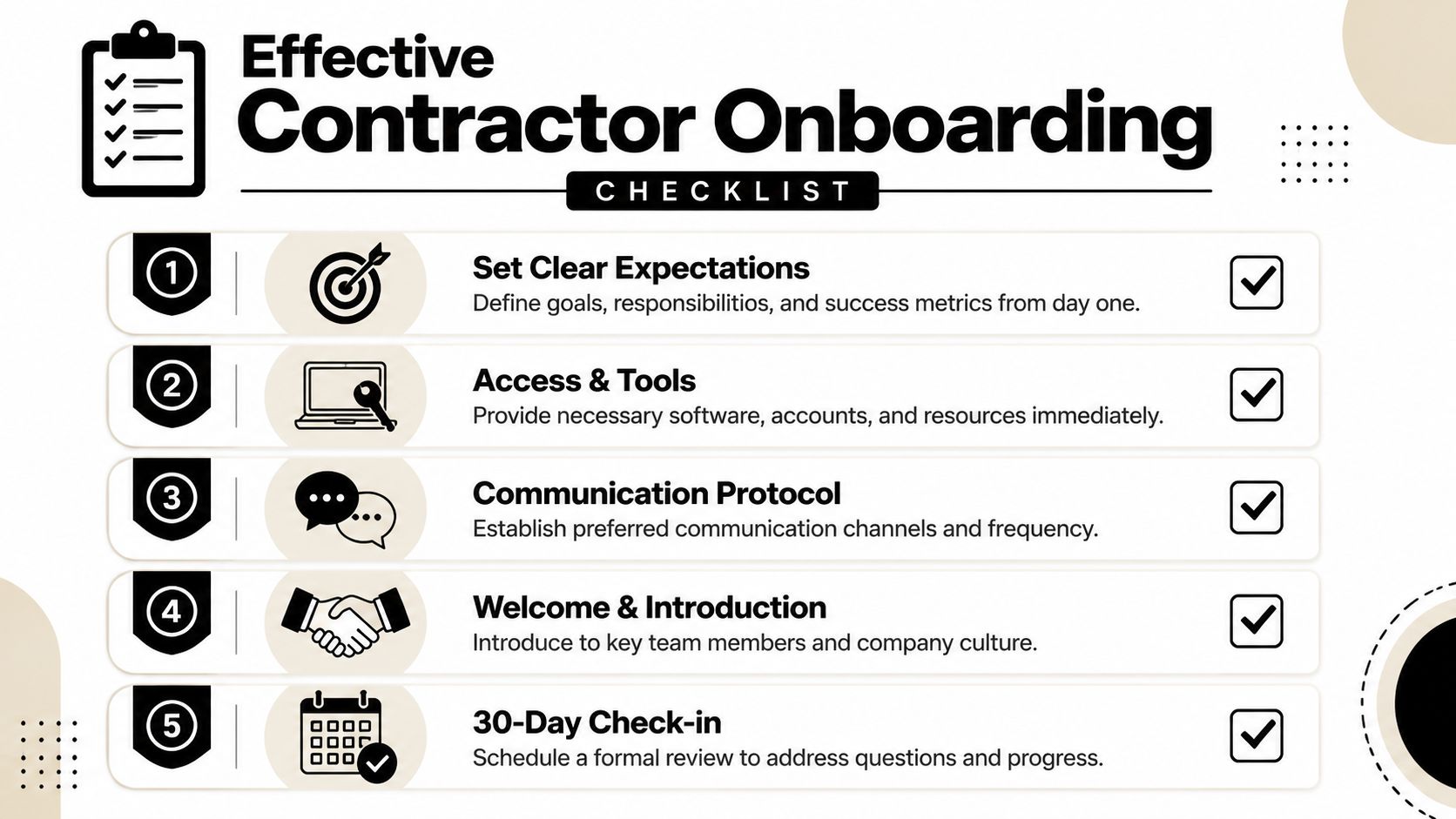
The first week should answer three questions fast. What can they access? Who do they need? What counts as success right now?
Give them the actual tools and systems they need. That usually includes ad account permissions, analytics access, brand files, current offers, existing creative, landing pages, and the names of decision-makers. If your contractor has to chase basic permissions for days, you're paying for admin delay.
Use one communication channel for day-to-day work. Slack works. Email works for approvals. Texting at night because “it's faster” is how boundaries die.
A clean onboarding rhythm often looks like this:
Week 1
Access, orientation, business context, offer review, account history, approval chain.
Week 2
Audit current campaigns, identify obvious waste, review creative inventory, flag tracking issues.
Weeks 3 and 4
Present a short roadmap, launch initial tests, establish reporting format, confirm decision cadence.
The best onboarding isn't warm and fuzzy. It removes excuses.
You don't need a giant brand bible. You do need a usable packet.
Include:
A contractor who understands your constraints on day three will outperform one who discovers them in a panic during launch week.
Book a formal review at the end of the first month.
Not a vague catch-up. A real review. What's working, what's blocked, what assumptions were wrong, and what needs to change in the next cycle. This keeps tiny misunderstandings from growing into expensive resentment.
Good onboarding doesn't guarantee performance. It just removes the dumb reasons performance fails.
Once the contractor is in motion, don't fall into one of two traps. Either you micromanage every click like a caffeinated hawk, or you disappear for a month and hope the dashboard tells a happy story.
Both are lazy.
Good performance management is simple. Agree on what matters, review it regularly, and separate signal from noise. For paid social, contractor guidance recommends defining success criteria before launch, matching attribution windows to the buying cycle, such as 28-day windows for long consideration cycles, and scaling budgets in 15 to 20% increments to avoid resetting algorithm learning, as outlined in this paid social testing and attribution guide.
That one point alone eliminates a lot of fake debate. If the contractor and client don't agree on attribution logic, every report becomes an argument.
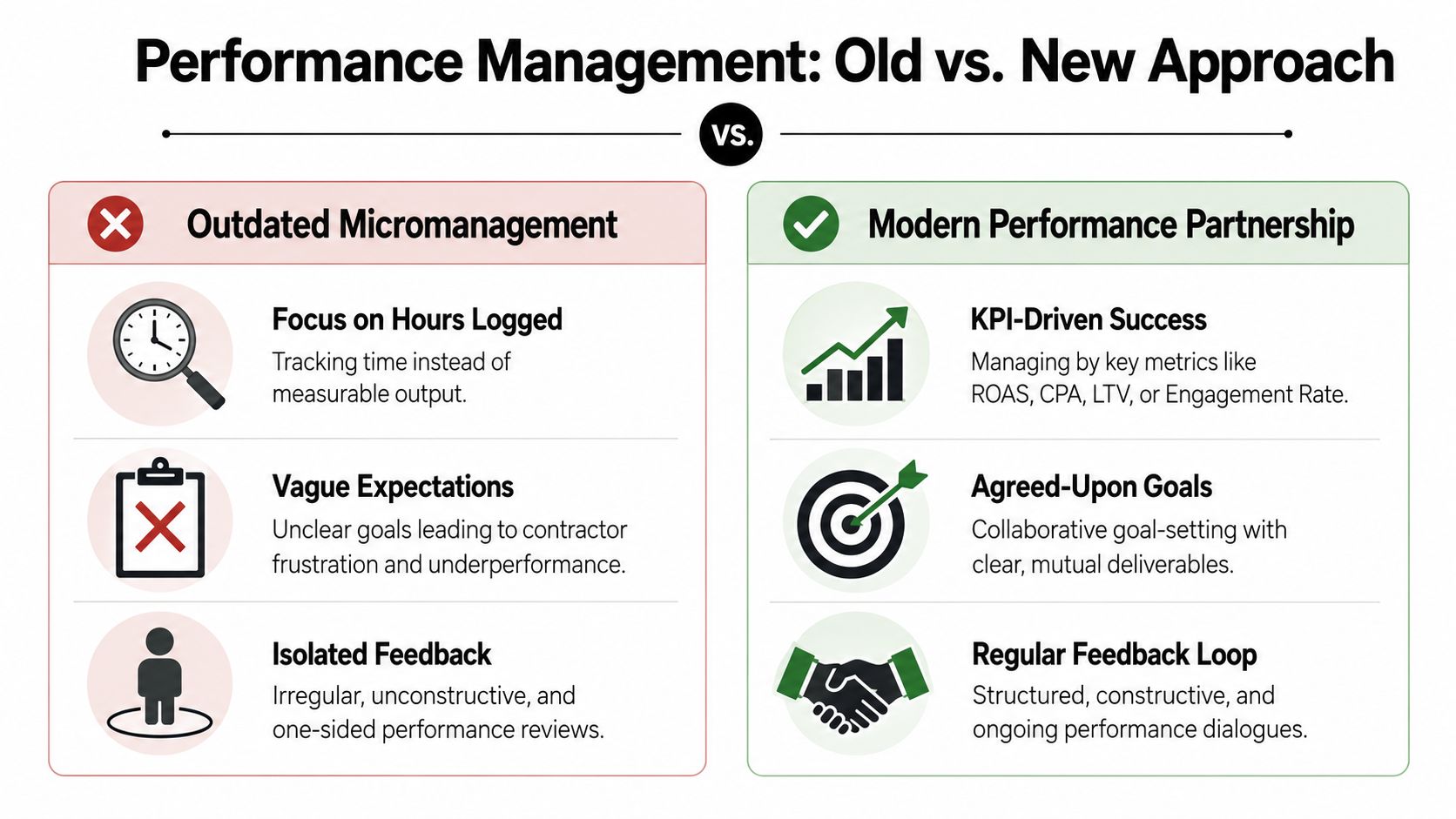
You don't need screenshots every afternoon. You need a consistent rhythm around output and decisions.
A healthy setup usually includes:
A media buyer who spends all week proving they're busy usually isn't spending enough time improving the account.
For remote teams, this matters even more. Async work can be excellent, but only if expectations are explicit. If they aren't, managers start judging responsiveness instead of results, and contractors start performing availability instead of actual problem-solving. There's useful operational thinking in this guide to managing distributed teams if your team is spread across time zones.
Now the unglamorous part. Paying remote contractors sounds easy until you're the one dealing with tax forms, cross-border payments, local labor questions, and awkward ownership issues when the contractor starts looking less like a contractor and more like a full-time team member.
You can do it yourself. Plenty of companies patch together Wise, PayPal, accounting workflows, emailed contracts, and a lot of crossed fingers. That can work for a while.
But let's be honest. Most marketing teams don't want to become a part-time international operations desk.
A cleaner option is to use a service model that handles payroll, contractor admin, compliance support, and replacements in one place. The point isn't bureaucracy. It's focus. Your team should be building campaigns and reviewing performance, not learning cross-border admin by trial and error.
The DIY route gives you control, but it also gives you paperwork, payment friction, and preventable risk.
The managed route costs more on paper sometimes, but it cuts operational drag and usually makes transitions cleaner when someone leaves or needs replacing. If you're hiring one specialist and know what you're doing, DIY may be fine. If you're building a broader remote paid media function, the admin burden grows fast.
Choose based on what business you're in.
If the answer is “we sell products” or “we generate pipeline,” then stop acting like you also wanted to run a miniature global HR department for fun.
If you want the shortest path to a reliable paid social hire, HireMediaBuyers.com is built for exactly that. You get access to pre-vetted media buyers and paid ads specialists, flexible hiring options, and a model that handles the messy operational stuff without turning your marketing team into an HR back office.


