


Fractional work is when an experienced specialist becomes an embedded, part-time member of your team on a monthly retainer, giving you senior expertise without the full-time salary and overhead. It has grown fast enough to stop being a niche idea, with fractional jobs up 57% since 2020 and 25% of U.S. businesses using fractional hiring in 2024 according to Fractional Jobs.
If you're reading this, you're probably in the same spot I've seen over and over. You need someone sharp. Not "eager and coachable." Sharp. Someone who can own a revenue-critical function without turning your week into an accidental training program.
And if that role touches paid media, the stakes get ugly fast. A bad designer wastes a sprint. A bad media buyer burns cash before lunch.
I've seen founders make the same miserable choice three ways. Hire a junior and hope they grow up quickly. Stretch a freelancer who says yes to everything. Or keep doing it yourself while your actual job rots in the corner. Fractional work is the fourth option, and in a lot of cases, it's the smart one.
Your ads are live. Spend is going out every day. Performance is flat, reporting is fuzzy, and nobody can tell you whether the problem is creative, targeting, offer, or the person touching the account.
I've seen this happen too many times. Founders wait too long because they assume the only serious fix is a full-time senior hire. Then they make a panicked choice and hand a revenue-critical function to the wrong person. If it's a media buyer, you do not just lose time. You burn cash while you learn they were bluffing.
That is the hiring problem. You need someone good enough to own the outcome, but you do not need that person forty hours a week.
You need judgment. You need pattern recognition. You need someone who has already made expensive mistakes on somebody else's budget.
Founders usually force this into three bad choices:
Fractional work fills that gap. You bring in a senior operator for the part of the week or month that is important, and you stop paying for hours you do not need.
I've seen founders call that a compromise. It is not. It is often better discipline.
A strong fractional hire gives you senior judgment without forcing you into a bloated salary, a long recruiting cycle, and months of hoping you picked the right person. That matters in any leadership role. It matters even more in paid acquisition, finance, and other functions where a weak operator creates expensive messes fast.
This is the part people underrate.
A bad full-time hire is painful. A bad fractional hire in a high-stakes role can still be expensive, especially if you treat "fractional" like a shortcut and skip the hard vetting. I have seen founders hire a media buyer based on confidence, jargon, and a few screenshots. Two weeks later, CAC spikes, attribution gets muddy, and nobody can explain what changed.
Do not hire fractional talent because the model sounds efficient. Hire fractional talent because you can verify they know how to handle the exact problem in front of you.
For a role like media buying, that means asking sharper questions. What accounts have they managed that look like yours? What did they change first? How do they diagnose creative fatigue versus audience saturation? What reporting do they send without being chased? If their answers stay vague, walk.
The point is simple. You do not need a full-time paycheck to justify hiring a real pro. But you do need a real vetting process, especially when the wrong person can light your budget on fire.
You do not bring in a fractional operator to fill hours. You bring one in to solve a problem that is already costing you money, speed, or focus.
I've seen founders confuse fractional with cheap labor and get exactly what they paid for. They hire someone for a few hours a week, toss them a login, and hope for magic. That setup produces task work, not ownership. In high-stakes roles like media buying, that mistake gets expensive fast. A weak operator does not just waste meetings. They burn budget while everyone debates what went wrong.
Fractional work means hiring a senior operator for a defined scope, usually on a monthly retainer, to own a function part-time and make decisions inside the business. The hours are limited. The accountability is not.
The primary distinction is involvement.
A freelancer usually completes assigned work. A fractional hire joins planning, reviews performance, spots problems early, and tells you what needs to happen next. That is why the model works. You are paying for judgment applied inside your business, not just output delivered to it.
Wikipedia gets that part right. Fractional work places an experienced specialist or executive in an embedded team arrangement, typically on a retainer rather than a traditional employee contract.
That embedded piece is where founders either win or fool themselves.
If your fractional media buyer never touches planning, never challenges the brief, and never owns performance conversations, you did not hire strategic help. You rented task capacity with a nicer title. If you want a setup built around defined ownership and easy exits, a cancel-anytime fractional media buying retainer is a much better fit than an open-ended freelance relationship.
Here is the practical breakdown.
| Attribute | Fractional | Freelance | Part-Time Employee | Contractor |
|---|---|---|---|---|
| Primary role | Owns outcomes in a defined function | Produces assigned deliverables | Supports ongoing internal work | Completes a project or fixed scope |
| Team integration | Joins meetings, planning, and reviews | Usually works outside core workflow | Fully internal | Depends on the contract |
| Engagement model | Monthly retainer with clear responsibilities | Hourly or per project | Wages or salary | Contract fee or milestone payments |
| Level of seniority | Usually senior specialist or executive | Mixed | Mixed | Mixed |
| Decision-making | Expected to recommend and prioritize | Usually waits for direction | Varies by role | Limited to scope |
| Best use case | Problems that need experienced judgment without a full-time hire | Overflow work or one-off specialist tasks | Steady recurring support | Temporary delivery work |
I use a simple filter.
If you need to explain the weekly priorities, review every move, and translate the business for them, they are not operating fractionally. They are giving you hours.
A real fractional hire steps into the mess, gets to the signal fast, and starts making sound calls. For a media buyer, that means they can audit account structure, question attribution, identify where spend is leaking, and explain the tradeoffs in plain English. I've seen polished candidates talk like strategists until you ask what they would cut first in an underperforming account. The wrong ones get vague immediately.
Hire fractional talent for ownership, judgment, and decision quality. Hire freelancers for execution.
Get that distinction right, and fractional work becomes one of the cleanest hiring moves a company can make. Get it wrong, and you are just paying premium rates for part-time coordination.
You hire a media buyer to fix performance. Two weeks later, spend is up, results are flat, and nobody can tell you which campaigns should be cut first. I've seen that movie before. The problem was not "fractional" as a model. The problem was paying for senior talent without vetting for senior judgment.
Fractional work can be excellent. It can also get expensive fast when the role touches ad spend, pricing, forecasting, or any function where bad calls burn cash.
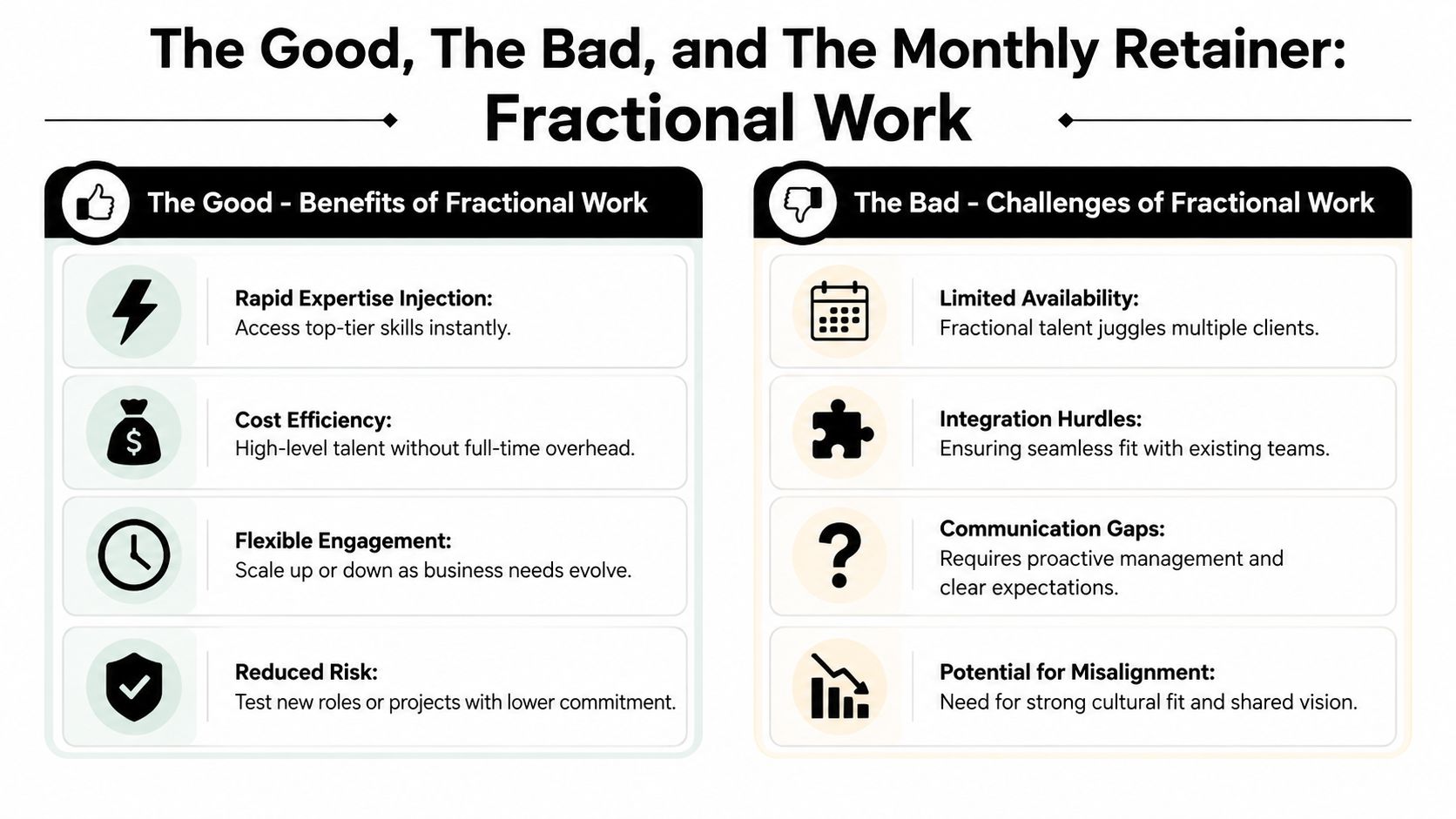
The best part is access to experience you probably should not hire full time yet. You get a senior operator focused on a defined problem, with enough context to make strong calls and enough distance to avoid your team's bad habits.
For paid media, that matters more than founders admit. A weak hire does not just waste meetings. They waste budget. A strong fractional media buyer can spot account bloat, bad attribution logic, weak creative testing, and channel mix mistakes before another month of spend disappears.
The upside usually shows up in a few clear ways:
That last point matters. Retainers should create focus, not trap you in a six-month mistake.
Retainers get messy when companies buy them like insurance. They assume monthly access means guaranteed outcomes, then hand over vague goals, partial account access, and five competing stakeholders.
That is how good people fail.
Fractional talent usually works across multiple clients, so you will not get unlimited attention. Fine. A potential risk many consider is less critical than this: inadequate vetting in high-stakes roles. I've seen founders hire a polished "fractional growth lead" who spoke beautifully on calls, then lit up budget because they could not explain bid strategy, incrementality, or what to pause in an underperforming account.
Watch for these failure points:
If the role controls spend, never hire from the resume first. Hire from the audit.
I want to see how they think with real constraints. Give them a live account, or a redacted one, and ask direct questions. What gets cut today. What stays funded. What KPI is lying to us. What would they test first with the next $10,000. I've seen average candidates hide behind channel jargon for weeks. They fall apart in ten minutes when you ask for tradeoffs.
My rule is simple. For high-stakes fractional hires, especially media buyers, the vetting process matters as much as the retainer itself. A clean monthly agreement helps. A sharp operator helps more. A bad one will burn through your savings while sounding confident the entire time.
Fractional talent works best in roles where judgment beats volume.
You don't hire fractionally for work that needs constant supervision, repetitive handoffs, or endless internal approvals. You hire fractionally when a smart person can create outsized impact with focused time. That's why the model fits roles like CMO, CFO, CTO, RevOps lead, and growth strategist.

A good rule is simple. If the role is mostly about doing more tasks, fractional is often a poor fit. If the role is about setting direction, making tradeoffs, and preventing expensive mistakes, fractional can be perfect.
That distinction matters because founders often hire backwards. They fill execution before strategy. Then they wonder why the team stays busy and the business stays confused.
Roles that tend to fit well include:
Paid media is where this model really earns its keep.
A mediocre media buyer doesn't just produce meh work. They can burn budget, misread attribution, chase vanity metrics, and swear the algorithm is "still learning" while your CAC steadily becomes a horror story.
A strong media buyer, on the other hand, can steer strategy, creative testing, budget allocation, and platform decisions without needing to sit in your office five days a week pretending to love kombucha on tap.
I've seen teams get far more value from a sharp fractional buyer than from a full-time generalist who only knows one ad platform well. That's especially true if you're hiring beyond your local market and comparing options like offshore hiring for paid media talent, where experience breadth matters more than zip code.
For media buying, the problem isn't usually lack of effort. It's lack of judgment under pressure.
The best fractional media buyers work across accounts, industries, and creative patterns. That cross-account exposure helps them spot changes faster. They see what Meta is rewarding, where Google campaigns are drifting, and which creative formats are holding up.
That doesn't make every fractional buyer great. Far from it. But when you find one who's strong, you're getting pattern recognition that many in-house hires haven't built yet.
That's the main appeal. Less time. Better calls.
The standard fractional setup is the monthly retainer. Good. It should be.
Hourly billing often creates dumb behavior. It rewards activity instead of ownership. A retainer buys dedicated time, attention, and strategic headspace. You're not just reserving calendar slots. You're reserving judgment.
One useful benchmark is this: 52.8% of fractional leaders earned $100,000 or more annually, and the standard engagement model often involves a monthly retainer for 10 to 15 hours per month per client. That's the clearest signal that you're paying for valuable expertise, not bargain-bin labor.
If you're evaluating a fractional hire, don't obsess over whether every hour gets spent exactly as planned. Obsess over whether the scope matches the business problem.
A solid agreement should spell out:
Bad contracts focus on time only.
Good contracts connect time to outcomes. If you're hiring a fractional media buyer, "10 hours a month" means very little by itself. "Own weekly budget allocation, creative testing direction, and channel reporting" is far more useful.
Here's the red-flag list I use when reviewing a scope:
| Green flag | Red flag |
|---|---|
| Clear ownership areas | Vague "marketing support" language |
| Defined meeting rhythm | Unlimited ad hoc availability |
| Access to tools and data | No mention of accounts or reporting access |
| Specific review cadence | No checkpoints until renewal |
| Outcome-based priorities | Hour counting without business context |
Start narrower than you think.
Most companies overstuff the first agreement because they're trying to squeeze maximum value out of every dollar. That's how you create a messy relationship by month two. Give the person a sharp brief, not a junk drawer.
If you can't describe the outcome in one sentence, you aren't ready to hire for it.
And one more thing. If someone is suspiciously cheap for a high-stakes role, keep your wallet in your pocket. Cheap paid media talent can become very expensive.
Many teams often fail at this stage.
They assume hiring fractional talent is easier than hiring full-time talent, so they lower their standards. They skim a resume, ask a few vague questions, get charmed by confidence, and call it due diligence. Then the campaigns wobble, reporting gets fuzzy, and everyone acts surprised.
Don't do that.
For high-stakes roles, especially paid ads, your vetting process should be more rigorous, not less. A bad fractional media buyer can torch ad spend while sounding articulate enough to survive three status calls.
The market is already telling you talent quality is hard to judge. According to a 2024 McKinsey report, 68% of US marketers struggle to find specialists who can effectively manage multi-platform campaigns. That's exactly why loose hiring processes fail.
Here's a relevant look at the kind of talent environment buyers are dealing with:
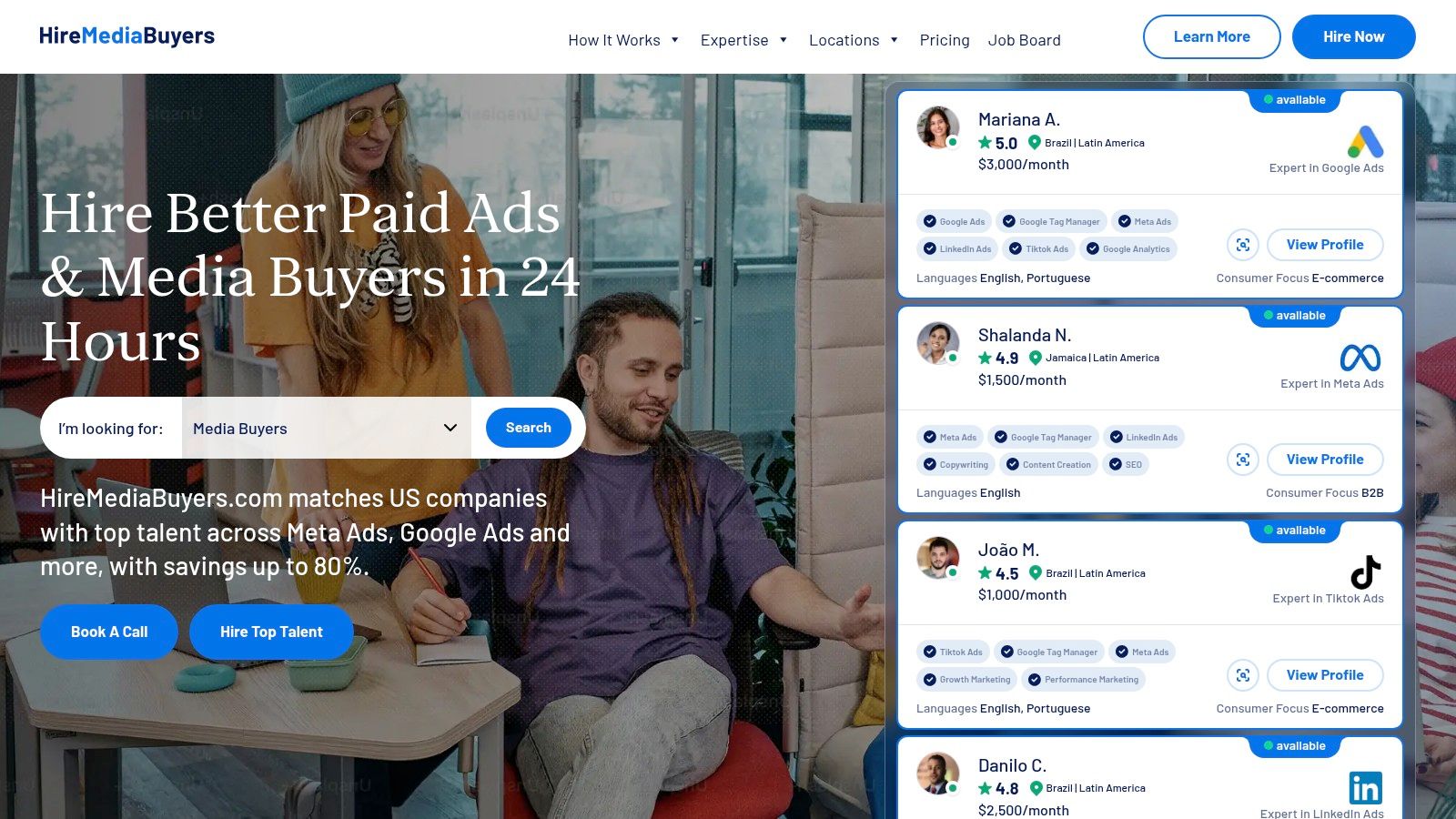
If someone says they're great at Meta, Google, TikTok, and LinkedIn, don't nod politely and move on. Test that claim. Platform depth is uneven. Typically, individuals have one real home turf and two "I can probably handle it" channels.
Use this before you hire anyone fractionally for paid media.
Define the business problem first
Don't start with tasks. Start with the mess. Are you trying to reduce wasted spend, improve lead quality, expand channels, or fix creative testing discipline?
Ask for channel-specific examples
If they claim multi-platform strength, make them walk through work on each platform. Not broad philosophy. Actual decisions.
Use scenario questions, not trivia
Ask what they'd do if Meta performance drops while Google branded search starts carrying the account. Ask how they'd rebalance. Good people think in tradeoffs.
Inspect communication quality
Can they explain performance clearly to a founder, a marketer, and a finance lead? If not, they'll create confusion.
Check references that speak to ownership
Don't just ask if they were "great to work with." Ask if they spotted issues early, handled pressure well, and improved decision-making. If you need a benchmark for what strong proof looks like, study how serious teams structure client references for marketing hires.
I want evidence of four things:
I've seen polished candidates talk a beautiful game and still fail the moment they need to make cross-platform decisions with incomplete data. That's why I care less about charisma and more about proof.
Toot, toot. Cynicism earned the hard way.
For a lot of companies, yes. Not because it's trendy. Because it's practical.
The old default was simple. Hire full-time, build around fixed roles, and hope demand stays neat enough to justify every salary. That worked when markets moved slower and companies had more room for inefficiency. Few organizations have that luxury now.
Fractional hiring makes the most sense when three things are true:
That's why it works so well for functions like finance, marketing leadership, technical leadership, and paid acquisition. These roles shape outcomes disproportionate to the hours spent. One good decision can matter more than a week of busywork.
Stop treating fractional as a backup plan for companies that can't "afford a full-time employee."
In many cases, it is authentic. Just delivered in a more efficient format. You get expertise where it counts, fewer hiring regrets, and less pressure to pretend every role deserves a permanent seat on the org chart.
If you've been asking what is fractional work, the practical answer is this: it's a way to buy experience without buying unnecessary overhead. That's not a workaround. That's good operating sense.
The caveat is simple. Be serious about vetting. Be clear about scope. Use fractional for strategic benefit, not for dumping random tasks onto a capable stranger.
Do that, and you'll build a team that's lighter, sharper, and a lot harder to outmaneuver.
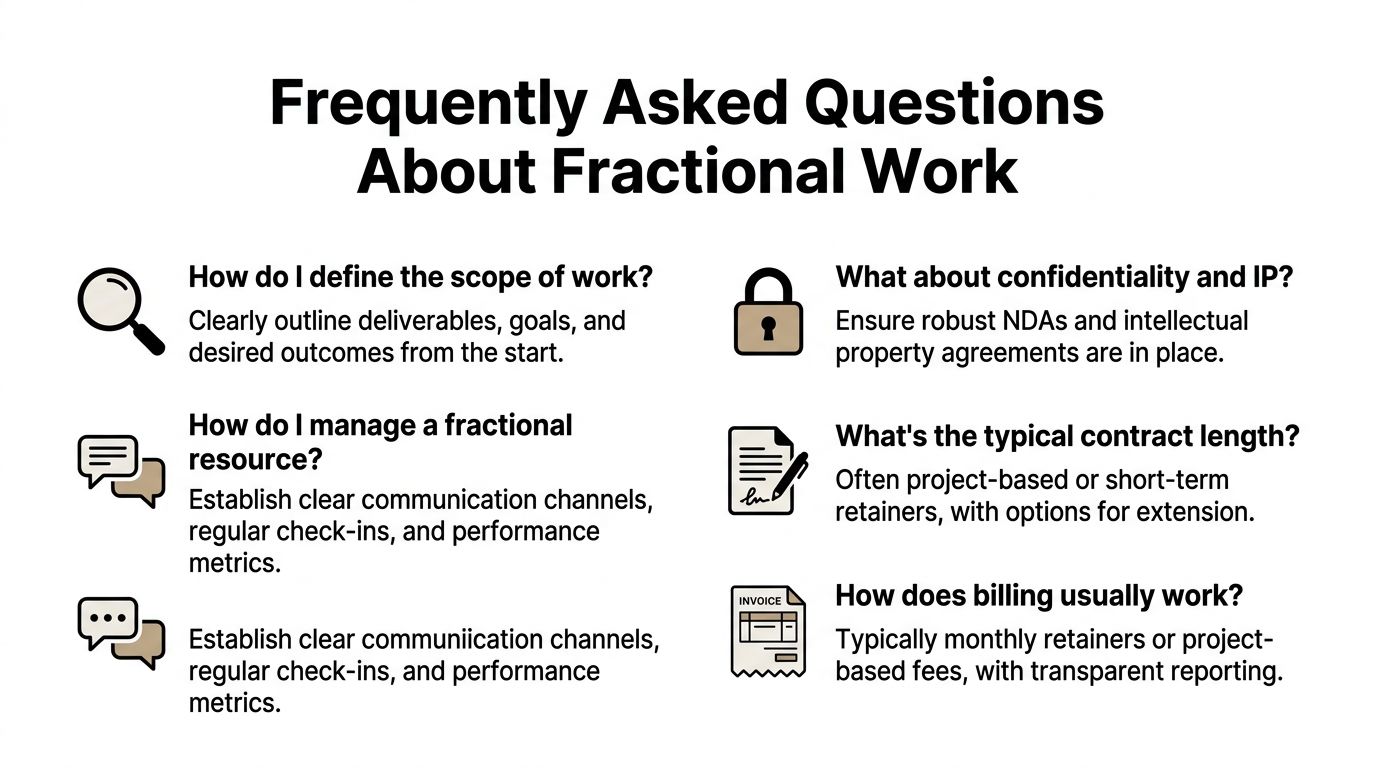
A few practical questions always come up after teams warm to the idea. Fair enough. Fractional work sounds simple until you have to run it well.
Usually, no.
A fractional hire should replace a capability gap, not the entire concept of full-time employment. They lead, guide, diagnose, and improve. In some cases they also execute, but the main value is strategic impact. If you need nonstop hands-on coverage, you'll probably need full-time support somewhere in the system.
You do it intentionally.
Add them to the right Slack channels. Give them access on day one. Invite them to meetings that matter, not every meeting invented by committee. Make one person accountable for the relationship.
A simple onboarding rhythm helps:
Short enough to reduce regret. Long enough to produce signal.
In practice, a retainer should last long enough for the expert to get context, make changes, and show whether they're improving the function. Agreements that are too brief create churn. Agreements that lock both sides in for ages create resentment.
Handle it upfront, in writing, like adults.
Use clear NDAs. Make intellectual property ownership explicit. Confirm who owns ad accounts, creative assets, reporting files, and strategy documentation. Ambiguity here is avoidable, and I've seen avoidable messes become expensive messes.
This is one reason many teams prefer a fractional model in the first place. The exit path is usually cleaner than with a full-time hire.
Still, don't rely on the contract alone. Protect yourself with clean documentation, shared passwords managed properly, straightforward reporting, and a transition plan. If someone disappears or underdelivers, you want replacement to be inconvenient, not catastrophic.
Hire for proof. Onboard for speed. Document for survival.
That's the operating mindset that makes fractional work feel like a strategic advantage instead of a staffing experiment.
If you need a media buyer who can effectively handle high-stakes paid acquisition without the usual resume theater, take a look at HireMediaBuyers.com. It's built for companies that want pre-vetted paid ads talent fast, without wasting weeks on interviews that sound impressive and say nothing.


