


You've got an open marketing role. Spend is live, targets are slipping, and your team is pretending they can “cover it for now.” They can't.
So you post the job. Then the circus starts. A flood of resumes from people who have “managed campaigns” but can't explain attribution, can't talk through creative testing, and somehow all claim expertise in Meta, Google, LinkedIn, TikTok, and probably lunar advertising too. Toot, toot.
That's where marketing job recruiters enter the chat. In theory, they save you time and find talent you won't reach on your own. In practice, some are sharp operators and some are glorified forwarding machines with a Calendly link. The difference matters more than most founders realize.
This isn't a polite little overview. It's the version you write after wasting money, sitting through nonsense interviews, and learning that hiring help can either solve a problem or add a second one.
I've seen this movie too many times.
You hire a media buyer because revenue pressure is rising and your team needs air cover. The candidate interviews well, says the right platform names, nods confidently when you mention CAC and creative fatigue, and starts on Monday. By Friday of week three, your reporting is murky, your agency lead is annoyed, and your ad account somehow feels both busier and dumber.
That's the awful feeling. Not just “this person might not work out.” It's the realization that a bad hire in marketing burns money while smiling at you in a Slack thread.
The pain gets worse because the best people often never applied in the first place. 50% of candidates would consider a new opportunity if approached by a recruiter even though 49% of American workers are not actively seeking new jobs. Relying on job boards alone guarantees you miss experienced operators who are already inside other companies, effectively making them money.
A weak marketer in a support role is annoying. A weak marketer in a paid acquisition role is expensive.
They don't just fail privately. They waste budget publicly. They launch campaigns with fuzzy targeting, let bad creative run too long, miss tracking issues, and explain every ugly result with “the algorithm is weird right now.” Convenient.
Great marketing hires create clarity fast. Bad ones create vocabulary.
That's why I don't think of marketing job recruiters as résumé suppliers. I think of them as a possible antidote to chaos. Possible. Not guaranteed.
You're not asking, “Should I use a recruiter?”
You're asking, “How do I get real help instead of outsourced noise?”
That's a much better question. It forces you to judge recruiters by whether they improve hiring outcomes, not whether they sound polished on an intro call.
Recruiters love labels. Agency. Boutique. Embedded. Executive search. Specialist. Strategic partner. Half the industry sounds like it was named in a conference hallway.
Ignore the branding. Watch the incentives.
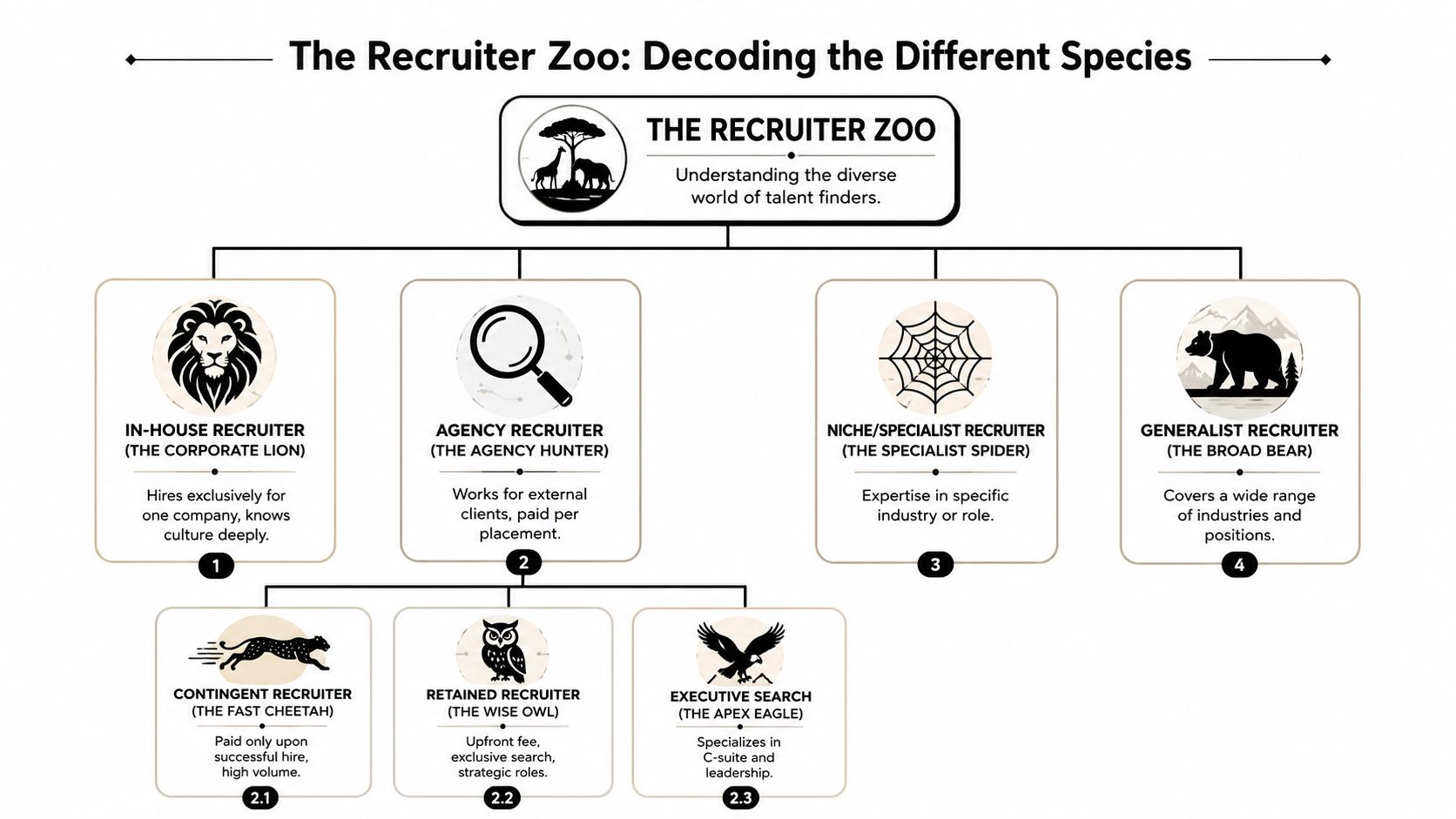
An in-house recruiter works for one company. They usually know the culture, the politics, the hiring manager's weird preferences, and which interview panelist always derails the process. That context is valuable.
An agency recruiter works across clients. They should have broader market exposure and deeper candidate networks. The problem is that “broader market exposure” can also mean “I'm juggling twelve searches and praying one closes.”
Here's the simple split:
| Recruiter type | Best at | Main risk |
|---|---|---|
| In-house recruiter | Company context and process ownership | May lack niche role depth |
| Agency recruiter | External reach and speed | Incentives can favor volume over fit |
Within agencies, the biggest difference is contingent vs retained.
Contingent recruiters only get paid if you hire their candidate. That sounds aligned. Sometimes it is. Sometimes it creates a speed-and-volume game where they spray resumes like confetti and hope one lands.
Retained recruiters get paid to run the search itself, not just collect a placement fee at the end. They usually work more exclusively and tend to be better for senior or harder-to-fill roles. You're paying for focus, not just introductions.
If a recruiter's model rewards speed above all else, don't act surprised when they send speed.
A niche recruiter can be excellent for marketing roles because they know the difference between someone who “ran paid social” and someone who can build a testing roadmap, diagnose audience saturation, and manage spend responsibly.
A generalist recruiter can still be useful, but you've got to be tougher in vetting them. If they recruit warehouse managers on Tuesday, SDRs on Wednesday, and your performance marketing lead on Thursday, they may not know your role sufficiently to filter signal from theater.
When you talk to marketing job recruiters, stop asking what they call themselves. Ask what their model pushes them to do.
A recruiter's business model isn't background info. It is the product.
Let's talk about the expensive handshake.
Most founders accept recruiter fees the same way people accept airport bottled water prices. It feels ridiculous, but everyone acts like this is just how the universe works. It isn't. It's just normalized.
Traditional recruiting is already costly before the recruiter sends a single candidate. The average cost per hire is approximately $4,700, and hiring a new resource can cost 3–4 times the position's salary. Add a recruiter fee on top and you're not making a small operational decision. You're making a capital allocation decision in a blazer.
Recruiting firms often price as a share of first-year compensation. You know the model. They call it standard. I call it the “very expensive introduction.”
And that's the thing that should bother you. The fee gets discussed like a line item. It should be discussed like an investment with downside risk.
If the hire underperforms, your losses stack up fast:
Some firms offer a replacement period. Fine. A replacement is not a refund on the chaos.
Before you accept the fee model, force a sharper conversation.
If you need a clearer understanding of how upfront search structures differ from success-based models, this breakdown of what a retainer in business means is worth a look.
A high fee can be justified. It often isn't.
It makes sense when the role is strategic, confidential, or painfully hard to fill. It makes less sense when you're hiring a specialist role that could be sourced through a more efficient channel with better proof of skill.
Paying more isn't sophistication. Sometimes it's just paying more.
Most hiring managers ask the wrong opening question.
They ask, “How big is your network?” That's like hiring a chef because they own a lot of pans. I don't care how many profiles a recruiter can access. I care how they decide who deserves my time.
The strongest marketing job recruiters have moved beyond résumé keyword bingo. The most effective marketing recruitment systems have shifted from keyword matching to evidence-based evaluation, where AI ranks candidates by role relevance and skill signals. Hiring for demonstrated ability, such as campaigns built and metrics improved, directly increases the likelihood of delivering outcomes.
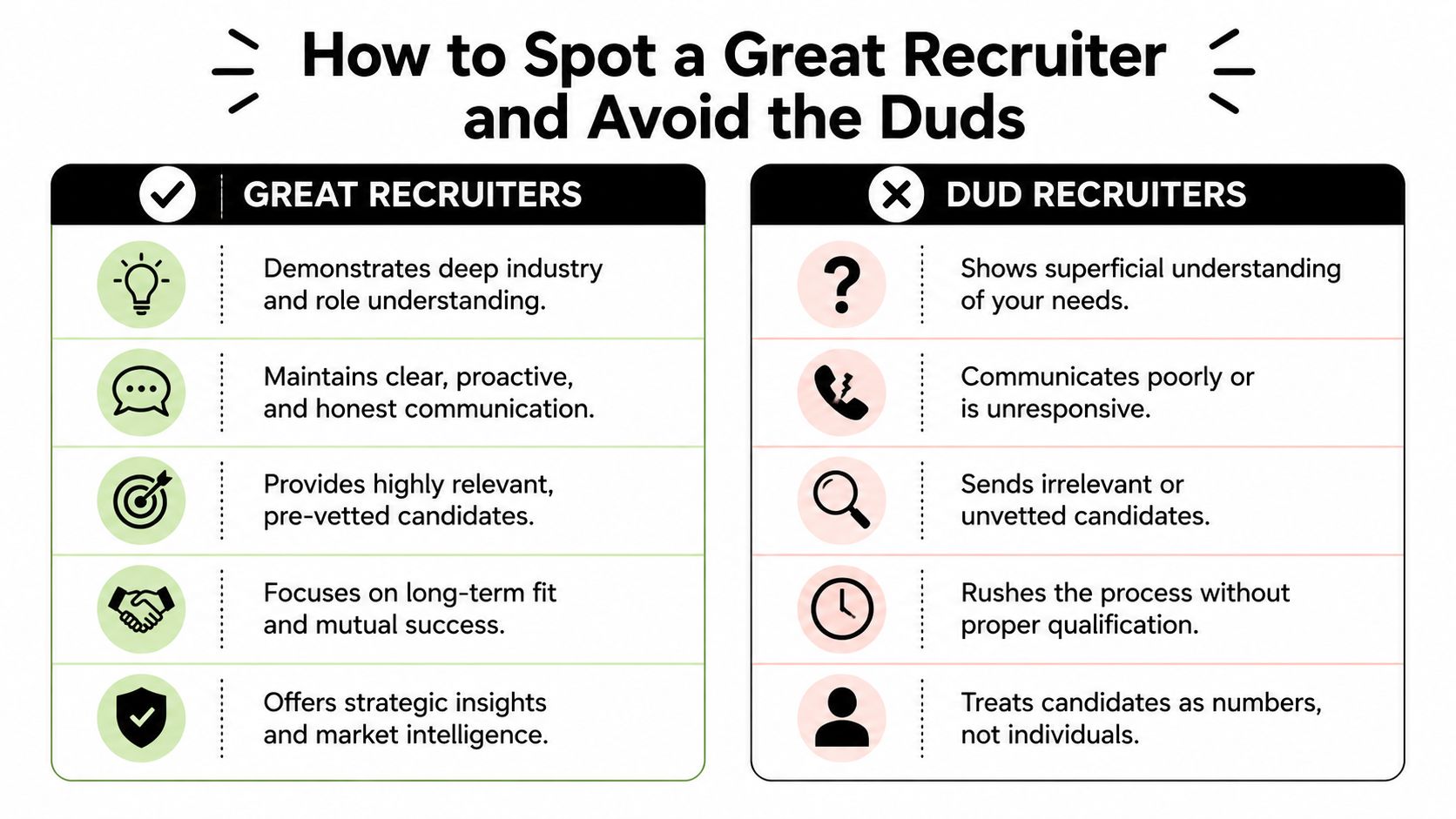
This is the question that sorts adults from amateurs:
“What evidence do you collect before you put a candidate in front of me?”
A great recruiter will talk about work samples, campaign breakdowns, tool fluency, strategic thinking, and why a candidate fits your context. A dud will say some version of, “They looked strong on paper.”
On paper is where bad hires go to look amazing.
Practical rule: If a recruiter cannot explain how they test for real ability before the interview, you are paying them to move screening work onto your calendar.
I like recruiters who push back. If they instantly agree with a messy job brief, a bloated requirement list, or a fantasy candidate profile, they're not partnering with you. They're managing you.
Look for these signs:
If you want a practical benchmark for evaluating recruiter credibility, reviewing strong client references and proof points helps you compare substance against sales patter.
Some warning signs are subtle. Others arrive wearing a clown horn.
Here are the big ones:
Ask these on the first call:
A recruiter who answers crisply is promising. A recruiter who answers like a brochure is trouble.
Not every hiring problem needs the same tool. Founders get burned when they treat recruiting like a universal appliance. It isn't.
Sometimes you need a retained search partner who can run a discreet, high-touch process for a leadership hire. Other times you need fast access to proven specialists without paying a premium for ceremony. That's where the recruiter versus marketplace decision gets real.
One more thing matters here: process quality. Only 26% of North American job seekers report having a great candidate experience. A clunky, opaque workflow can damage your reputation and shrink your future pipeline. If your hiring method creates friction, you're not just losing candidates. You're teaching them not to trust you.
I'd use a recruiter when the role has one or more of these traits:
That's what retained search is built for. It's expensive, slower, and sometimes worth every penny.
For specialist marketing roles, especially media buyers, paid social specialists, paid search managers, and channel-specific operators, the traditional recruiter model often feels bloated.
A modern talent marketplace is usually a better fit when you need:
| Hiring need | Better fit |
|---|---|
| Senior leadership and confidential search | Traditional retained recruiter |
| Specialized execution role with clear skill criteria | Talent marketplace |
| Flexible remote hiring across regions | Talent marketplace |
| Heavy strategic courtship | Traditional recruiter |
| Fast shortlist and lower process drag | Talent marketplace |
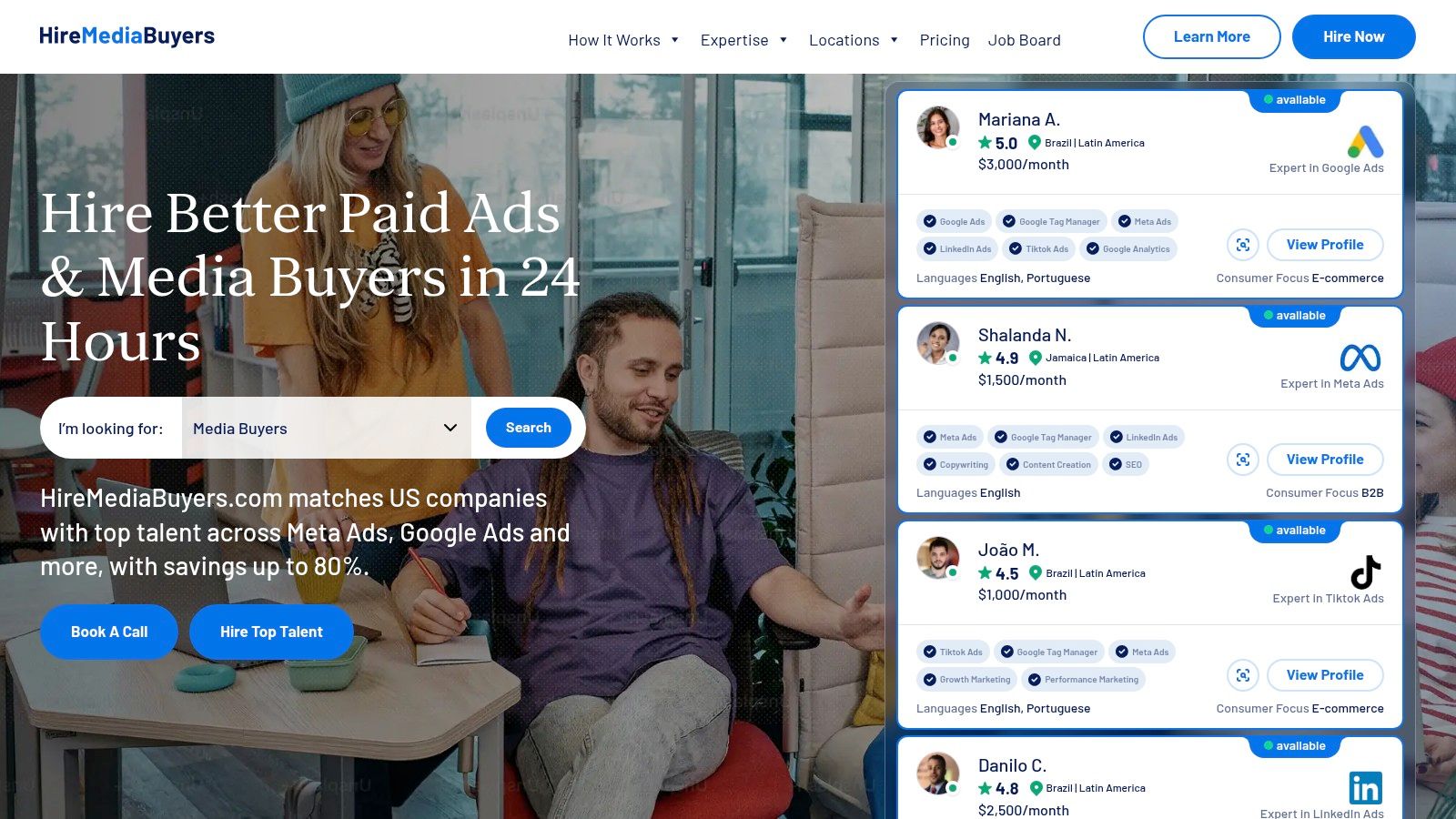
Why? Because marketplaces can remove the fluff. Instead of paying for endless sourcing theater, you get access to pre-vetted talent pools, transparent pricing, and a shorter path from need to interview.
For most execution-heavy marketing roles, the old recruiter model is too often an expensive wrapper around sourcing. You wait, you get mystery candidates, and you still end up doing the actual evaluation yourself.
A good marketplace flips that. The screening happens earlier. The economics are cleaner. The candidate experience is often better because the process is simpler and expectations are clearer.
That doesn't mean marketplaces replace recruiters across the board. It means you should stop using a scalpel to chop wood and stop using an axe to do surgery.
Use a recruiter when the role is strategic, sensitive, or politically complex.
Use a marketplace when the role is skill-specific, execution-focused, and better judged by demonstrated ability than by polished storytelling.
Most paid media hires fall squarely into the second bucket.
Hiring the recruiter isn't the finish line. It's the starting gun.
A lot of client-recruiter relationships fail for a boring reason. The kickoff is sloppy. The brief is vague, feedback is delayed, and everyone acts confused later as if chaos floated in through the air vents. It didn't. You invited it.
The cleanest way to avoid that is to treat recruiter onboarding like a mutual success plan.
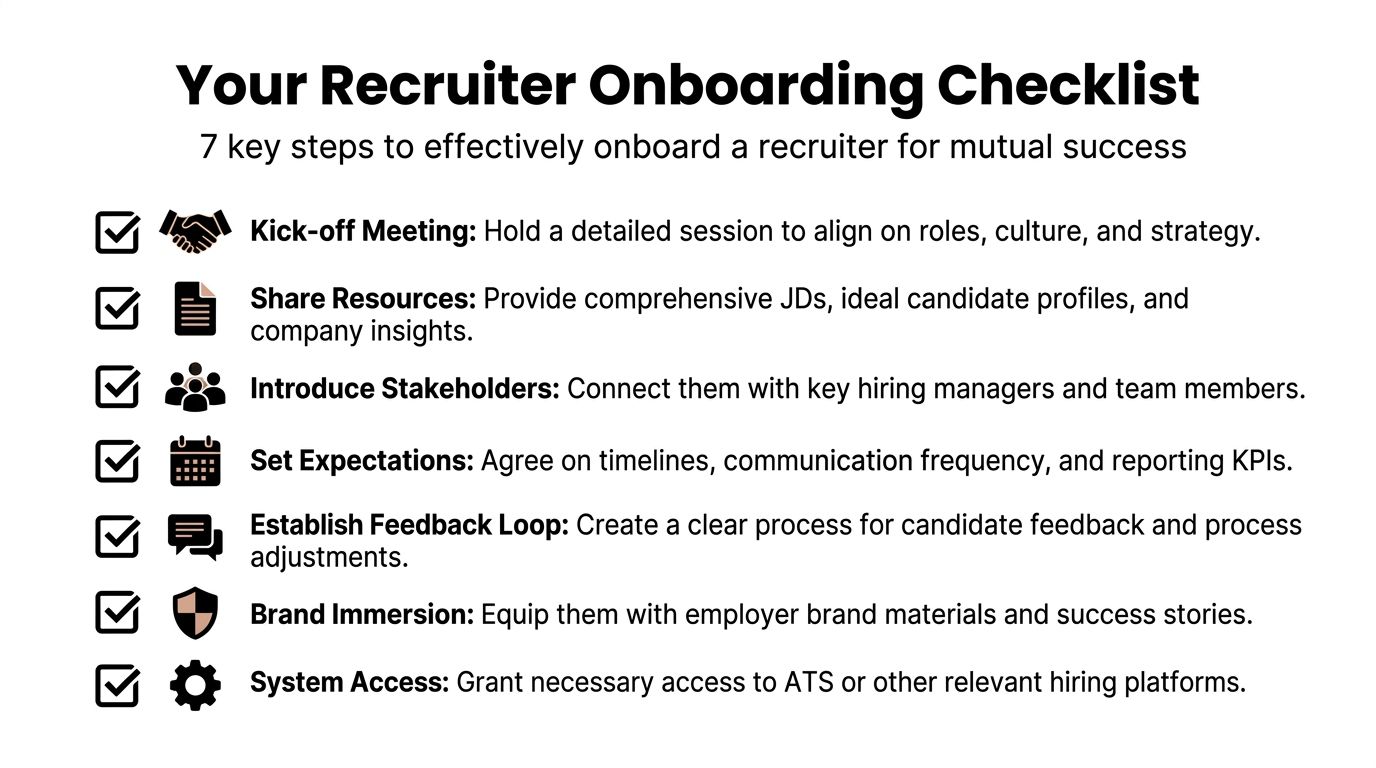
Don't send a job description and call it alignment. A job description is usually legal copy with bullet points stapled to a wish list.
Give your recruiter these instead:
The best recruiter relationships are boring in a good way. Everyone knows the cadence.
I'd recommend:
Good recruiters can adjust to hard feedback. They can't adjust to silence.
You need metrics, but not vanity metrics. “We sent lots of candidates” is not a result. It's activity dressed up as progress.
A composite quality-of-hire score, calculated with 50% weight on retention and 50% on performance, is the industry benchmark for success. That same guide notes that effective recruitment marketing should achieve interview-to-offer conversion rates above 30% and time-to-impact within 60 days.
That should shape your review process.
Don't outsource judgment.
A recruiter can improve sourcing, filtering, and process management. They cannot define excellence for your business unless you do the work first. If you're fuzzy, they'll be fuzzy on your behalf. Very efficient. Very expensive.
Hiring isn't admin work. It's strategy with payroll attached.
That's why picking among marketing job recruiters, retained firms, and talent marketplaces deserves the same level of thinking you'd give to channel mix, attribution, or budget planning. The tool has to fit the job. If it doesn't, you get noise, delay, and a fresh invoice.
My view is simple. Don't romanticize recruiters, and don't dismiss them either. Use them when the search needs discretion, courtship, and senior-level handling. Use a marketplace when the role is specialized, execution-heavy, and easier to judge through proof than polish.
And stop tolerating bad process. Slow feedback, vague briefs, résumé dumping, and candidate ghosting aren't normal. They're symptoms of a lazy hiring system.
If you want a clearer sense of what a faster, tighter process should look like, this hiring timeline overview is a useful gut check.
The companies that hire well don't hunt harder. They choose better filters, better partners, and better systems. That's the whole game.
If you need paid media talent without the usual recruiter fog machine, HireMediaBuyers.com is built for that job. It helps US companies find pre-vetted Media Buyers and Paid Ads Specialists quickly, with customized shortlists, transparent monthly pricing, flexible contracts, and support for full-time or part-time remote hiring. It's a practical option when you need real operators, not another stack of resumes wearing buzzwords.


