


You probably know the feeling.
You open Meta Ads Manager or Google Ads with coffee in hand, a tiny flicker of optimism in your chest, and by lunch you're staring at a dashboard full of clicks, impressions, and other decorative nonsense while revenue refuses to RSVP. The spend went out. The customers didn't come in. Congratulations, you've funded the internet's electric bill.
I've hired media buyers who looked brilliant in the pitch and then performed like a raccoon with a credit card. I've also hired killers who turned paid acquisition from a casino into a system. The difference wasn't the platform. It wasn't the ad account. It was the person, or company, doing the work.
Most advice about media buyer companies is too polite. This won't be. If you're about to trust someone with real budget, you need to know what kind of operator they are, how they think, and whether the person you meet is the person touching your account.
You don't need another article telling you to "test creatives" and "monitor performance closely." Yes, thanks, very useful. That's like telling someone with a house fire to consider using water.
The problem usually starts earlier. You hired the wrong kind of help. Maybe you signed with an agency that dazzled you on Zoom and then tucked your account behind three layers of account managers. Maybe you hired a freelancer who was excellent at sounding busy. Maybe your cousin's "Google guy" decided he'd also become your Meta strategist over the weekend.
This is why the decision about which media buyer company model you choose matters more than most founders realize. The media buying industry isn't some tiny specialist corner of marketing. The global media buying market hit $82.94 billion in 2024 and is projected to reach $97.55 billion by 2028, according to this GlobeNewswire market analysis.
That means one thing. You're not shopping for a side service. You're choosing who gets to steer a material part of your growth engine.
I've seen companies celebrate cheap clicks while sales quality cratered. I've seen teams brag about reach while customer acquisition got uglier every month. A pretty dashboard is easy to manufacture. Profitable customer acquisition is not.
Most ad accounts don't fail because nobody touched the buttons. They fail because the wrong person touched them for the wrong reasons.
The painful bit is that this doesn't feel dramatic at first. It feels like "we need more data" or "the platform needs time to learn." Sometimes that's true. Often it's camouflage for weak strategy, weak execution, or weak accountability.
Before you care about bid strategies, landing pages, or creative testing cadence, ask a simpler question. Who is responsible for outcomes? Not who sold you. Not who sends recap emails. Who is in the ad account, making decisions when performance goes sideways on a Tuesday afternoon?
If you get that wrong, the rest becomes theater.
If you think a media buyer just launches campaigns and tweaks budgets, you're paying surgeon rates for someone to hold a flashlight.
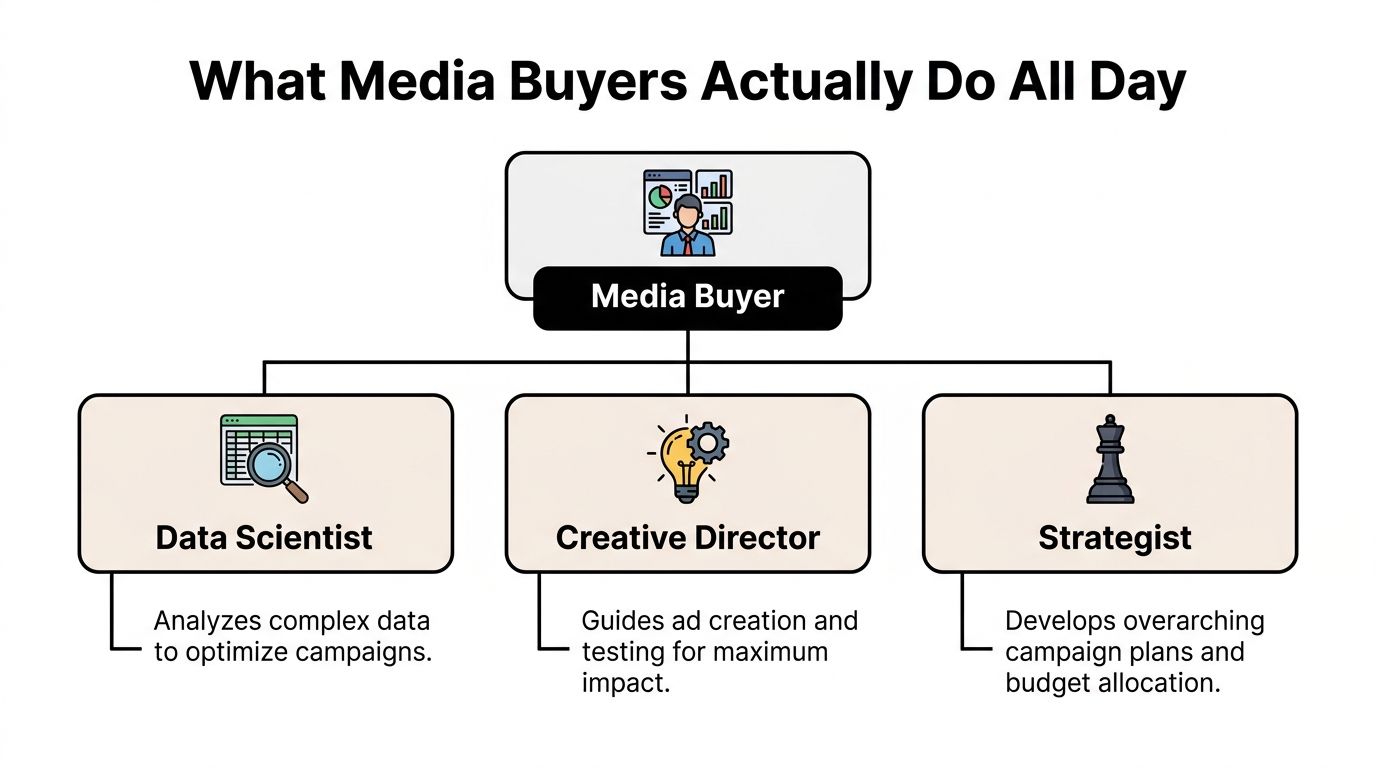
Good media buyers do three jobs at once. They read messy data, shape creative direction, and allocate budget like an investor who hates waste. They aren't "buying ads." They're managing an acquisition system.
Modern media buying runs on automation. Programmatic advertising accounts for over 65% of market share, and mobile captures nearly 70% of total ad spend, according to this market outlook on digital media buying. That means the job isn't to out-muscle the algorithm. It's to feed it better inputs than everyone else.
In practice, that means a serious buyer spends time on things like:
If you want a deeper look at the mechanics of digital media buying, start there. Just don't confuse platform access with competence. Plenty of people can click "publish." That's not the hard part.
Weak operators manage ads like a receptionist managing a calendar. They keep things moving. They answer questions. They don't challenge assumptions.
Strong operators treat your account like a machine with several failure points. They ask ugly questions. Why is conversion rate down after the click? Why is one audience absorbing spend with weak downstream quality? Why is creative refresh lagging? Why are you trusting platform metrics without validating business impact?
Practical rule: If your media buyer never pushes on offer, funnel, creative, or tracking, you don't have a strategist. You have a dashboard chaperone.
The day-to-day work isn't glamorous. It's repetitive, analytical, and occasionally annoying. That's exactly why it matters. The buyer who can keep doing the boring, disciplined work without drifting into superstition is the one worth keeping.
Not all media buyer companies are selling the same thing, even when the website copy sounds suspiciously similar. "Performance-driven." "Data-led." "Full-funnel." Sure. And every steakhouse says it has the best steak.
There are four common models. Each can work. Each can also go sideways fast.
| Model | Best For | Typical Cost | Biggest Risk |
|---|---|---|---|
| Full-service agency | Companies that want broad marketing support under one roof | Usually layered around retainers, spend-based fees, or both | You get sold by senior talent and serviced by someone else |
| Boutique specialist shop | Brands that need a narrower channel or vertical focus | Often more focused than large agencies, but still structured as agency pricing | Key-person dependency or limited bandwidth |
| Freelancer | Small teams that need flexibility and direct execution | Usually simpler and more direct than agency contracts | Inconsistency, limited coverage, and single-point failure |
| Vetted talent marketplace | Teams that want direct access to screened operators | Typically tied to the individual talent profile and hiring structure | Quality depends on how strong the marketplace vetting actually is |
If you're comparing service models, a media buying service overview can help you map what you're buying. Again, the point isn't labels. It's execution.
Big agencies can be useful if you need many functions coordinated at once. Creative, planning, reporting, ad ops, strategy. Fine. The machinery exists.
The catch is the outsourcing transparency gap. Data cited by InBeat's review of media buying agencies says 60% of clients report only having access to an account manager, not the actual media buyer, and brands working with buyers who have direct backend access see a 35% higher ROAS on average. That's not a small footnote. That's the plot.
You thought you hired the gray-haired expert from the pitch. In reality, you got a project manager relaying Slack messages to someone you've never met. That's not partnership. That's telephone.
A good boutique shop can be excellent. They usually have stronger specialization and less internal bloat. You often get closer to the person doing the work, which already solves half the problem.
But boutiques can still hide behind process. Ask who owns execution. Ask who logs into Meta or Google. Ask what happens when your main buyer goes on vacation, gets overloaded, or leaves. If the answer sounds mushy, it is.
I like freelancers when the scope is clear and the operator is senior. You get directness. You get speed. You often get better honesty because there are fewer layers and fewer people writing "just circling back."
You also get fragility. One person gets sick, disappears, or overbooks themselves and your acquisition engine starts wheezing. Great freelancers are fantastic. Average freelancers become your new management project.
The newer marketplace model is useful because it shifts the question from "Which agency brand do I trust?" to "Which actual operator do I trust?" That's a healthier frame.
If you can't identify the exact person responsible for execution, don't sign the contract.
That single rule would save a lot of founders from very expensive lessons.
A lot of hiring mistakes come from chasing the mythical paid ads unicorn. The person who's elite at Google, Meta, TikTok, LinkedIn, YouTube, creative strategy, landing pages, analytics, and making your CFO feel emotionally safe. Good luck with that.
Different channels reward different instincts. Hire for the wrong one and you'll get competent-looking failure.
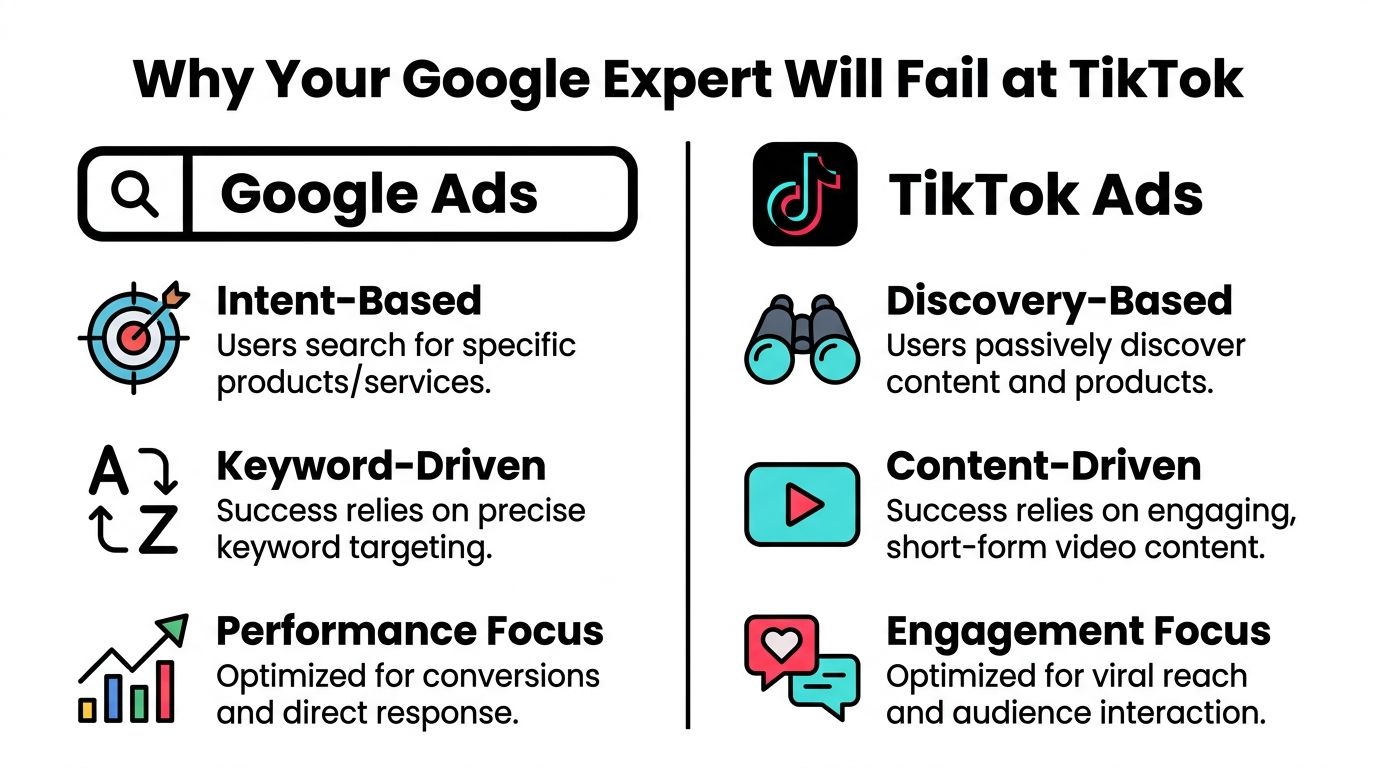
Google Search is built for capturing demand that already exists. Someone searches. You show up. The game is matching intent, structuring campaigns cleanly, controlling bids, and understanding which queries deserve budget.
This rewards buyers who think precisely. They like structure. They care about query quality, conversion paths, and disciplined account architecture. That's a different brain than a paid social creative operator.
TikTok doesn't care about your neat keyword map. It cares whether your creative earns a thumb-stop. This is a content environment first and an ad environment second.
A buyer who wins here understands hooks, native-looking video, creative testing velocity, and the strange art of making an ad feel less like an ad. If your Google specialist approaches TikTok like a spreadsheet exercise, your campaigns will feel like a tax form in a dance club.
Meta buyers sit in the middle. They need enough analytical discipline to manage scale and enough creative judgment to keep performance from stalling. They also need the humility to admit when the ad account isn't the problem and the offer is.
LinkedIn is another beast entirely. The traffic is pricier, the audience is narrower, and mistakes compound faster because there are fewer places to hide. B2B buyers who understand lead quality, sales cycles, and audience nuance can do well there. Everyone else tends to pay premium rates for politely underwhelming results.
Hire for the primary channel that matters most to your business. Don't hire a generalist and hope they shape-shift later.
That's the move. Not sexy. Very effective.
Let's talk fees, a subject on which media buyer companies suddenly become poets. The language gets soft. The scope gets fuzzy. The invoice does not.
There are three common pricing models. Percentage of ad spend, flat retainer, and some hybrid version where everybody nods seriously and hopes nobody asks too many questions.
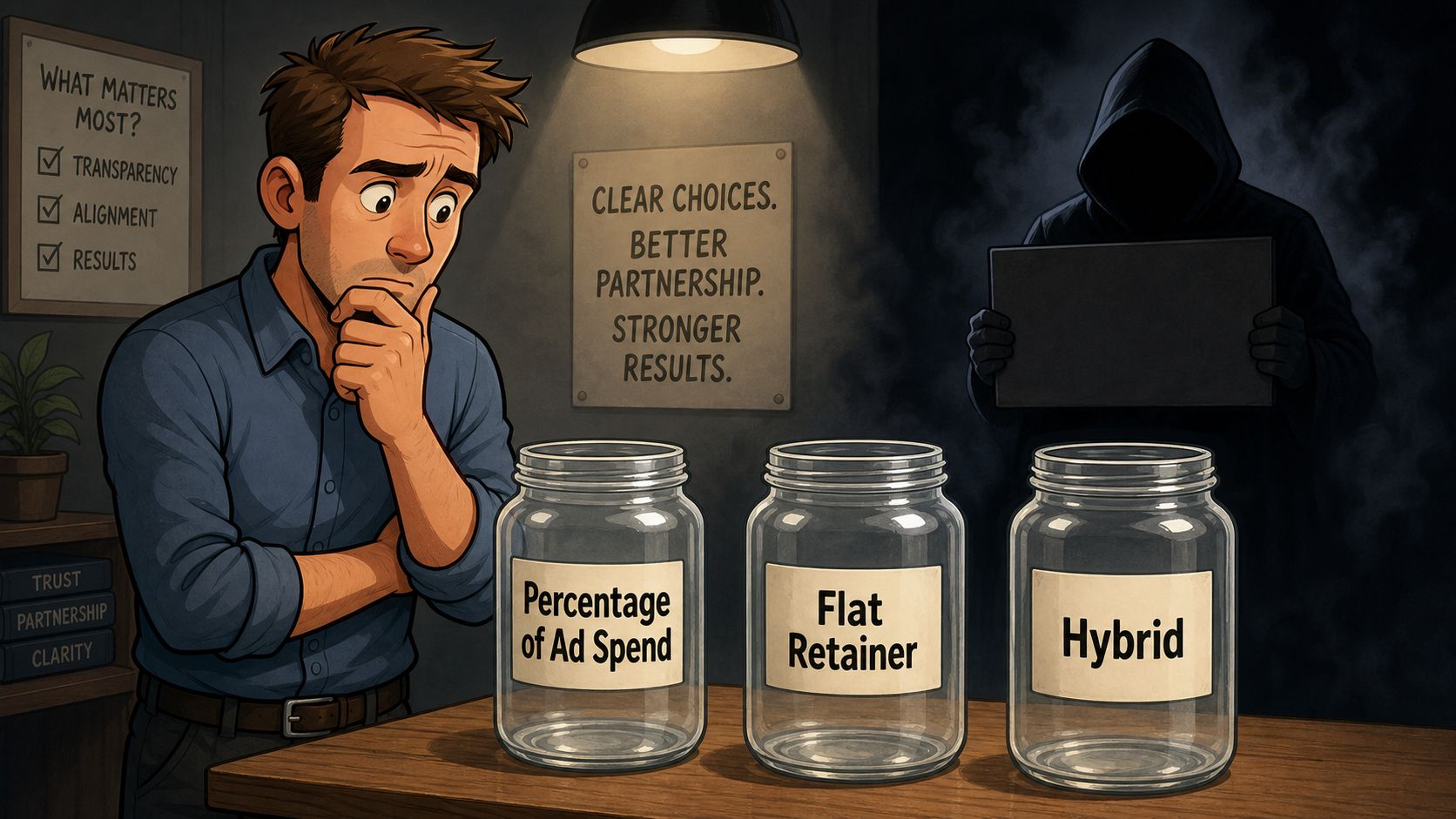
The smart move isn't picking a universally "best" model. It's forcing clarity. What exactly is included? Strategy? Ad ops? Trafficking? QA? Creative feedback? Reporting? If you don't define scope, you'll end up paying premium rates for a mystery box.
A useful sanity check from Financial Model Lab's media buying KPI breakdown is that high-performing firms should maintain a Billable Utilization Rate between 75 to 85%, and target CLV:CAC ratios of 3:1. You don't need to memorize the acronym soup. You do need to understand the core principle. Healthy economics require disciplined use of talent and disciplined acquisition efficiency.
Founders often get stuck in old thinking. They assume quality lives in a handful of US zip codes and nowhere else. That's expensive nostalgia.
According to Hire With Near's breakdown of media buyer hiring costs, a senior media buyer in New York can cost over $150,000 annually, while vetted talent in Latin America can cost $24,000 to $36,000, cutting costs by up to 80% without sacrificing quality.
That's not a tiny arbitrage. That's the difference between hiring one overpriced generalist and building actual bench strength.
If you're small, pay for direct access to a real operator and keep the agreement brutally clear. If you're larger, separate strategic ownership from platform execution so no one hides behind process.
Cheap media buying isn't cheap when it burns budget. Expensive media buying isn't smart when you're paying for office rent in Manhattan instead of skill.
You want aligned incentives, visible accountability, and enough flexibility to replace underperformance quickly.
Resumes are marketing documents. Certifications are nice decorations. Neither tells you whether someone can diagnose a sick account under pressure.
The best buyers think like mechanics and investigators. They don't start with "I'll raise budget here." They start with "What's broken, what's misread, and what's being falsely credited?"
The strongest advice on this topic is also the least glamorous. According to this breakdown of the detective-engineer framework for media buyers, the best buyers should diagnose a messy ad account by separating platform-reported results from actual business impact and auditing data quality before suggesting bid changes. That practical test filters out 90% of candidates.
That's exactly right.
Don't ask for a polished case study. Ask for a cold read on an imperfect account. Winning accounts hide bad thinking. Messy accounts expose it.
Use questions that force reasoning, not rehearsed talking points.
If they answer like a platform help center article, keep moving.
Here's the short version I wish more companies used:
Give them a live scenario
Use anonymized data from a real account. Ask for diagnosis, not magic tricks.
Verify direct platform fluency
They should be comfortable in the actual tools, not just fluent in presentation mode.
Listen for business language
The good ones talk about margin, lead quality, sales quality, customer value, and conversion bottlenecks. Not just CTR and CPM.
Look for process discipline
The serious operators mention data audits, creative refreshes, and landing page checks without being prompted.
Confirm who does the work
If you're hiring through a company, ask whether the interviewee is the actual executor or just the front-of-house act.
A buyer who jumps to bid changes before checking tracking, creative, and funnel friction is like a doctor prescribing surgery before taking your temperature.
A lot of candidates still over-index on platform-native reporting. That's dangerous. Strong buyers know that raw dashboard numbers can flatter bad decisions. They don't worship reported ROAS if lead quality, revenue quality, or downstream conversion says otherwise.
That's why I trust thinking process over portfolio screenshots every time.
Elite media buyers aren't hanging around job boards refreshing Indeed between campaign checks. The ones worth hiring are usually busy. They're managing meaningful budget, solving ugly problems, and getting pulled through private networks instead of public listings.
According to Elevarus on how to hire a media buyer, the top 1% of media buyers manage $100k to $1M+ in monthly ad spend and aren't found on job boards. Their core point is right. The only reliable vetting method is a practical test using a live ad account.
That leaves you with two choices. Spend months building your own sourcing machine, infiltrating niche communities, and running hands-on evaluations. Or use a curated path that already screens for actual capability.
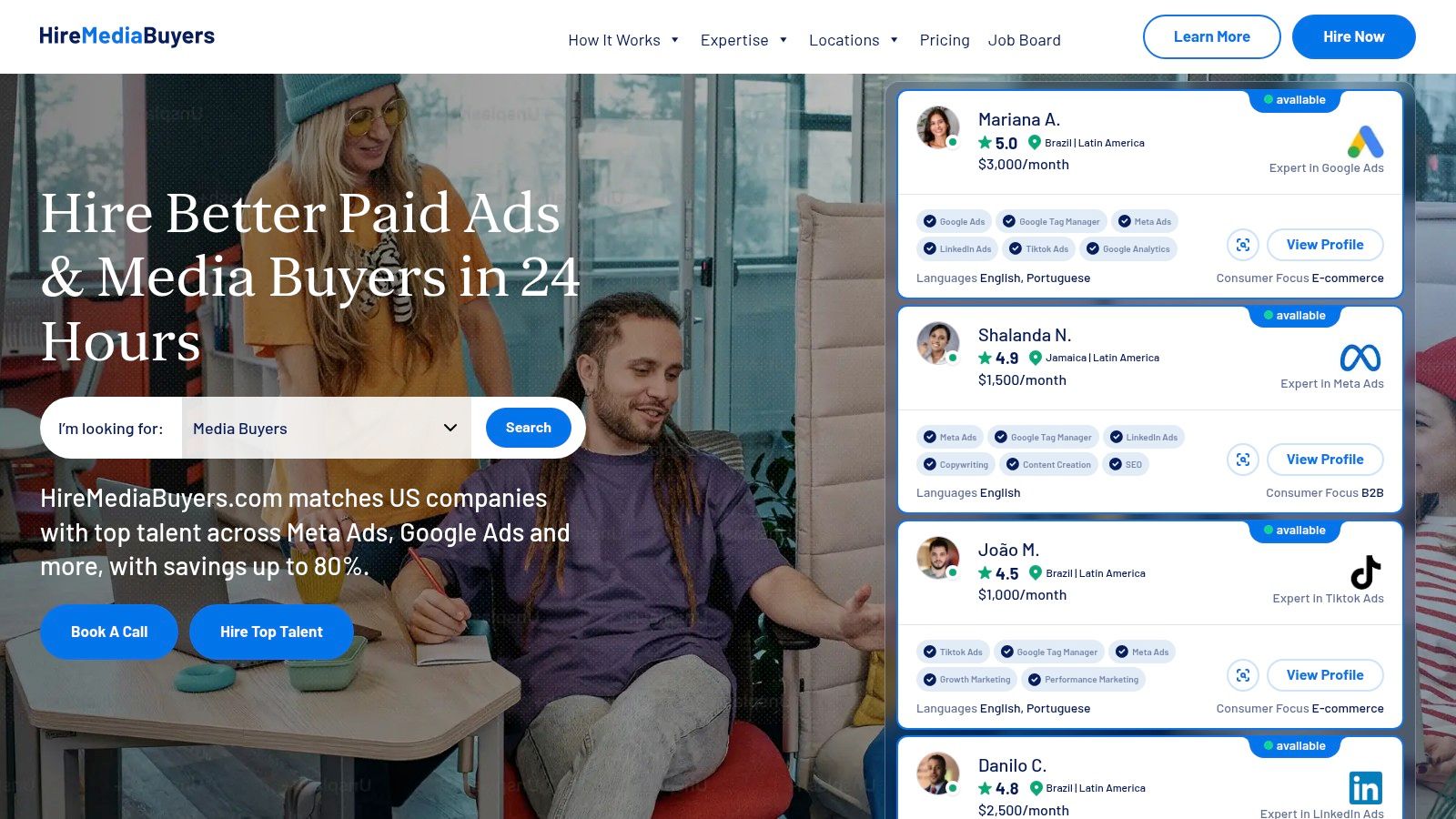
If you want speed, direct access, and less guesswork, a dedicated marketplace is the cleanest option. One example is HireMediaBuyers.com's hiring timeline, which shows how companies can move from request to shortlist quickly without pretending a PDF resume is enough evidence.
Toot, toot. Yes, that's a bit self-aware.
But the logic holds whether you use a marketplace, your own network, or a recruiter. Stop optimizing for polish. Start optimizing for who does the work, how they think, and how fast you can replace them if they don't deliver.
You've probably wasted enough money already.
If you want a simpler way to hire without playing resume roulette, take a look at HireMediaBuyers.com. It's a focused marketplace for vetted media buyers and paid ads specialists, with direct-access talent across channels like Meta, Google, LinkedIn, and TikTok. The useful part isn't the branding. It's that you can evaluate actual operators instead of buying an agency promise and hoping the right person shows up after the contract is signed.


