

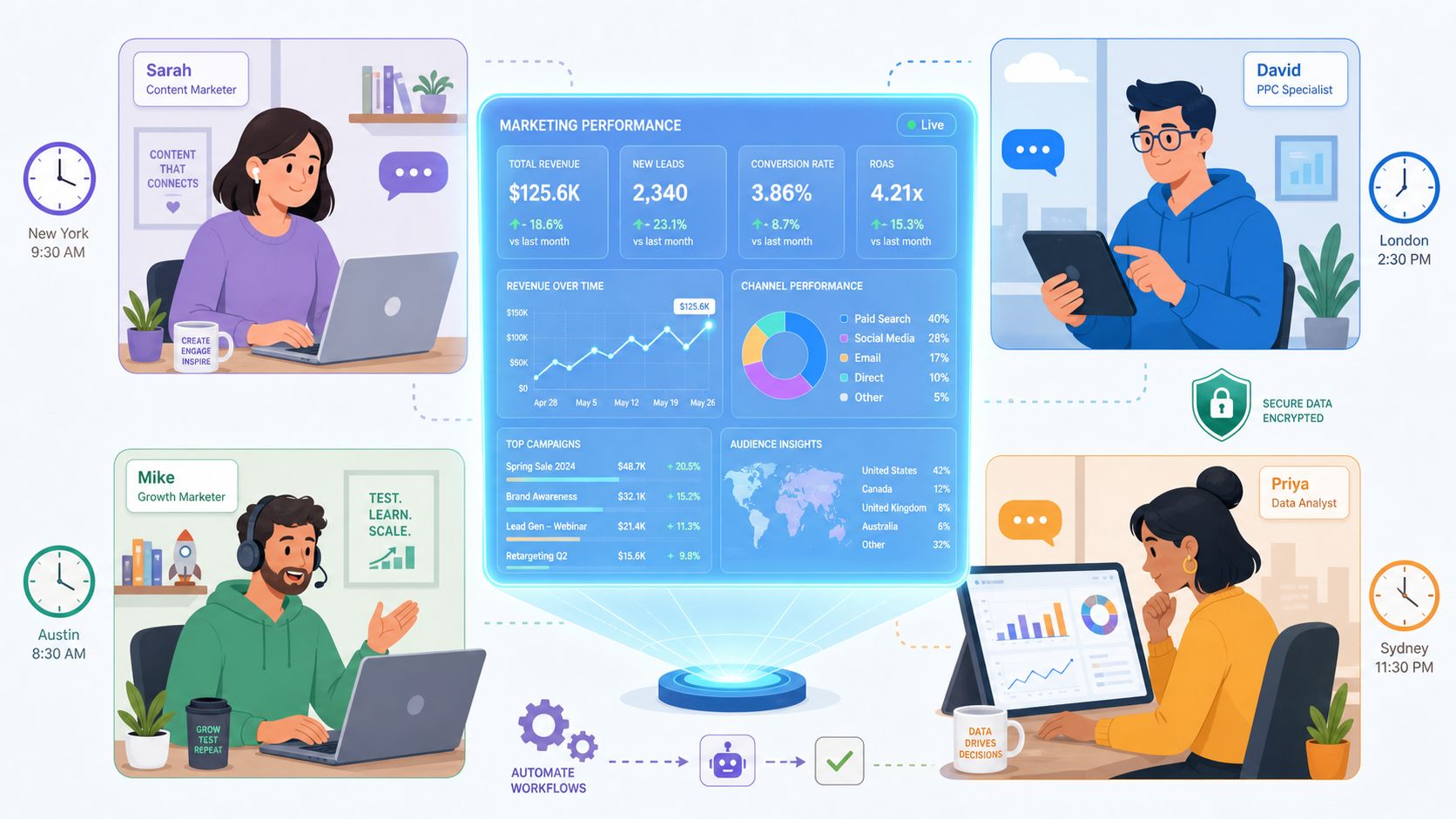
Your remote team is bleeding ROAS. You hired a remote media buyer hoping for a closer who could live in Ads Manager and print money. Instead, you got delayed updates, fuzzy reporting, and a Slack status that looks like it's on a permanent coffee break. The problem usually isn't remote work. It's your playbook.
Remote work isn't a side quest anymore. In the United States, about 22.8% of employees were working remotely at least part of the time as of March 2025, which is roughly 36 million people and a share that stayed in a narrow 21% to 23% range since early 2024, according to Worktime's remote work statistics. That means if your marketing team still runs like everyone's in one office, you're the one leaving money on the table. Let's get into the practices that keep remote media buyers sharp, accountable, and profitable.
A remote media buyer working from bed is not “flexible,” they're one barking dog away from a bad campaign decision. The fix starts with a dedicated space, even if it's only a desk shoved into a quiet corner with decent lighting and a chair that doesn't punish the spine. A real workspace tells the brain, “We're on,” and the rest of the apartment can stop freeloading on focus.
The point isn't to mortgage your office ping-pong table and build a Silicon Valley set piece. It's to create a clean line between campaign mode and home mode. For a buyer juggling launch calendars, creative reviews, and budget pacing, that line matters more than most founders want to admit.
Start with the basics, then stop shopping. A desk, a chair, a monitor if you can swing it, and enough light to read a dashboard without squinting like a cave troll. If there's no spare room, use a bookshelf or divider so the workspace feels separate.
Practical rule: If a candidate says they “mostly work from the couch,” ask them how they keep themselves organized during launch week. The answer tells you a lot.
Noise-canceling headphones are also a smart buy. They're cheaper than a soundproof room and a lot less dramatic than renovating your apartment because Meta decided to raise bids at 4 p.m. If you're hiring remote media buyers, ask about their setup before day one. You want people who can focus, not people who need a home makeover to open Google Ads.

If your remote team thinks availability means “answer messages every time your phone lights up,” you've already lost. The better move is core hours, the overlap window when everyone is online and reachable, while the rest of the day stays open for deep work. That's how you get coordination without turning your team into a hostage situation.
This matters even more for US marketing leaders managing media buyers across time zones. Hybrid work is now the dominant mode in many remote-capable roles, and the highest-adoption setup is split-week work, not full-time office cosplay, as summarized in SQA Magazine's remote work statistics. So stop acting like every update must happen live.
Put core hours in onboarding, contracts, and calendar settings. Don't tuck them into a vague doc nobody reads. If you work with buyers in Latin America, an overlap window with US client hours gives everyone breathing room without creating 24/7 Slack theater.
Use Slack Do Not Disturb, Calendly with time zone detection, and recorded walkthroughs so people aren't punished for living in another time zone. For launch reviews, creative approvals, and budget resets, schedule the meeting when the overlap exists. For everything else, async wins. That's not soft. That's sane.
Practical rule: If a meeting can be a Loom, make it a Loom. If a decision can be documented, document it. Save live time for the parts that actually need live brains.
Remote teams don't fail because they talk too little. They fail because they talk too loosely. A buyer says one thing in Slack, another thing in a call, and then six days later nobody can remember who approved the new creative test. Written communication fixes that mess by leaving a trail.
The best remote media buyers are usually obsessive note-takers. They know that campaign history, testing logic, and stakeholder decisions are assets, not admin fluff. In remote work, clarity beats charisma every single time. Toot, toot.
Slack is fine for quick updates. Use email or a document for anything that matters. That includes budget changes, creative approvals, and reporting summaries that your future self will need when a client suddenly develops amnesia.
Recurring templates help a lot here. Build a standard format for weekly campaign updates, launch briefs, and performance recaps so nobody has to reinvent the wheel every Monday like it's a creative writing exercise. If you want a useful benchmark for written operating habits, MIT Sloan Review's guidance on remote visibility and documentation is worth reading for the broader logic around staying visible without living in meetings, especially this piece on remote workers and visibility.
Weekly written standups are non-negotiable. A good one covers wins, blockers, next steps, and anything a client would be annoyed not to know.
For complex walkthroughs, record the screen. A Loom video often explains a new account structure faster than a 700-word Slack sermon. And if someone on your team keeps saying “I thought you meant the other campaign,” congratulations, you've discovered why written records exist.
Time zones are not an inconvenience. They're a constraint. Treating them like a minor nuisance is how teams end up scheduling every meeting at the expense of one person's sleep and another person's sanity. The fix is simple. Use tools that do the math, and stop making humans do calendar gymnastics.
Async-first communication is especially useful for distributed media buying teams because campaign work doesn't always need a live audience. Changes can be reviewed, approved, and executed with recorded briefings and documented instructions. A lot of remote team guidance now pushes toward documented workflows instead of meeting dependency, which is exactly the right instinct for cross-time-zone execution, as discussed in TrackingTime's remote work best practices.
Use scheduling tools that auto-convert time zones. Block focus hours and keep them sacred. If one person is always stuck with the ugly meeting slot, your “global team” is just a polite way of saying “the West Coast pays the tax.”
For actual operations, invest in a recording tool such as Loom, Slack clips, or Vidyard. Then use it. Creative QA, landing page feedback, pacing updates, and experiment recaps don't need to become a weekly live parade. They need to be clear, searchable, and easy to revisit.
A rotating meeting schedule helps too. Nobody should always own the 6 a.m. slot. That's how you lose goodwill before the quarter is even halfway done.
A lot of founders avoid 1-on-1s because they feel awkward. Fine. So does firing a bad hire. Still part of the job.
Remote work removes the hallway conversations where you'd normally catch a problem early. Weekly or biweekly one-on-ones replace that random office drift with a structured space for feedback, blockers, and career conversation. Gallup explicitly recommends one meaningful conversation per week with each direct report, tied to progress, obstacles, workload capacity, wellbeing, and development needs, and also pushes managers to define measurable goals and align priorities regularly, according to its guidance on managing remote workers.
Bring an agenda. Leave room for the other person to steer. Ask how they're feeling about the account, not whether they're “happy,” because that's a useless question unless you're running a kindergarten classroom.
Take notes. Follow up on action items. For remote media buyers, these calls should cover tool access, creative constraints, reporting pain, and whether they've got the support to do the job well. If someone is drowning in Slack pings and broken attribution, you want to hear it before performance review season.
Managing distributed teams only works when the manager manages. Fancy dashboards don't replace a conversation. They just make the problem prettier.
If you hire a remote media buyer without written expectations, you're not being flexible. You're being vague. And vague management is how good people get blamed for unclear priorities.
Define success before the work starts. That means the goal, the timeline, the reporting rhythm, the response-time rules, and the handful of metrics that matter. Gallup's advice to anchor management in measurable outcomes is the right model, because remote teams don't need more peeking over shoulders. They need clear finish lines.
Build a campaign brief template that includes goals, audience, budget, timeline, and success metrics. Then keep the list tight. Too many KPIs turn a buyer into a dashboard janitor.
A written brief also lowers friction. The more explicit the scope, the fewer arguments you'll have later about what “good” meant. If you're interviewing or hiring through skills-based hiring practices, you'll already know how much cleaner the process gets when output is defined in advance.
Simple rule: Slack during core hours, email within a day, and monthly performance reviews should be based on data, not vibes.
For compensation, tie bonuses to a small number of metrics, not ten. Too many levers create confusion, and confusion is where trust goes to die. The goal is to get everyone rowing in the same direction, not to create a spreadsheet so dense it needs its own zip code.
Remote culture is what people do when nobody's watching, and what leadership rewards when something goes well or badly. You can buy Slack, Notion, and Zoom and still end up with a team that feels like a row of disconnected freelancers yelling into the void.
For US marketing leaders managing remote media buyers, culture is the difference between a team that ships clean, learns fast, and stays accountable, and a team that hides behind updates and tools. The best remote setups make wins visible, treat mistakes like useful signal, and protect focus time without guilt. That is healthier than hustle theater, and it keeps good buyers around long enough to compound real skill.
Share campaign wins and lessons in a public channel each week. Build a “what didn't work” space where people can discuss misses without getting treated like they torched the server room. Teams learn faster when mistakes are handled as data, not drama.
That approach matters because remote work rises or falls on trust, clarity, and how well people stay connected without constant supervision, as noted in the remote work statistics summary from Worktime. Zapier's remote culture is famously documented and anti-hustle in tone, which is part of why it stands out.
Virtual employee engagement activities help too, but only when they support the bigger goal, which is a team that feels connected without being micromanaged. If your “culture” is just forced fun and too many GIFs, your media buyers will spot the gimmick fast.
Tool sprawl is a tax. Every extra app adds another login, another notification, another place to lose the brief, and another excuse for a buyer to spend twenty minutes hunting down the “final final” version of a doc. That's not productivity. That's administrative hopscotch.
The better approach is a small, integrated stack and a clear source of truth. One central map that says where briefs live, where budgets live, where reporting lives, and where the team goes when something breaks. Clean systems beat clever ones.
A solid default stack looks like Slack, Notion, Google Workspace, Calendly, and Monday.com. That's enough for most remote marketing teams to communicate, document, schedule, and track work without building a software shrine.
Use a source-of-truth doc during onboarding. Show the new buyer where campaign briefs live, where performance dashboards sit, and which channel is for urgent issues versus routine updates. Then do a quarterly audit and kill anything nobody has touched in months. That's how you keep the stack lean and the team moving.
Practical rule: The best tool is the one your team actually uses. The second-best tool is the one that doesn't make them curse under their breath.
Research-oriented workplace guidance on remote team management consistently points to technology and documentation as the backbone of remote execution, which is why deliberate tool choice beats app collecting every time, as reflected in SOTI's remote team management overview. Give people fewer places to look and they'll spend more time optimizing campaigns instead of rummaging through software like it's a lost coat closet.
Campaign optimization does not happen in the cracks between messages. It happens when a buyer can think, compare, test, and adjust without getting yanked into five different conversations. If your team gets interrupted every ten minutes, you're paying for motion, not progress.
Remote work gives you the chance to protect real focus. Use it. Leaders have to model this first, because if you're pinging everyone during their optimization block, you're basically announcing that deep work is a nice idea for other people.
A remote-work guide from the University of California, Santa Cruz recommends a structured day, including a clear start and end time, and practical habits like opening meetings a few minutes early, pausing for interaction, and sending an email recap after important discussions, all of which help keep work from bleeding into the rest of life, according to its remote work tips and best practices. The same logic applies to focus time. Block it, defend it, and stop pretending interruptions are harmless.
For media buyers, I'd go blunt. Three uninterrupted hours a day for optimization is not a luxury. It's the job. A structured focus rhythm like 25 minutes on, 5 minutes off, repeated several times, then a longer break, can help with the grind, and Indeed's remote worker guidance also recommends a genuine shutdown routine so work doesn't stalk your evening, as outlined here.
Set a team norm that urgent issues go through a defined path instead of random pings. Then use Do Not Disturb yourself. Leaders who say “protect your focus” while spamming people during lunch deserve the eye-roll they get.
Remote teams perform better when transparency is visible. Not the polite version. The actual numbers. That's why weekly reports, monthly reviews, and quarterly strategy sessions matter. They stop remote management from turning into a vibes contest.
Transparent dashboards make this easier because everyone can see what's moving in real time. That's not micromanagement. That's shared reality. If a buyer knows the numbers and knows how leadership reads them, trust goes up and nonsense goes down.
Keep the weekly report simple. Wins this week, blockers, next week's focus, metrics update. That's enough to keep momentum without turning reporting into a creative writing elective.
Your dashboard should show the metrics the team uses, like ROAS, CPC, conversion rate, spend, and impressions, all in one place. Then use monthly 1-on-1s to connect performance to context. Ask what the data says and how the buyer feels about it. Both matter, and pretending otherwise is how managers end up blind.
Practical rule: Quarterly business reviews should show strategic thinking, not just a pile of charts. A strong media buyer explains what happened, why it happened, and what they'd do next.
Structured feedback loops also make scaling less painful. A remote team that knows how work is judged can move faster because nobody is guessing in the dark. That's the difference between a team that gets bigger and a team that gets messier.
| Item | Implementation complexity | Resource requirements | Expected outcomes | Ideal use cases | Key advantages |
|---|---|---|---|---|---|
| Establish a Dedicated Workspace (Even If It's Just a Corner) | Low–Medium: basic setup and habit changes | Moderate: desk, chair, lighting, headphones | Improved focus, clearer work/home boundary, better video presence | Remote specialists, client-facing roles, focused campaign work | Better concentration; professional calls; reduced physical strain |
| Create and Enforce Core Hours (Not 'Always On') | Medium: policy design and consistent enforcement | Low: scheduling tools, team alignment | Predictable collaboration windows, reduced after-hours work | Distributed teams needing overlap and synchronous meetings | Improved work-life balance; coordinated availability |
| Over-Communicate in Writing (Your Future Self Will Thank You) | Low–Medium: habit/templating adoption | Low: docs, Slack, email, recording tools | Clear audit trail, less rework, scalable onboarding | Async teams, complex decisions, onboarding processes | Searchable records; legal/operational clarity; reuseable knowledge |
| Use Time-Zone-Aware Scheduling and Async Tools | Medium: tooling + workflow changes | Low–Moderate: scheduling apps, recording tools | Fewer synchronous meetings, global hiring enabled, less burnout | Truly global teams and geographically distributed projects | Respects time zones; reduces meeting fatigue |
| Implement Regular 1-on-1s (Even If They Feel Awkward) | Low–Medium: recurring calendar + manager discipline | Low: time, note-taking tools | Early detection of issues, improved morale and retention | People management, performance coaching, engagement focus | Builds relationships; proactive problem detection |
| Set Clear Expectations and KPIs Upfront | Medium: documentation and alignment work | Moderate: templates, reporting formats, onboarding | Fewer misunderstandings, data-driven performance discussions | Campaign-based work, contractor/agency relationships | Objective accountability; autonomy for contributors |
| Build a Remote-Friendly Culture (Not Just Remote Tools) | High: leadership modeling and sustained effort | Moderate: communication channels, rituals, training | Higher retention, trust, and team morale | Long-term remote-first organizations | Attracts talent; trust without surveillance; faster problem-solving |
| Use Tools Intentionally (Don't Let Tools Use You) | Medium: tool selection, documentation, audits | Moderate: core subscriptions, training time | Reduced context switching, faster onboarding, cost control | Teams with tool sprawl or onboarding challenges | Lower cognitive load; consistent data/workflows; cost savings |
| Protect Deep Work Time (Treat Interruptions Like Invasions) | Medium: scheduling norms and example-setting | Low: calendar blocks, DND workflows | Improved work quality, higher output, less burnout | Roles requiring concentrated optimization (e.g., media buyers) | Better campaign quality; more uninterrupted execution time |
| Create a Structured Feedback Loop (Data Over Gut Feel) | Medium–High: reporting cadence and dashboards | Moderate–High: dashboards, data pipelines, reporting templates | Objective measurement, faster scaling, transparent performance | Performance-driven teams, client reporting and optimization | Data-based decisions; early problem detection; measurable impact |
These remote work best practices are not theater. They're the operating system for marketing teams that need remote media buyers to perform like adults, not like freelancers waiting for a nudge. If you want better output, you need clearer workspace boundaries, better written communication, stronger async habits, tighter expectations, and a feedback loop that runs on data instead of managerial mood swings.
The most effective approach is hiring people who already work this way. That saves you from mortgaging your afternoons to debug every hire, every process, and every missed update. It also means you're not spending half your week teaching someone how to behave like a remote professional.
At HireMediaBuyers.com, you can find pre-vetted Media Buyers and Paid Ads Specialists who already know how to work remotely, communicate clearly, and keep campaigns moving. The marketplace is built for US teams that want faster hiring, cleaner execution, and less chaos, which is a fancy way of saying you get to stop fixing the process and start scaling the thing that matters.
If your remote media buyer setup feels more like controlled chaos than a growth engine, HireMediaBuyers.com can get you moving fast with vetted talent that already knows the remote game. You'll spend less time babysitting Slack and more time watching the numbers do what they're supposed to do.


