


White glove service is a premium, high-touch approach where the provider handles the entire delicate process end-to-end, from planning to execution to cleanup, so you don't get stuck babysitting the mess. In logistics, it started in North America in 1985 with fewer than 50,000 deliveries annually, and by 2023 it was reportedly moving over 150 million specialized shipments per year globally with premium installation and setup in 98% of contracts (market reporting on white glove services). That's not a cute buzzword. That's a service model that grew up because somebody had to stop fragile, expensive, high-stakes work from being treated like a cardboard box toss.
You're probably here because you're tired of doing the ugly middle yourself. Maybe it's hiring, maybe it's delivery, maybe it's onboarding a remote team, but the pattern's the same, standard service leaves you with the coordination debt and white glove service takes the whole headache off your plate.
You post a role for a senior media buyer, and suddenly you're swimming in resumes from people who “live and breathe performance.” Cute. Then comes the work: screening, technical interviews, reference checks, and the painful moment when you realize you've spent half a week sorting signal from noise while your campaigns keep burning budget.
That's the part no one likes admitting. The job isn't just hiring the person, it's managing the search, the filtering, the follow-up, the scheduling, and the inevitable “they're not a fit” rerun. Hope you enjoy spending your afternoons fact-checking resumes and running interviews, because that's now your full-time job.
White glove service is the antidote to that nonsense. It's the version where the hard parts are already handled, so you don't have to mortgage your office ping-pong table just to get a competent person in the seat. In hiring, that means someone else owns the sourcing, screening, and packaging of the shortlist before you ever waste a calendar slot.
If you want the ugly truth, this is why a lot of teams get interested in a hiring timeline that's built to remove the junk work. They don't want more process. They want fewer bad decisions, less delay, and a result they can trust without becoming part-time recruiters.
Practical rule: if your team's “simple hire” turns into a three-week scavenger hunt, you're already paying for complexity. You're just paying in salary waste instead of service fees.
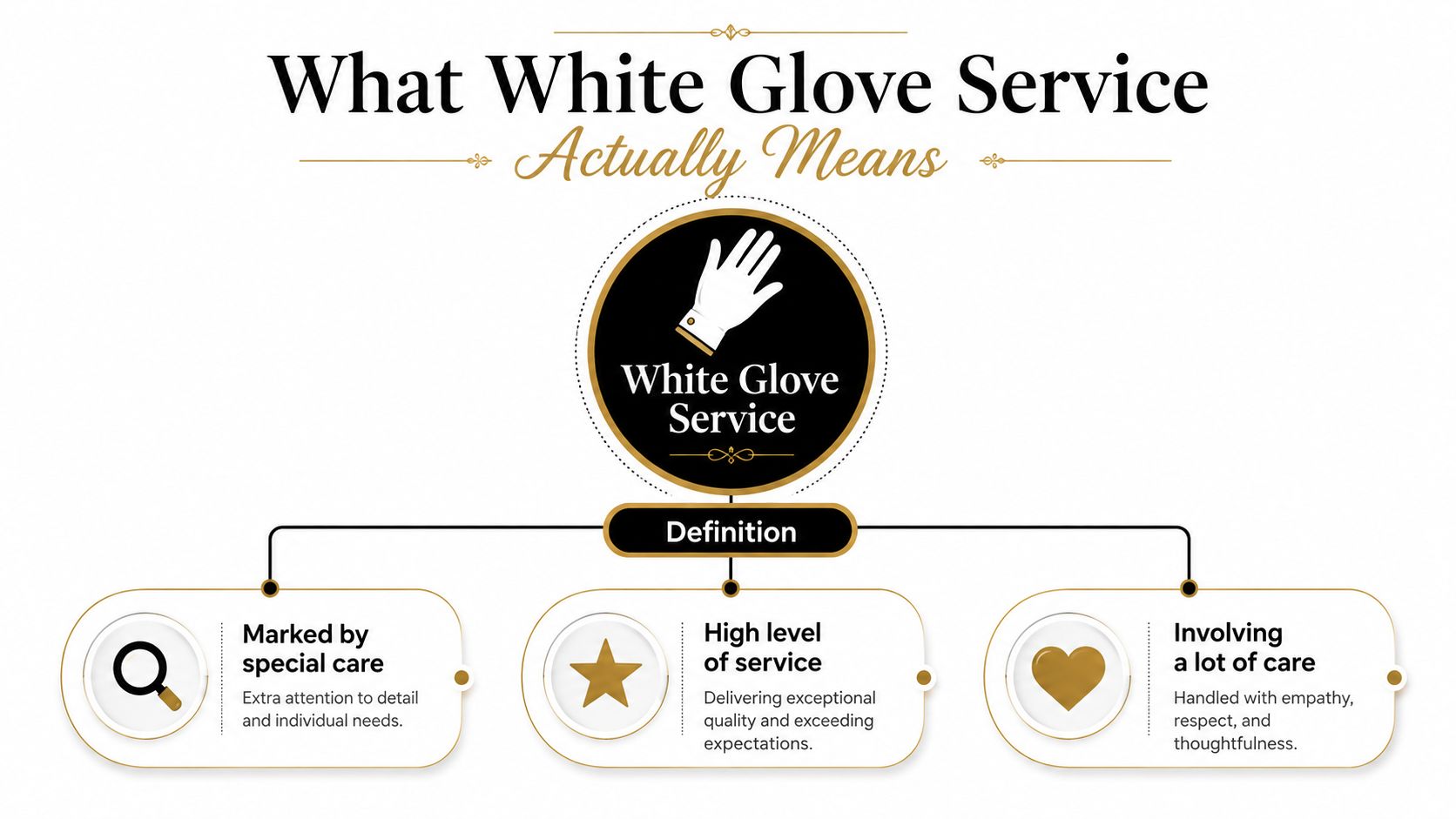
The phrase isn't mysterious. Merriam-Webster defines white glove as “marked by special care or attention”, and Cambridge defines it as “providing a very high level of service, or involving a lot of care about small details” (Merriam-Webster's definition). That's the whole ballgame, special care, high attention, and a refusal to treat detail as optional.
White glove service is not just “nice service” with a fancier invoice. It means the provider owns a delicate, complex, or high-stakes process from start to finish, and the client doesn't have to stitch it together. In logistics, that shows up as inside delivery, unpacking, assembly, installation, debris removal, and inspection (Ship Smart's breakdown). In IT, it looks like devices arriving preconfigured and ready to use, instead of dumping setup on the employee (IT onboarding example).
That's why the phrase matters. It's not code for expensive. It's code for precision. If the work needs fewer handoffs, fewer mistakes, and less client involvement, the white glove model makes sense.
People throw the term around like it just means “premium.” That's lazy. The actual definition points to care, control, and consistency, which is why it fits logistics, workplace operations, and high-touch support so neatly. The provider isn't just being polite, it's doing the annoying part well enough that the client doesn't need to hover.
White glove service is what you buy when the cost of mistakes is higher than the cost of competence.
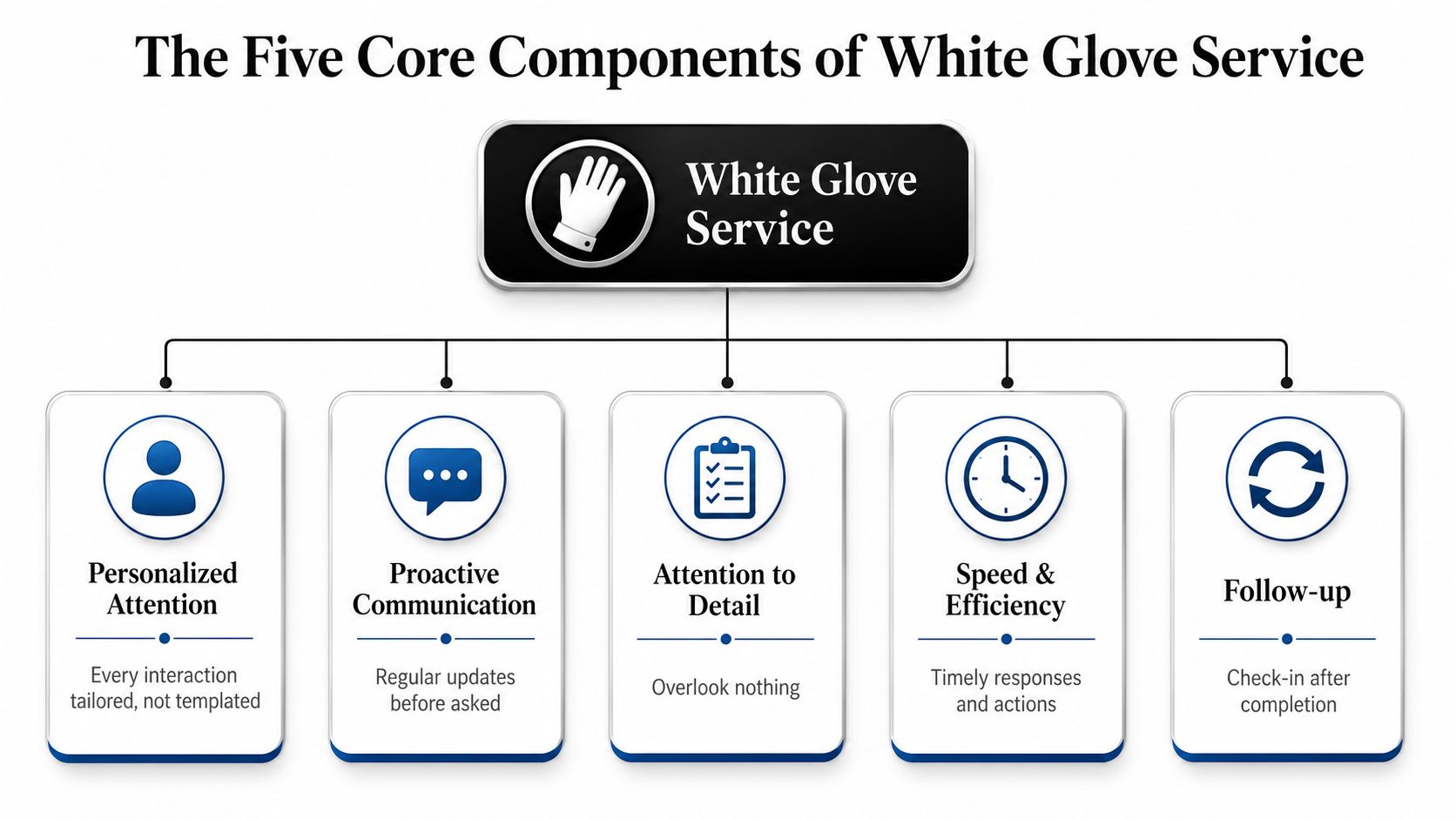
The label only matters if the work changes the customer experience in a real way. If the provider handles the job the same way a standard service does, the term is just decoration.
White glove service starts with tailoring, not templating. The provider should understand the customer's needs and constraints, then shape the process around them. In logistics, that can mean room-specific placement or careful handling instructions. In hiring, it means a shortlist built for the role, not a stack of profiles that are only close enough.
Good providers do not wait for clients to chase updates. They flag issues early, explain timing clearly, and keep each step visible. That matters because white glove work usually involves fragile handoffs, and each handoff creates a place where the process can slip.
This is the part people praise and then ignore. The details are the service. If the provider misses the setup, packaging, handoff, or qualification standard, the premium claim falls apart.
Fast does not mean sloppy. It means the provider has built a repeatable process that cuts delay without cutting corners. In white glove delivery, that may include inside delivery and setup instead of a second trip. In IT, it means devices arrive ready to use instead of piling into a ticket queue.
A real white glove provider does not disappear after the handoff. They confirm completion, handle cleanup, and check whether the result worked. That is the difference between finishing a task and owning the outcome.
A B2B SaaS company needs a senior Meta Ads manager yesterday. Standard self-service means the team posts the role, sorts through a pile of applicants, interviews a few decent-looking candidates, and hopes one of them can manage spend without setting it on fire. You know how that story ends, painfully and late.
With a white glove hiring model, the company gets a curated shortlist of pre-vetted media buyers and paid ads specialists, with a five-stage vetting process that includes AI-powered screening, in-depth interviews, skills assessments, and HR checks. HireMediaBuyers.com says it can help US companies find pre-vetted talent in as little as 24 hours (publisher details). That changes the job from “please become a recruiter by Tuesday” to “choose between people who've already been screened.”
In the self-service version, your team owns every ugly step, sourcing, scheduling, filtering, chasing, rejecting, and starting over when the first pick flakes. In the white glove version, the platform absorbs the operational overhead and hands you a smaller, cleaner decision. That's the whole point.
Short version: standard hiring gives you work. White glove hiring gives you a decision.
And yes, this applies far beyond hiring. The same pattern shows up in logistics and IT onboarding, the provider handles the messy middle so the client doesn't have to act like operations support. The service feels premium because the friction disappears, not because somebody used nicer language on the sales page.
Why outsourcing sometimes beats building in-house is the same basic question wrapped in a different costume, do you want to own the process, or do you want the outcome with less drag?
| Dimension | Standard Service | White Glove Service |
|---|---|---|
| Ownership | You coordinate the moving parts | The provider coordinates the moving parts |
| Client effort | Higher, because you manage the process | Lower, because the process is managed for you |
| Risk handling | You absorb more of the fallout | The provider is expected to control more of the fallout |
| Delivery style | Transactional and task-based | Relational and outcome-based |
| Quality control | You catch problems after they show up | Problems are supposed to be caught earlier |
| Best fit | Lower-stakes, commoditized work | Fragile, high-value, or high-consequence work |
Standard service is fine when the work is replaceable and the downside is small. White glove service makes sense when the process itself is part of the product, and sloppy handling creates real cost.
The mistake companies make is treating these as personality choices. They're not. They're operating models. One asks your team to manage the mess. The other is paid to prevent the mess from landing on your desk.
Here's the question nobody answers cleanly enough, when does the premium pay for itself? Most articles describe white glove service beautifully, then duck the actual decision. That's weak thinking, and it leaves buyers guessing when the math should be obvious.
The test comes down to three things, value, fragility, and operational bandwidth. If the item or hire is expensive to get wrong, white glove gets justified fast. If the process is delicate, the premium buys risk reduction. If your team is already overloaded, paying to remove the hassle is usually smarter than pretending you've got capacity you don't have.
Shipping medical equipment, fine art, or other high-value items is an easy call. Damage risk isn't an inconvenience there, it's a business problem. The same logic applies in hiring a senior media buyer who will control meaningful ad spend. One bad hire doesn't just waste salary, it can burn weeks of campaign momentum.
If the task is commoditized, low risk, and easy to replace, don't cosplay as a luxury buyer. Standard service is fine when the downside is small and the process doesn't need heavy coordination. You're not proving sophistication by overpaying for simplicity.
Buyer's rule of thumb: if you'd be annoyed by a mistake, use standard service. If you'd be hit by a mistake, use white glove.
The gap in coverage is real. Most articles define the term, but they don't give buyers a framework for choosing between service levels, and they don't quantify ROI or break-even points for the premium (the coverage gap is documented here). That's why decision-makers keep asking the same blunt question, and why the answer should stay blunt too.
A white glove label doesn't mean much if the provider can't prove it. Plenty of companies slap the words on a sales page and then hand you the same old friction with a ribbon on it. Don't buy the ribbon.
If you're looking at hiring support, ask whether the shortlist is carefully curated, how replacements work, and whether the provider handles HR, compliance, and setup or shoves that burden back on you. A real white glove operation should reduce your workload, not rename it.
A strong provider should make the process boring in the best way. You should know what's covered, what's not, what happens if the first fit misses, and how quickly the team responds when something changes. That's not luxury. That's accountability.
For companies hiring paid media talent, Client references that show real outcomes matter more than slick promises. If the provider can't show you evidence, they're asking you to pay a premium for faith, and that's not a serious operating decision.
White glove service is not a polished synonym for “good customer service.” It is a deliberate trade, you pay more to get tighter control, less operational drag, and fewer costly mistakes when a shipment, device, or hire cannot go wrong. In logistics, that means inside delivery, unpacking, assembly, installation, debris removal, and inspection handled as one controlled workflow. In IT, it means devices arrive ready to use instead of forcing the employee or internal team to burn time on setup.
The test is simple. Use white glove when the item is expensive, fragile, hard to replace, or expensive to fix if the handoff goes badly. Use standard service when the item is routine, replaceable, and not worth a premium layer of handling. If a mistake would create lost ad spend, damaged inventory, a delayed launch, or a mess that pulls your team off higher-value work, the premium is justified. If it would just add a nicer experience, you are probably buying a label.
That same logic applies to hiring support for paid media. HireMediaBuyers.com helps US companies find pre-vetted media buyers and paid ads specialists with white-glove support around sourcing and vetting. Visit HireMediaBuyers.com if you want a cleaner hiring process, a faster shortlist, and less time spent pretending recruitment is your core competency.


