


86% of B2B purchases stall mid-process, and 81% of buyers end up dissatisfied with their final pick. That's why speed of placement doesn't fix the core problem digital marketing staffing agencies are supposed to solve, signal quality does.
If you've hired in paid media before, you already know the pain. A fast hire who looks great on paper can still burn ad spend, wreck reporting hygiene, and leave you doing damage control while the agency invoices you for the privilege.
81% of buyers are dissatisfied with their final pick, which is a polite way of saying most hiring decisions are messier than the brochure makes them sound. In digital marketing, that mess gets expensive fast because the work is tied to revenue, not just headcount. When the wrong person runs your campaigns, you lose time, money, momentum, and credibility with the client sitting in the next meeting.
The economics are ugly enough already. In one 2026 benchmark, labor costs represented 55% to 65% of gross agency revenue, the median marketing strategist salary was $72,720, and fully loaded employment cost climbed to roughly $91,000 to $98,000 once benefits and overhead were included, according to Stealth Agents' 2026 agency staffing costs benchmark. That is not a rounding error. That is the kind of line item that decides whether your month feels healthy or like you are mortgaging the office ping-pong table.
Practical rule: if one bad hire can cost you both salary and client confidence, the core question isn't “Can we hire?” It's “Can we validate this person before they touch budget?”
Replacing a mid-level agency employee can cost $18,000 to $32,000 once recruiting, onboarding, and lost productivity are counted, as noted earlier in the same 2026 benchmark. That is why digital marketing staffing agencies exist in the first place. They are not a convenience layer. They are a risk-management layer for roles where the wrong hire is loud, visible, and expensive.
The staffing model also fits the way the labor market already works. U.S. staffing firms provided job and career opportunities for about 11 million employees in 2024, and about 3.0 million temporary and contract employees worked for staffing firms in a typical week, with the U.S. accounting for around 31% of global staffing-industry revenue, according to the American Staffing Association's industry statistics. In other words, flexible hiring is not a workaround anymore. It is standard operating procedure for a huge slice of the market.
Use a staffing agency when the problem is risk, not just headcount. If you need to fill a specialized gap, cover a short-term project, or test a new market before you commit to a permanent seat, the agency route gives you a faster way to see whether someone can do the work. That matters in digital marketing, where a polished resume can hide weak execution and a strong operator can show up without a perfect pedigree.
A hybrid model usually works best in messy, high-stakes situations. I've seen it work well when a team needed paid media coverage fast, but didn't want to lock in the wrong person after one decent interview. The agency sourced and screened the candidate, the internal team ran the work through real campaigns, and the company converted only after the person proved they could manage budgets, communicate clearly, and handle pressure. That approach beats hiring on confidence alone, and it fits the way the market already works, according to the same industry data cited earlier.
A direct hire makes more sense when you are building the core of the business and the role needs long-term ownership. If the position affects company culture, compensation philosophy, or the shape of the team for years, I want a direct process with full control over who gets in the door. The same applies when you need to define equity, title, and internal growth path without a third party making the first pass for you.
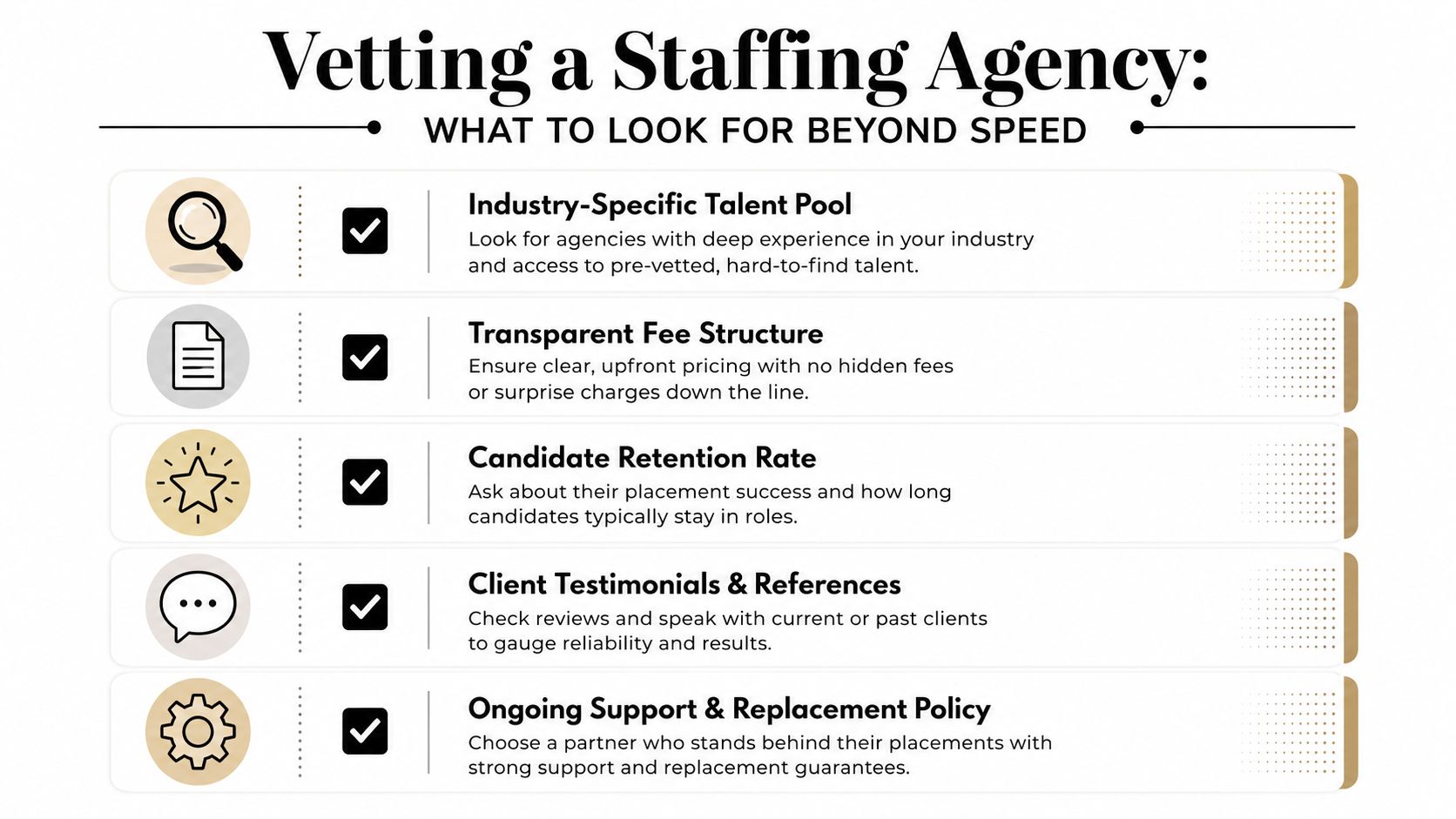
The question is not whether staffing is faster. The question is whether the agency can validate execution before the candidate reaches your team. Use client references that prove actual performance as part of that check, because fill speed means nothing if the hire cannot deliver once the work starts.
| Factor | Staffing Agency | Direct Hiring |
|---|---|---|
| Best use | Urgent, specialized, or temporary roles | Permanent core team roles |
| Risk | Lower upfront commitment, easier to replace | Higher if the hire misses |
| Control | Less control over sourcing and screening | More control over every step |
| Fit | Good for testing skills before conversion | Better for roles tied to culture and long-term ownership |
A staffing agency is the right call when you need proof of competence under pressure. Direct hiring is the right call when you are building the spine of the company and you can afford to be selective.
An agency can clear resumes fast and still send you people who freeze the moment the work starts. That is the mistake to avoid. I want to know whether the agency can spot real execution, because a polished CV is easy to fake and a strong campaign operator is not.
Ask for two-year retention data. Guidance in the brief says leading agencies typically hit 80%+ retention at 2 years, and anything below 70% is a red flag, according to Cloud Scope's evaluation framework. That tells you whether the agency understands the work or just moves resumes until someone gives in.
Ask how they screen for execution ability. Do they use real skills-based assessments, or do they rely on hope, vibes, and a slick LinkedIn profile? If the answer sounds like “we know talent when we see it,” keep walking.
Red flag: if an agency talks endlessly about talent pools but can't show how it verifies actual platform skill, you're not buying quality. You're buying optimism in a nice font.
You also want to know the interview-to-offer ratio, because it shows how selective the agency is before candidates reach your desk. The same applies to time-to-hire, client satisfaction, and replacement terms, all of which belong in the evaluation conversation from day one. The evaluation flow in Cloud Scope's guidance is straightforward, define the role, verify specialization, request performance metrics, assess technical screening, compare terms, check references, and negotiate SLAs and replacement guarantees.
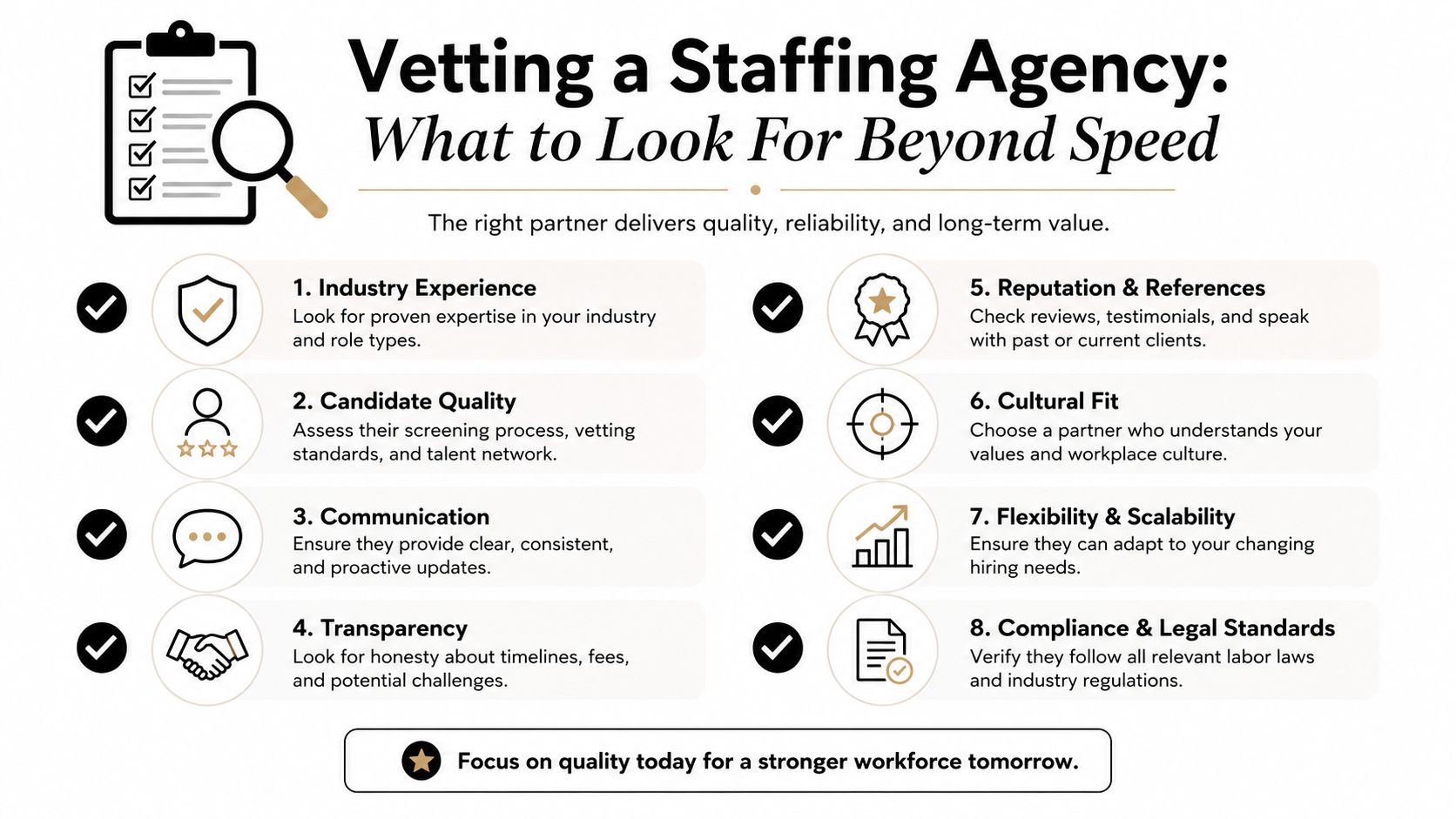
Use the reference call. Don't skip it because the deck looked polished. If you want a benchmark for what to ask past clients, the client references guide is the sort of practical checklist that keeps people from making expensive assumptions.
| Priority | Question | Red Flag |
|---|---|---|
| High | How do you screen for actual execution skill? | “We review resumes and interviews” with no test |
| High | What is your two-year retention rate? | They won't answer directly |
| Medium | Can you share client references in this niche? | No references, or only generic testimonials |
| Medium | What happens if the hire misses? | Vague replacement language |
| Medium | How do you handle technical screening? | No skills assessment at all |
A good staffing agency improves your decision quality. A bad one just makes the hiring process feel busy.
Most agency-submitted candidates can talk a good game. That's the problem. You don't need another person who can recite best practices while their hands hover uselessly over a campaign dashboard like a tourist in a server room.

Use three buckets. First, strategic thinking. Ask how they'd handle a stalled Meta Ads campaign, what they'd check first, and what signals would tell them the problem is creative, audience, tracking, or offer. Second, tactical execution. Have them walk through conversion tracking from scratch and explain where implementations usually go wrong. Third, creative judgment. Show two ads and ask why one performs better, then make them defend the answer with evidence, not adjectives.
That line of questioning matters because skills-based hiring is increasingly treated as a better predictor of performance than pedigree or job history, especially in roles where execution quality is harder to infer from credentials alone, as noted in Arc.dev's employer guidance. You're looking for pattern recognition, not a polished résumé recital.
A few exercises work better than generic aptitude games:
If they can explain what they'd do and why, good. If they lean hard on tool names and platform jargon but can't defend tradeoffs, that's a miss. Same if they sound smart but can't connect the work to business results.
Don't hire the candidate who sounds like a dashboard. Hire the one who can read the dashboard and make a decision.
For teams that want a more formal stance on this, skills-based hiring is the right mindset. It keeps you from mistaking polish for competence, which is a mistake every agency founder eventually pays for.
A lot of buyers get lazy. They compare headline rates, nod politely, and then act shocked when the cheap option turns into fees, weak screening, and a stack of excuses. That is not a bargain. That is bad procurement.
Staffing agencies usually charge hourly or monthly rates, percentage-based placement fees, or retainers. The U.S. employment and recruiting agencies industry is estimated at $34.0 billion in 2026, according to IBISWorld, so the market is crowded with sellers who can talk fast. That does not mean they can place people who perform.
Transparent monthly rates are easier to budget against because you can see what you are paying for each month. Percentage-based fees make more sense when the role is permanent and the agency is running the search from start to finish. Retainers fit hard-to-fill, high-stakes, or highly specialized roles, where the agency should be spending real time on screening, not just blasting résumés.
Here's the comparison most buyers should have in front of them before they sign anything:
| Model | First-Year Cost Range | Best For |
|---|---|---|
| Hourly or monthly | Varies by scope and tenure | Flexible, ongoing support |
| Percentage-based fee | Tied to salary | Permanent placement |
| Retained search | Premium search structure | Hard-to-fill or strategic roles |
Do not compare a staffing quote only against base salary. Compare it against the full cost of a bad hire, the recruiting time you avoid, and the replacement risk you are buying down. A cheaper rate that leads to another search, more manager hours, and a reset on onboarding is not cheaper. It is a slow leak.
Ask for a replacement guarantee of at least 90 days, ideally 180. Push for SLA language around response times and quality thresholds, not just “we'll send candidates fast.” Clarify termination terms, IP ownership, and whether HR and payroll support are included. If they want flexibility from you, they should offer flexibility back.
Use the cancel-anytime policy page as the standard for plain-English off-ramp language. If an agency refuses to spell out cancellation, they are asking you to trust them without giving you control. I would not sign that.
Negotiation rule: the cheaper deal is only cheaper if it does not create extra management work, payroll confusion, or a replacement headache three weeks later.
A staffing partner should reduce friction, not create a new bureaucratic hobby for your team. If they cannot explain the money, the terms, and the exit path clearly, the quote is already too expensive.
Getting the person is only half the job. The other half is making sure they don't arrive, stare at your stack, and wonder whether they've joined a company or a group project that escaped supervision.
Start with access and ownership. Campaign accounts, analytics permissions, creative files, naming conventions, and reporting dashboards should all be mapped before day one. If the hire came through an agency, make sure the handoff from the agency's process to your internal process is clean, because every ambiguous workflow becomes a drag on momentum.
In the first 30 days, focus on environment and context. They need to understand the brand, the offer, the reporting cadence, and who approves what. They should also know where historical performance lives, because a marketer without prior context tends to reinvent the wheel and call it strategy.
In days 31 to 60, shift into ownership of smaller campaigns or slices of the account. Let them run work with supervision, then review their decisions against your standards. If they're strong, the goal is confidence. If they're shaky, the goal is early correction, not late disappointment.
By day 61 to 90, they should be driving core execution with fewer check-ins. That's when you decide whether the arrangement stays agency-managed, moves to direct employment, or gets re-scoped. Transition decisions should be based on productivity, communication, and fit, not on sunk cost or awkwardness.
Cultural onboarding matters too. People stay when they understand how decisions get made and what good looks like on your team. If your internal culture is opaque, no staffing agency can save you from yourself.
The cleanest setups are the ones where the agency hire has a defined transfer point, a clear manager, and measurable milestones. Anything else turns onboarding into a slow-motion improv show, and nobody asked for that.
Don't measure success by how quickly a seat was filled. That's a vanity metric dressed like progress. Measure whether the person is still doing good work after the novelty wears off.
Two-year retention is the gold standard, and the earlier guidance says leading agencies typically reach 80%+ retention at 2 years. If your agency partner can't stay near that level, the screening process probably isn't strong enough. That doesn't mean every miss is fatal. It does mean the pattern matters.
The other numbers that deserve attention are candidate quality as rated by hiring managers, cost-per-hire versus direct hiring, ramp-to-productivity, and interview-to-hire ratio. Those are the metrics that tell you whether the agency is improving your hiring outcomes or just filling your inbox with activity.
The broader lesson is simple. A staffing agency should function like any other vendor relationship, with periodic review and a willingness to switch if the value isn't there. Quarterly check-ins are enough to catch drift. Annual contract reviews keep inertia from turning into a hostage situation.
If the agency is helping you make better decisions, keep them. If they're just making the process feel busy, move on. There are too many capable options in the market to stay loyal to a bad fit out of politeness.
HireMediaBuyers.com helps US companies find pre-vetted media buyers and paid ads specialists, which makes it relevant when you need digital marketing staffing support without running a full search from scratch. If you're trying to fill paid media roles faster and with better signal, visit HireMediaBuyers.com and see how the marketplace is structured for that kind of hiring.


