

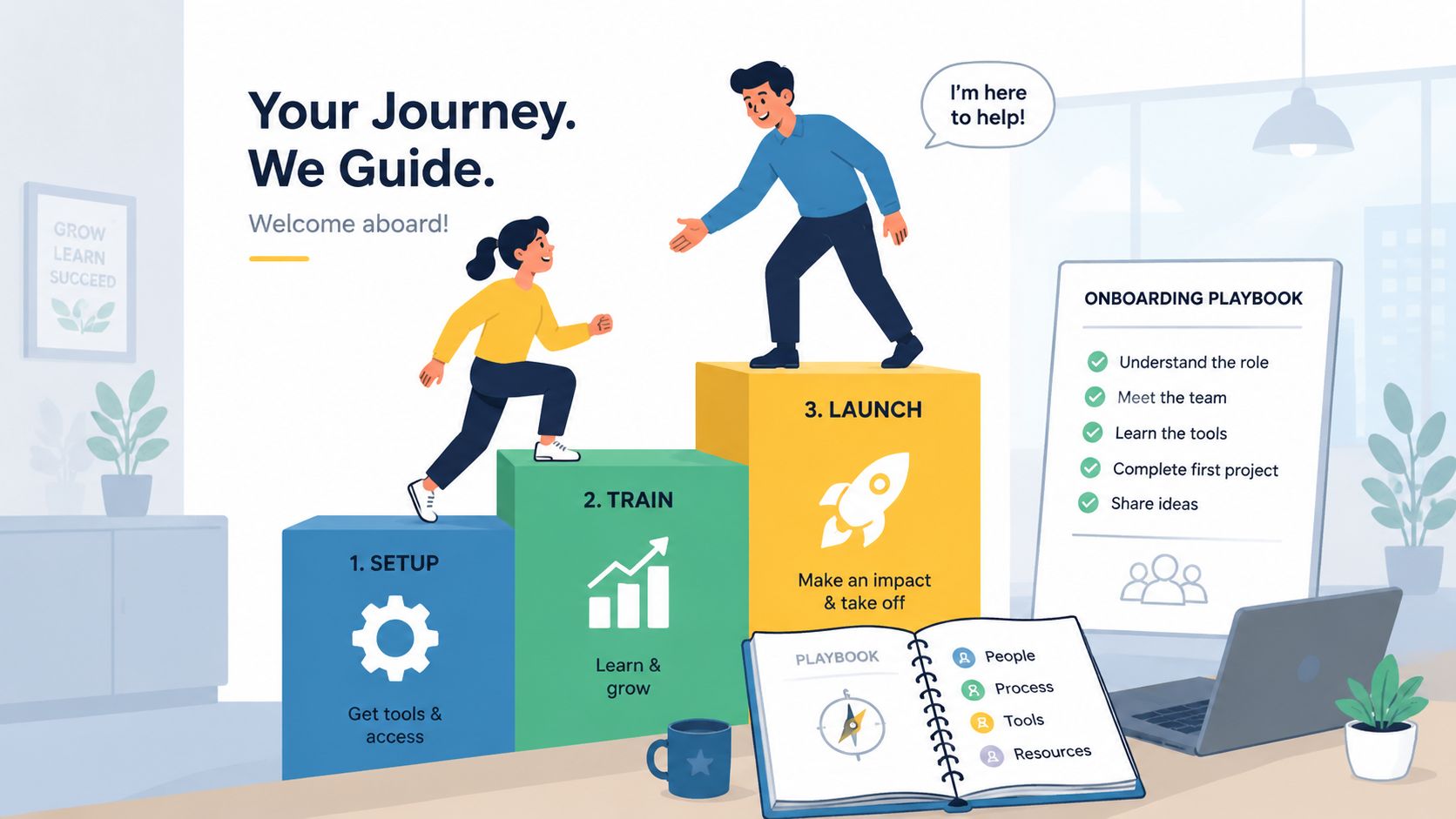
Most advice about training for new hires starts in the wrong place. It tells you to send a welcome email, assign an onboarding buddy, and point people toward the company wiki. Useful? Sure. Sufficient? Not remotely.
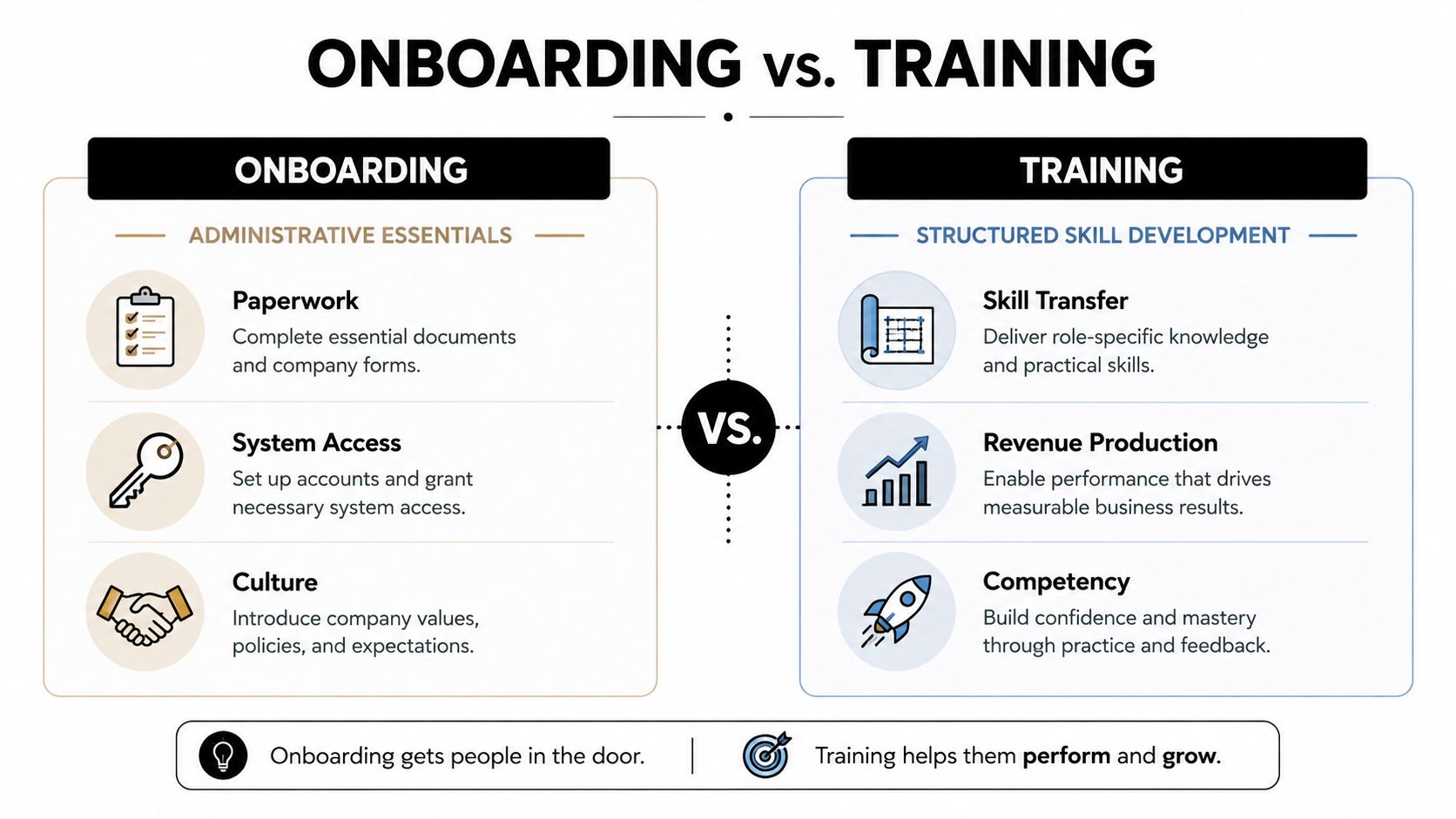
Onboarding gets someone into the building, the Slack workspace, and the payroll system. Training gets someone competent enough to produce valuable work. If you run an agency or manage paid acquisition, that difference shows up quickly in campaign quality, client confidence, senior-buyer workload, and revenue.
I've hired and ramped paid-media specialists long enough to see the same mistake repeat: a new buyer spends a month absorbing information, then touches a live account without knowing how the team thinks. That isn't a ramp. It's a very polished way to create expensive supervision.
The popular assumption is that onboarding and training are interchangeable. They aren't.
Onboarding covers paperwork, system access, policies, and culture. Training transfers the skills a person needs to perform a role. A new Meta buyer can finish every compliance module, meet the team, and still be unable to explain why CPA drifted or which campaign should receive the next budget adjustment.
The early window matters. 86% of new hires decide how long they'll stay with a company during the first six months, while 65% receive on-the-job training as part of onboarding, according to AIHR's employee onboarding statistics. Yet independent industry summaries report that only 29% of new hires feel fully prepared after onboarding, which points to a readiness problem, not an email problem.
Most weak programs fail in predictable ways:
That's how a media buyer reaches day 30 still unsure whether the agency names campaigns by audience, offer, funnel stage, or some mysterious convention invented by a former employee in 2018.
A practical training system starts before day one, establishes a baseline, and turns learning into increasingly valuable outputs. Use the same discipline in skills-based hiring for paid-media roles so the training plan matches the person you hired.
Manager rule: If the new hire can't show you a piece of work, they haven't demonstrated the skill yet.
The fix is a staged capability ramp. Preboarding removes friction. The first week creates momentum. The next month builds role-specific competence. The following two months transfer ownership under review. That structure keeps HR involved without asking HR to teach auction dynamics, attribution, or account diagnosis.
Training looks like overhead when you isolate the first week. It looks like operational insurance when you examine the first year.
New hires commonly take 8 to 12 months to reach proficiency comparable to tenured coworkers, according to Enboarder's onboarding benchmark summary. The same source reports that organizations with standard onboarding can improve new-hire productivity by 54% and help employees reach full proficiency 34% faster than those with the shortest programs, a difference of about four months. Training an employee averages about $1,678, while lost productivity during new-hire learning curves has been estimated at 1% to 2.5% of total business revenue.
That's not abstract HR language. In a paid-media agency, a slow ramp means senior buyers spend their time checking budgets, rebuilding broken structures, correcting reports, and rewriting client recommendations. The junior may be on payroll, but the senior is still doing the job.
The retention side is just as direct. SHRM-published material cites research showing that structured onboarding improves new-hire retention by 82%, and employees with great onboarding are 69% more likely to stay at least three years, as summarized by Compeo's onboarding best-practices overview. Those figures don't replace judgment, but they make one point hard to ignore: structure is cheaper than repeated failure.
| Metric | No Formal Training | Structured Training |
|---|---|---|
| Ramp experience | Shadowing and scattered instructions | Sequenced learning with deliverable gates |
| Senior-buyer time | Rework, rescue, and constant review | Planned coaching tied to defined outputs |
| Account exposure | New hire touches live work before readiness is clear | Access expands as competencies are demonstrated |
| Retention risk | Confusion and weak early confidence | Clear expectations and regular feedback |
| Business effect | Cheap-looking first week, expensive quarter | Deliberate investment in speed and reliability |
A short program can also be a false economy. Agency staffing solutions work best when the staffing decision and the ramp plan are designed together. Hiring someone with experience doesn't eliminate training. It only changes the starting line.
The first week should remove uncertainty, not manufacture it.
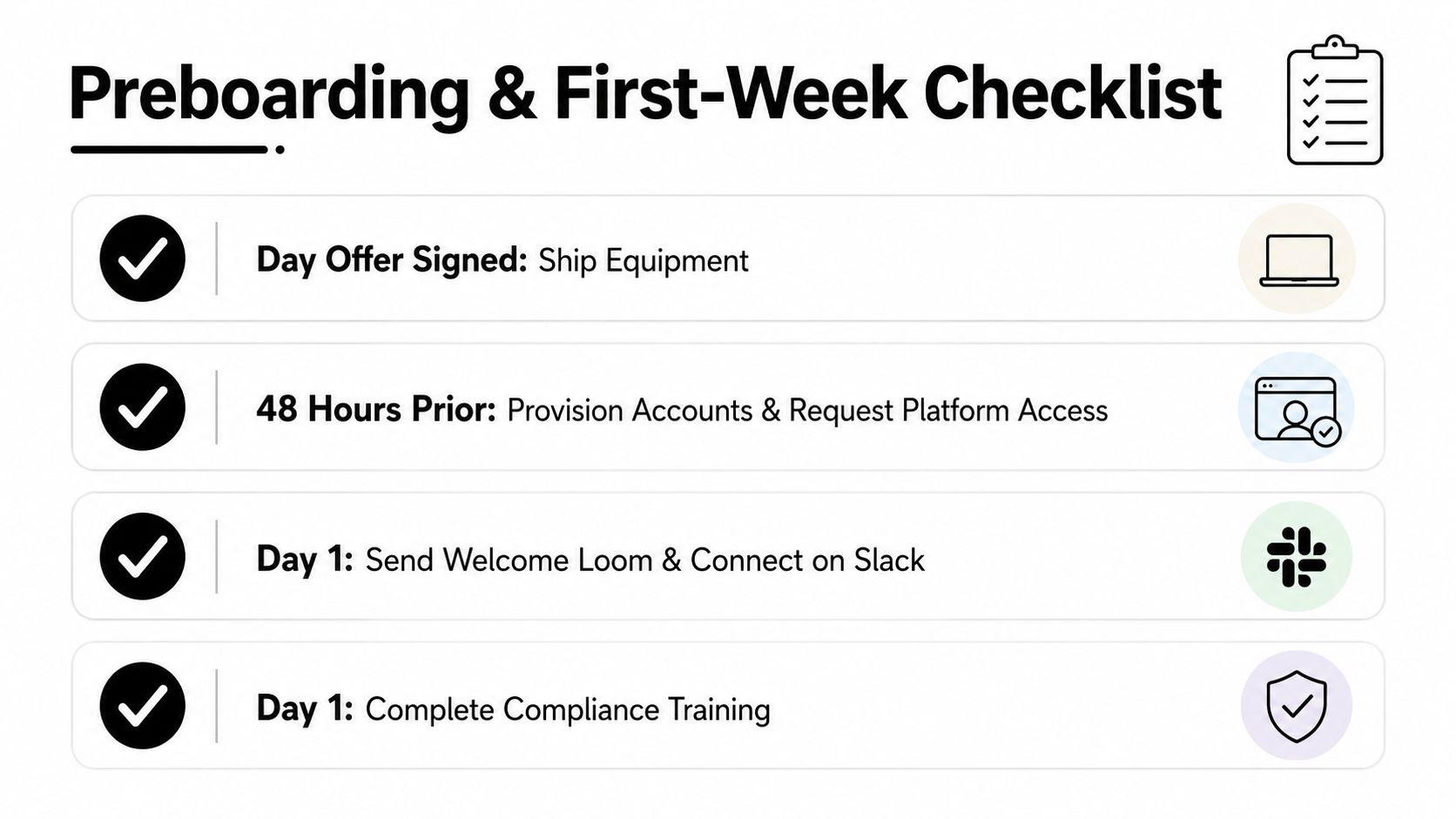
Send the checklist the day the offer is signed. Ship the equipment. Provision the required accounts. Ask IT for Slack and ad-platform access before the start date. Record a short welcome Loom from the hiring manager that explains what the person will work on, who they'll meet, and what success looks like at the end of the first week.
This sounds basic because it is. Basic tasks still fail when nobody owns them.
Assign an owner to each item and mark completion visibly:
The buddy matters because new hires need somewhere to ask the supposedly “dumb” questions that they won't raise in a formal manager meeting. For more ideas on building connection across distributed teams, use these virtual employee engagement activities, but don't confuse social contact with skills training.
Day one needs a focused manager session, not a parade of introductions. Spend 60 minutes on the org chart, account portfolio, role boundaries, and the single KPI that will matter most for the initial ramp.
For a paid-media specialist, that KPI might be reporting accuracy, pacing accuracy, qualified-lead volume, CPA, or another role-specific measure. Pick one primary signal. A new hire who's told to optimize everything usually optimizes nothing.
Schedule a daily 15-minute check-in during the first two weeks. Keep it practical: what they learned, what they attempted, what's blocked, and what they'll ship next. Don't turn it into a status-theater ritual.
By Friday, require one small, visible deliverable. A Meta campaign draft, keyword audit, account-structure map, creative QA checklist, or weekly performance summary works well. The work should be low risk but real enough to reveal how the person thinks.
A new hire should leave week one with evidence of progress, not a folder full of documents.
Generic training is especially dangerous in paid media because platforms change, accounts vary, and small errors spend real money.
I use a four-week sprint that moves from fundamentals to supervised execution. Each week ends with a competency gate, not a quiz. Knowing a definition isn't the same as making a sound decision inside an account.
Start with auction dynamics, attribution models, Meta and Google account structures, naming conventions, and the agency's rules for documentation. Give the trainee a real account with sensitive details removed where necessary, then ask them to map the funnel and explain how campaigns connect to business objectives.
The gate is simple: can they describe the account structure, identify the conversion event, and apply the naming convention without being corrected line by line?
Move into budget pacing, bid strategies, audience targeting, exclusion logic, creative QA, and change logs. Assign exercises that mirror production work. The trainee might review a set of ads for broken links, missing UTMs, policy concerns, inconsistent offers, and mismatched landing pages.
The work should come from your accounts, not a generic case study. Generic examples are tidy. Client accounts are where the weeds live.
Have the trainee read the account funnel and investigate CPA drift. Ask for a written hypothesis, the evidence supporting it, the next test, and the risk of taking no action. Then require a short weekly snapshot that a client could understand.
The gate is whether the recommendation is specific enough to execute. “Improve creative” isn't a diagnosis. “Refresh the weakest prospecting angle because frequency is rising while click-through quality is falling” gives the manager something to evaluate.
Give the trainee a low-budget test campaign in a sandbox or low-risk account. The required output isn't just the launch. It's a teardown explaining the setup, assumptions, early signals, and what they'd change next.
Every exercise gets graded as if it came from a paying client. That standard creates useful pressure without handing an unproven buyer the keys to the whole account.
| Week | Core Topics | Hands-On Exercise | Competency Gate |
|---|---|---|---|
| Week 1 | Auctions, attribution, account structure, naming conventions | Reverse-engineer a real account and document the funnel | Explain structure and apply naming rules accurately |
| Week 2 | Pacing, bids, targeting, exclusions, creative QA | Audit ads, links, tracking fields, and campaign settings | Identify risks and recommend corrections |
| Week 3 | Funnel analysis, CPA drift, hypotheses, reporting | Write a performance snapshot and optimization hypothesis | Connect evidence to a defensible action |
| Week 4 | Supervised launch, testing, teardown | Build and review a controlled test campaign | Launch safely and explain the result |
The point isn't to cram platform trivia into someone's head. The point is to prove that they can turn account data into a responsible decision.
A probation period asks, “Can this person survive here?” A revenue ramp asks, “What valuable work can this person own next?”
Use 30-60-90 days as the operating agreement. The structure aligns with Cornerstone's 30-60-90 onboarding framework, which places learning and context in the first 30 days, applied output in days 31 to 60, and independent contribution in days 61 to 90.
The new hire sits inside live accounts, listens to client calls, reverse-engineers existing campaigns, and documents what they see. They shouldn't spend the month watching someone else work. Assign one internal deliverable every week, such as a creative swipe file, account map, tracking audit, or performance summary.
Measure the quality and timeliness of those outputs. You're looking for clear thinking, careful execution, and the ability to absorb feedback.
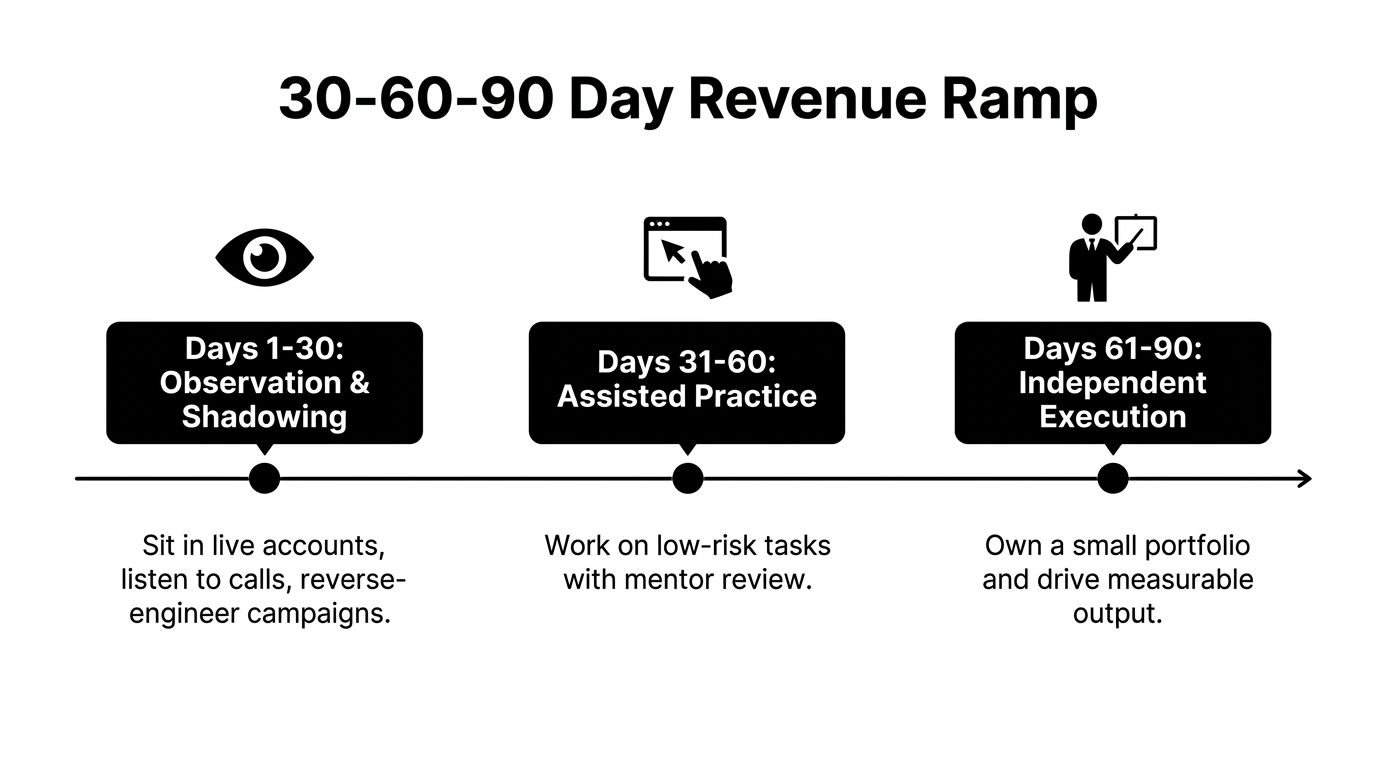
Give the trainee one campaign or ad set with a defined risk boundary. They run weekly optimization cycles, propose changes, update the log, and co-present in client reviews with their manager.
The manager shouldn't rewrite every recommendation. Ask the buyer to defend the decision, explain the expected effect, and identify what would invalidate the hypothesis. That conversation reveals more than a knowledge test ever will.
Move the specialist toward a small book of business or test portfolio. Set clear expectations around CPA, ROAS, pacing accuracy, reporting timeliness, and recommendation quality. The target isn't perfection. It's controlled ownership with an appropriate level of escalation.
SHRM recommends buddy-program onboarding for at least 90 days, with check-ins at weeks 1, 2, 4, 8, and 12, as described in SHRM's guidance on onboarding buddy programs. That cadence gives managers deliberate moments to inspect progress rather than waiting for a vague end-of-probation conversation.
Publish the ramp on day one. Define what good looks like at each checkpoint, what evidence the hire must provide, and what triggers an extension. Gallup also cautions that the right onboarding window varies by role and industry, ranging from 30, 90, 150, or more than 365 days, according to its effective onboarding guidance. Ninety days is a useful operating frame, not permission to pretend every specialist reaches full proficiency on the same schedule.
Most remote onboarding fails because companies copy office rituals onto video calls. Three hours of introductions on Zoom doesn't create context. It creates a tired person with 47 browser tabs and no idea which one matters.
Distributed training needs deliberate documentation, predictable access, and fewer meetings with better objectives. Ship equipment and credentials before day one. Record login flows in Loom so people can replay them across time zones instead of waiting for a live walkthrough.
Run a daily Slack standup using one fixed template:
That format gives managers visibility without demanding constant calls. It also teaches the new hire to report work in the same concise way they'll use with clients.
Schedule two live working sessions each week. One should be paired screen-share time inside live accounts. The other should focus on written deliverables and feedback. Neither is a status meeting wearing a fake moustache.
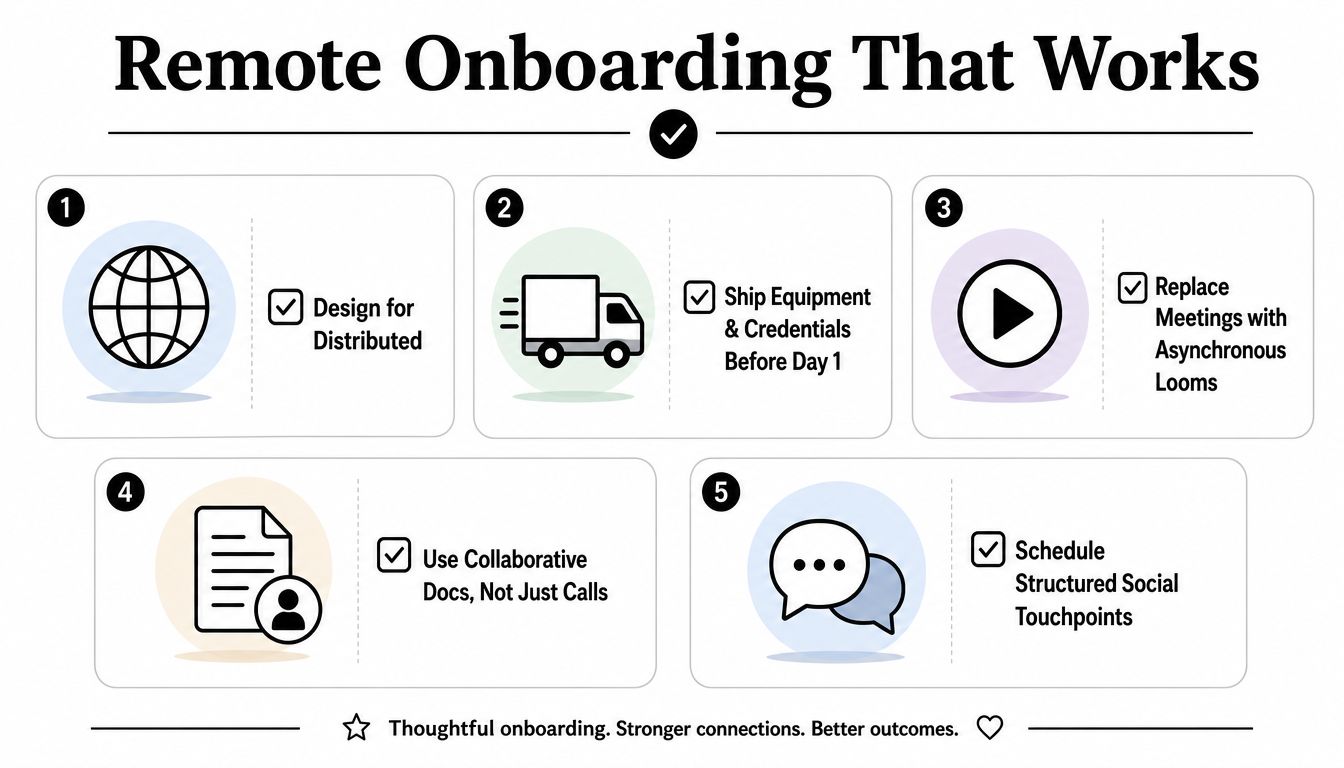
Assign a buddy outside the direct reporting line. The manager evaluates performance. The buddy helps the new hire understand how work moves through the company, where decisions get recorded, and which questions belong in which channel.
Add a 30-day skip-level conversation so leadership hears friction before it becomes resignation. Replace “feel free to ask” with a weekly Friday office hour that has an agenda, an open Zoom link, and permission to bring unfinished questions.
Remote work doesn't remove the need for social connection. It removes the accidental moments where people used to gather context. Your program has to replace those moments with intentional systems, not more calendar clutter.
Training works when it changes what a new hire can safely and consistently produce. Attendance, completed videos, and cheerful Slack reactions don't prove that.
Track four signals. Keep each one tied to a source and an intervention.
The operational context is sobering. Onboarding task loads average 54 tasks per new hire, while 52% of programs end within one month and 14% within one week, according to Yomly's employee onboarding statistics. The same source associates poor onboarding with 24% of workers leaving within the first 90 days, and reports that one-third experienced a poor onboarding process. A checklist can be busy and still fail.
If the ramp is slow, inspect access, task sequencing, and manager review time first. If knowledge gaps appear around day 45, replace passive content with a live account exercise and require a written explanation. If the hire only shadows and never ships, assign a small deliverable with a real deadline and review it publicly with the manager.
The manager owns the correction. Sending another course to a person who needs feedback is how companies end up mortgaging the office ping-pong table to pay for an LMS nobody opens.
To scale, turn the ramp into a reusable template without flattening every role into the same curriculum. Store Looms, account examples, QA checklists, reporting standards, and approved exercises in a searchable library. Version the content when platform workflows or internal processes change.
Before launching the program for another cohort, certify the managers. They should know how to set competency gates, give actionable feedback, protect low-risk practice time, and escalate performance concerns. A training system can't outperform the person responsible for reviewing the work.
Good training for new hires doesn't feel like a content library. It feels like a clear path from access, to practice, to accountable output. If the new buyer knows what to learn, what to ship, who will review it, and how ownership expands, you've built a business process. If they're still collecting badges while senior staff repair campaigns, you've built paperwork with better branding.
HireMediaBuyers.com helps US companies find pre-vetted Media Buyers and Paid Ads Specialists for remote roles, so you can pair stronger hiring with the structured 90-day ramp outlined here. Visit HireMediaBuyers.com to explore qualified talent and build a paid-media team that's ready for disciplined training and measurable output.


