


Here’s the short version: the companies that actually get costs under control stop the cycle of repeat trims and reset their structure instead. That corporate diet-and-binge cycle—cut now, hire back later—is exactly why your savings never stick.
Sound familiar? Let's fix it.
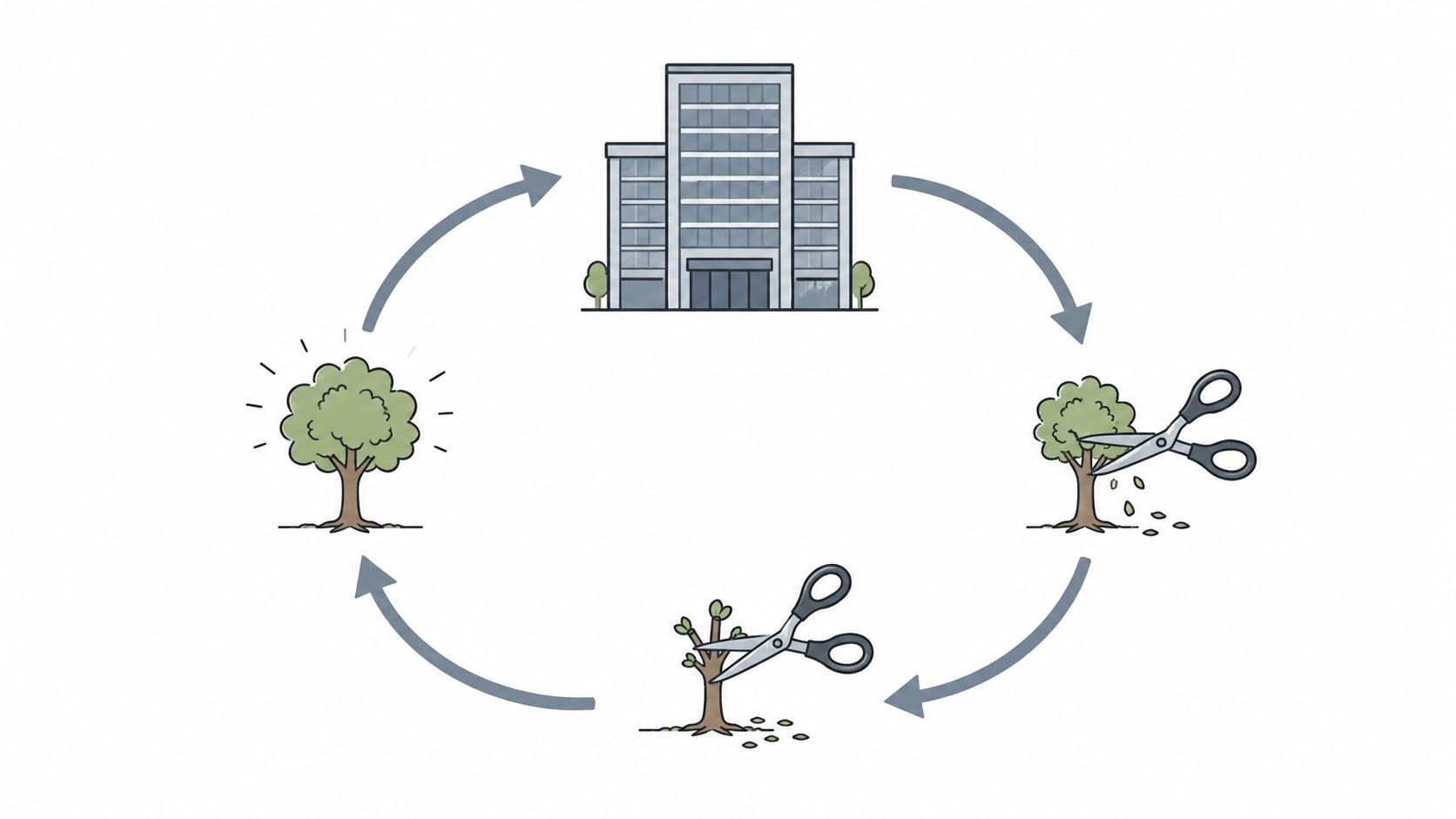
If your board celebrates a 5% headcount reduction only to watch payroll creep back to where it started six months later, you’re caught in the trimming trap. Congratulations.
| Cut Frequency | Share of Firms | Real Opex Drop |
|---|---|---|
| Quarterly reactive cuts | 40% | ~1–3% |
| Annual strategic resets | 25% | 8–15% |
| One-off layoffs without redesign | 35% | Temporary only |
Short, defensive cuts feel safe. They're quick, they're politically painless, and they make for a good quarterly headline. But they rarely touch the underlying cost structure that keeps driving recurring spend. So the same leak just shows up again next quarter, like a bad sequel.
Breaking out requires honest diagnostics and a clear KPI lens. The move is straightforward: map every recurring spend line to a single measurable outcome.
The single metric that exposes waste fastest is simple: dollars not tied to an owned KPI are fuel for the diet-and-binge.
A DTC brand I worked with did this and discovered that 22% of their Meta ad budget was cycling into audiences so saturated they were basically shouting into a void. They paused those segments, and overall ROAS improved within three weeks.
If you want savings that last, stop treating cost cutting like triage. Rebuild around measurable outputs instead of headline percentages. That's how you move from short-term applause to durable margin improvement.
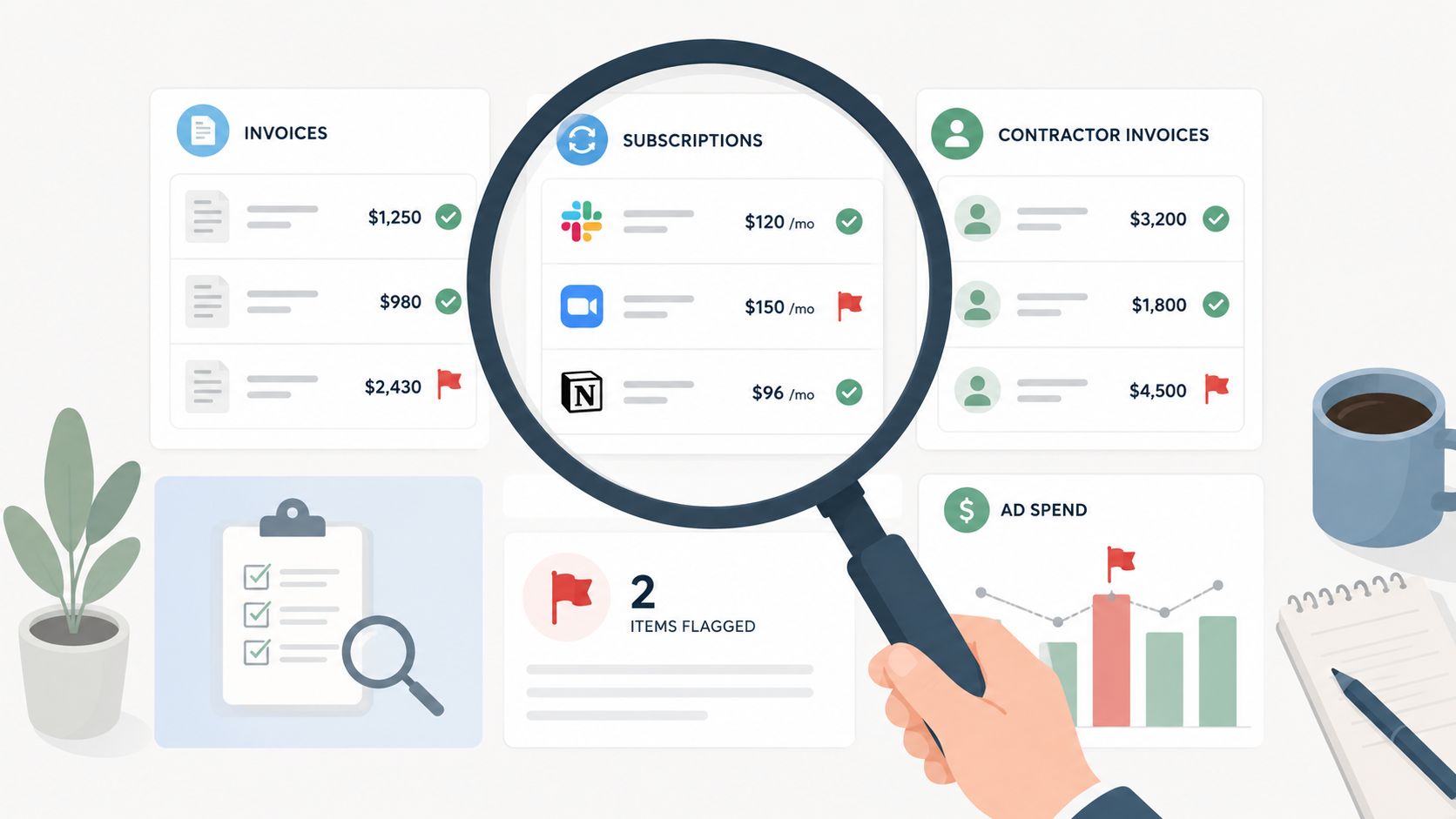
Before you start popping champagne over so-called "savings," do yourself a favor: pull the last 90 days of paid media bills, SaaS charges, and contractor invoices.
Hope you enjoy spending your afternoons fact-checking resumes and running technical interviews—because that’s now your full-time job if you skip this step. That's not a weekend plan anyone wants.
The exercise is simple: map each line item to a single KPI you actually review every week. If a subscription, ad line, or contractor deliverable doesn't tie directly to CPA, ROAS, MQL quality, or an ops SLA, flag it. This forces real accountability instead of relying on ritual cuts that look good on paper but don't move the needle.
The fastest detector of waste is simple: dollars not linked to an owned KPI are likely pointless spend.
Once the obvious gaps are flagged, dig into these common culprits:
When you're ready to act, start by pausing unowned spend for 14 days and just watch how your KPIs respond. Then reassign ownership. Whatever cash you free up, redirect it into high-performing channels or retained talent that's already proving its value.
A practical note from experience: a focused two-week experiment will teach you more than a month of back-to-back opinionated meetings.
Diagnose first and redesign around measurable outputs. Otherwise, you're just setting up the corporate diet-and-binge cycle for another round with a fresh set of headlines.
Turns out there’s more than one way to hire elite developers without mortgaging your office ping-pong table. Most companies approach hiring media buyers the same way they always have—post a job, pay a full salary, hope for the best.
There’s a smarter play: outsourcing to vetted remote talent.
The appeal is simple. Remote, pre-vetted media buyers let you pay for outcomes, not attendance. Salaries are sticky. Between contracts, benefits, and office politics, unwinding a bad hire is painful and slow. Swapping fixed payroll for variable, measurable deliverables tied to CPA and ROAS gives you a flexibility that traditional hiring can't touch.
Take HireMediaBuyers.com. They deliver vetted specialists across Meta, Google, LinkedIn, and TikTok within 24–48 hours and advertise 80–90% potential salary savings compared to US-based hires. That's not theoretical—it's actual cash you can redirect toward what's already working.
Hiring someone from a gig site is cheap until creative drains, accounts tangle, and you spend your weekends fact-checking results.
Here's a real-world example: A SaaS company switched from a local full-time hire to a vetted part-time remote buyer and cut CAC by 38% within three months—all while maintaining pipeline volume. The key? They insisted on daily reporting and a simple quality score for every lead. No ambiguity, no hand-waving.
The real trade-off: You get rapid scaling, up to 90% payroll reduction, and flexible contracts. What you give up is the illusion of control. This model demands stricter KPI governance and a real investment in onboarding upfront.
If you're serious about durable margin improvement, stop worshipping headcount and start paying for verified output. For a practical playbook with contract language and KPI templates, check out our Skills Based Hiring Guide.
Toot, toot—your ping-pong table can stay.
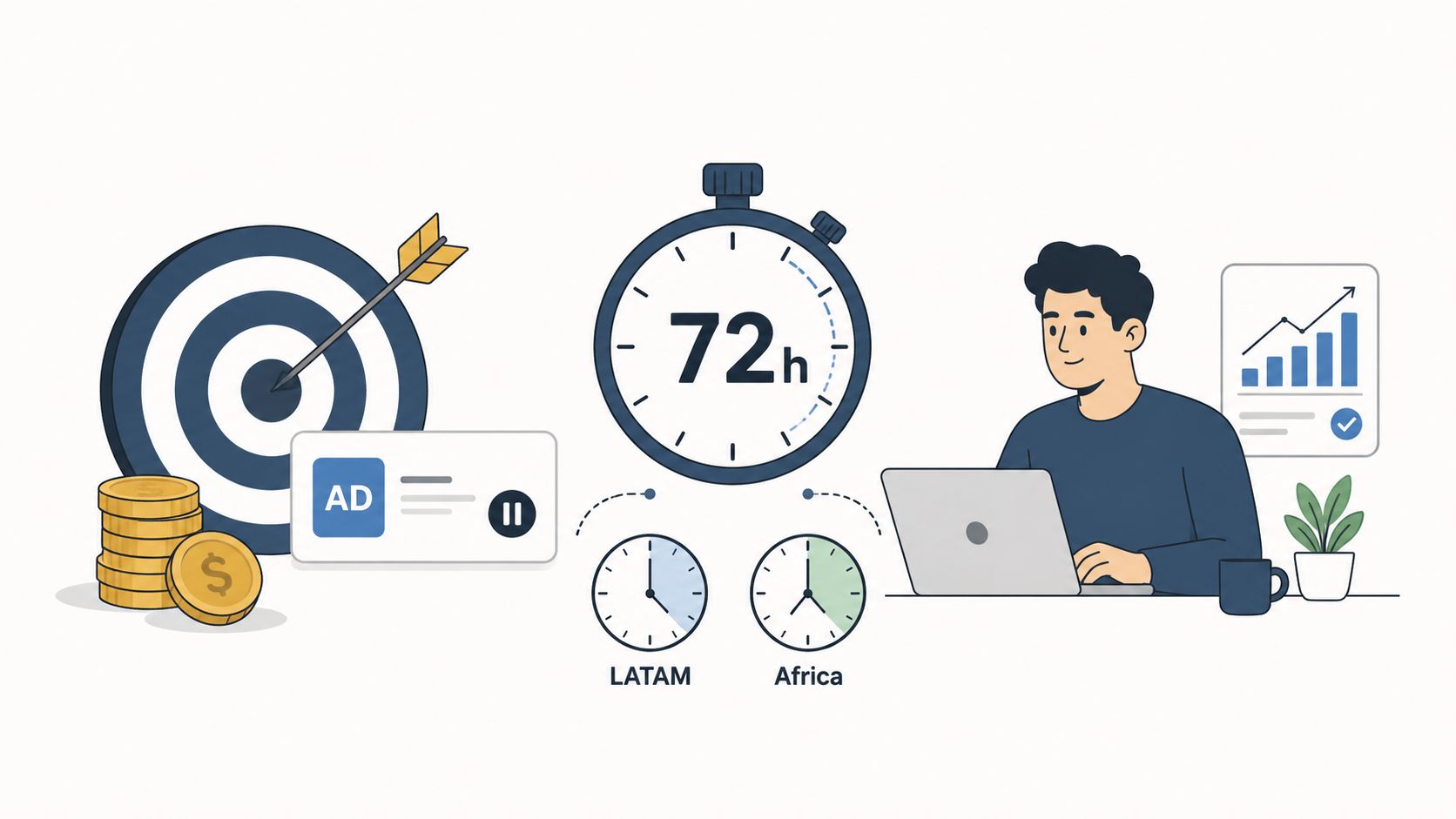
Ah, the $500 Hello—that wasted test campaign you launched without confirming audience fit. It’s pure entertainment for the ad platforms and tax-time pain for you.
Here's a better idea. Pause low-ROAS ad sets within 72 hours if they’re not trending up. That stops small leaks from turning into a full-blown budget hemorrhage and forces sharper creative or targeting hypotheses.
Next, match buyer time zones with vetted remote specialists in LATAM or South Africa. A half-day overlap beats a 12-hour lag when you need hourly bidding moves and rapid creative swaps.
The real metric: incremental revenue per dollar after excluding recycled spend.
That focus reveals whether campaigns are additive or just firing at your existing audience again.
Real scenario: a SaaS firm moved media buying to a vetted part-time specialist and cut CAC by 38% in three months. They insisted on daily reporting, a simple lead quality score, and pausing tests that missed CPA targets by day three.
Avoid the cheap‑freelancer trap. Price alone doesn’t predict competence.
For a practical primer on proving incrementality before you scale spend, read our article on incrementality testing.
Small, ruthless experiments beat big, sloppy cuts when optimizing paid media spend.
Alright, let's talk triage. Cancel those SaaS subscriptions nobody owns anymore. Pause the traffic that never converts. Shut down ad sets that have been quietly draining your budget for weeks. These are immediate cash recovery plays that work fast enough to calm the board and buy you some breathing room.
But here's the thing: short-term fixes are temporary. Use them to fund smarter experiments, not to paper over deeper problems. That's the real opportunity.
Small, ruthless experiments beat big, sloppy cuts — test, measure, repeat.
Once those quick trims are done, the real work starts. If pausing spend exposes capability gaps, plan the hires or outsourcing needed to keep momentum. Don't just stop spending—figure out what needs to replace it.
Long-term moves rebuild around output, not headcount. Embed vetted remote media buyers. Rewrite contracts so payments tie to KPIs. Redesign processes so deliverables, not seats, become the currency.
This table lays out the difference between quick trims and the structural resets that actually reshape your cost base.
| Time Frame | Action | Risk | Saving Type |
|---|---|---|---|
| This Week | Pause low-ROAS campaigns | Low | Immediate cash recovery |
| This Month | Audit subscriptions | Low | 5–15% OpEx freed |
| 3–6 Months | Onboard vetted remote talent | Medium | 80–90% salary savings |
| 12+ Months | Rebuild ops around output | Medium-High | Structural margin lift |
Quick trims are about stopping the bleed. Structural resets are about changing how the machine works. You need both, but they serve different purposes.
Here's a concrete example: one B2B SaaS client paused saturated Meta segments and reallocated that spend to a vetted LATAM buyer. CAC dropped 38% in three months while pipeline stayed intact. That's the kind of move that happens when you stop treating a cost cutting strategy as a one-time event.
Sell the plan in stages. Quick trims to prove discipline, structural resets to lock in margins. We’re not saying we’re perfect. Just more accurate more often.
Cutting training to save a few payroll dollars is one of those moves that feels clever until your churn, errors, and rework double the cost six months later. Funny thing is, most teams never connect those dots until the damage is already done.
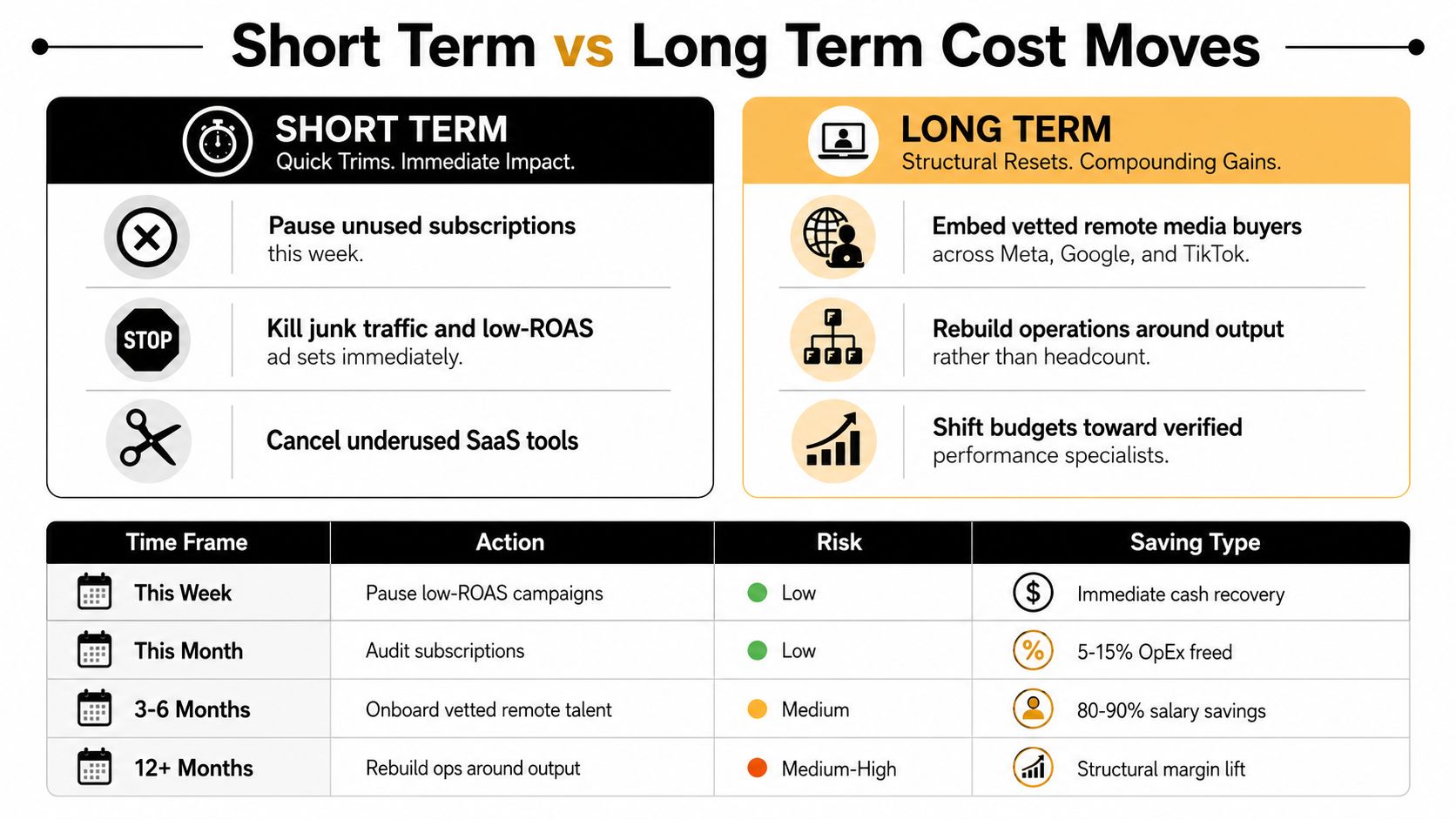
The infographic above breaks down quick trims against structural resets. The goal is simple: help you see which moves buy you breathing room and which ones actually change how the machine runs.
| Short-Term Wins | Long-Term Structural Resets |
|---|---|
| Pause non-essential subscriptions | Renegotiate vendor contracts with KPI clauses |
| Freeze hiring for non-critical roles | Document tribal knowledge before people leave |
| Reduce agency hours temporarily | Consolidate overlapping tools and platforms |
| Cut discretionary spend | Build outcome-based partnerships |
Small cuts that look smart on a spreadsheet often hide long tails nobody accounts for. Fire the one person who understood how an account was set up, and sure—you save salary now. But you'll spend double on re-onboarding and lost momentum before the year is out.
Thought that 10% agency fee cut was clever when retention slid and re-onboarding cost you double? You're not alone.
Cutting enablement saves pennies and creates pounds of mistakes later. Employees make avoidable errors, contractors underperform, and you end up paying for fixes that training would have prevented.
"Training is expensive until you calculate the cost of mistakes you made by not training."
Letting one expert carry critical knowledge is more common than you'd think. When they leave, accounts fracture and recovery costs spike overnight.
Here's a real one: a marketing ops lead walked out the door, and three months later the entire account structure needed a rebuild. That rebuild cost more than six months of their salary. Bet on it—this story repeats itself across companies of every size.
Slash an agency retainer and guess what happens. Retention drops, institutional knowledge evaporates, and onboarding a new team costs more than the fee you saved.
Try this instead: renegotiate outcomes and add KPI clauses tied to CPA or ROAS. You keep accountability without torching the relationship.
Killing a tool without checking feature overlap creates more manual work and duplicated effort. Someone ends up doing the same task in two places, and nobody catches it for months.
Quick audit: map tools to owners and the single KPI they affect before cancelling anything. If you can't name the owner and the metric, that spend is already on autopilot.
If you want a low-risk way to replace costly hires with verified output and sidestep these traps entirely, check out our cancel-anytime hiring guide.
The bottom line? Stop saving pennies and losing dollars. Build cost discipline that actually lasts.
What’s the fastest way to trim paid acquisition without tanking the pipeline?
You can pause obvious waste immediately with no pipeline shock if you act surgically. Start by pausing ad sets with flat or declining ROAS for 72 hours and reallocating 30% of that budget to your top performers. Monitor CPA and lead velocity daily; if volume dips, restore spend to the best-performing cohorts. This is tactical triage that buys you time for smarter moves.
They cut salary overhead because you pay for verified output, not seniority perks and benefits. Vetted hires from places like LATAM or South Africa often deliver equivalent campaign management at 80–90% lower total payroll cost versus US hires. The catch? You need tight KPIs. Insist on a 14–30 day proof window tied to CPA or ROAS and daily reporting.
Key insight: Replace fixed payroll risk with milestone-driven contracts to make savings durable.
What if my company isn’t struggling? Is a cost cutting strategy still useful?
Yes. Healthy companies use it to squeeze out incremental margin, not just to survive. Short experiments free up cash to double down on high-ROI channels. Structural moves—like embedding remote media buyers and using output-based SLAs—turn temporary wins into lasting competitive advantages. It's not just about saving money; it's about spending it smarter.
Expect early wins in 4–12 weeks. The proof-of-performance window should show measurable CAC or ROAS improvements within a month. The structural salary savings will materialize over a 3–6 month onboarding horizon. Real case: a SaaS client cut CAC by 38% in three months after switching to a vetted part‑time buyer.
Practical checklist before you switch:
If you want low‑risk replacements for costly hires, try HireMediaBuyers.com https://hiremediabuyer.com


