


Your dashboard says the campaign is working. Your bank account says somebody's lying.
You've probably lived this already. Ads are bringing in conversions. The spreadsheet says your CPA looks tidy. Then payroll hits, the agency invoice lands, your design contractor sends a reminder, and suddenly that “cheap” acquisition looks like an expensive little gremlin chewing through margin.
I've been there. You celebrate the headline number, then spend the rest of the month wondering why the business feels cash-starved anyway. That disconnect is the whole game. Most CPA advice is too neat, too clean, and way too forgiving. Real businesses don't buy customers with ad spend alone.
A founder I know once bragged about a paid search campaign that was “crushing it.” Low reported CPA. Nice conversion volume. Lots of smug nodding in the Monday meeting.
Three weeks later, same founder was freezing software spend and delaying hires.
That's the classic CPA hangover. The ad account says one thing, your operating account says another, and everyone starts acting like accounting is being dramatic. It isn't. You're just measuring the flattering number instead of the useful one.
The average CPA for PPC search across all industries is $59.18, according to Umbrex's CPA analysis. Useful benchmark. But that same source also points out that display and social often push costs higher, especially when you don't segment CPA by acquisition source.
That matters because “our CPA is fine” often really means “one campaign in one channel looks decent if we squint.”
If you lump paid search, paid social, retargeting, and display into one cheerful blended number, you're not doing analysis. You're hiding from it.
And if you're pouring budget into the wrong channel without source-level segmentation, you're basically hiring developers while running technical interviews yourself instead of using a vetted platform. Lots of effort. Weird confidence. Avoidable pain.
Ask yourself a few rude questions.
Did you include the freelancer who made the creatives?
Did you include the person inside the company babysitting Meta Ads and Google Ads all week?
Did you include tracking cleanup after your attribution went sideways?
Did you include the tools?
Usually, the answer is no. That's why founders end up chasing “efficient” campaigns that still make the business feel poorer every month.
If your reported CPA looks healthy but the business feels sick, stop admiring the dashboard and start testing what's incremental. A good place to sharpen that instinct is this guide to incrementality testing for paid media.
Cheap-looking acquisition can still be expensive. That's the trap.
A founder sees a $40 CPA in the ad account and starts feeling clever. Then payroll hits, the agency invoice lands, three software subscriptions renew, and the “cheap” acquisition suddenly looks a lot less charming.
That's the whole problem with how CPA gets explained. The textbook version is useful for judging campaign efficiency. It is also incomplete enough to get you into trouble if you mistake it for business reality.
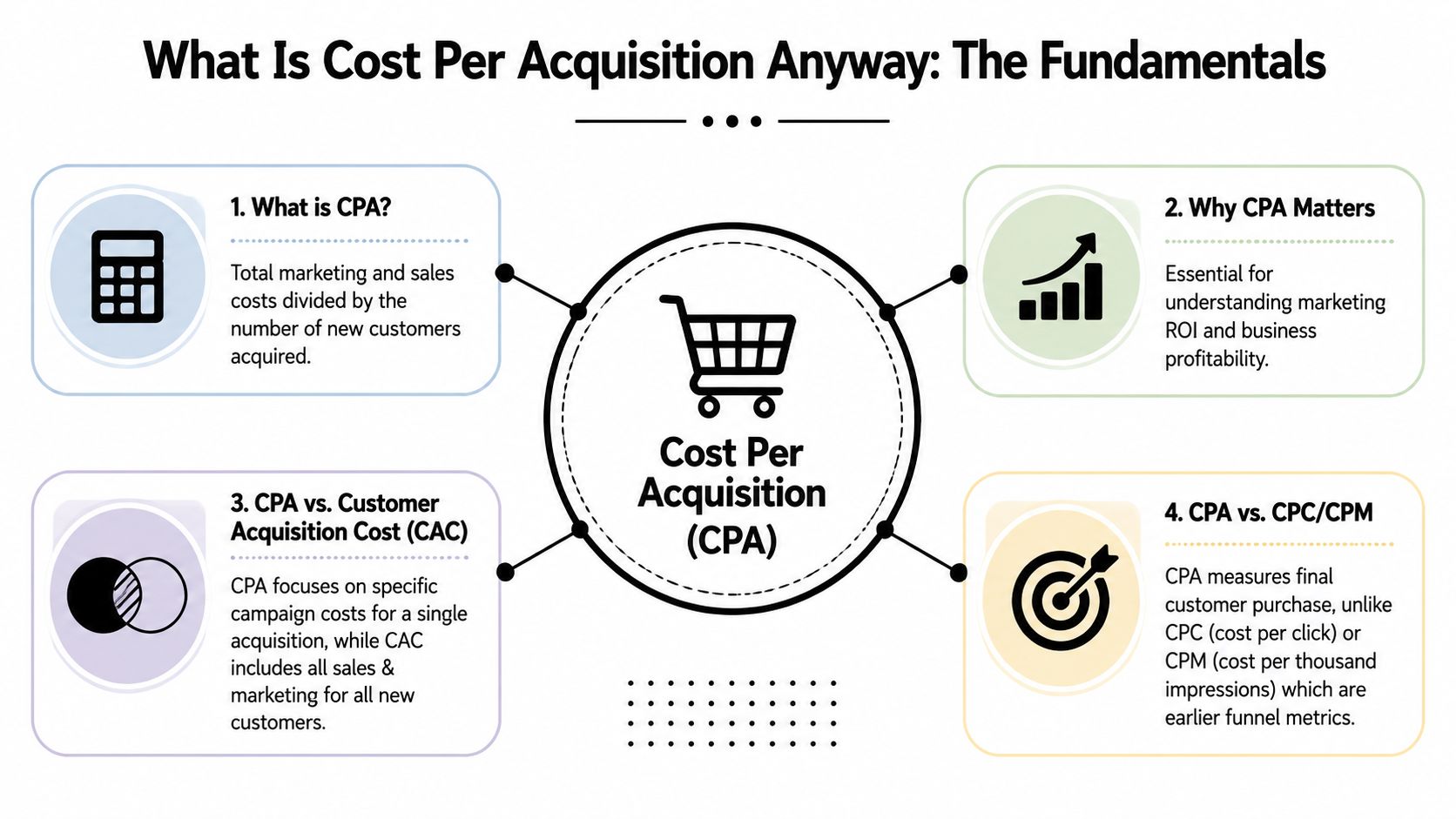
Cost per acquisition is the amount you spent to get one conversion from a campaign.
The standard formula is simple: total campaign spend divided by total conversions. Use it to judge whether an ad, audience, or channel is pulling its weight. Use it inside platforms. Use it in weekly reporting. Just do not pretend it tells you the full cost of growth.
That distinction matters because CPA often tracks a conversion event, not always a paying customer. If your tracking is sloppy, your CPA is sloppy too. Before you trust the number, make sure your events and attribution are set up correctly with conversion tracking that reflects real acquisition.
Founders blur CPA and CAC because both numbers sit near the top of the dashboard and both sound expensive. They are not interchangeable.
| Metric | What it measures | Founder version |
|---|---|---|
| CPA | Campaign cost divided by conversions | What this ad effort cost per result |
| CAC | Total sales and marketing cost divided by new customers | What the business actually paid to bring in a customer |
CPA helps you decide whether a campaign deserves more budget. CAC tells you whether your growth model makes money.
That gap is where bad decisions happen. A campaign can show a healthy CPA while the company still acquires customers at an ugly all-in cost. Paid media teams love the first number. Founders need both.
There is no universal “good CPA.” Anyone giving you one without asking about margins, retention, payback period, and average order value is guessing with confidence.
Use a simple rule instead. Your CPA has to leave enough room for the business to breathe after fulfillment, support, overhead, and the rest of the mess that comes with serving customers. If it does not, you do not have efficient acquisition. You have a polite way to lose money.
One more thing. Cheap conversions can be terrible customers.
If a channel produces low-intent leads, one-time bargain hunters, or users who churn before the second billing cycle, the CPA can look pretty while profit gets strangled. That is why simplistic CPA advice is dangerous. It trains founders to optimize the ad account instead of the business.
Most CPA reporting is vanity math dressed up in a blazer.
The usual formula gets treated like gospel: spend divided by conversions. Fine for platform optimization. Bad for business decisions. If you're making hiring, budget, and growth bets off that number alone, you're steering with the windshield painted on.
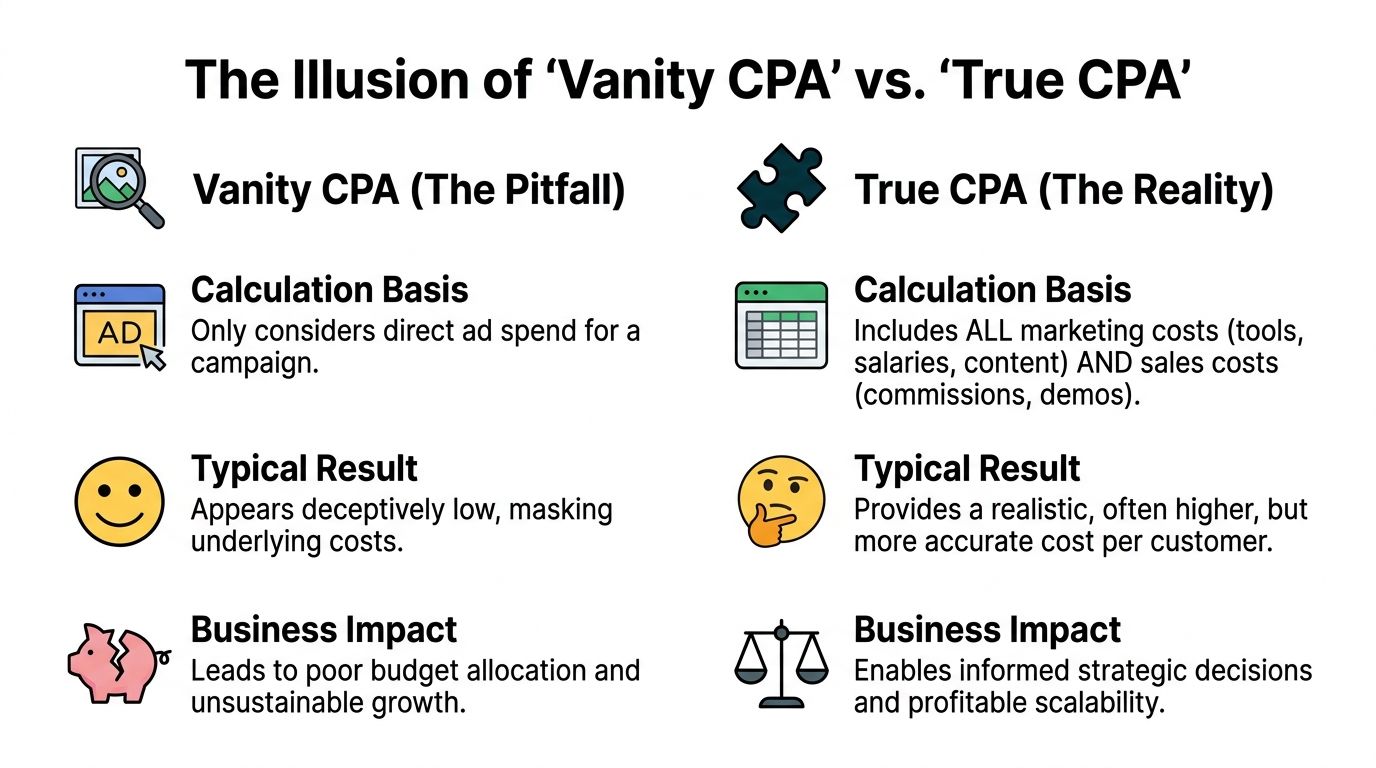
The ugly truth is that a lot of brands leave out the expensive parts on purpose. Not because they're evil. Because those costs are inconvenient, and inconvenient costs ruin pretty dashboards.
A 2025 study of DTC brands found that 68% of companies underreported their true CPA by 25–40% because they excluded marketing team salaries. The same source notes that if 50% of a person's time goes to acquisition, then half their salary belongs in acquisition cost. That comes from Amplitude's guide on true CPA.
That's not a rounding error. That's a strategy problem.
If a cost exists because you're trying to acquire customers, it belongs in the conversation.
Use this checklist:
You don't need a finance degree. You need honesty.
Build two numbers:
| Version | Includes | Use it for |
|---|---|---|
| Media CPA | Ad spend only | Platform optimization |
| True CPA | Ad spend plus salaries, fees, tools, and creative | Budgeting, forecasting, profitability |
Run both every quarter. Monthly is even better if spend is moving fast.
Then compare them. If the gap is ugly, good. Now you know where the bodies are buried.
The purpose of true CPA isn't to make marketing look worse. It's to stop founders from scaling channels that quietly eat profit.
And before you trust any number, make sure your tracking isn't stitched together with hope and browser cookies. If your setup is shaky, fix the plumbing first with a clean conversion tracking audit and setup process.
The actual number usually hurts a little. That's why it's useful.
A founder sees a $90 CPA and feels smart. Another sees $600 and panics. Either reaction can be dead wrong.
“Good” CPA is not a universal number. It depends on what you sell, your margins, your sales process, and what a customer is worth after the first conversion. A CPA that works for a SaaS company with strong retention can wreck an e-commerce brand selling low-margin products.
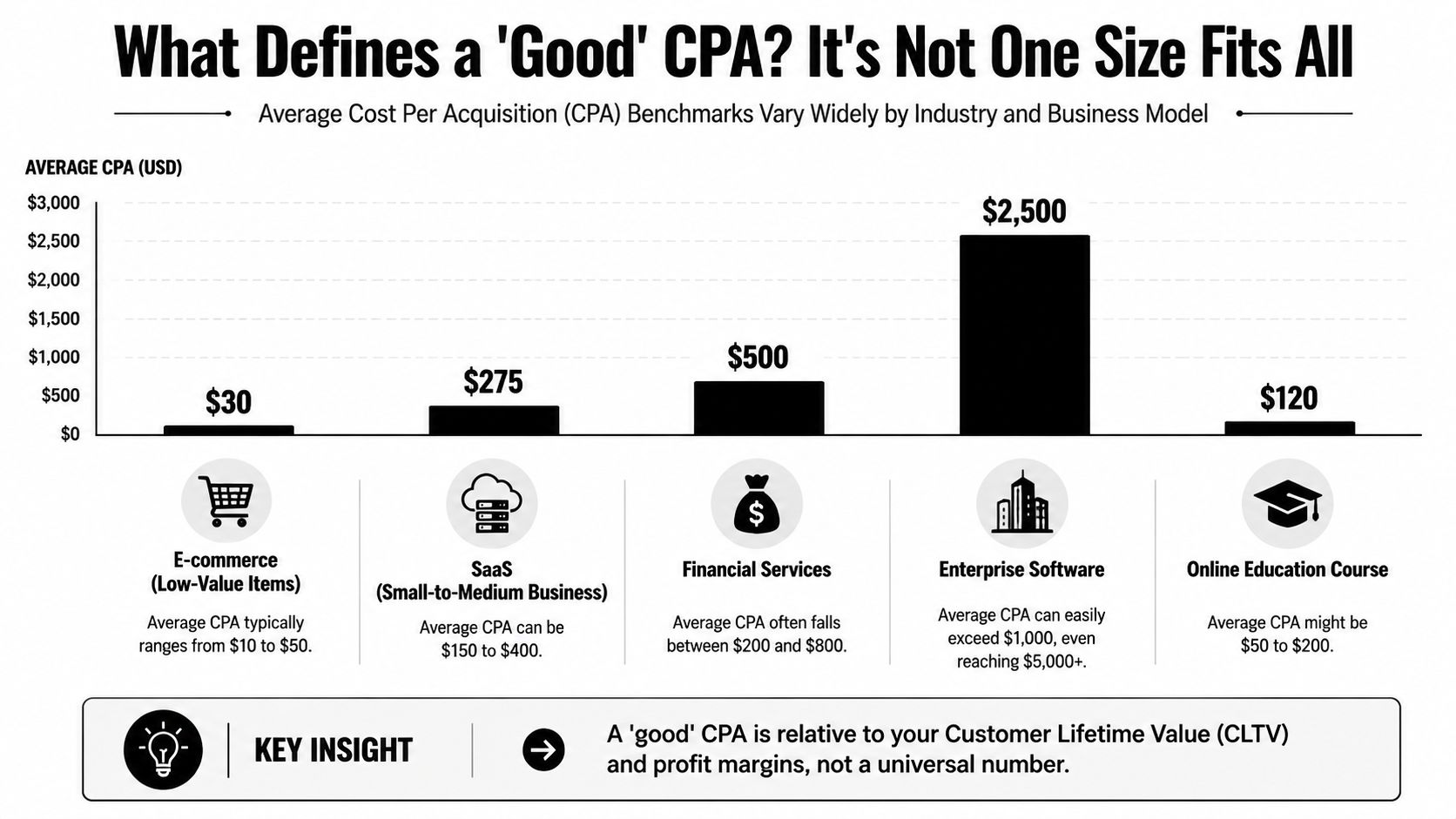
Analysts at Attainment Lab's CPA benchmark breakdown show just how wide the spread is. SaaS can run far higher than e-commerce, healthcare sits in its own range, and regional costs vary sharply too, with lower acquisition costs in Latin America than North America.
That should end the lazy question fast.
If you run a DTC brand, a bloated CPA will hurt quickly. Lower ticket sizes and tighter margins give you less room to be wrong. You do not get to hide behind “brand building” while your paid traffic chews through cash.
SaaS has more breathing room, but SaaS founders also tell themselves some seriously expensive bedtime stories. “We'll make it back on lifetime value” sounds great right up until churn shows up and your payback period turns into fiction.
Use three filters.
That last one gets ignored all the time.
A low headline CPA can look fantastic in a dashboard and still be garbage for the business. If the buyers are low intent, discount-hungry, or impossible to retain, you did not solve acquisition. You just bought yourself a retention problem.
As Userpilot's CAC benchmark guide explains, B2B SaaS acquisition costs can land much higher than e-commerce, especially for enterprise or regulated products. That is exactly why cross-industry CPA comparisons waste so much time.
Here's the rule I'd use. A good CPA leaves enough room for fulfillment, overhead, and profit after your fully-loaded costs are counted. If your number only looks “good” because you ignored salaries, tools, agency fees, or creative costs, your CPA is still lying to you.
Benchmarks give you context. Your true CPA tells you whether you're building a business or funding a hobby.
You don't lower cost per acquisition by chanting “optimize” in a meeting and opening five tabs in Google Ads. You lower it by fixing the leaks in the system.
And yes, there are usually leaks.

In B2B, 6–10 channels influence a single acquisition, yet 72% of marketers still use single-touch CPA models. That leads teams to underinvest in nurturing channels that contribute 30–45% to final conversions, according to Kissmetrics on SaaS CPA and attribution.
This is one of the dumbest self-inflicted wounds in paid media.
If email nurtures demand, content warms it, retargeting revives it, and branded search closes it, don't give all the credit to branded search and call yourself clever. You'll starve the channels doing the heavy lifting upstream.
If your reporting gives all credit to the last click, your CPA decisions are crooked from the start.
Use a model that reflects how buyers move. Even a simple multi-touch framework is better than worshipping last-click because it's easy. If you're a B2B team, this isn't optional. Complex funnels punish lazy attribution.
Founders love tinkering with ad creative because it feels fast. Fine. But if the landing page looks like a rushed intern built it during a group project, your CPA will stay stubborn.
Focus on message match. If the ad promises a sharp solution for a specific buyer, the page should continue that exact conversation. Tight headline. Clear proof. One action. Fewer distractions. Stop making people hunt.
Broad targeting has its place. So does not lighting money on fire.
Split campaigns by intent, awareness, and offer fit. Returning visitors should not get the same pitch as cold traffic. Branded search should not share a budget logic with prospecting social. Different audiences need different economics, different creative, and different patience.
Some channels produce loads of “conversions” that sales hates. Others look expensive at first glance but bring in buyers who close faster and stay longer.
Review channel performance with sales outcomes attached. Not just form fills. Not just demo bookings. Actual revenue quality. If a channel creates busywork instead of customers, cut it or quarantine it.
You don't need more channels. You need fewer lies between click and customer.
Use this before increasing spend:
Teams often don't have a traffic problem. They have a measurement problem with a side of landing page sloppiness.
Fix that first.
The fastest way to wreck your CPA is hiring someone who talks fluently about clicks and vaguely about profit.
The fastest way to improve it is hiring someone who treats acquisition cost like a business metric, not a platform trophy.
When you interview a media buyer, don't ask for favorite channels or “what budget sizes have you managed?” That's résumé wallpaper. Ask how they define success when campaign performance and business performance disagree.
Good questions:
A strong candidate won't panic at those questions. They'll get sharper.
Listen for these answers and get nervous:
| Red flag answer | What it really means |
|---|---|
| “I focus on platform-reported CPA.” | They may optimize dashboards, not profit |
| “Last-click is fine for most accounts.” | They like easy answers more than accurate ones |
| “We can scale once CPA is low enough.” | They may ignore lead quality and LTV |
| “Creative is separate from buying.” | They don't understand the machine, only one gear |
The best media buyers talk about funnel quality, conversion tracking, offer fit, landing pages, and attribution without acting like any one of those things lives in isolation.
A real operator should be able to explain:
If you want a practical framework for what strong candidates should own, this media buyer job description is a useful benchmark.
You are not hiring a button-pusher. You're hiring judgment.
And judgment is what protects the budget when the ad platforms start telling their favorite bedtime stories.
Cost per acquisition matters. Obviously. Ignore it and you'll waste money with enthusiasm.
But obsess over it in isolation and you'll make the opposite mistake. You'll chase cheaper conversions, weaker customers, bad-fit traffic, and pretty reports that subtly wreck the business. Congratulations. You saved money on paper and lost it in real life.
The better move is boring and effective.
Know your media CPA so you can optimize campaigns. Know your true CPA so you can run the company. Judge both against customer value, margin, and actual sales outcomes. Then scale the parts that hold up under adult supervision.
The goal isn't the lowest CPA. The goal is profitable, repeatable growth that doesn't require financial acrobatics every quarter.
Founders get into trouble when they treat acquisition like a casino and reporting like a comfort blanket. Don't do that. Build a system where the numbers can offend you early, while there's still time to fix them.
That's how you stop cost per acquisition from eating your business alive.
If you're tired of sorting through candidates who can talk about ROAS for an hour but go silent when you ask about true acquisition cost, HireMediaBuyers.com is worth a look. It helps companies find pre-vetted media buyers and paid ads specialists fast, so you can hire someone who understands attribution, conversion tracking, creative, and the difference between a nice dashboard and a healthy business.


