


Three months into a six-month agency engagement, the dashboard still looks healthy. Meta spend is moving, campaigns are active, Slack is full of friendly updates, and the media buyer has a plausible explanation for every soft result. The problem is simpler: the pipeline is dry, and the account has burned through $40K without an attributable return.
That situation feels like a hiring failure. Often, it's a contract failure wearing a hiring failure's name tag.
Paid acquisition is unusually difficult to judge early. Tracking windows distort the picture, attribution can lag, platform policy changes can scramble delivery, and a quiet underperformer can hide behind tidy reporting longer than an obviously chaotic one. If the agreement gives you no practical performance off-ramp, a mediocre hire becomes a capital problem.
Month to month agreements can help, but only when they're drafted for the actual work. A residential lease template gives you a useful termination skeleton. It doesn't tell you who owns the ad account, who exports the pixel history, or what happens to customer lists when a remote contractor disappears. Those details need to be designed, not assumed.
The founder in this story doesn't need another dashboard. They need an advantage.
A fixed-term agreement with no sensible exit clause forces the business to keep paying while the buyer gathers more data, waits for attribution to mature, and explains why the next creative test will turn the corner. Maybe that explanation is right. Maybe it isn't. The contract has made the distinction expensive.
A media buyer can underperform without creating obvious drama. They may launch campaigns on schedule, produce weekly reports, and keep cost per click within a familiar range while lead quality deteriorates. The founder sees activity, not necessarily economic value.
The risk compounds when the buyer controls operational details. Conversion events may be configured incorrectly. Meta or Google may reject ads after a policy change. A reporting view may exclude delayed conversions. Audience exclusions can weaken prospecting. None of these problems automatically proves misconduct, but each one makes a vague service agreement harder to enforce.
Practical rule: If you can't define what gets handed back when the relationship ends, you haven't finished defining the service.
That's why the contract structure matters more than a polished recruiting process. A strong interview can identify technical fluency. It can't rescue a six-month commitment that treats every month of poor performance as unavoidable. The founder needs a way to evaluate the buyer inside the actual account, with actual creative constraints, actual tracking, and actual budget pressure.
A month-to-month frame would have created a controlled test. The company could still set expectations, pay for legitimate work, and give the buyer time to stabilize the account. It also could have ended the arrangement after a notice period instead of mortgaging the office ping-pong table to preserve a bad decision.
Before signing, review the buyer's references, working style, and ownership terms through a resource such as client references for media buyers. Then build the agreement around what happens when performance is unclear, access is revoked, or either side decides the fit isn't working.
The point isn't to make cancellation casual. It's to make the business survivable when the hire isn't right.
A month-to-month agreement is a periodic contract that renews for another rental or billing period until one party gives valid written notice. In service work, that usually means the engagement continues through each monthly cycle rather than ending on a fixed calendar date. The agreement still has obligations, deadlines, and consequences.
The structure comes from residential tenancy law. A tenant pays for recurring occupancy, and the landlord or tenant uses notice rights to end the arrangement. The legal details vary sharply. The Cornell Legal Information Institute overview of month-to-month tenancies explains the core distinction, there's no fixed expiration date, so termination depends on notice rather than a contract end date.
For media buyers, translate the apartment analogy carefully. The buyer can leave after the applicable notice period, and the client can end the engagement under the same contract mechanics. But the buyer still owes the agreed work during the notice window, and the client still owes payment for completed services.
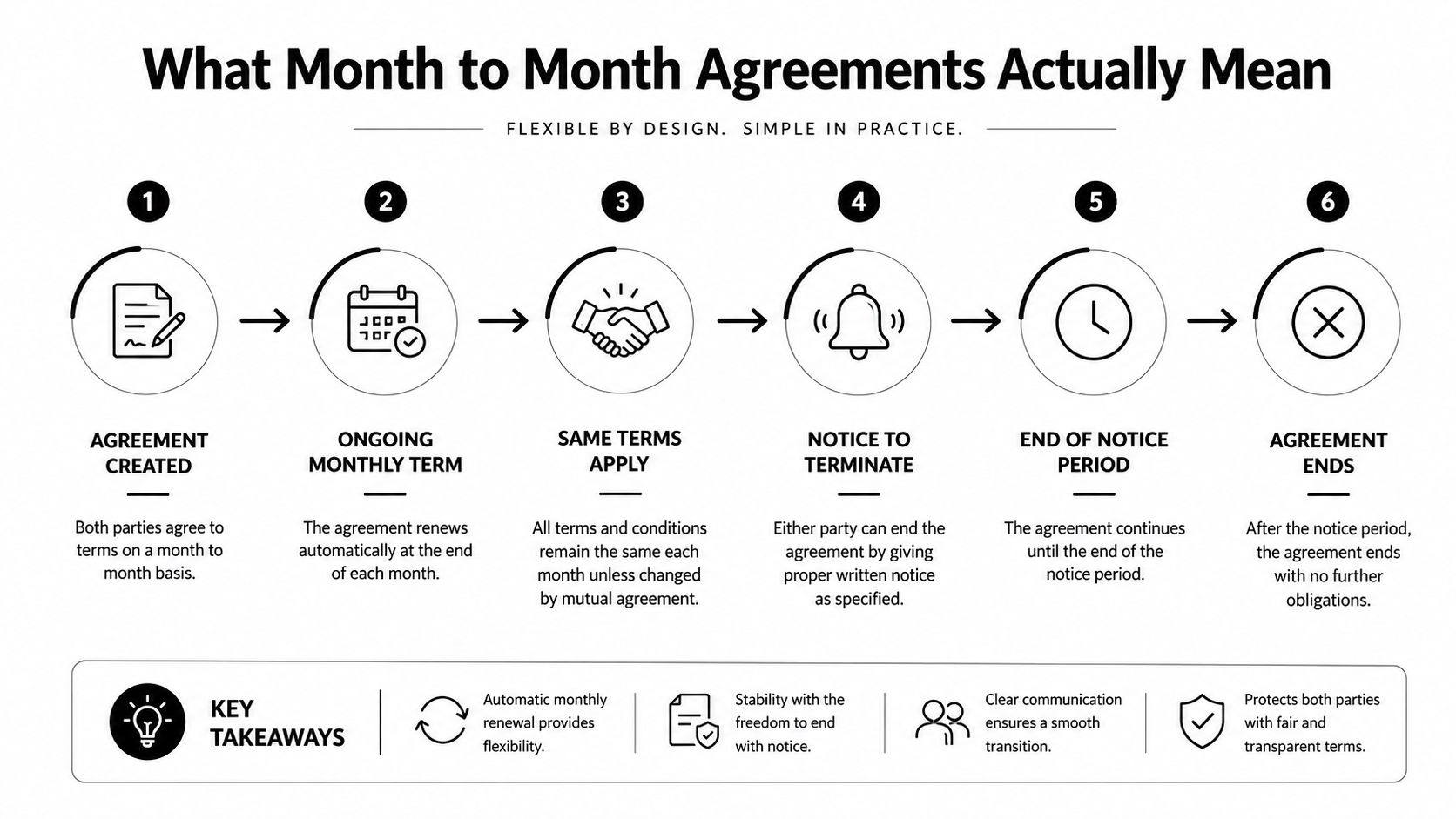
Month-to-month doesn't mean handshake-only. The agreement should still address:
It also isn't the same as at-will employment. An employee relationship brings employment-law questions that a contractor agreement can't erase. Project-based work ends when the defined deliverables are complete. A rolling retainer may recur monthly but still include a minimum commitment or a termination floor.
The practical takeaway is straightforward: month-to-month is a tempo, not a loophole. It gives both parties a recurring decision point. It doesn't excuse sloppy scope, unclear ownership, or jurisdiction-blind notice language.
Paid ads rarely reward commitment for commitment's sake. A long contract can make sense when the buyer is senior, the scope is stable, and both sides have priced the risk. It can also turn an uncertain experiment into a very expensive subscription.
The comparison below is the decision screen I'd use before signing.
| Dimension | Month-to-Month | 12-Month Fixed-Term | Rolling Annual |
|---|---|---|---|
| Flexibility | High, subject to notice | Low unless an off-ramp exists | Moderate, depending on renewal and notice terms |
| Cost control | Easier to cut after poor fit, but rates may be less favorable | Predictable commitment, with potential penalties for early exit | Predictable renewal cycle, often paired with commitment pricing |
| Termination speed | Usually the shortest practical path | Often delayed until the term ends or a negotiated exit applies | Depends on the annual notice window |
| Talent access | Attractive to cautious clients and trial-stage teams | Can appeal to buyers seeking certainty | Strong fit for established senior relationships |
| Risk transfer | Client retains more flexibility risk | Client carries more underperformance risk | Risk is shared through renewal timing and negotiated terms |
| Best use | Testing fit, changing channels, volatile acquisition plans | Stable scope, proven operator, deliberate long-term investment | Mature relationship with predictable needs |
A 12-month fixed-term can win when senior talent demands income certainty, an agency discounts management fees for commitment, or a platform-access arrangement depends on a committed spend floor. Those benefits are real. So are the hidden costs: kill fees, early-termination penalties, and the legal expense of negotiating an ugly escape.
A rolling annual deal offers some flexibility, but don't confuse a renewal date with an immediate exit right. Read the notice mechanics. Missing a renewal window can keep the relationship alive when the business has already moved on.
For a clearer distinction between recurring service arrangements and one-off work, review this explanation of what a retainer means in business. Then ask three questions before you sign:
My default for a new media buyer is month-to-month with a defined review cadence. Earn the longer commitment after the account proves the relationship deserves it.
The contract needs five working parts. Not fifty pages of legal fog. Five parts that tell both sides what happens when the account, the budget, or the relationship changes.
A short notice period gives the client speed. A longer period gives the buyer income continuity and time to wind down campaigns. The right choice depends on account complexity, but vague wording such as “reasonable notice” is an invitation to argue.
Sample language:
Notice: Either party may terminate this Agreement by delivering written notice to the other party. Termination will become effective at the end of the applicable notice period stated in the Order Form. Notice must identify the effective termination date and may be delivered by email to the designated contract contacts.
State the actual period in the order form. Don't make the reader hunt for it.
“Manage paid ads as needed” is not scope. It's a blank check with a friendly font.
Define the platforms, campaign responsibilities, reporting frequency, approval process, and limits on spend or structural changes. A buyer shouldn't move budget into TikTok, launch a new objective, or alter conversion events without approval.
Sample language:
Scope and approvals: Contractor will manage the platforms and deliverables listed in Exhibit A. Contractor may not add a platform, materially change campaign objectives, alter conversion events, or increase approved spend without Client's prior written approval.
The client should control the assets created for its account. That includes ad accounts, campaigns, audiences, tracking configurations, creative files, copy, reports, and documentation, subject to any clearly identified pre-existing materials.
Sample language:
Work product and access: Upon creation and payment, all campaign structures, creative assets, copy, audience configurations, reports, and account documentation created specifically for Client are assigned to Client. Client will retain administrative ownership of its advertising accounts and associated business data.
A kill fee can be fair when the buyer has reserved capacity or must complete a partial-month handover. It shouldn't function as a disguised penalty for leaving.
Sample language:
Ramp-down fee: If Client terminates during a billing period, Client will pay for services performed through the effective date and the documented handover work described in Exhibit B. No additional termination fee applies unless expressly stated in the Order Form.
Pixel data, customer lists, conversion records, and performance data can expose the business far beyond the ad account.
Sample language:
Confidentiality: Contractor will use Client Confidential Information only to perform the services, will protect it with reasonable safeguards, and will return or delete it upon request or termination, except where retention is legally required.
| Clause | Must Contain | Risk If Missing |
|---|---|---|
| Notice | Delivery method, effective date, notice period | Disputes over when the relationship ended |
| Scope | Platforms, deliverables, approval limits | Scope drift and unauthorized changes |
| IP | Account ownership and work-product assignment | Lost campaigns, creatives, audiences, or data |
| Kill fees | Defined ramp-down work and payment rules | Surprise charges or unpaid transition labor |
| Confidentiality | Permitted use, safeguards, return or deletion | Exposure of customer and tracking data |
This clause stack turns a handshake into an enforceable off-ramp. Have qualified counsel adapt it to the parties, jurisdiction, and worker classification. A template is a starting point, not a magical legal shield.
Flexibility isn't free. The invoice may be small, but the operational bill can be ugly.
Consider scope drift first. A buyer begins with Meta and Google, then starts “helping” with TikTok, landing-page feedback, CRM tagging, and creative production. The P&L impact isn't just an unexpected fee. It can include unapproved media changes, internal review time, and a channel strategy nobody formally owns.
Don't invent a fake precision here. You can't price every failure without knowing spend, wages, replacement speed, and legal exposure. You can, however, create a simple model: unapproved spend + idle notice-period cost + replacement cost + transition labor + professional fees.
Residential tenancy rules show why a universal notice policy is careless. The California Department of Real Estate's moving-out guidance identifies different notice mechanics across jurisdictions, including 30 days in California, 60 days in Maryland in many landlord-termination cases, and at least 28 days in Wisconsin. England's periodic tenancy rules can require two months' notice for private assured periodic tenants, while the English Housing Survey reported that 53% of renters identified two months as the most common landlord notice period, and 8% reported no formal notice period. The English Housing Survey 2024 to 2025 provides that market context.
Those residential rules don't automatically govern a contractor. They do illustrate the core lesson: notice is local, procedural, and deadline-sensitive. Draft the service agreement for the actual parties and governing law, then keep account access and handover obligations separate from assumptions imported from an apartment lease.
A clean exit starts before the first invoice. Ask for a notice window that matches the risk of the work, not the provider's preferred template. Tie the relationship to defined performance reviews, require a documented ramp-down, and add mutual non-disparagement language so a normal business decision doesn't become a networking bonfire.
Put these items in writing:
The English Housing Survey's notice-period findings reinforce why a notice period needs a clear endpoint. That source has already been used above, so the practical principle matters here: write the date, the delivery method, and the obligations during the remaining term.
Boring is good. Send written notice early enough to satisfy the contract, then state the effective date and handover requirements.
“This email provides written notice that we're ending the paid media services agreement effective [date]. Please continue the agreed services through that date, avoid material budget or tracking changes without written approval, and deliver the account handover materials listed in Exhibit B. We'll confirm completion when ownership, reporting, creative, and documentation transfers are complete.”
After sending it, pause unnecessary spend authority, preserve access logs, and export current reports. Don't delete anything in a panic. Document the state of each platform, open tests, pending reviews, and outstanding invoices.
For a practical look at monthly cancellation mechanics, including billing, service stoppage, and asset handling, review how to cancel a media-buyer arrangement.
Collect four artifacts before you close the file:
A respectful exit protects the founder's reputation in talent networks and leaves the contractor willing to recommend future clients. You don't need to pretend poor performance was acceptable. You do need to handle the ending like someone other professionals might someday work with.
Month-to-month works best when uncertainty is real and reversible. It bites when the client uses flexibility to avoid making decisions, or when the buyer needs a stable runway to build a complicated acquisition system.
A DTC brand expanding into TikTok and Meta Advantage+ needs room to test creative, audience structure, and attribution before scaling. A 30-day cycle lets the brand increase spend only after CAC payback and contribution margin clear the agreed bar. Verdict: month-to-month wins, because channel uncertainty is the central risk and the contract keeps the learning loop honest.
A SaaS team inherits an underperformer on an annual contract. The buyer sends reports, but qualified pipeline doesn't improve, tracking ownership is murky, and the company faces a long exit process while paying for replacement recruiting. A probationary month-to-month arrangement would have allowed the team to test execution before accepting a longer obligation. Verdict: month-to-month wins, but only if the team defines pipeline quality and handover requirements before the first campaign launch.
A performance agency staffing for a seasonal retail client needs more capacity during Q4 and less after January. Rolling monthly agreements let the agency flex headcount without pretending seasonal demand is permanent. Verdict: month-to-month wins for variable capacity, but the agency must document account ownership and preserve client continuity when a contractor rolls off.
| Scenario | Contract Used | Outcome | Verdict |
|---|---|---|---|
| DTC brand entering TikTok and Meta Advantage+ | Month-to-month | Scale follows CAC payback and contribution margin signals | Use it while attribution and channel fit stabilize |
| SaaS team evaluating an inherited underperformer | Annual contract | Replacement becomes slower and more expensive | Use a probationary monthly structure first |
| Agency staffing seasonal retail demand | Rolling monthly | Capacity expands and contracts with client needs | Use it with strict handover controls |
The failure mode in all three cases isn't flexibility. It's unmanaged ambiguity. A monthly agreement without scope, ownership, reporting, and notice terms makes confusion recur every billing cycle.
For US teams hiring remote paid-ads talent, HireMediaBuyers.com offers pre-vetted media buyers and paid ads specialists with monthly, remote hiring arrangements and replacement support. Use the platform when you want to test capability without turning the first hiring decision into a long-term bet.
If your current media-buyer contract makes it painful to leave, audit the notice, scope, IP, handover, and confidentiality clauses before the next invoice lands. Visit HireMediaBuyers.com to find paid-ads talent through a flexible hiring model, then put the right month-to-month agreement around the relationship from day one.


