


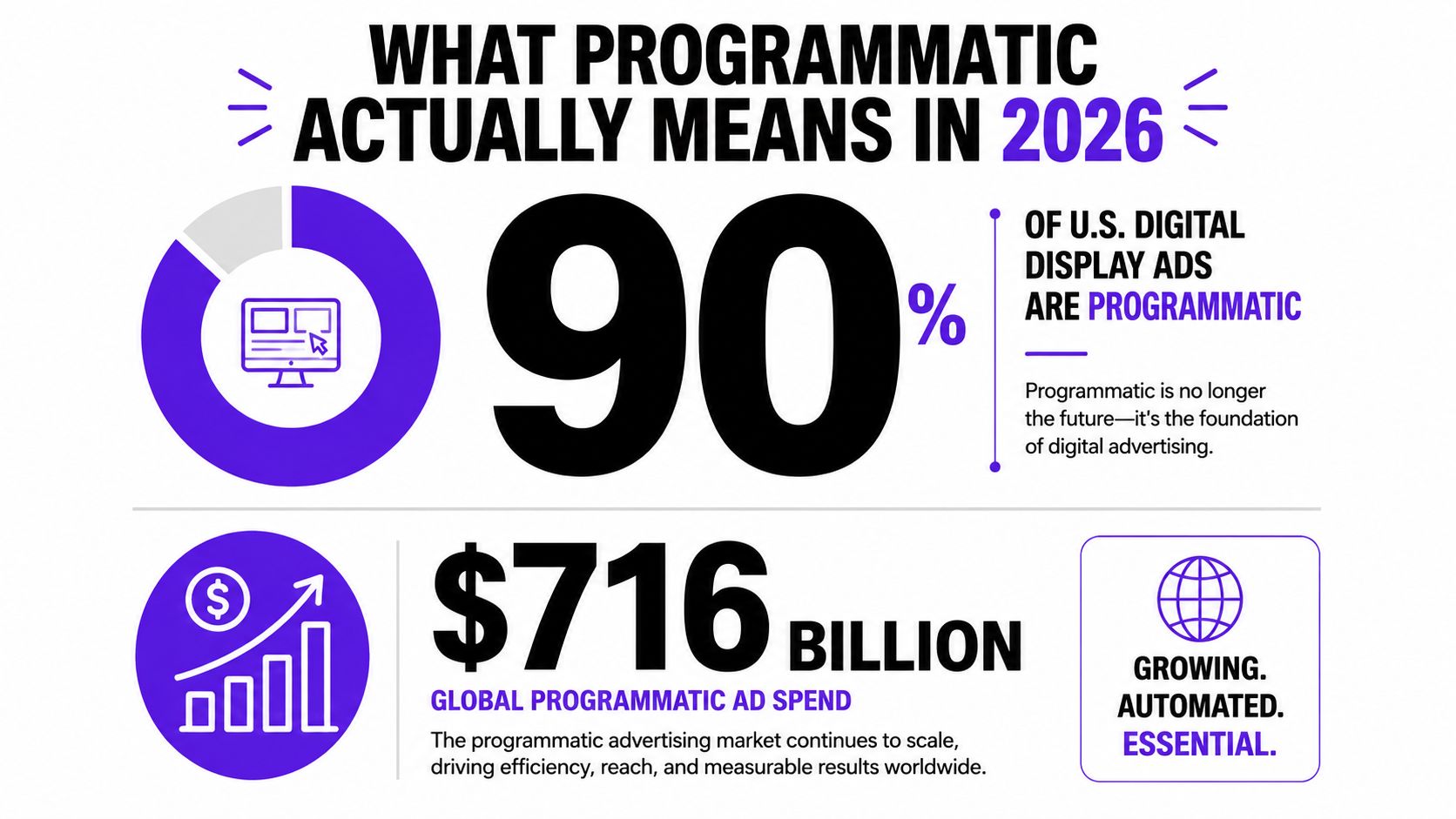
Programmatic media buying now handles over 90% of U.S. digital display advertising, and global programmatic spend was already at roughly $716 billion in 2025. That's not a side quest. It's the plumbing.
The weird part is how many buyers still talk about it like it's a clever trick. It isn't. It's the default infrastructure for buying display inventory in major markets, and if you treat it like an experiment, you'll end up paying tuition to the ad-tech gods at 2 a.m.
The romantic version says computers buy ads. Cute. The useful version says programmatic media buying is the market structure that lets software decide, in milliseconds, whether an impression is worth bidding on.
That matters because scale changed the rules. Industry estimates put programmatic at over 90% of U.S. digital display advertising by 2025, with global spend projected to exceed $725 billion by 2026 and moving toward $800 billion by 2028. Another benchmark pegs programmatic at about 90% of global display ad spending. Translation, this isn't a niche automation layer anymore, it's the default way the display market clears inventory. Programmatic advertising statistics
Programmatic isn't a channel in the same way search or email is a channel. It's more like a set of rails, with rules, middlemen, data signals, and a whole lot of opportunities to waste money if the rails are misconfigured. The buyer's job is less “place ads” and more “decide what should even be eligible to compete.”
That's why DSP fluency, audience logic, bidding strategy, and inventory quality control have moved from specialist trivia to core capability. If you've ever watched a campaign spend happily on junk inventory while your best audience segments barely got a sniff, you already know the difference between theory and the auction floor.
Practical rule: If your team is treating programmatic like manual media buying with extra dashboards, you're probably paying for speed without getting the selection logic that speed was supposed to buy.
The old idea that you “buy placements” also falls apart fast. In practice, the system evaluates audience, context, and price signals, then decides in the moment whether to bid. That's a very different beast from negotiating a fixed slot with a publisher and calling it a day. If you want the longer buying philosophy, the basics are laid out cleanly in this media buying overview, but the short version is simple, programmatic is now the operating system, not the novelty.
The auction is brutally simple once you stop letting acronyms do cartwheels in your head. A person loads a page, the supply-side platform sends a bid request, and the demand-side platform decides whether to play.
From there, the ad exchange runs the auction, the highest bid wins, and the ad server serves the creative back to the page. That whole dance happens through real-time bidding, where decisions are made at impression time, not in bulk. One standard explanation breaks the flow into user visit, SSP request, DSP bid decision, auction, and ad serving, which is exactly the sequence you should keep in your head when the dashboards get messy. RTB auction mechanics
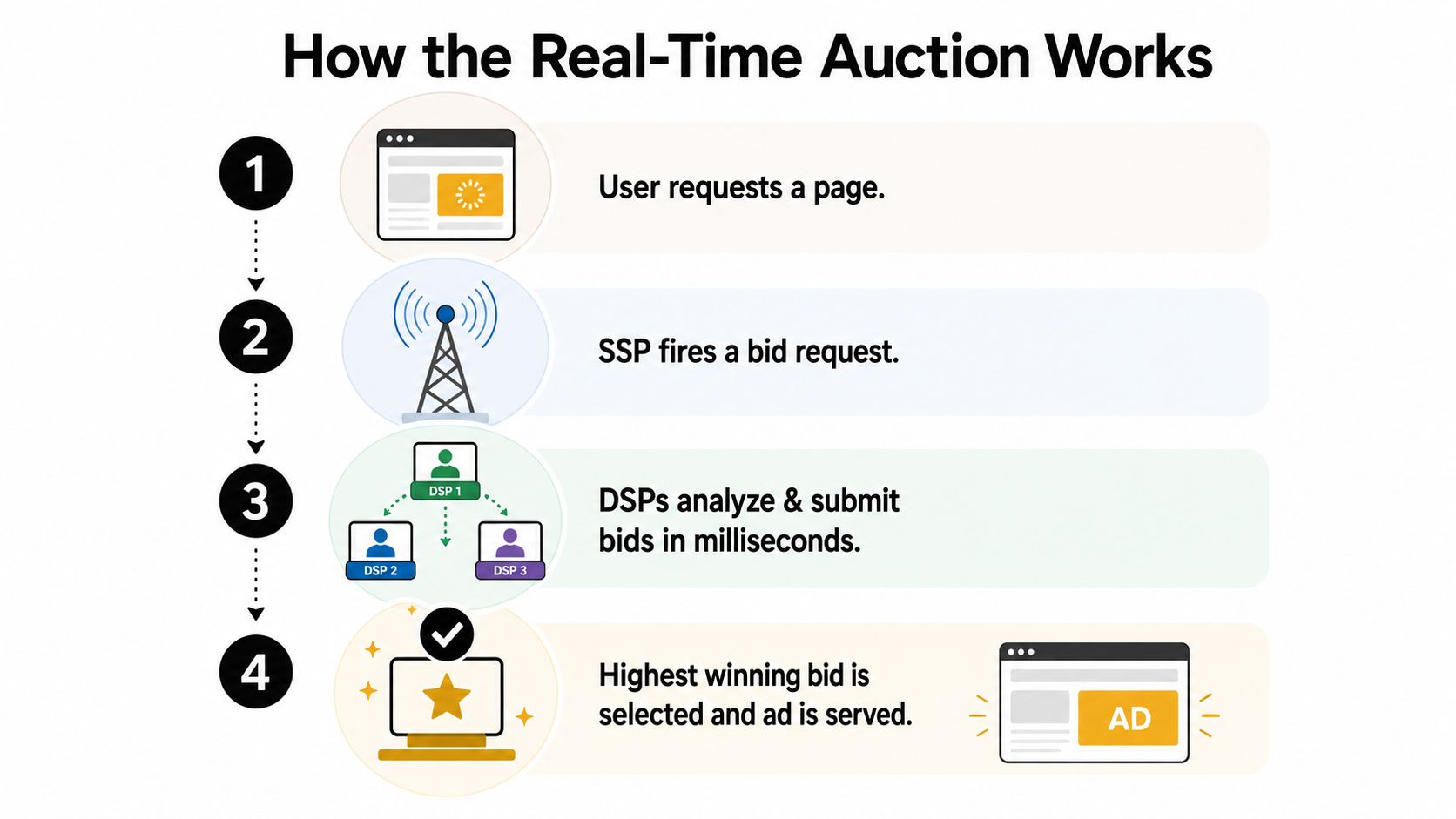
The SSP represents the publisher's side, packaging the inventory and sending the request. The DSP sits on the buyer's side, reading the impression like a suspicious detective with too much caffeine. The ad exchange is the auction floor, and the ad server is what delivers the ad once the winner is chosen.
If you've ever wondered why latency matters so much, this is why. Amazon's explanation says the whole process can run in less than a second, and it can work across web, mobile, apps, video, and social media within advertiser-defined parameters. That speed is the whole point. Less handshake, more auction. Less theatre, more math. Amazon on programmatic speed
The bidder with the prettiest slide deck doesn't win the impression. The bidder with the right signals, the right rules, and the right timing does.
The practical takeaway is this, the auction doesn't reward chaos. It rewards clean inputs. If your audience data is sloppy, your contextual signals are weak, or your eligibility rules are too broad, the DSP is basically trying to win a race with one shoe missing.
Same audience, very different bills. That's usually not because the platform is lying to you. It's because the inventory type changes the economics before your bid even shows up.
Open auction is the public RTB firehose. It's broad, noisy, and usually the cheapest place to hunt for scale. The catch is obvious, competition is intense, quality can be uneven, and you spend more time filtering junk than celebrating efficiency. Great for reach, less fun for your brand team when the placement list looks like a garage sale.
Private marketplaces are invitation-only deals. You get more control, more curated supply, and more predictable quality, but you give up some of the bargain-bin convenience. It's the grown-up version of buying inventory, especially when brand safety matters and you'd rather not explain why your ad showed up next to nonsense.
Programmatic guaranteed is reserved inventory booked through pipes. You're paying for certainty, usually at a premium, and you're getting the comfort of knowing the placement is locked in rather than fought over in a live auction. Good when you need a specific publisher or moment. Not so good if you're hoping the market will magically overdeliver value because you smiled at the dashboard.
| Dimension | Open Auction | Private Marketplace | Programmatic Guaranteed |
|---|---|---|---|
| Access | Public | Invitation-only | Reserved |
| Price behavior | Variable | More controlled | Fixed or negotiated |
| Inventory quality | Mixed | Cleaner | Premium and predictable |
| Best use | Scale and testing | Curated reach | Certainty and tentpole buys |
The decision isn't philosophical. It's operational. If you need reach and fast learning, open auction has a role. If you need better supply and less nonsense, PMP is usually the cleaner lane. If you need certainty, budget discipline, and a known placement, guaranteed is the grown-up choice. That's the whole game, no incense required.
Raising the bid is the easiest way to feel productive and the fastest way to burn money with confidence. Been there, regretted that, watched the spend graph climb while the signal got mushier.
The better lever is bid eligibility logic, meaning the rules that decide which impressions your DSP is even allowed to compete for. Programmatic runs on impression-level decisions, so the buyer who filters smarter wins more often than the buyer who shouts louder at the auction.
That matters even more now that signal quality is degraded. Independent guidance says buyers should expect lower match rates, lean more on first-party data, modeled audiences, and post-campaign reporting, and avoid hyper-specific audiences that get too tiny to be useful. FreeWheel also warns against ultra-specificity and recommends using audiences large enough to represent meaningful supply, which is exactly the kind of unglamorous advice that saves budgets from becoming tribute. FreeWheel programmatic playbook
If you want the sharpest answer on why this matters in practice, the missing piece is measurement discipline. incrementality testing is where a lot of teams discover that their “obvious” audience assumption was mostly vibes in a nice dashboard jacket.
If your team keeps asking, “Should we raise bids?”, the better question is, “Should this impression have been eligible in the first place?” That's where the waste hides.
This isn't a holy war. It's a comparison of tools with different failure modes, and anyone selling you a universal answer is probably selling you something else too.
Programmatic wins on speed and targeting because the system can launch fast, optimize fast, and slice audiences more precisely than a manual IO process usually can. Traditional buying still wins when you care more about direct publisher relationships, premium placement guarantees, and negotiated control than about algorithmic scale. The mistake is pretending one replaces the other in every case.
| Dimension | Programmatic | Traditional |
|---|---|---|
| Speed to launch | Fast, automated setup | Slower, human negotiation |
| Targeting precision | Strong audience and contextual control | More placement-led than audience-led |
| Transparency | Good if you inspect the right layers | Clearer on the deal, less granular in delivery |
| Ops overhead | Higher if the team lacks expertise | Higher upfront coordination, but simpler execution |
Programmatic is the better default for prospecting, testing, and iterative optimization. It's also easier to scale when you're willing to trade some certainty for learning velocity. Traditional buying still makes sense for tentpole moments, specific publisher relationships, or situations where brand safety and placement control matter more than auction efficiency.
The hybrid model is where most grown-up teams end up. Programmatic carries the exploration and optimization workload, while direct IOs handle the moments where you want a known house, a known room, and fewer surprises in the plumbing.
A buyer who understands both can spot nonsense faster. A buyer who only knows one model tends to overpay for the other.
Most dashboards are a museum of numbers nobody uses. If a team is checking forty metrics, it usually does not have a measurement strategy, it has anxiety in spreadsheet form.
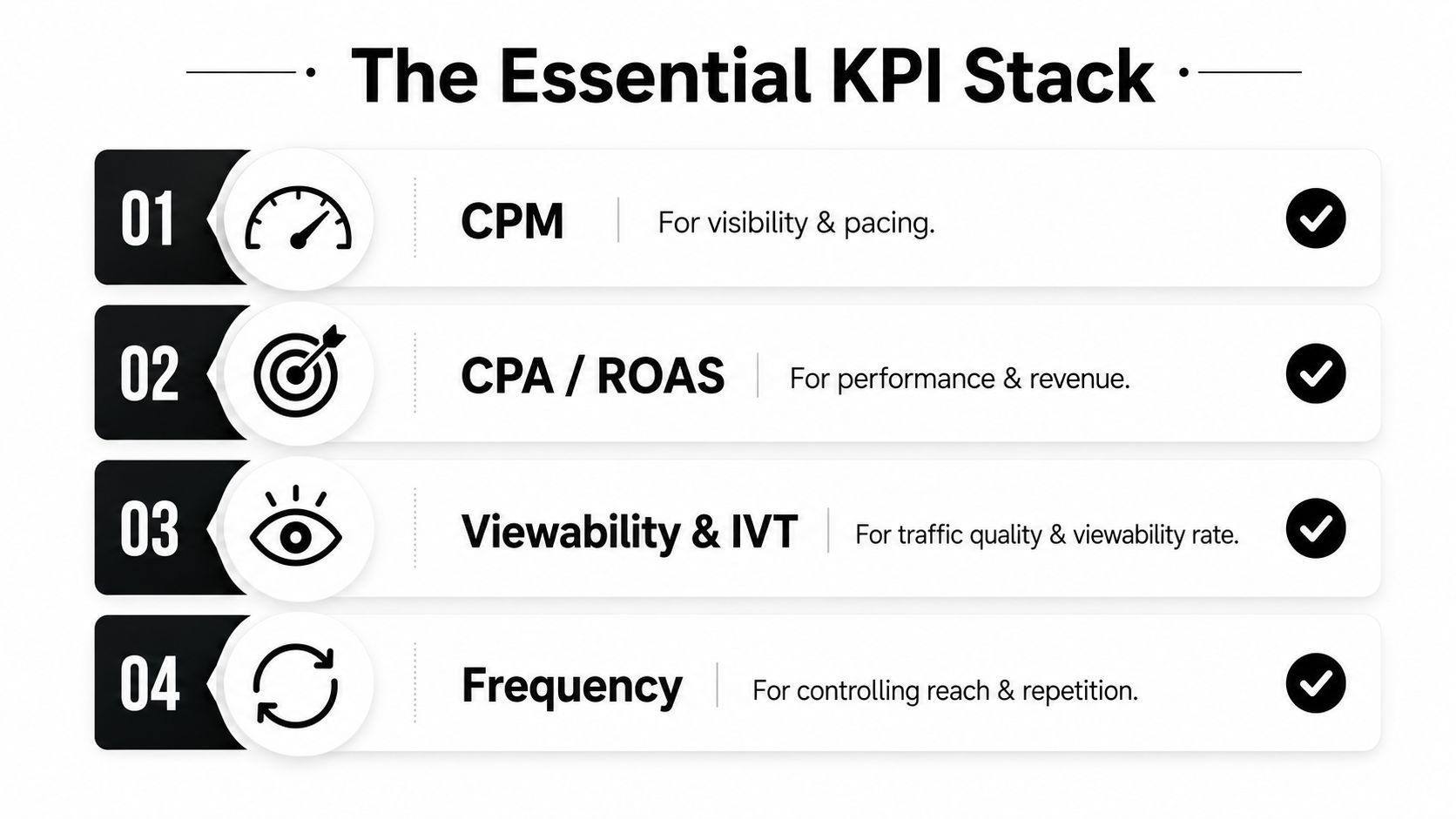
Start with CPM for visibility and pacing. Add CPA and ROAS if the campaign has a performance target that matters to the business. Keep viewability and IVT on the table for traffic quality, and watch frequency so you do not pay to annoy the same person into hating your brand.
The useful dashboards are the ones that change decisions fast. Industry guidance recommends dashboards that refresh every 5 to 15 minutes, plus controlled A/B testing and significance checks before you scale changes. That cadence matters because programmatic can magnify both good and bad decisions quickly, which is great when the signal is real and awful when you are overreacting to noise. Realtime programmatic metrics guidance
For a deeper look at setting up reliable measurement, see our guide to conversion tracking.
Practical rule: If a metric cannot trigger a budget decision, it does not belong on the front page of your dashboard.
CTR gets too much respect in programmatic. It can help in some cases, but it is usually a flimsy proxy for actual business value. Last-click attribution can also flatter the wrong channel, especially when upper-funnel impressions are doing the quiet work of creating demand before the conversion happens elsewhere.
The test-and-learn loop should look disciplined, not heroic. Launch multiple creatives in parallel, review exchange-level and placement-level performance, and only scale after the result holds up under real scrutiny. Without that, you are just feeding the machine more budget and hoping it develops character.
If you're spending modestly, hiring a full in-house programmatic team can be a very expensive way to discover that media buying is a craft, not a title. The talent you need is part analyst, part operator, part diplomat, and part person who doesn't panic when a campaign starts behaving like a feral raccoon.
Agencies can work, but quality varies and pricing often feels like it was assembled after a long lunch. Freelance marketplaces are cheaper on paper, though vetting can be a pain and you'll spend real time separating the skilled operators from the enthusiastic improvisers. Specialized hiring platforms that pre-vet media buyers reduce that sorting burden and make remote hiring far less of a gamble.
The best buyers are usually fluent in the mechanics that matter, DSP control, audience strategy under privacy constraints, creative iteration discipline, and client communication that doesn't sound like it was written by a management consultant on decaf. If someone can't explain why a bid strategy changed, what signal degraded, or why a segment should be widened, they're not ready to touch budget.
Remote hiring can save up to 80 to 90% versus U.S. full-time salaries, according to the publisher's own product positioning. That's a big enough gap to change how founders staff growth, especially when the role is execution-heavy and the work can be done without sitting in your office pretending the conference room has better Wi-Fi than everyone's apartment.
You don't need a trophy team to buy media well. You need someone who can debug the system, protect the budget, and keep the learning loop alive.
Complimentary HR, payroll, compliance, and easy replacements also matter more than people admit. The downside of a bad hire isn't just the salary. It's the time lost, the mess left behind, and the awkward month where everyone hopes the numbers improve before anyone has to say a hard thing out loud.
Every decent programmatic proposal comes down to five decisions. Which inventory type fits the goal. Which data signals reach the auction. Which bidding logic matches the funnel stage. Which KPIs will get checked. Which team can run the loop without turning the budget into confetti.
That's the filter. If a vendor can't answer those five cleanly, keep your wallet in your pocket.
I haven't touched every corner case here, CTV quirks, header bidding, and ID-less targeting all deserve their own fights. But if you use this lens on the next pitch deck that lands in your inbox, you'll spot the difference between a real buying system and a very expensive confidence trick.
If you want help finding the right people to run this without the usual hiring chaos, talk to HireMediaBuyers.com.


