


Most hiring advice treats the offer letter as the finish line. It isn't. For a media buyer, the offer letter is when the expensive part starts.
A "great hire" who needs months to understand the account, clean up tracking, learn the creative process, and earn stakeholder trust can cost more than a merely good buyer who starts making sound decisions quickly. I've hired enough media buyers to know that pedigree is a weak predictor of early impact. Time to productivity is the hiring metric.
That doesn't mean rushing someone into a live account and hoping the algorithm is feeling generous. It means defining productive work, removing avoidable friction, and testing whether the buyer can make independent decisions under real operating conditions.
The most popular advice says to hire for potential, give people time to learn, and trust the process. Fine advice, if your acquisition budget is imaginary.
A media buyer who looks excellent on paper can still spend weeks waiting for access, deciphering a chaotic account structure, learning undocumented naming conventions, and discovering that “our tracking is mostly fine” means three different conversion events are fighting for attribution. During that time, your campaigns still spend money. The new hire still draws a salary or agency fee. Your existing team still answers questions instead of doing higher-value work.
The hidden cost isn't just the buyer's compensation. It includes missed optimization windows, delayed creative tests, founder interruptions, slower client responses, and the opportunity cost of leaving budget in campaigns nobody fully owns. You may even mistake activity for progress because the new buyer has produced audits, dashboards, and cheerful Slack updates.
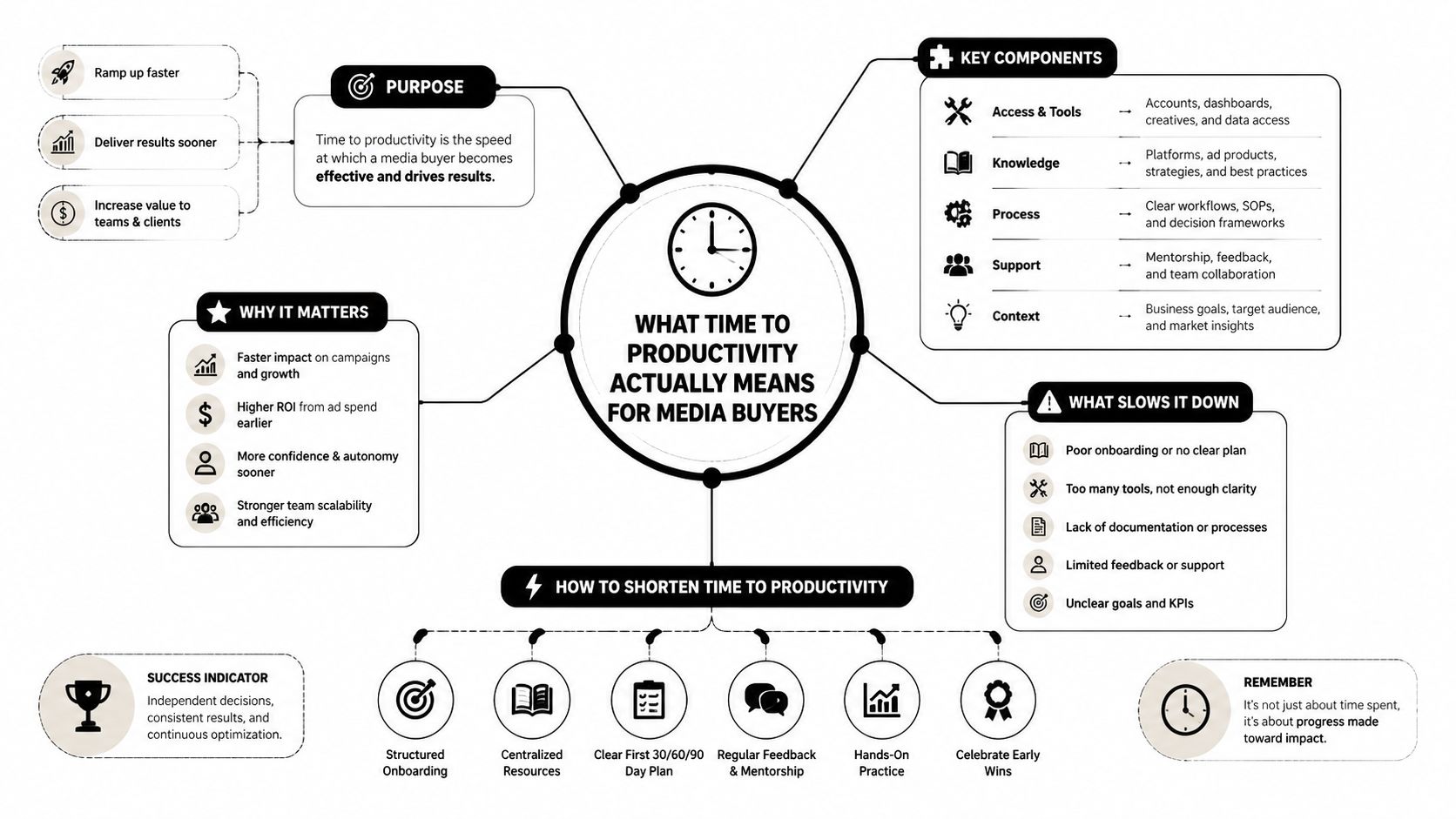
Time to productivity means the period between the start date and a role-specific threshold of independently effective performance. For knowledge workers, a widely cited 2025–2026 benchmark places the median at 65 days, while sales and client-facing roles can take 5–6 months, technical hires around 90 days, and complex enterprise roles 6–9 months, according to onboarding benchmark data from FirstHR.
Paid media borrows from all of those categories. A junior buyer may learn platform mechanics quickly, but a senior buyer needs to understand economics, positioning, creative judgment, attribution limits, and stakeholder priorities. The account doesn't care how impressive the résumé looked during the interview.
Founder rule: Don't ask when the hire will be “fully ramped.” Ask when they can independently protect and grow a defined slice of budget.
That shift changes hiring conversations. Instead of celebrating the start date, you plan for the first defensible win. Instead of accepting “they're still onboarding” as a foggy excuse, you inspect the blockers. Instead of treating ramp time as an unavoidable tax, you manage it like a variable.
The rest of the hiring decision follows from that. Vet the actual work before hiring. Prepare access before day one. Give the buyer a scorecard. Review decisions, not just results. Otherwise, you're paying for a passenger while calling them a driver.
“Productive” is not a personality trait, and “ramped” is not a mood. For a media buyer, time to productivity runs from the start date to an observable proficiency threshold that the buyer sustains across 2–4 consecutive weeks, following a practical onboarding measurement framework.
Set that threshold against the job, not a generic checklist. For one buyer, it may mean independently managing target CPA across a defined campaign group. For another, it means maintaining target ROAS while reallocating budget, briefing creative, explaining performance, and flagging risks before the account catches fire. The hiring model changes how quickly the buyer reaches that standard, but the standard itself must stay visible.
Use a scorecard with three layers:
“Gets good ROAS” is not a productivity definition. A short performance spike can reflect seasonality, delayed conversions, a small spend sample, or luck. Specify the budget slice, conversion event, reporting window, and decision rights around the result.
Technical and senior roles often require more ramp time than entry-level roles because access, knowledge transfer, and decision complexity create friction. One practical framework places entry-level productivity around 30 days, while technical or senior positions commonly need 60–90 days or longer, according to role-specific time-to-productivity guidance. Pre-vetting reduces the learning burden before day one. Structured onboarding removes the avoidable delays after it.
Rewarding an early win at any cost creates bad media buyers. Someone can cut spend, pause learning campaigns, cherry-pick reporting, or overreact to noisy data, then look brilliant briefly. If sound judgment never develops, the fast ramp was delayed damage.
Early productivity decline during the first 90 days has been linked in recent onboarding summaries to 2.5x higher 12-month attrition, according to the 2026 onboarding cost analysis from Stealth Agents. Treat that finding as a warning about measurement, not a reason to worship one number.
Ask one hard question: Can this buyer repeatedly make profitable, explainable decisions without constant rescue? Evidence earns the productivity label. A manager's good feeling does not.
Generic onboarding benchmarks mislead paid media teams because the hiring model changes the friction. An in-house employee may wait on internal approvals. An agency buyer may understand platforms but lack your commercial context. A remote contractor may be highly capable and still lose days to permissions, time-zone gaps, and missing documentation.
Historical benchmarks reinforce the point. Older industry summaries commonly place full productivity at about 8 months, while more recent summaries cite 8–12 months in many roles. Structured onboarding is associated with faster outcomes, including 65% of new hires becoming fully productive within 3 months, compared with 45% under unstructured onboarding, according to comparative onboarding benchmarks from WorldMetrics.
Those figures aren't a media-buyer forecast. They're a reminder that “they'll figure it out” is not a ramp strategy.
| Hiring Model | Typical Ramp Range | Main Friction Points |
|---|---|---|
| In-house full-time hire | Often measured in months, with timing shaped by role complexity | Internal HR steps, delayed access, undocumented processes, stakeholder overload |
| Agency-provided buyer | Can start faster operationally, but context transfer may extend independent productivity | Multiple accounts, competing priorities, limited brand immersion, handoff gaps |
| Remote contractor | Can be fast when pre-vetted and prepared, slower when access and support are improvised | Account permissions, timezone coordination, unclear ownership, weak documentation |
For a more detailed hiring workflow, review this media buyer hiring timeline. The useful comparison isn't “which model is cheapest?” It's “which model gets competent decisions into the account with the least avoidable drag?”
An internal hire can spend the first weeks meeting people who don't control campaign outcomes. An agency can assign someone competent who still divides attention across clients. A contractor can arrive ready to work but find that nobody knows who owns Business Manager access, conversion tracking, creative approvals, or reporting definitions.
Remote hiring deserves special attention. Recent summaries report that remote hires without structured onboarding can take 90–120 days, compared with roughly 60–65 days with structured onboarding, as noted in the Stealth Agents onboarding analysis. The lesson isn't that remote workers are slower. The lesson is that remote work exposes weak transfer systems immediately.
Choose the model that matches the work, then engineer the handoff. A mediocre process makes every model look expensive. A sharp process makes a capable buyer look fast.
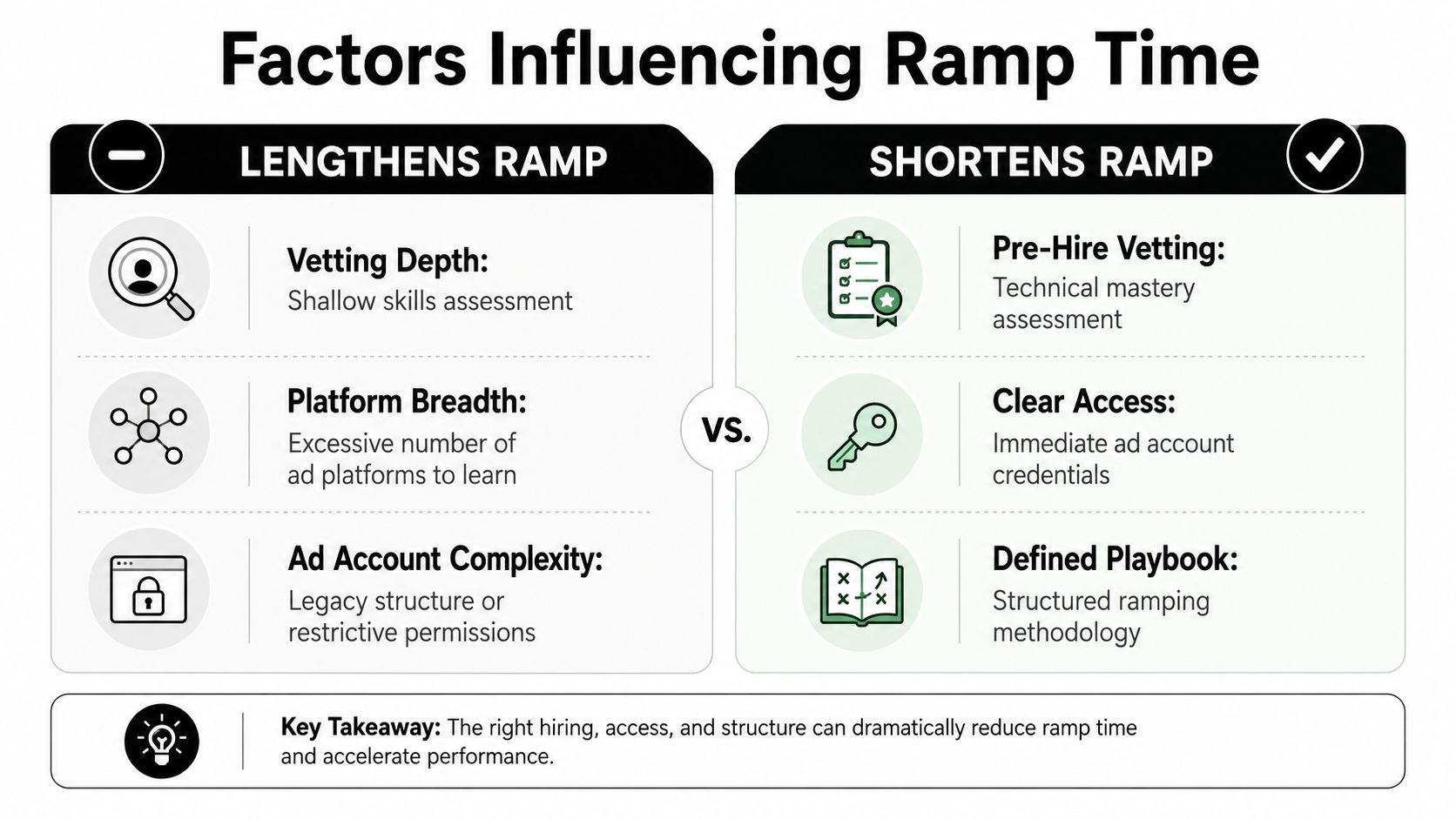
Ramp time usually breaks in one of three places: talent quality, knowledge transfer, or operating readiness. Founders often blame the first because it's emotionally convenient. The buyer is “not strategic enough.” Sometimes that's true. More often, the company hired for résumé familiarity instead of testing the decisions the job requires.
Start before the offer.
A shallow assessment that asks a candidate to describe Meta Ads experience tells you very little. Give them a messy performance scenario. Ask what they'd inspect first, which signal they'd distrust, how they'd choose a test, and when they'd move budget. Platform breadth matters too. A buyer moving from Meta into Google, LinkedIn, TikTok, Microsoft Ads, Apple Search, Pinterest, or YouTube needs a clear boundary around what they own first.
Before day one, inspect:
On day one, remove:
During week one, create:
A defined playbook compresses the curve because it turns tribal knowledge into repeatable decisions. That playbook shouldn't prescribe every bid change. It should show the operating logic, including how the team diagnoses performance, prioritizes tests, records learnings, and escalates risk.
If the buyer can't launch because access is missing, you have an operations problem. If they launch but can't explain the measurement model, you have a knowledge-transfer problem. If they understand the account but make reckless budget decisions, you have a talent or judgment problem.
Do not solve all three with more meetings. Fix the specific constraint. A remote buyer without structured support can look slow even when the person is strong, while an in-house buyer can look fast because colleagues are constantly filling the gaps. That isn't productivity. That's hidden labor.
The cheapest ramp improvement is often preparation, not compensation.
A scorecard should tell a new buyer what good work looks like before the buyer touches meaningful budget. It should also tell the manager whether the person is learning, executing, or improvising.
Use first wins that test real capability:
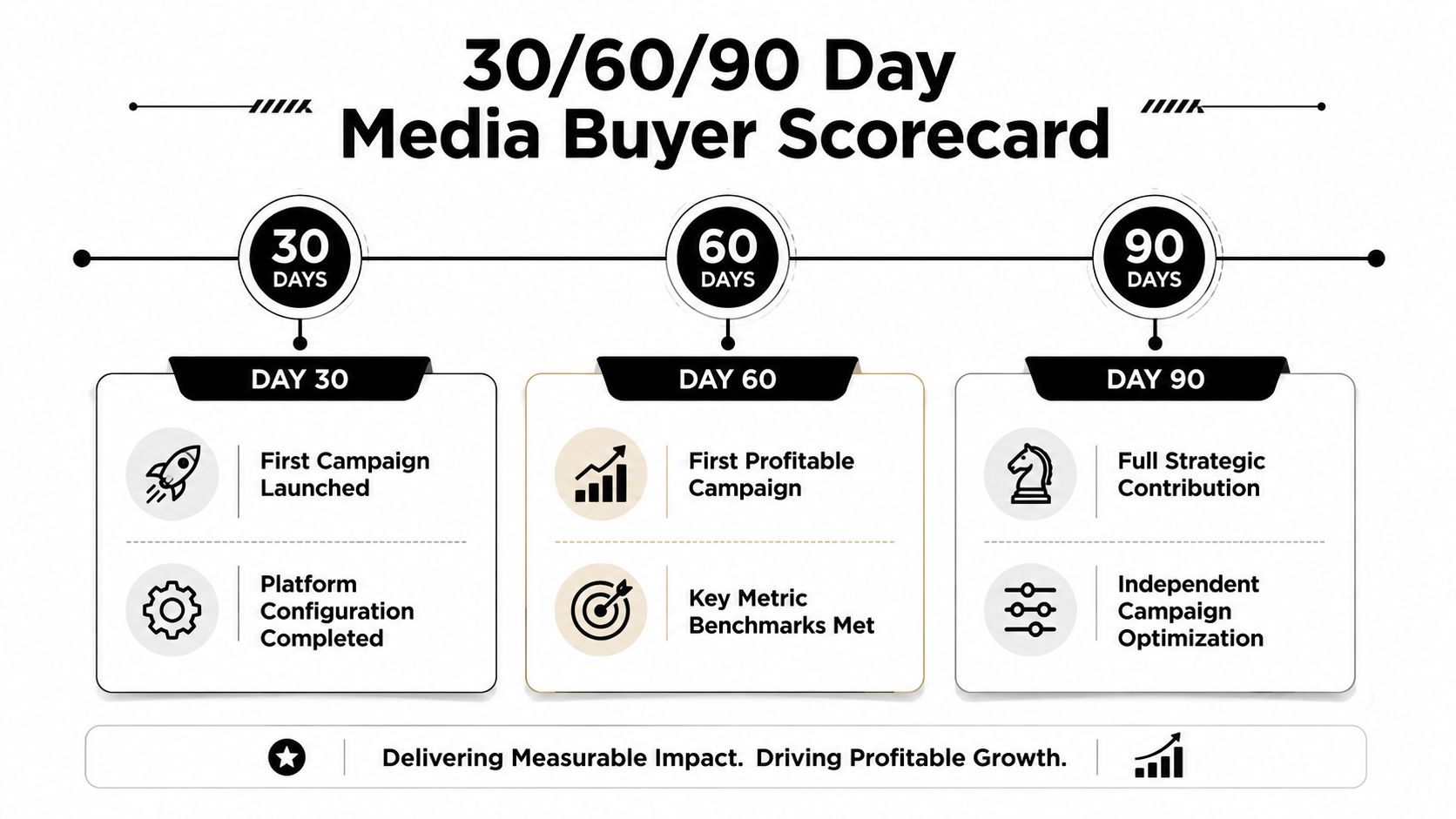
By day 30, expect orientation to become controlled execution. The buyer should understand the account architecture, complete platform configuration, produce a baseline readout, and launch the first properly instrumented campaign.
By day 60, expect evidence of commercial judgment. The buyer should have a first profitable campaign or a clearly documented path toward one, meet the agreed metric benchmarks where the data supports that conclusion, and make optimization recommendations without requiring a manager to translate every observation.
By day 90, expect ownership. The buyer should contribute strategically, optimize campaigns independently, explain performance to stakeholders, and maintain a reliable testing and learning cadence.
ROAS is a lagging result. You also need evidence that the buyer is building a repeatable operating rhythm. For engineering roles, one technical measurement approach compares output with the median productivity of existing employees and uses indicators such as check-in frequency, lines changed, and files changed. The same principle applies to media buying, as shown in research on operationalizing ramp-up with role-specific telemetry.
For media buyers, leading indicators might include:
Use guidance for managing distributed teams to make those signals visible without turning management into surveillance. The goal isn't to count keystrokes. It's to see whether the buyer is developing reliable judgment.
A spike is not a ramp. Sustained, explainable performance is.
The fastest ramp I've seen doesn't come from throwing a new buyer into a live account and calling the chaos “ownership.” It comes from doing the hard evaluation before the hire, then giving the person a narrow, well-supported path to independent decisions.
A sensible pre-vetting process tests four things:
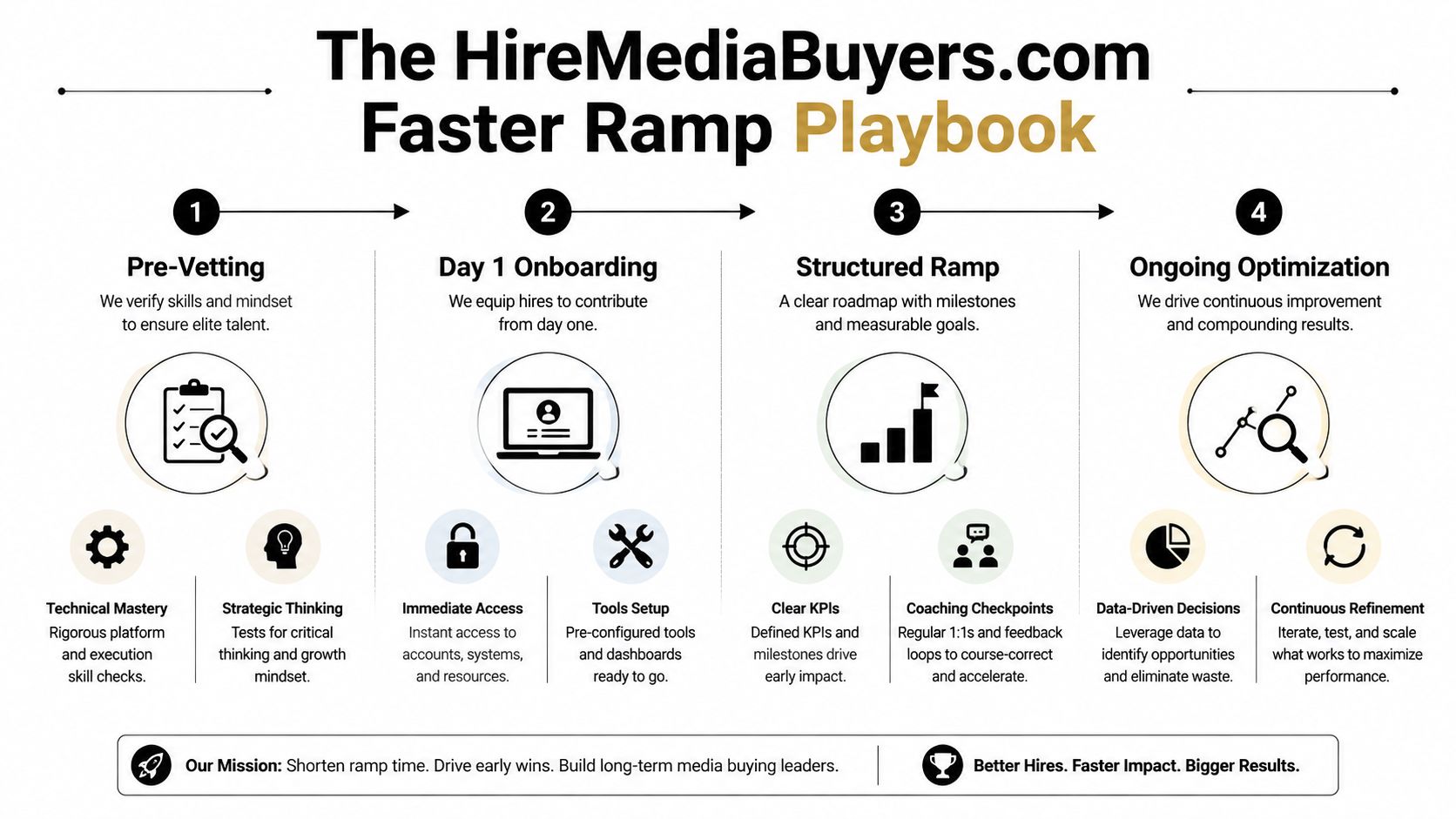
HireMediaBuyers.com applies this model through a five-stage vetting process that includes AI-powered screening, interviews, skills assessments, and HR checks. Its marketplace covers 10,000+ professionals across Meta Ads, Google Ads, LinkedIn, TikTok, Microsoft/Bing, Apple Search, Pinterest, YouTube, and other channels, with timezone matching and custom shortlists delivered within 24–48 hours, according to the publisher's stated platform information.
The commercial setup matters because hiring risk can slow decision-making. The platform states that companies receive transparent monthly rates, no deposits, flexible cancel-anytime contracts, complimentary HR, payroll, and compliance support, and replacement options. Those terms don't make a weak buyer strong, but they can make it easier to test a model without building a second HR department.
The critical point is skills-based hiring. Use a skills-based hiring approach for media buyers to judge the decisions the role requires, not the confidence with which someone discusses familiar platform labels.
AI can help with repetitive, information-dense onboarding tasks, such as answering process questions, organizing documentation, and surfacing relevant account history. It won't replace creative review, strategic calibration, or stakeholder trust. Treat it as an assistant that reduces administrative drag, not as a substitute for coaching.
Audit your last media buyer hire without protecting your feelings. Write down the start date, first correct launch, first useful creative iteration, first independent budget move, and the date when performance became sustained and explainable.
Then label every delay. Was it weak vetting, missing access, unclear tracking, slow creative approval, scattered management, or a genuine capability gap? You can't fix “slow onboarding” until you know which kind of slow you bought.
If the pattern is talent quality, improve the assessment. If it's operational readiness, prepare access and documentation before the person starts. If it's knowledge transfer, build a role-specific playbook with review checkpoints. If the model itself creates context switching or timezone friction, test a different hiring structure.
The decision is not whether to move fast or move carefully. The decision is whether your process makes speed and quality reinforce each other. Stop measuring the hire by how impressive they sounded in the interview. Measure how quickly they can make good decisions that survive contact with a real account.
HireMediaBuyers.com connects US companies with pre-vetted remote media buyers and paid ads specialists, with full-time and part-time hiring options, timezone matching, and structured support around the ramp. Visit HireMediaBuyers.com to review qualified talent and replace résumé roulette with a faster, lower-risk path to paid media ownership.


