

Consumers will pay an average 11% premium for price transparency, so a transparent pricing model can increase what buyers accept, not just reduce friction. Fully detailed pricing can also feel economically equivalent to a 15.6% price decrease, while basic detail can equal an 8.1% decrease in the buyer's mind. Wharton research on price transparency backs the counterintuitive conclusion: showing your cards can be a revenue tool.
That matters because many businesses still treat pricing like a hostage negotiation. “Contact sales” appears where a number should be, mandatory fees emerge at checkout, and the buyer gets a lovingly crafted quote that requires three calls, two follow-ups, and one small sacrifice to the invoicing gods.
I've lived through the vague-quote era. It was the age of mortgaging the office ping-pong table to fund sales cycles that should've been a pricing page. A transparent pricing model doesn't mean every customer pays the same amount. It means every customer understands what drives the amount.
A founder once told me that publishing prices would make the company look cheap. The alternative was sending every prospect into a custom quoting process, where the sales team spent hours discovering budgets before anyone discussed outcomes. That isn't premium positioning. It's expensive hide-and-seek.
Buyers don't interpret missing prices as sophistication. They often interpret them as risk. If a prospect can't tell whether implementation, support, usage, or third-party costs are included, they'll assume the final invoice contains a few unpleasant plot twists.

A clear price does something useful before a salesperson ever enters the conversation. It repels buyers who can't afford the offer and attracts buyers who can. That's not lost demand. That's a cleaner pipeline.
A serious buyer wants to answer practical questions quickly:
The price fairness research supports the underlying logic. Customers judge fairness partly by whether they can determine the market offering's price clearly. They don't need your entire cost accounting ledger. They do need enough information to understand the offer without hiring a forensic accountant.
Practical rule: If your sales team has to explain a fee that your pricing page could explain in one sentence, fix the page.
Transparency also signals confidence. A company that publishes its rates is saying it knows what it sells, who it serves, and why the price makes sense. That signal is more persuasive than another paragraph about “world-class solutions.”
A transparent pricing model is not a number slapped onto a homepage. “$500 per month” tells a buyer almost nothing if the plan excludes onboarding, usage charges, support, or the features needed to make the service useful.
A workable model shows the total price, its components, the conditions that change it, and the value attached to each tier. The buyer should be able to self-qualify before speaking with sales.
Research from Wharton treated transparency as a spectrum rather than a binary switch. In the driving-school study, the highest transparency tier disclosed the total price, all included components, and some or all component prices. Consumers were willing to pay an average premium of 11% of the service price for transparency, according to the Wharton working paper.
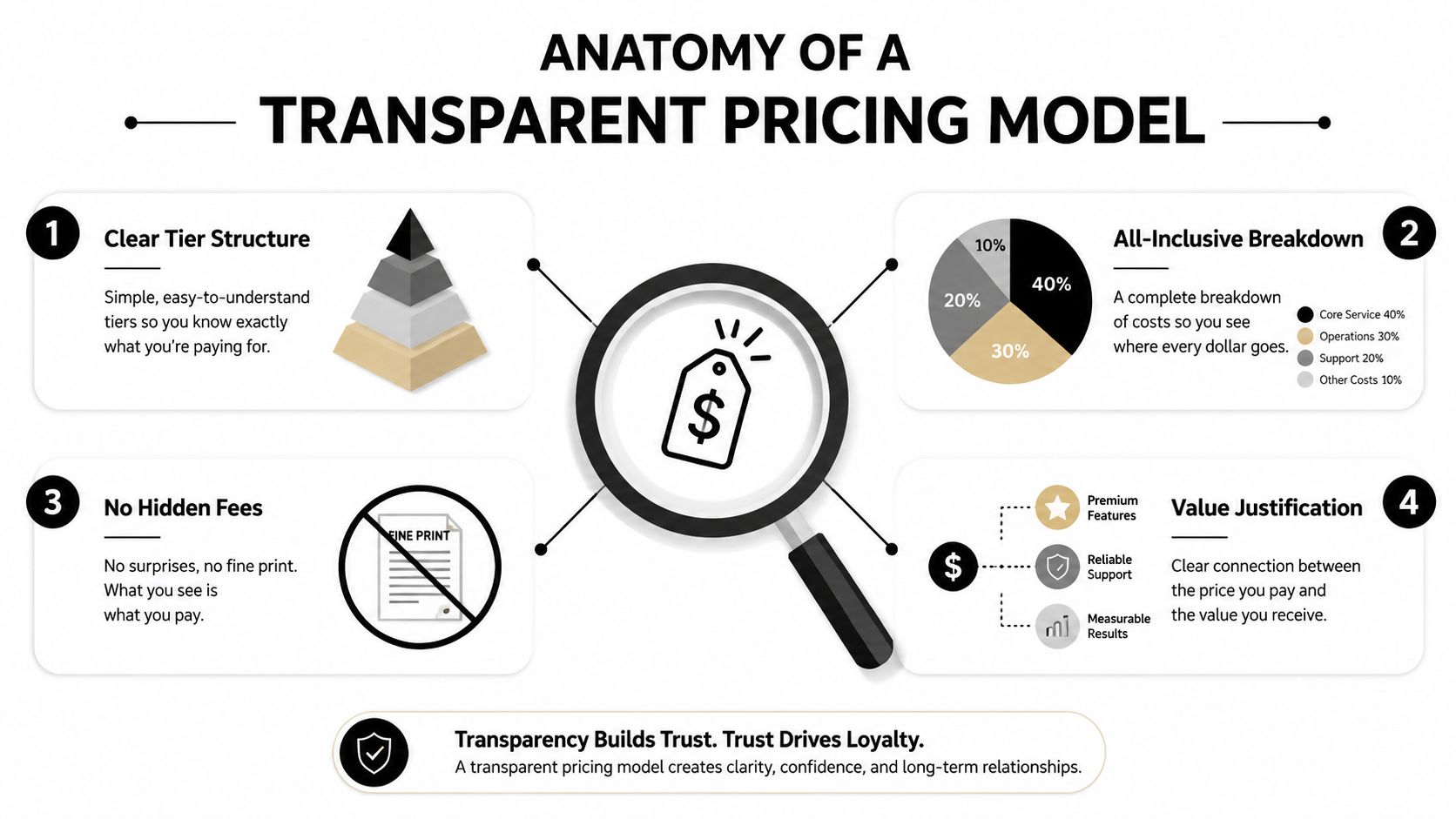
Base rate: State the recurring or project price plainly. If the price varies by volume, role, geography, or scope, show the rule rather than hiding behind “custom.”
Included value: Name what the buyer receives. A media buying retainer, for example, might include campaign management, reporting, testing, and account communication. If creative production costs extra, say so.
Add-ons and pass-through costs: Separate optional extras from mandatory charges. Software, media spend, implementation, rush work, and third-party services should each have a clear treatment.
Pricing logic: Explain why one tier costs more than another. Buyers can accept variable pricing when the variables make sense. They struggle with numbers that appear after checkout like uninvited relatives.
A retainer deserves special care because the term can mean different things across agencies. Explain whether it buys reserved capacity, defined deliverables, access to specialists, or a combination. This guide to what a retainer means in business can help frame that distinction.
Your tiers don't need to reveal profit margins. They do need to reveal enough structure for comparison. The standard is simple: customers should understand the offer, the total, and the reason for the difference.
Quote-based pricing looks flexible from inside the business. From the buyer's side, it often feels like a tollbooth.
Every prospect must book a call, repeat the same requirements, wait for an estimate, and wonder whether another buyer received a better deal. Meanwhile, your team burns productive hours calculating prices that could have been published in advance.
A clear rate card doesn't eliminate customization. It gives customization boundaries. That distinction protects margin without forcing every buyer through a bespoke sales ritual.
| Feature | Opaque/Quote Model | Transparent Model |
|---|---|---|
| First interaction | Buyer requests a price | Buyer sees a starting point or total |
| Qualification | Sales team qualifies before disclosure | Buyer self-qualifies before contact |
| Scope discussion | Price and scope evolve together | Scope maps to published tiers or rules |
| Add-ons | Often appear late | Listed beside the core offer |
| Comparison | Difficult for the buyer | Line-by-line comparison is possible |
| Sales workload | Repeated explanation and manual quoting | Sales focuses on fit, outcomes, and exceptions |
| Negotiation | Can feel arbitrary | Exceptions follow stated criteria |
| Purchase confidence | Depends heavily on the salesperson | Built into the pricing experience |
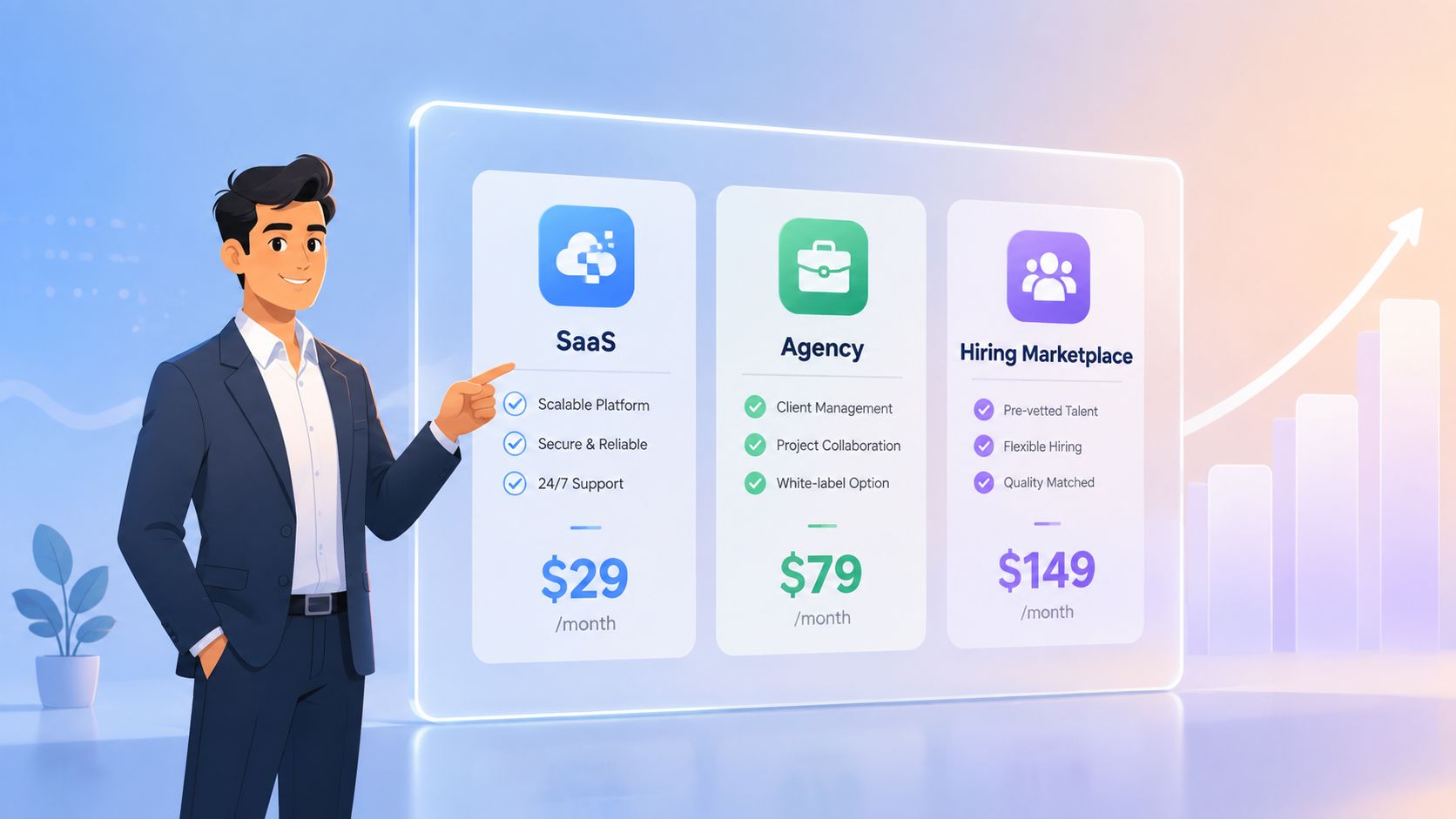
A transparent model works especially well for services with repeatable delivery. Hiring marketplaces can show monthly rates by role or specialization. SaaS companies can separate starter access, team functionality, and enterprise requirements. Agencies can publish management fees while clearly separating ad spend and production.
The pricing page becomes a pre-sales employee. It answers ordinary questions, exposes poor-fit accounts early, and lets qualified buyers arrive with context. Hope you enjoy spending your afternoons explaining the same setup fee to every prospect, because that's now your full-time job if the page refuses to do its job.
Custom work still has a place. Keep it for genuinely variable inputs, not for hiding a standard offer. Publish the baseline, identify the variables, and give buyers a method for estimating the final price.
Transparent pricing looks different across industries, but the operating principle stays consistent: show the buyer enough of the commercial structure to make a rational next move.
A software company might publish starter, team, and enterprise plans. The useful part isn't the label. It's the boundary between them. A starter plan should explain user access and core functionality. A team plan should identify collaboration or administration features. Enterprise should explain what triggers a conversation, such as security review, procurement requirements, or a negotiated service level.
"Contact sales" can remain appropriate for complex deals. It shouldn't be the only price information on the page.
A digital marketing agency can publish a management fee, define the work included, and list costs that remain outside the fee. Media spend, landing-page development, creative production, and specialist tools often require separate treatment. The agency doesn't need to promise identical pricing for every account. It needs to explain which variables change the bill.
That structure also helps buyers researching SEO cost for small businesses. A useful pricing page distinguishes strategy, content, technical work, link development, reporting, and third-party expenses instead of bundling everything into a mysterious “growth package.”
A talent marketplace can publish rates by role, availability, or engagement type. The buyer still evaluates skill and fit, but the commercial conversation starts with a known range or monthly rate rather than a blank sheet.
The same approach works for paid media specialists. A company might show the cost of hiring support, explain whether the arrangement is full-time or part-time, and state how cancellation or replacement works. Those details reduce anxiety because the buyer sees both the price and the exit path.
Buyers don't need perfect certainty. They need honest mechanics.
The strongest examples also disclose implementation. If onboarding requires work, price it or explain the conditions. If a third-party platform charges separately, name that relationship. “Included” should mean included, not “included until the invoice arrives.”
The fear is familiar: publish the price, and high-value buyers will negotiate you downward. That fear confuses secrecy with pricing power.
High-value buyers don't automatically pay more because you hide the number. They pay more when they believe the offer is reliable, relevant, and easy to approve. Transparency removes uncertainty, which can make a premium feel safer.
The Wharton research puts a sharper edge on this point. Consumers were willing to pay an average 11% of the service price for price transparency, and fully detailed information was economically equivalent to an additional 15.6% price decrease relative to having no price information, according to the study's findings. Basic detail still carried the equivalent of an 8.1% price decrease.

A premium offer needs a premium explanation. If buyers can't connect price to scope, expertise, speed, or risk reduction, they'll compare your number against cheaper alternatives. If they can see what changes between tiers, they can compare value instead of hunting for a discount.
The revenue paradox becomes practical when the buyer understands what they're buying and believes the price won't mutate later. The premium is attached to confidence, not merely labor.
Consumer expectations reinforce the pressure for clarity. VTEX reported that 82% of Americans said clear pricing and no hidden fees were essential to a less stressful and more satisfying shopping experience, as summarized by CXM World's coverage. Trust also remains fragile. CCPC research found that 63% of consumers didn't trust that Black Friday discounts were legitimate, a figure reported in the same source.
A transparent model can still be dynamic. Show the total early, identify the inputs that change it, and explain whether demand, scope, usage, location, or timing affects the price. If an algorithm influences the number, disclose that fact and describe the relevant logic in plain English.
Don't promise “no surprises” while reserving the right to add surprises. That's not flexibility. That's a credibility leak.
Transparency fails when the public pricing page says one thing and the sales contract says another. Build the model from the invoice backward, then make the website match reality.
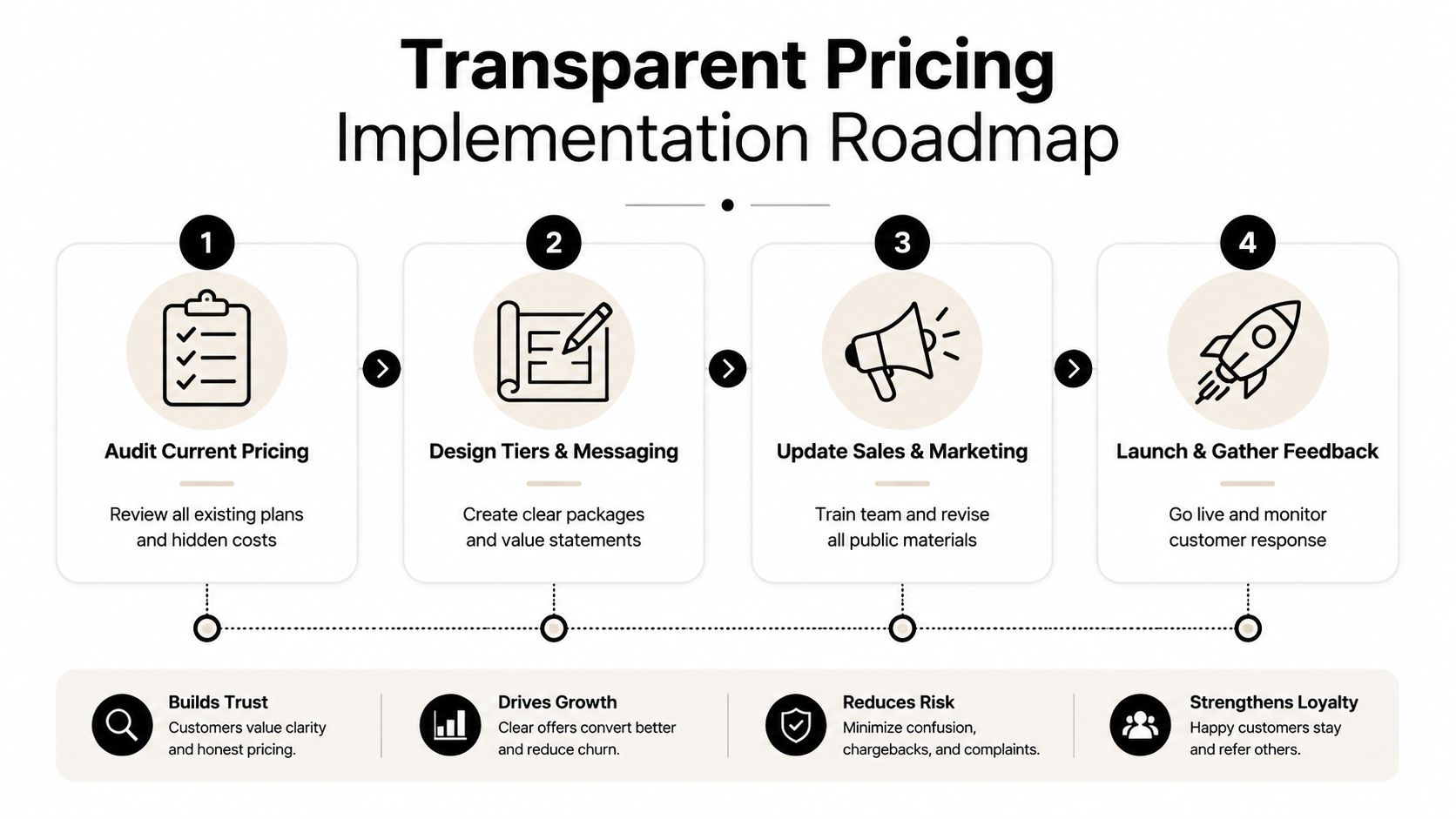
Audit every charge connected to delivery. Include onboarding, account management, usage, support, expedited work, software, payment processing, travel, and third-party services. Mark each item as included, optional, conditional, or mandatory.
Then design tiers around meaningful differences. Don't create three plans because three columns look attractive. Create tiers because customers have different needs, capacity requirements, urgency, or service depth.
Use direct microcopy:
Those sentences do more work than vague reassurance. They tell the buyer what happens before the buyer has to ask.
Use a pricing calculator when a few inputs determine the total. Keep the running total visible. Add a comparison table that shows inclusions, limits, response times, and optional services. Connect the form, calculator, and proposal system so salespeople aren't rebuilding the same quote in three different tools.
Train sales to explain exceptions consistently. If a rep can discount without a rule, the public price becomes decorative. Track questions from prospects, then update the page when the same confusion appears repeatedly.
Launch with a clear change policy. Tell existing customers how price updates work, when they take effect, and what remains protected. Transparency includes the uncomfortable parts, not just the attractive headline.
Pricing transparency has moved from good etiquette to a serious compliance issue. The details vary by market and transaction type, so treat this as an operating discipline, not a legal shortcut.
The UK Competition and Markets Authority says mandatory charges must appear in the upfront price, while optional extras can't be preselected. That distinction matters for service businesses, marketplaces, travel providers, software products, and any checkout flow that presents add-ons.
Use this test: can the customer complete the advertised purchase without paying the fee? If no, the fee belongs in the upfront total. If yes, it may remain separate, but the buyer must be able to see it clearly before committing.
Common trouble spots include:
The U.S. Federal Trade Commission finalized its junk-fees rule requiring total pricing to appear early and clearly, with states adding similar requirements. A recent state tracking summary found more than 100 price-transparency bills introduced across 33 states and D.C. in 2025, as described in the CMA guidance and related compliance discussion. The direction is obvious. Businesses are facing more disclosure rules, not fewer.
Map each offer by location, customer type, transaction type, and sales channel. A US website, a UK checkout, a marketplace listing, and a negotiated enterprise contract may not follow identical rules.
Keep records of the prices shown, the terms attached, and the date each version went live. Assign ownership to someone who can coordinate marketing, finance, sales, product, and counsel. If customers can't understand cancel anytime terms, your pricing page hasn't finished the job.
Healthcare shows why governance matters. CMS announced a final rule on October 29, 2020, stating that about 200 million Americans would gain access to real-time healthcare price information. The phased requirements began January 1, 2021, with major consumer shopping tools arriving on January 1, 2023 and January 1, 2024, while standardized public data files were required by January 1, 2022, according to the documented CMS rule summary. By January 2023, 77.1% of US hospitals were publicly disclosing prices, and more than half of those disclosures occurred within six months of the final rule, as reported in the market transparency analysis.
Public prices become reference points. They influence negotiations, expose inconsistencies, and force businesses to defend their structure. Publish carefully, update consistently, and get legal advice before relying on a marketing interpretation of a rule.
HireMediaBuyers.com offers US companies a pay-as-you-go way to find pre-vetted media buyers and paid ads specialists, with transparent monthly rates, flexible cancel-anytime contracts, and support for full-time or part-time remote hiring. Visit HireMediaBuyers.com to compare a clearer hiring model with the opaque quote cycles that drain your team's time.


